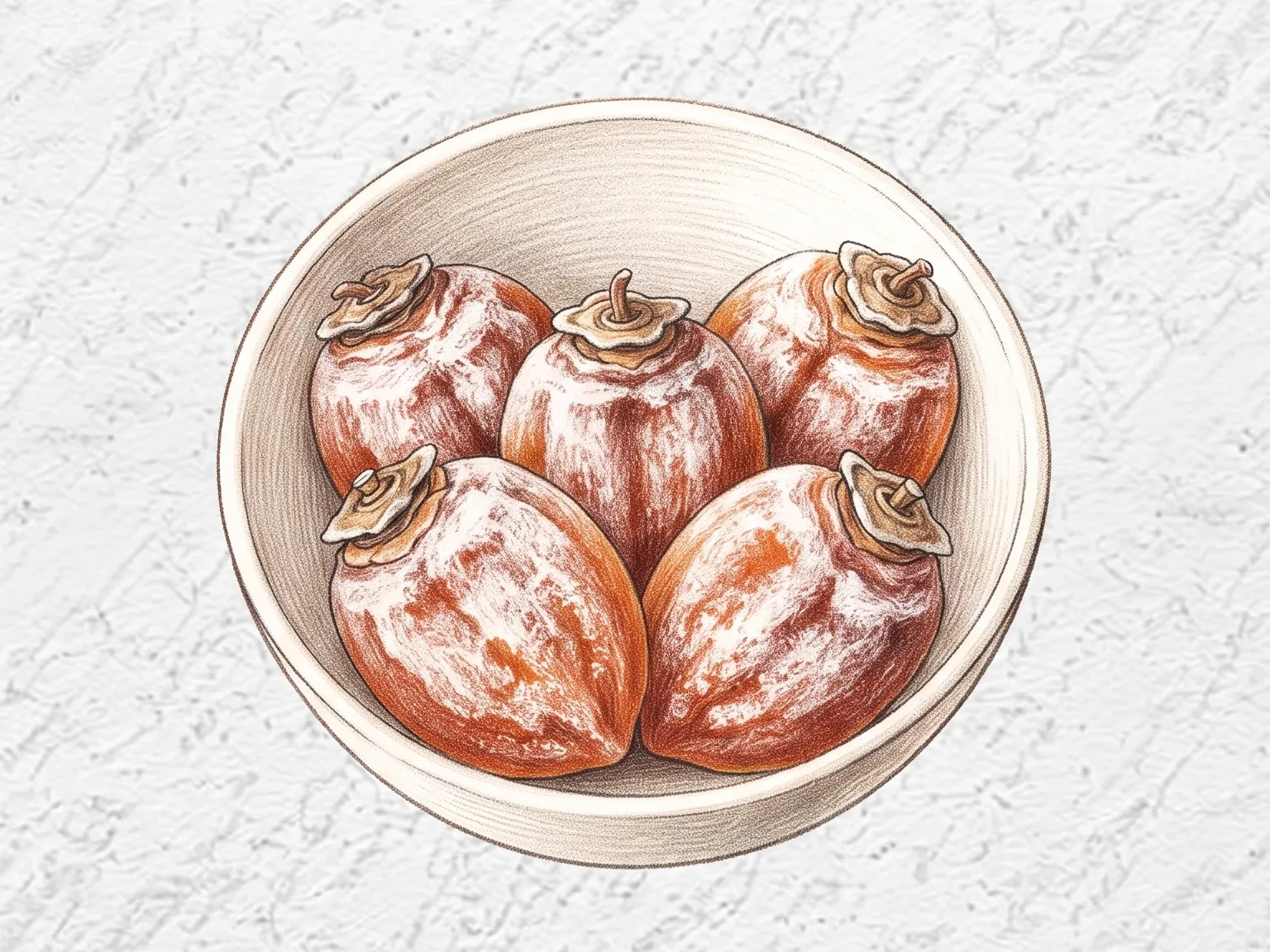
Korogaki (Yamanashi Hand-Kneaded Dried Persimmons)
Quick answer
- Total time
- At least 30 days
- Level
- Hard
- Servings
- 20 servings
- Ingredients
- 2
About this dish
Among Japanese dried persimmons, the soft ones with roughly 50% moisture are called anpo-gaki, while korogaki are dried longer, down to about 25 to 30%, until the sugars crystallize into a white bloom on the surface.
Read more
The name is said to come from rolling the peeled fruit, korokoro, to new positions so the sun reached every side. Large astringent varieties are used, and the Matsusato area of Koshu City has long been a known source because it grows the big Koshu Hyakume persimmon.
Ingredients
Instructions
Stops the screen from turning off while you cook.
- 1
Around mid-November, choose astringent persimmons that are fully red but not overripe.
When picking, cut the branch so a T-shaped piece stays above the stem; if buying, look for fruit with that piece still attached.
- 2
Wearing plastic gloves, run a knife around the calyx to remove it.
Peel the fruit, leaving only a small patch of skin at the tip of the bottom. A vegetable peeler makes this faster.
- 3
If you can, dip each peeled persimmon into boiling water for a few seconds and lift it out.
This helps prevent mold and removes the sticky tannin on the surface, making the fruit easier to handle.
- 4
Cut the plastic string into 60 cm (23½ inches) lengths and tie each into a loop, then hook a persimmon's T-shaped stem piece onto each end and tie it on. Stagger them, one side short and the other long, so the fruit dries efficiently. Hang them on a pole under the eaves in the sun.
- 5
Keep them out of the rain and shift them so the sun reaches the whole fruit.
After about a week, when they start to soften, begin kneading them gently with your fingertips. Keep drying and kneading until they reach the softness you like, about a month of drying in all, around mid-December.
- 6
Take the persimmons down, remove the string and cut off the T-shaped stem pieces with pruning shears.
Press each one by hand into a flat oval.
- 7
If you have rice straw, wrap the persimmons between layers of it and keep them in a cool, dark place.
They are ready once a white powder blooms on the surface, around the end of the year if they came down in mid-December.
References checked
These references were consulted when this page was prepared or corrected. A source check does not mean the recipe was independently kitchen-tested.
- 枯露柿 山梨県 | うちの郷土料理
農林水産省(レシピ提供: 新海桂子氏) · Checked: 2026-11-18