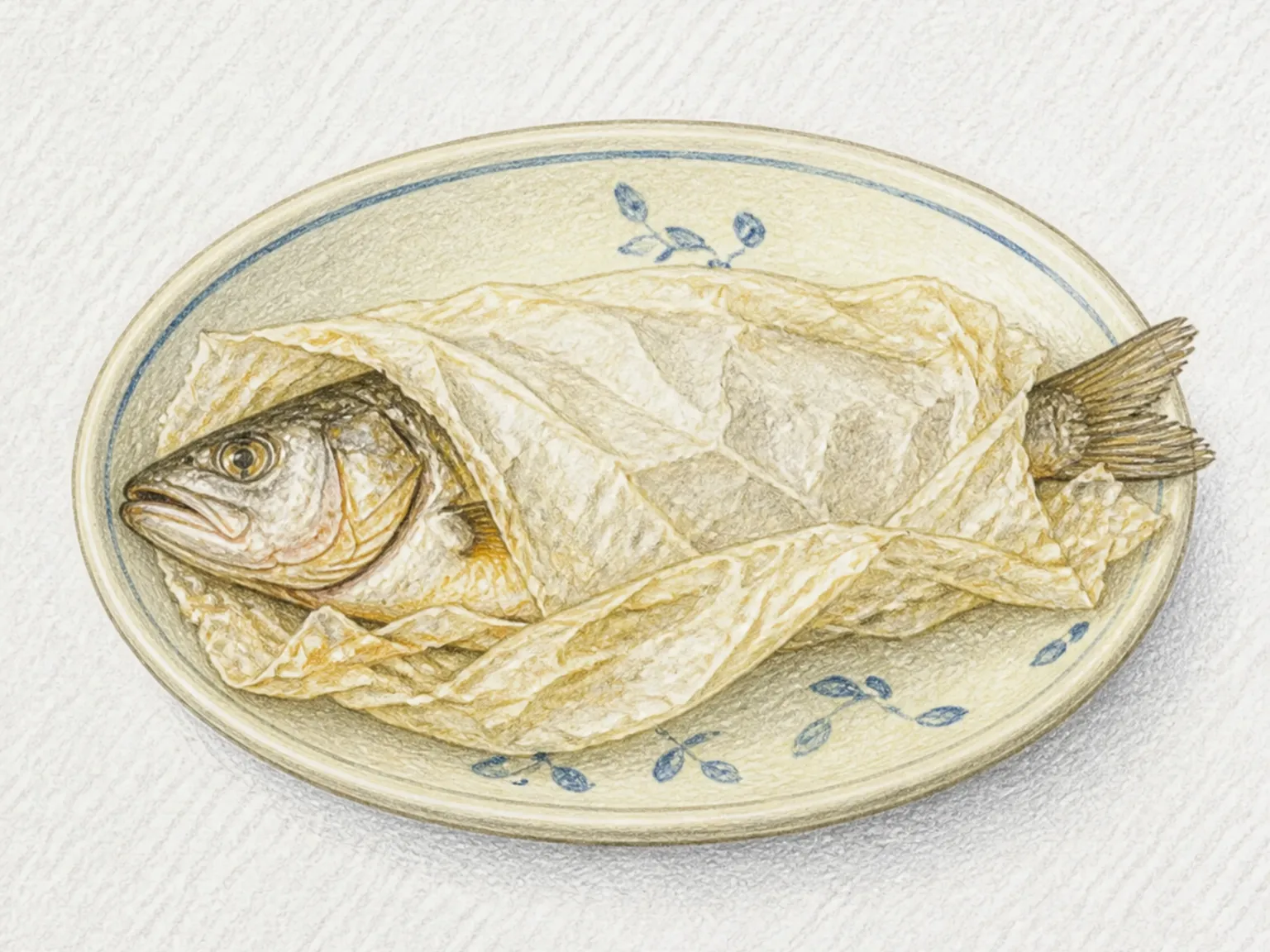
Suzuki no Hoshoyaki (Washi-Wrapped Sea Bass)
Quick answer
- Total time
- 65 min
- Level
- Hard
- Servings
- 4 servings
- Ingredients
- 4
About this dish
The sea bass cooks in something close to steam inside wet washi, which holds in the fish's own moisture while the paper soaks up surface oil, leaving the flesh moist without heaviness.
Read more
In Matsue, Shimane, Lake Shinji sea bass is cleaned through the gills (the tsubo-nuki method) so the belly stays uncut, then wrapped whole and opened at the table at autumn and early-winter banquets, when the fish carries more fat.
Ingredients
Instructions
- 1
Scrape off the sea bass scales from tail toward head and remove the gills.
Rinse the surface and gill cavity under running water, then pat dry.
- 2
Carefully pull all the viscera and gallbladder out together through the gill opening and discard them.
Work slowly to avoid rupturing the gallbladder, then rinse the gill area and empty cavity under running water.
- 3
Pierce the sea bass skin shallowly in several places with a metal skewer and distribute the salt over both sides and inside the gill opening. Rest for 10 minutes.
- 4
Soak all three hosho sheets completely in the water until pliable, then let excess water drip off.
Wrap the fish in the first sheet and add two more in alternating directions with overlapping seams, creating three closed layers.
- 5
Place the wrapped fish on a rack over a baking tray and steam-roast in a 180C oven for 35 to 40 minutes.
Remove it when the paper is dry and lightly browned, the thickest flesh is opaque, and its center reaches at least 63C. Rest for 5 minutes and open the paper at the table.
References checked
These references were consulted when this page was prepared or corrected. A source check does not mean the recipe was independently kitchen-tested.
- 일본 농림수산성 うちの郷土料理
島根県食生活改善推進協議会 · Checked: 2026-08-11