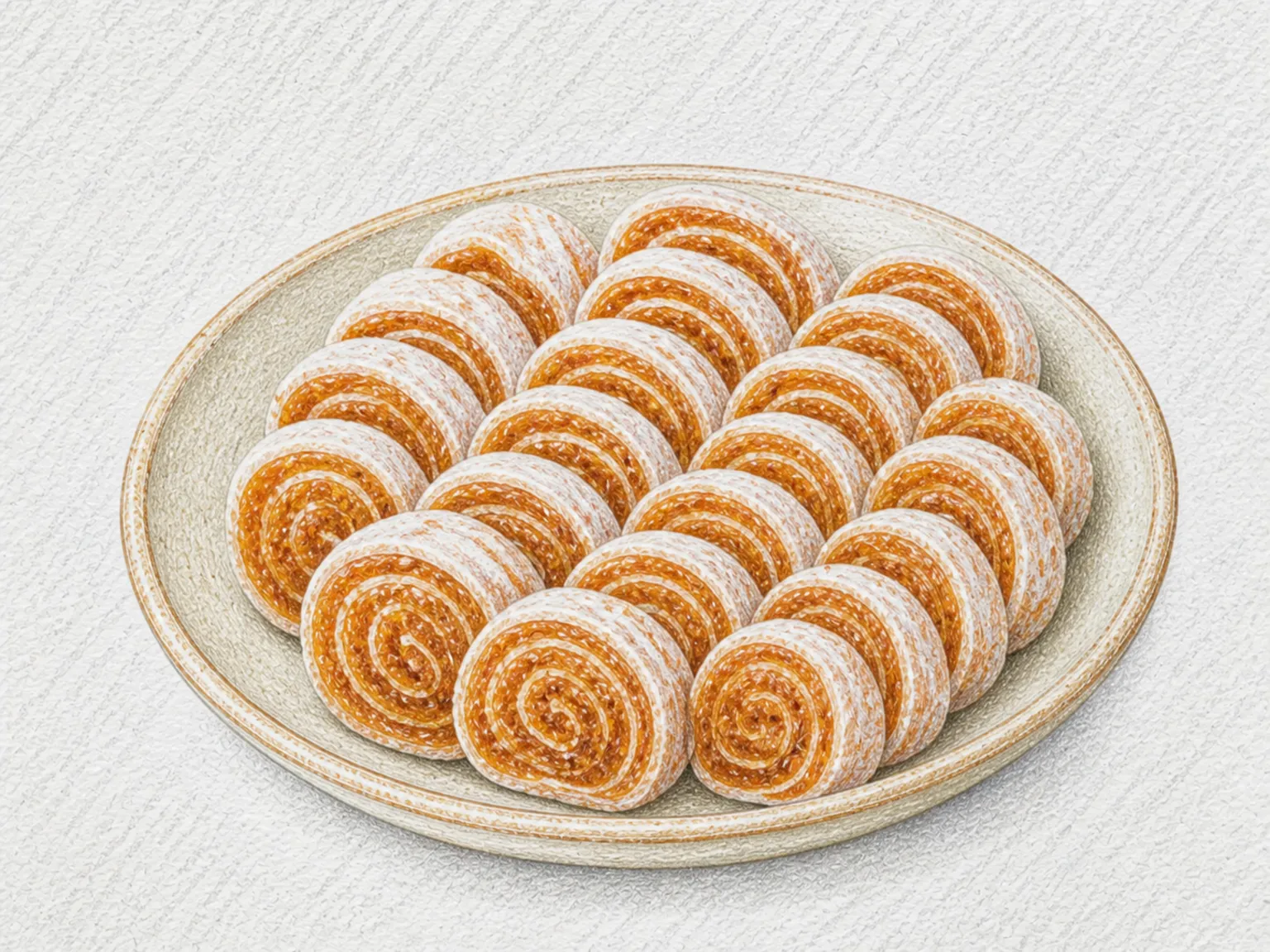
Maki-gaki (Pressed Dried Persimmon Roll)
Quick answer
- Total time
- 75 min
- Level
- Hard
- Servings
- 10 servings
- Ingredients
- 4
About this dish
About twenty dried persimmons are joined into one tight cylinder, so a thin slice shows amber flesh and white sugar bloom layered like a rose.
Read more
In Uki and Yamato in Kumamoto it carries the wish of raking in good fortune and is given as a year-end gift and eaten at New Year. Momi-gaki, kneaded by hand several times while drying, give the tightest and clearest pattern.
Ingredients
Instructions
- 1
Inspect every persimmon for rotten odor, fuzzy mold, or wet spots.
Confirm that the white coating is dry, even crystallized fructose, then trim off the stem and tip.
- 2
Make one lengthwise cut along the side and open each fruit into a sheet.
Remove every seed and hard seed pocket, then flatten torn edges with your fingers to even the thickness.
- 3
On a sanitized, dry bamboo mat, line up 5 to 6 opened fruits so each overlaps half the previous one.
Roll tightly as for sushi, then grip the cylinder firmly by hand to remove internal gaps.
- 4
Overlap the next fruit halfway onto the end of the roll and continue adding in the same way.
After using roughly 20 fruits, reroll several times in the mat to make the thickness even and compress into a firm rugby-ball shape.
- 5
Wrap the roll without gaps in food-safe cellophane and tie both ends.
Place it in a woven rice-straw cover and wind straw rope tightly around the outside in a spiral until nothing shifts.
- 6
For serving, unwrap and use a clean knife to cut ten thin rounds 5 to 8 mm thick.
Arrange without overlap so the white sugar pattern in each cross-section remains visible.
References checked
These references were consulted when this page was prepared or corrected. A source check does not mean the recipe was independently kitchen-tested.
- 일본 농림수산성 うちの郷土料理
「くまもとのふるさとの食レシピ集 上巻」(熊本県) · Checked: 2026-08-11