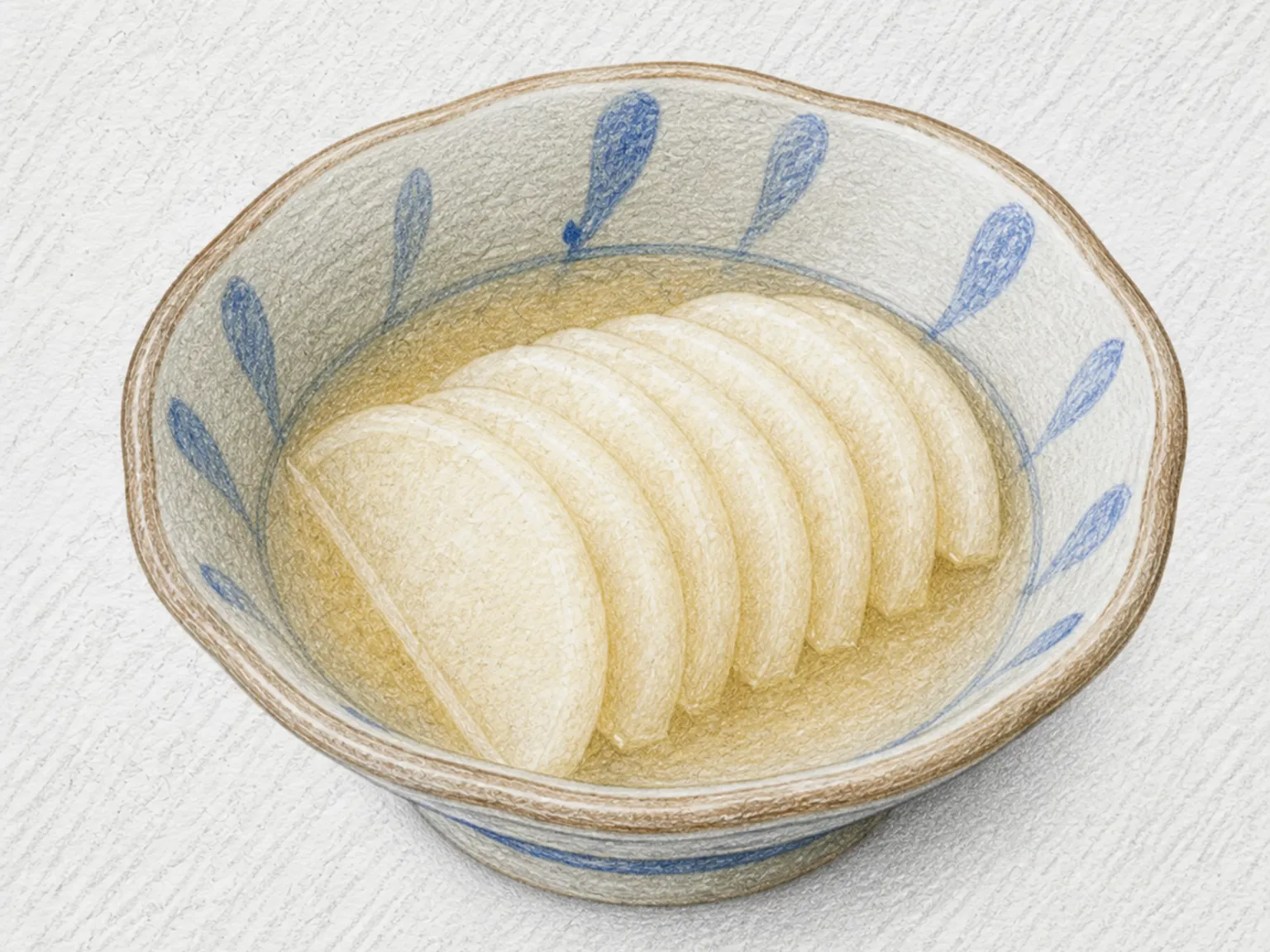
Namagusa-Koko (Daikon Pickled in Salted Sardine Liquid)
Quick answer
- Total time
- Approx. 210 days
- Level
- Hard
- Yield
- 1 batch
- Ingredients
- 7
About this dish
Sardines salted in spring sit through the summer, then are cooked down in late autumn into a thick liquid that pickles whole daikon.
Read more
Spanning two seasons, this Kakudahama, Niigata tradition is closer to a yearly project than a quick pickle. The radish stays firm but takes on the strong salt and smell of fermented fish. It is sliced thin and eaten with rice a little at a time. The makers use shirokubi daikon, and bottled fish sauce does not stand in for the brine the spring cure produces. A ventilated space for handling and cooking fish, a large barrel and heavy weights matter as much as the ingredients.
Ingredients
As an Amazon Associate, we may earn from qualifying purchases.
Instructions
- 1
Begin in spring with 100 very fresh sardines and 1.8 L salt measured by volume.
Remove the heads and carefully draw out the innards without slitting the bellies lengthwise. In this documented method, the cleaned fish are salted without rinsing in water.
- 2
Coat the fish with part of the measured salt.
Pack them closely in a radial arrangement in the pickling barrel, fill the gaps with the remaining salt and cover the top. Use all the measured salt in these stages. Leave at room temperature for 2 to 3 days for the salt to penetrate.
- 3
Add a weight of about 10 kg and cover the barrel.
Keep it in a dark, ventilated place at ambient temperature from spring until late autumn or early winter, a period of at least half a year. Retain the liquid that develops. The first 2 to 3 days are part of this maturation period.
- 4
In late autumn or early winter, transfer the matured sardines to a large pot.
Add enough water to just cover them and a little of the brine from the barrel. Bring to a simmer, stirring.
- 5
When the fish start losing their original shape, add a small amount of sake and bonito dashi granules.
Continue cooking and stirring for about 3 hours in total, until the mixture becomes a thick liquid, then remove from the heat and let the strongest heat subside.
- 6
Wash soil off the shirokubi daikon, remove the leaves and cut the roots into sections about 15 cm long.
Weigh the daikon being used and pack it into the pickling barrel. Use only as much daikon as the prepared sardine mixture can cover completely.
- 7
Pour in the sardine mixture after its strongest heat has subsided, covering all the daikon.
Add a weight equal to twice the daikon weight and keep it in a cool, dark place for about a month. Keep the radish below the liquid.
- 8
From about one month onward, remove a portion, slice it thinly and serve a small amount with rice.
If it tastes strongly salty, serve a smaller portion. Do not add an unmeasured amount of water to the stored barrel to dilute its salt concentration.
References checked
These references were consulted when this page was prepared or corrected. A source check does not mean the recipe was independently kitchen-tested.
- 和製アンチョビーで漬けるたくあん
料理通信 · Checked: 2026-09-13
- なまぐさごうこ | 水産加工品図鑑
水産加工品図鑑 · Checked: 2026-09-13