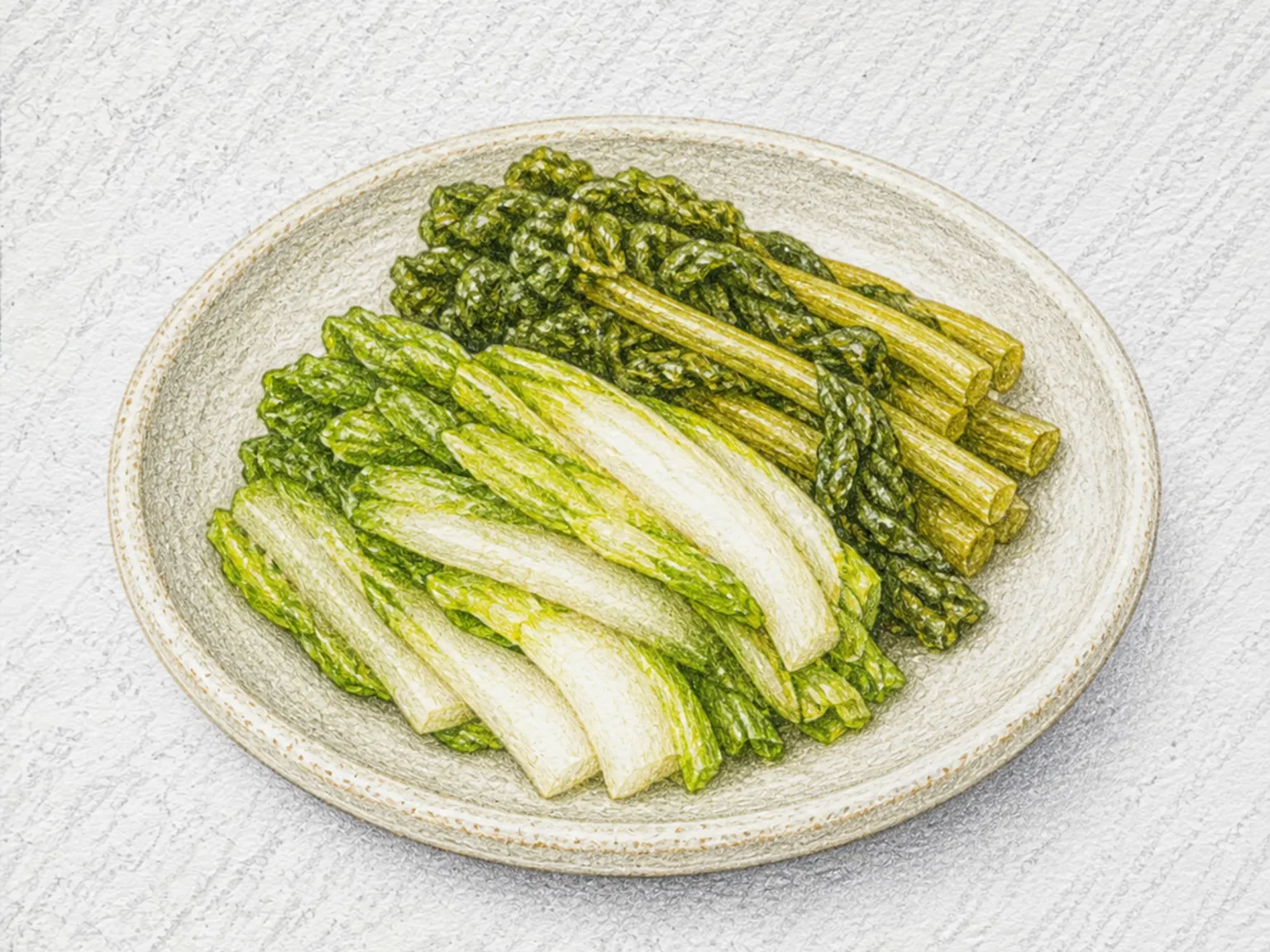
Suguki-zuke Lactic-Fermented Turnip Pickles
Quick answer
- Active time
- 80 min
- Waiting
- See the steps
- Level
- Hard
- Servings
- 20 servings
- Ingredients
- 2
About this dish
Suguki turnips salted with nothing else are held at about 40°C for roughly 14 days, and lactic fermentation turns their purely salty taste distinctly sour.
Read more
That warm stage, the muro, needs a dedicated fermentation room with temperature and hygiene control; ordinary room temperature or a fluctuating space is no substitute. Before warming, the shrunken leaves and roots should sit firmly under their own brine. The traditional season is winter, when the roots are sweetest, and the finished pickle goes out in small portions with rice, ochazuke or drinks.
Ingredients
As an Amazon Associate, we may earn from qualifying purchases.
Instructions
- 1
Wash 2000g whole suguki turnips with leaves without bruising them, remove soil and damaged sections, and dry the surface completely. Divide 120g salt accurately into 60g for preliminary pickling and 60g for main pickling.
- 2
Pack the suguki tightly in a sanitized, dry pickling vessel, sprinkling with the 60g preliminary salt.
Apply a heavy pickling stone that presses the entire batch and pre-pickle in a cool place for 24 hours, until liquid released by the suguki rises evenly around the top layer.
- 3
Remove the pre-pickled suguki, sprinkle with the remaining 60g salt, and rub it evenly over leaves and roots.
Repack tightly for the main pickling stage, replace the heavy stone, and leave for 48 hours. It is ready for warming when the volume has contracted and leaves and roots remain firmly pressed under the released liquid.
- 4
Move the main-pickling vessel, still under its stone, into a dedicated muro chamber held steadily at about 40°C.
Warm for about 14 days to promote lactic fermentation, finishing when the initially salty suguki develops a distinct acidity. Do not substitute an uncontrolled room-temperature space.
- 5
Cut the finished suguki leaves and roots separately.
Chop the leaves finely or into bite-size lengths, and slice the roots into 5mm half-moons or quarter rounds. Moisten lightly with the fermented liquid and serve in small portions with rice, ochazuke, or sake.
References checked
These references were consulted when this page was prepared or corrected. A source check does not mean the recipe was independently kitchen-tested.
- 일본 농림수산성 うちの郷土料理
Checked: 2026-08-11