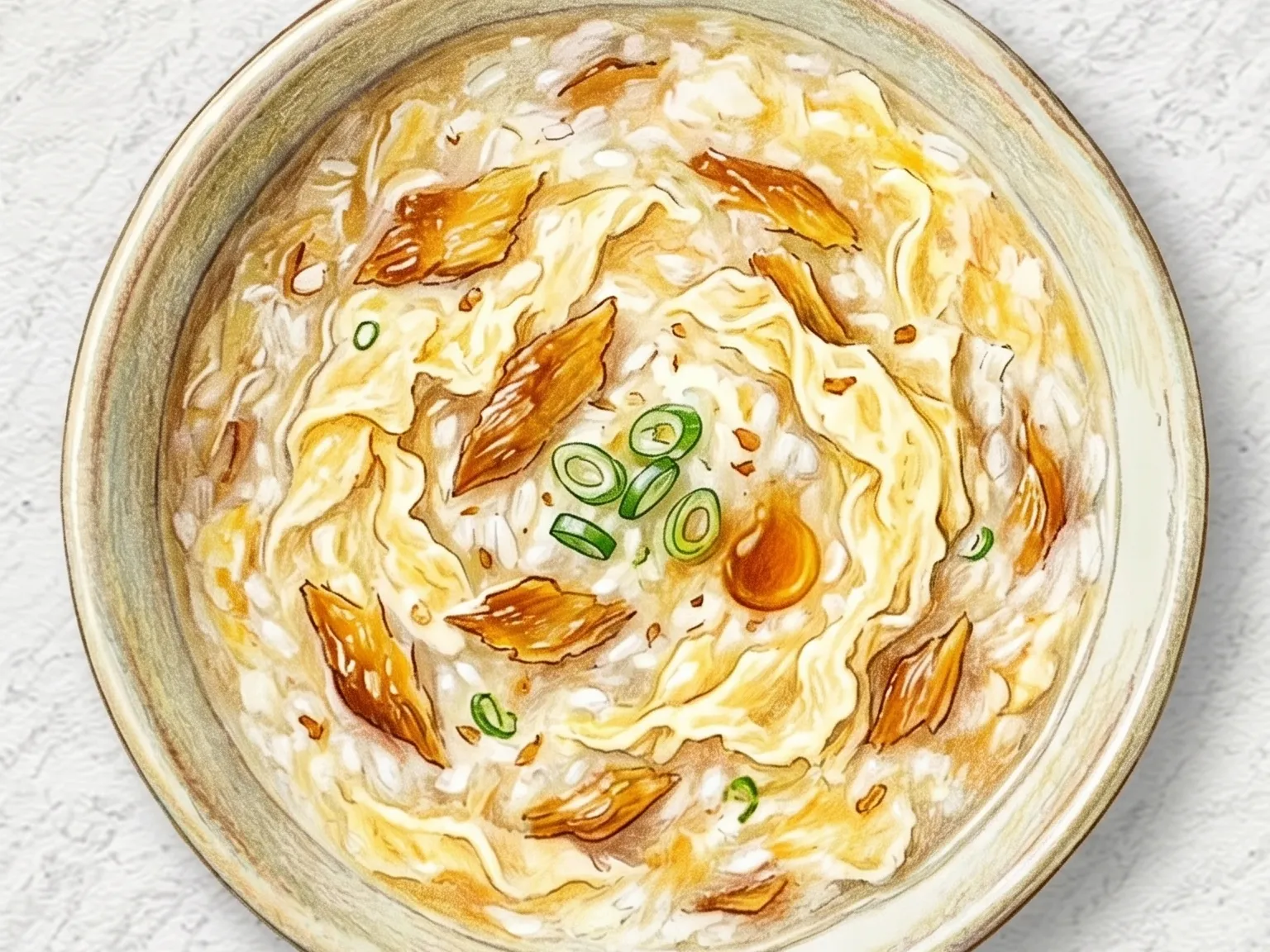
Korean Dried Pollock Egg Porridge
Rice Easy

Korean Dried Pollock Egg Porridge

Quick answer

Bukeo gyeran juk is a Korean porridge made by toasting dried pollock strips in sesame oil until fragrant, then simmering them with soaked rice until the grains fully brea...

What makes this special

  • Toasting dried pollock strips in sesame oil creates a deep, nutty aroma for Bukeo Gyeran Juk.
  • Dried pollock strips sauteed in sesame oil so fat coats protein for nutty aroma throughout
  • Drying process concentrates pollock protein delivering clean, clear umami
Total time
40 min
Level
Easy
Servings
2 servings
Ingredients
8
Calories
360 kcal
Protein
18 g

Key ingredients

Soaked short-grain riceDried pollock stripsEggSesame oilMinced garlic

Core cooking flow

  1. 1 Rinse 1 cup of rice and soak in cold water for 20 minutes, then drain well.
  2. 2 Cut 40g dried pollock into 3-4cm pieces and rinse quickly to reduce saltiness.
  3. 3 Heat 1 tbsp sesame oil in a pot over medium heat and saute the pollock with...

Bukeo gyeran juk is a Korean porridge made by toasting dried pollock strips in sesame oil until fragrant, then simmering them with soaked rice until the grains fully break down, and finishing with beaten egg stirred in just before the heat is turned off. Dried pollock concentrates protein during the drying process, producing a clean, direct savoriness without heaviness. Toasting it in sesame oil first coats the fish in fat, which spreads a nutty richness throughout the porridge as it cooks. Adding the egg at the very end and stirring immediately keeps it from setting into firm pieces and instead creates soft, silky ribbons through the gruel. Soup soy sauce seasons the dish without darkening the color of the broth. Mild and easy on the stomach, this porridge is a reliable choice for the morning after drinking or whenever the body wants something warm and light.

Prep 15min Cook 25min 2 servings

Instructions

Read the steps as a cooking flow: prep, heat, seasoning, doneness control, and finish.

7 steps
  1. 1
    Finish

    Rinse 1 cup of rice and soak in cold water for 20 minutes, then drain well.

    Soaking more than 20 minutes makes the grains too soft and the finished porridge loses body.

  2. 2
    Control

    Cut 40g dried pollock into 3-4cm pieces and rinse quickly to reduce saltiness.

    Rinse for no longer than 30 seconds or the savory flavor will wash out.

  3. 3
    Control

    Heat 1 tbsp sesame oil in a pot over medium heat and saute the pollock with 1/2 tsp minced garlic for 1 minute until slightly translucent. The sesame oil coats the protein and builds a savory aroma throughout the porridge.

  4. 4
    Control

    Add soaked rice and stir 2 more minutes until coated with oil, then pour in 5 cups of water and simmer over medium-low heat, stirring. Reduce to low once grains begin to open, stirring frequently to prevent sticking.

  5. 5
    Season

    Once the rice has fully opened, season with 1 tbsp soup soy sauce.

    Lighter in color than regular soy sauce, it keeps the porridge clear while adding both saltiness and umami.

  6. 6
    Control

    Reduce to the lowest heat, drizzle in 1 beaten egg in a thin stream, wait 30 seconds, and then stir gently just once.

    Stirring too hard breaks the egg into cloudy wisps that muddy the porridge.

  7. 7
    Finish

    Serve immediately in warm stone bowls and garnish with 1 tbsp chopped scallion.

    The porridge sets quickly as it cools, so finish just before serving.

After the steps

Pick a recipe that fits this dish.

Continue with shared ingredients, meal pairings, or a similar method.

Recipes That Go Well With This

More Rice →

Based on shared ingredients and meal pairing

Korean Egg Porridge (Silky Sesame-Scented Rice Porridge)
Shared ingredient: soaked short-grain rice Rice

Korean Egg Porridge (Silky Sesame-Scented Rice Porridge)

Gyeran juk is a mild, gentle rice porridge that starts by stir-frying soaked rice in sesame oil before any liquid is added, a step that coats the starch granules in oil to prevent the finished porridge from clumping and works the sesame fragrance evenly into every grain. Water is added and the pot simmers on low heat for twenty minutes with frequent stirring, breaking down the grains gradually until they dissolve into a smooth, cohesive base. Constant stirring on low heat is what prevents the rice from scorching on the bottom and what creates the uniformly silky texture that defines a well-made juk. Beaten egg is drizzled in at the very end in a thin stream and folded gently for just one minute, creating soft, ribbony layers of cooked egg throughout the porridge without allowing them to toughen. Soup soy sauce and salt provide restrained seasoning that stays behind the sesame fragrance rather than overpowering it, and sliced green onion scattered on top adds a fresh note over the warm nuttiness beneath. This is the kind of bowl that asks nothing of the stomach, which makes it the standard choice after illness, on mornings when appetite is low, or whenever a light and restorative meal is needed.

Korean Mushroom Soft Tofu Porridge
Shared ingredient: soaked short-grain rice Rice

Korean Mushroom Soft Tofu Porridge

Shiitake mushrooms and sliced onion are sauteed in perilla oil until their edges soften and the oil takes on a faint herbal fragrance, then soaked rice and kelp stock go into the same pot. The mixture simmers until the grains break down into a smooth, cohesive porridge. At that point, the heat is lowered and spoonfuls of silken tofu are dropped in without stirring - preserving the soft, pillowy clusters that give the bowl its characteristic texture variation. Kelp stock brings a clean, moderate umami that anchors the dish without heaviness, and perilla oil contributes a slightly bitter, grass-like finish that differentiates this porridge from sesame-based versions. Soup soy sauce provides the seasoning, and chopped scallion goes on last. The result is gentle enough for a sensitive stomach yet complete enough to serve as a full meal.

Korean Ox Bone Soup (Milky Slow-Simmered Beef Bone Broth)
Serve together Soups

Korean Ox Bone Soup (Milky Slow-Simmered Beef Bone Broth)

Seolleongtang is one of Korea's oldest and most enduring soups, produced by simmering ox leg bones and beef brisket together for six to eight hours until the broth turns a deep, opaque milky white. The bones are soaked in cold water for a minimum of two hours to purge as much blood as possible, then blanched in a separate pot and rinsed before the true simmering begins in fresh water. Over the course of a half-day at a steady, rolling boil, marrow and collagen break down and emulsify into the water, creating a broth with a heavy, almost creamy viscosity and a deep bovine savoriness that accumulates slowly and cannot be replicated with shortcuts. The brisket is removed after two hours, when it has turned tender and fully cooked, then sliced thin across the grain and returned to the bowl as a topping. The defining tradition of seolleongtang is that the broth arrives at the table completely unseasoned, and each person adds their own salt, white pepper, and sliced green onion to taste. This custom underscores the expectation that the broth itself should carry the bowl with its own richness. Steamed rice or thin wheat noodles are added directly to the soup and left to soak, absorbing the milky liquid until each grain or strand carries the flavor of the bone broth. In Korea, seolleongtang is eaten as a restorative meal after illness, as a morning hangover cure, and as a deeply satisfying cold-weather comfort food.

Korean Pollock Roe Egg Porridge
Similar recipe Rice

Korean Pollock Roe Egg Porridge

Rice is simmered in anchovy stock until the grains soften and the porridge thickens, then finished with pollock roe and beaten egg. The roe dissolves into the broth and spreads its briny, savory depth throughout the bowl, while the egg forms soft curds that add body to the texture. Because pollock roe already carries significant salt, soup soy sauce is added only in small amounts at the very end to fine-tune the seasoning rather than build the base flavor. Stirring the egg in gently over low heat produces delicate, smooth curds. Rushing the egg over high heat causes it to seize into rough clumps that interrupt the silky consistency of the porridge. A drizzle of sesame oil, a scattering of dried seaweed flakes, and sliced green onion finish the bowl with a nutty fragrance and a clean finish. This is a natural choice for days when appetite is low or the stomach feels unsettled, and the roe's depth of flavor means a small number of ingredients produces a genuinely satisfying result.

Serve with this

Korean Aralia Shoot Soybean Paste Stew
Stews Easy

Korean Aralia Shoot Soybean Paste Stew

Dureup, the young shoots of the aralia tree, appear for only a few weeks in spring. Their pleasant bitterness and firm bite translate well into the savoury heat of doenjang broth. Anchovy stock forms the base, and both doenjang and gochujang are stirred in together to give the soup an earthy depth with a steady background heat. Zucchini and onion round out the bitterness with sweetness. Tofu fills the bowl with a soft contrast. The shoots go in late in the cooking so their crunch survives the heat of the broth.

🏠 Everyday ⚡ Quick
Prep 12min Cook 16min 2 servings
Korean Stir-fried Butterbur Stems
Side dishes Medium

Korean Stir-fried Butterbur Stems

Meowi-namul-bokkeum stir-fries boiled butterbur stems in perilla oil, adding a cooking step that distinguishes it from the cold-dressed muchim version. While the muchim blanches and seasons immediately without further heat, the bokkeum takes the boiled stems into a pan with soup soy sauce and water for five minutes or more, driving the seasoning deep into the plant fibers. This additional cooking time also volatilizes more of the butterbur's bitter compounds, producing a milder flavor compared to the cold preparation. Perilla oil, though more prone to oxidation than sesame oil, is the traditional choice because its earthy, grassy aroma harmonizes with the herb's character in a way sesame oil cannot. Adding perilla seed powder in the last minute causes its starch to partially gelatinize, giving the sauce a thicker consistency, but leaving it on the heat too long makes the dish chalky and heavy. Timing this final step precisely is what separates a well-made version from an overcooked one. This banchan appears on spring mountain-village tables alongside gondeure-namul and chwinamul as part of the seasonal wild greens spread that marks the transition out of winter.

🏠 Everyday 🍱 Lunchbox
Prep 18min Cook 12min 4 servings
Korean Scallion Kimchi (Whole Stalk Anchovy Shrimp Paste)
Kimchi Medium

Korean Scallion Kimchi (Whole Stalk Anchovy Shrimp Paste)

Jjokpa kimchi is a traditional Korean scallion kimchi made by briefly brining whole scallions in coarse salt, then coating them from root to tip with a seasoning paste of anchovy fish sauce, fermented shrimp, gochugaru, and sweet rice flour paste. Using both anchovy fish sauce and salted shrimp together is intentional: the two condiments each carry a different profile of seafood umami, and combining them produces a more complex, layered depth than either alone could achieve. The sweet rice flour paste acts as a binder, adhering the seasoning evenly to the surface of each scallion and keeping it in place as moisture releases during fermentation. Without this paste, the pickling liquid would dilute the coating and the flavor would fade over time. The white bulb sections of the scallion hold their crunch through the brining and fermentation process while absorbing the spice of the gochugaru, and the green tops wilt to a silky texture that releases the scallion's characteristic sweet, pungent aroma. After six hours at room temperature followed by a day of refrigeration, the seasoning has fully penetrated the scallion and the kimchi is ready to eat alongside grilled pork belly or bossam. After three or more days of fermentation, a gentle lactic acidity develops that makes the kimchi equally useful as an ingredient in stews or stir-fries.

🏠 Everyday 🍱 Lunchbox
Prep 25min 4 servings

Similar recipes

Korean Shrimp Porridge (Creamy Rice Porridge with Shrimp Broth)
Rice Easy

Korean Shrimp Porridge (Creamy Rice Porridge with Shrimp Broth)

Saeu-juk is a Korean shrimp porridge that simmers rice with shell-on shrimp to draw out a gentle oceanic broth. The heads and shells are cooked down to build a flavorful stock, while the shrimp meat is minced and stirred in separately so each spoonful carries bursts of umami. Diced zucchini and carrot add mild sweetness that balances the seafood character. Soaked rice is first toasted in sesame oil before the liquid goes in, which gives the finished porridge a nuttier base and slightly thicker consistency. The result is a light, nourishing bowl with a clean finish - commonly served as a gentle breakfast or a recovery meal, where the warmth and mild flavor are as important as the nutrition.

🏠 Everyday
Prep 15min Cook 30min 2 servings
Korean Bean Sprout Dried Pollock Soup
Soups Easy

Korean Bean Sprout Dried Pollock Soup

Kongnamul-hwangtae-guk pairs dried pollock strips with soybean sprouts in a clear broth that is widely eaten as a morning-after remedy. The pollock is toasted briefly in sesame oil to coax out a nutty, savory aroma before radish slices and water are added for ten minutes of simmering, which forms the foundational stock. Rinsing the pollock quickly in cold water rather than soaking it for a long time keeps the strands pleasantly chewy rather than soft and falling apart. Bean sprouts and minced garlic are added uncovered for five more minutes: leaving the lid off is essential, as the open steam carry away the raw beany smell while preserving the sprouts' characteristic crunch. Soup soy sauce and a pinch of salt finish the seasoning, and sliced green onion goes on just before serving. The broth turns a milky, pale white as the pollock proteins leach into the liquid, which is the visual marker of a properly cooked bowl.

🏠 Everyday 🥗 Light & Healthy
Prep 10min Cook 20min 2 servings
Korean Dried Pollack Egg Soup
Soups Easy

Korean Dried Pollack Egg Soup

Hwangtae-gyeran-guk is a Korean clear soup that pairs dried pollock with silken egg threads in the same bowl. Toasting the pollock strips in sesame oil at the start is what gives the broth its foundation: the oil absorbs the nutty, roasted fragrance and carries it throughout the liquid as it simmers. Radish and green onion add a clean sweetness and mild sharpness, and once the broth is seasoned with soup soy sauce and garlic, beaten egg is streamed in slowly to form wispy, floating ribbons. The chewy pollock and the soft egg offer a changing texture from one spoonful to the next. Hwangtae is produced on outdoor racks in the Gangwon-do mountains through a winter-long cycle of freezing and thawing that breaks down the protein into a more digestible form and increases the amino acid content. In Korean households this soup appears at both the breakfast table and the post-drinking recovery meal, favored because the protein-rich pollock is gentle on a tired stomach and the whole pot comes together in under twenty minutes.

🏠 Everyday 🥗 Light & Healthy
Prep 10min Cook 18min 4 servings

Tips

Stir every few minutes to prevent sticking.
Add a few extra drops of sesame oil for nuttier flavor.

Nutrition (per serving)

Calories
360
kcal
Protein
18
g
Carbs
56
g
Fat
8
g