French Celeriac Remoulade
Salads Medium

French Celeriac Remoulade

Quick answer

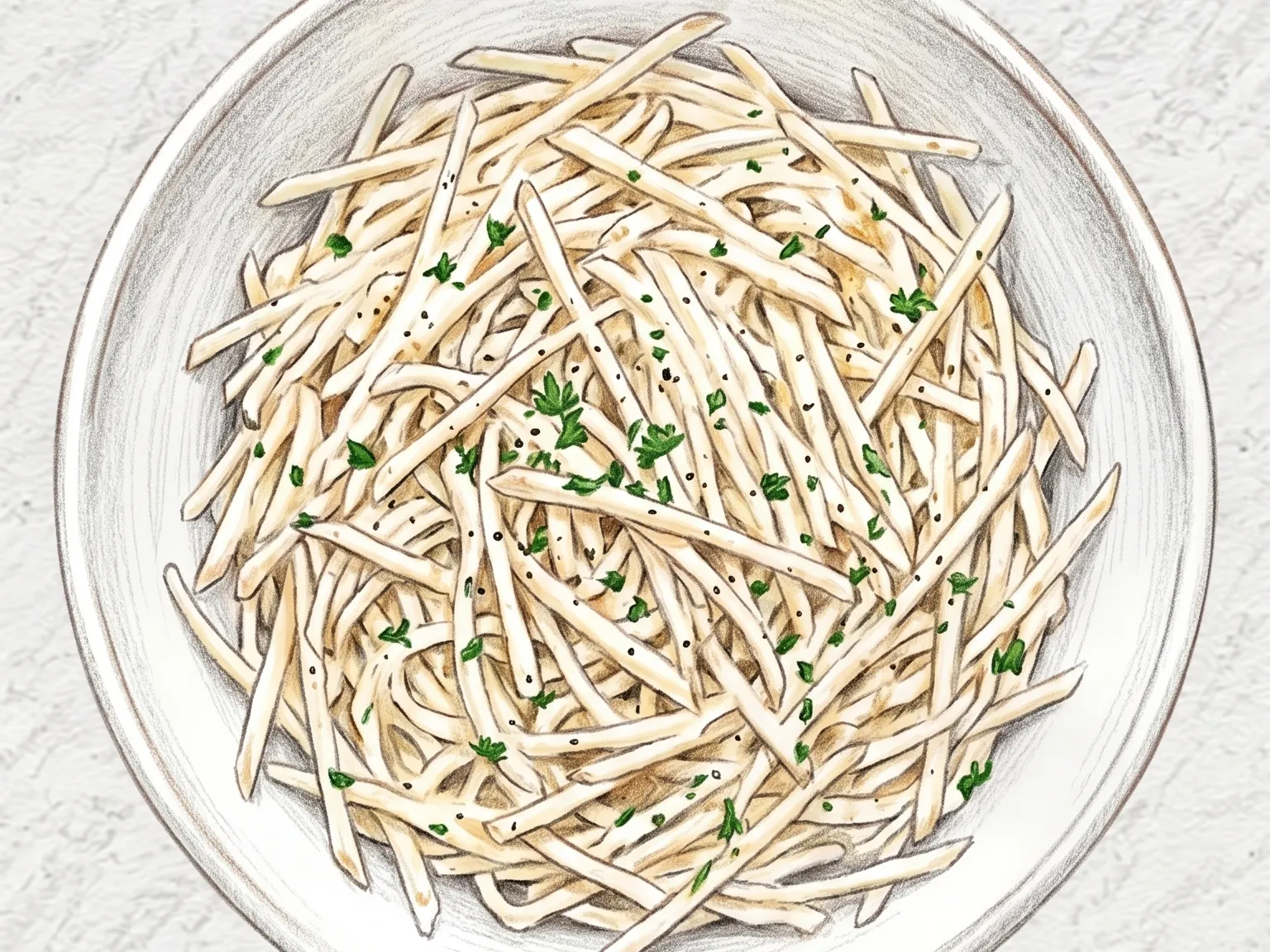
Celeriac remoulade shreds thickly peeled celeriac into fine matchsticks and dresses them in a mixture of Dijon mustard, mayonnaise, lemon juice, and white wine vinegar.

What makes this special

  • Tossing julienned celeriac in lemon juice immediately prevents browning while maintaining a bright acidity.
  • Half the lemon juice goes on the julienne immediately to prevent browning
  • Dijon's sharp bite creates a pointed balance against mayonnaise's fat
Total time
20 min
Level
Medium
Servings
2 servings
Ingredients
7
Calories
240 kcal
Protein
3 g

Key ingredients

celeriacmayonnaiseDijon mustardlemon juicewhite wine vinegar

Core cooking flow

  1. 1 Brush off any soil, rinse 300 g celeriac, and cut away the tough skin thickly.
  2. 2 Slice the peeled celeriac into matchsticks no thicker than 0.2 cm using a mandoline or sharp knife.
  3. 3 As soon as the celeriac is cut, toss it gently by hand with half of the 1.5 tbsp lemon juice.

Celeriac remoulade shreds thickly peeled celeriac into fine matchsticks and dresses them in a mixture of Dijon mustard, mayonnaise, lemon juice, and white wine vinegar. Tossing the shreds immediately with half the lemon juice prevents enzymatic browning, while the rest goes into the dressing to balance acidity. The Dijon's sharp heat cuts through the mayonnaise's richness, and the white wine vinegar keeps the finish clean and bright. Cutting the matchsticks as thin as possible maximizes surface area so the dressing absorbs quickly and evenly. A 15-minute chill in the refrigerator lets the flavors settle throughout; overnight refrigeration deepens the result further. The salad pairs well with cold meats and charcuterie, where its tangy crunch offsets richer textures.

Prep 20min 0 2 servings
Recipes by ingredient → mayonnaise lemon juice parsley

Instructions

Read the steps as a cooking flow: prep, heat, seasoning, doneness control, and finish.

6 steps
  1. 1
    Season

    Brush off any soil, rinse 300 g celeriac, and cut away the tough skin thickly.

    Check the surface carefully and remove any brown fibrous patches so the salad stays clean-tasting and tender.

  2. 2
    Prep

    Slice the peeled celeriac into matchsticks no thicker than 0.2 cm using a mandoline or sharp knife.

    Keep the cuts even, because thick pieces absorb dressing slowly and stay too firm.

  3. 3
    Prep

    As soon as the celeriac is cut, toss it gently by hand with half of the 1.5 tbsp lemon juice.

    Coat the surfaces lightly so browning slows and the pale color brightens.

  4. 4
    Prep

    In a bowl, combine 3 tbsp mayonnaise, 1 tbsp Dijon mustard, 1 tsp white wine vinegar, the remaining lemon juice, and 1/4 tsp black pepper. Stir until smooth, creamy, and free of mustard streaks.

  5. 5
    Step

    Add the celeriac to the dressing and toss with forks or tongs, lifting from the bottom instead of pressing down.

    Stop once every strand has a thin coating, before the matchsticks break.

  6. 6
    Control

    Fold in 10 g chopped parsley, mix once more, and refrigerate for 15 minutes before serving cold.

    For a deeper flavor, cover and chill overnight, then toss again before plating.

After the steps

Pick a recipe that fits this dish.

Continue with shared ingredients, meal pairings, or a similar method.

Recipes That Go Well With This

More Salads →

Based on shared ingredients and meal pairing

Salade Niçoise
Shared ingredient: dijon mustard Western

Salade Niçoise

Salade Nicoise is a classic salad from Nice in southern France that arranges tuna, soft-boiled eggs, olives, anchovies, tomatoes, and blanched green beans in separate sections on a plate, finished with a vinaigrette of olive oil, lemon juice, and Dijon mustard. The traditional presentation keeps each ingredient in its own zone rather than tossing everything together. Soft-boiling the eggs for six minutes yields a runny yolk that acts as a natural dressing when broken. The salty depth of anchovies and the oily richness of olives add complexity over the mild tuna, while the mustard vinaigrette brightens and ties the whole plate together with its acidity.

Socca Niçoise (French Chickpea Flour Flatbread)
Serve together Western

Socca Niçoise (French Chickpea Flour Flatbread)

Socca nicoise is a chickpea-flour flatbread from Nice, France, made by whisking chickpea flour with water, olive oil, salt, pepper, and rosemary, then baking the thin batter in a preheated oven-safe pan at 220 degrees Celsius for twelve to fifteen minutes. Resting the batter for ten minutes allows the flour to hydrate fully, which produces the characteristic texture - crisp and almost shatteringly crunchy at the edges, soft and slightly custardy in the center. The pan must be fully preheated and generously oiled so the batter sizzles on contact and releases cleanly. Sliced red onion and halved cherry tomatoes placed on top before baking lose their moisture in the oven and concentrate into sweet, slightly charred toppings. A final grind of coarse black pepper emphasizes the nutty, earthy flavor of the chickpea base.

Kimchi Tofu Alfredo Farfalle (Creamy Kimchi Bow-Tie Pasta)
Serve together Pasta

Kimchi Tofu Alfredo Farfalle (Creamy Kimchi Bow-Tie Pasta)

Kimchi tofu Alfredo farfalle is a fusion pasta that counters the richness of a cream-and-Parmesan Alfredo sauce with the lactic acidity of well-fermented kimchi. Garlic bloomed in butter forms the aromatic base, then cream, milk, and Parmigiano are combined into the classic Alfredo sauce, after which chopped kimchi is folded in to introduce fermented tang and a layer of umami that a standard Alfredo lacks. Firm tofu cut into cubes and pan-fried until each side is golden provides a mild, neutral protein element with direct textural contrast against the smooth sauce. Farfalle's pinched center holds pockets of sauce against each piece of pasta, delivering a consistent hit of creaminess in every bite, and freshly ground black pepper draws a sharp line through the richness at the finish. The entire dish moves from pan to plate in about 15 minutes.

Lobster Bisque
Similar recipe Western

Lobster Bisque

Lobster bisque serves as a foundational dish within the French culinary tradition, specifically categorized as a smooth cream soup based on crustacean shells. The preparation begins by roasting the lobster shells in butter until they reach a dark, saturated color, a step that develops the base flavors of the dish. This is followed by a flambe process using cognac, which serves to eliminate any lingering bitterness from the shells while introducing a layer of smoky depth to the mixture. Once the shells are prepared, they are placed in a pot with fish stock, whole tomatoes, and a selection of aromatic vegetables to simmer for a minimum of thirty minutes. This extended simmering time allows for the maximum extraction of flavor from the lobster shells into the surrounding liquid. After the simmering process is complete, the mixture is passed through a fine sieve to remove all solid fragments and ensure a uniform consistency. The resulting broth is then combined with heavy cream, which provides a thick and velvety texture that characterizes the final soup. Fresh tarragon is incorporated to provide an herbal element that balances the concentrated richness of the cream and seafood. The lobster meat, which was set aside earlier in the process, is stirred into the hot liquid at the final stage of preparation to ensure that its texture remains tender and does not become tough. The final result is a soup that features a concentrated essence of the ocean and represents one of the most technical and polished preparations found in French cooking.

Serve with this

Jianbing (Chinese Savory Breakfast Crepe)
Asian Medium

Jianbing (Chinese Savory Breakfast Crepe)

Jianbing is a northern Chinese street breakfast crepe assembled on a flat griddle within minutes. A thin batter of mung bean flour and wheat flour is spread into a wide circle, then an egg is cracked directly on top and smeared across the surface while still liquid. Chopped scallion is scattered over the egg before the crepe is flipped briefly to set the other side. Sweet bean sauce and chili sauce are brushed on, followed by fresh cilantro and a crispy fried wonton sheet that provides the signature crunch. The mung bean flour gives the batter a distinctive nutty flavor and slightly crisp edge that plain wheat flour cannot replicate. The whole assembly is folded into a neat rectangle meant to be eaten by hand. Timing is critical for the wonton cracker, which should be added last to prevent sogginess, creating a layered contrast of soft crepe, runny egg, sharp sauce, and shattering crunch.

🏠 Everyday ⚡ Quick
Prep 20min Cook 15min 2 servings
Korean Scallion Pancake
Grilled Easy

Korean Scallion Pancake

Pa-jeon is a Korean scallion pancake made by cutting scallions into six-to-seven-centimeter lengths, laying them across an oiled pan, and pouring a batter of Korean pancake mix, water, egg, and salt directly over them before frying on medium heat. The method of placing the scallions first and covering them with batter means one side of each scallion presses against the hot pan surface, which caramelizes them and coaxes out a sweet, aromatic fragrance that would not develop if the scallions were simply mixed into the batter. Batter consistency is a meaningful variable: the mixture should flow off a spoon in a continuous stream rather than plopping, because anything thicker makes the pancake bready and reduces the proportion of scallion in each bite, while anything too thin prevents the distinctive crispy rim from forming around the edges. Adding an extra drizzle of oil around the perimeter before flipping fries the outer edge like a fritter, creating a sharp contrast between the crunchy border and the soft, scallion-loaded interior when dipped into a soy-based dipping sauce. Pa-jeon is also known in Korean culture as a dish that people instinctively crave on rainy days, a reputation closely tied to the sound of batter hitting a hot oiled pan.

🍺 Bar Snacks ⚡ Quick
Prep 15min Cook 10min 2 servings

Similar recipes

French Toast
Western Easy

French Toast

French toast soaks thick bread slices in a mixture of beaten eggs, milk, sugar, vanilla extract, and cinnamon until both sides absorb the custard evenly. The soaked bread is then cooked in melted butter over medium-low heat until each side turns golden brown and lightly caramelized on the surface while staying soft and moist inside. Slightly stale bread works better than fresh because its drier crumb absorbs more of the egg mixture without falling apart. Warm cinnamon and vanilla fragrance fills the kitchen during cooking. A drizzle of maple syrup and a dusting of powdered sugar finish the dish, and adding whipped cream or fresh fruit elevates it further.

🏠 Everyday 🧒 Kid-Friendly
Prep 10min Cook 10min 2 servings
Duck a l'Orange
Western Hard

Duck a l'Orange

Duck a l'orange is a French classic built on the contrast between shatteringly crisp duck skin and a glossy, bittersweet orange sauce. The skin of the duck breast is scored in a crosshatch pattern and seasoned with salt and pepper, then placed skin-side down in a cold pan before any heat is applied. Starting from cold is the key: as the pan warms gradually to medium-low, the thick layer of subcutaneous fat renders out slowly and evenly, leaving the skin golden and crackling rather than greasy. After flipping and cooking for two to three more minutes, the breast is removed to rest while the sauce is assembled in the same pan. Excess fat is poured off, then sugar and red wine vinegar are cooked together into a dark caramel. Orange juice and zest go in next, and the liquid reduces by half into a glossy sauce with concentrated citrus intensity. A tablespoon of cold butter swirled in at the very end smooths out the acidity and gives the sauce a sheen. Over-reducing the sauce draws out bitterness from the zest, so pulling the pan off heat at the right moment is critical. The rested breast is sliced on the bias and arranged on the plate, with the sauce spooned over and alongside.

🎉 Special Occasion 🍺 Bar Snacks
Prep 20min Cook 25min 2 servings
French Omelette
Western Medium

French Omelette

A French omelette is defined entirely by technique, which is precisely why it appears in professional kitchens as a benchmark for a cook's fundamental skill. The eggs are beaten just enough to combine the yolks and whites into a uniform liquid without introducing air, then poured into a butter-coated pan over moderate heat. From that point on, constant stirring with a fork or chopsticks, combined with rhythmic shaking of the pan, coaxes the eggs into the tiniest possible curds that bind together into a seamless, pale yellow sheet. No browning of any kind should appear on the exterior surface. The interior, described in French as baveuse, remains slightly underset with a custard-like center that carries the richness of the egg in its purest form. Folding or rolling the omelette into a neat oval shape should happen within ninety seconds from the moment the egg touches the pan; anything beyond that overcooks the inside. Fillings are minimal by design: fine herbs, a small amount of grated Gruyere, or nothing at all, so the egg remains the sole subject. The simplicity of the ingredients removes every excuse and makes even small errors in heat management immediately visible in the finished result. Practice tightens the margins, but each attempt teaches something precise about timing and temperature.

⚡ Quick 🌙 Late Night
Prep 5min Cook 6min 1 servings
Classic Croissant
Baking Hard

Classic Croissant

A classic croissant is built through lamination: a process of folding cold butter into yeast-leavened dough in successive turns to create dozens of alternating layers. Three sets of folds produce a structure so layered that when baked, the butter melts and releases steam, forcing each layer apart from within. Keeping the butter at a similar temperature to the dough throughout is critical because if the block grows too hard it shatters through the layers and if it grows too soft it merges with the dough and the lamination collapses. The exterior caramelizes into a shell so thin and crisp it shatters at the slightest pressure, scattering golden flakes. The interior, by contrast, is a honeycomb of soft, airy strands held together by the ghost of dissolved butter. Tearing a warm croissant apart releases a rush of butter fragrance, and the dough itself carries a faint sweetness from sugar and milk.

🎉 Special Occasion 🧒 Kid-Friendly
Prep 120min Cook 18min 8 servings

Tips

Cut celeriac very thin for better dressing absorption.
Flavor improves after a short overnight chill.

Nutrition (per serving)

Calories
240
kcal
Protein
3
g
Carbs
15
g
Fat
19
g