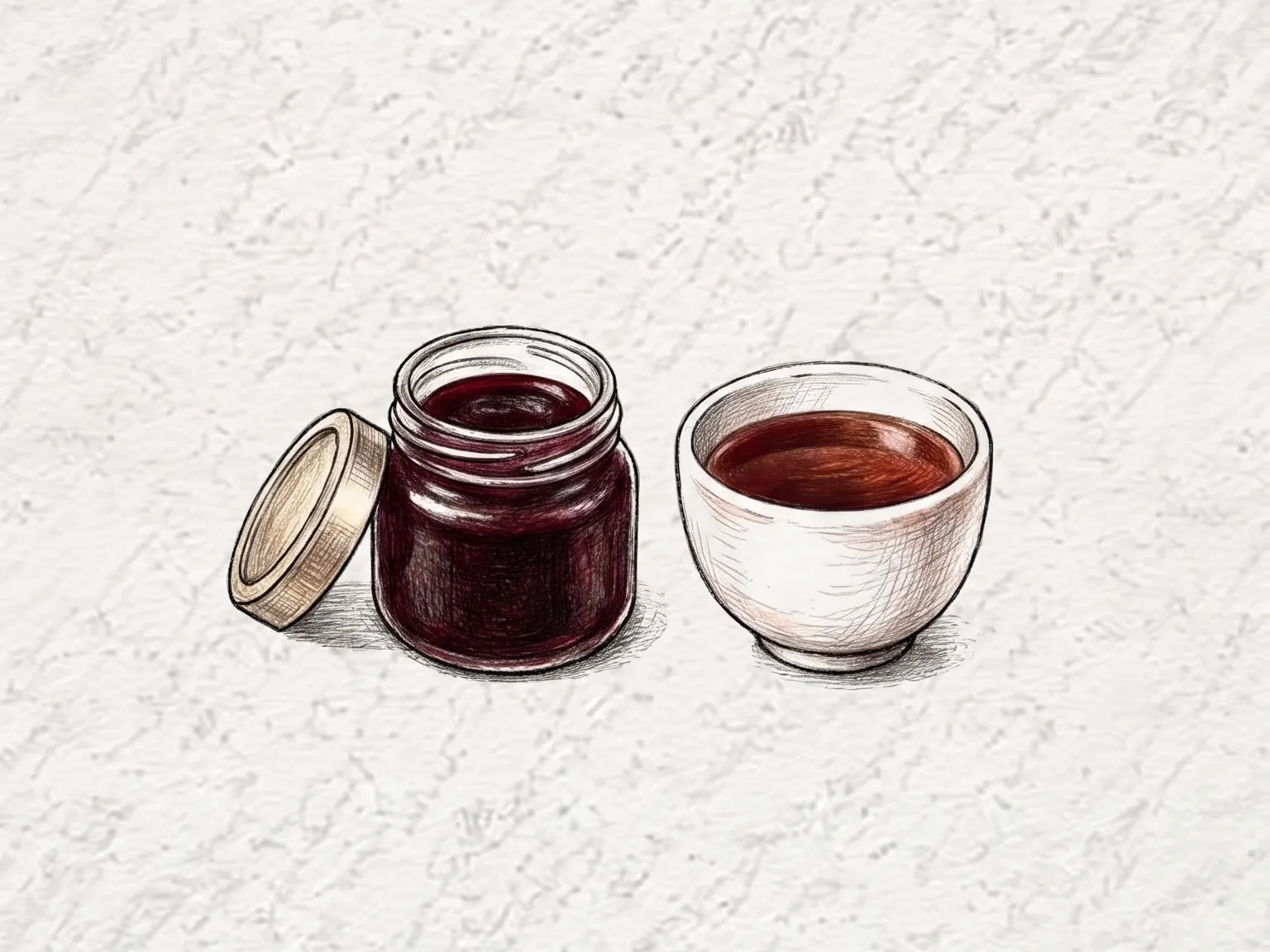
Korean Jujube Paste (Daechu-go)
Quick answer
- Total time
- At least 3 hr 40 min
- Level
- Medium
- Yield
- 1 batch
- Ingredients
- 3
About this dish
How smooth the paste is, and how much of it you get, is settled at the sieve.
Read more
Pour the soft-simmered jujubes onto the sieve with their cooking water and rub them through with a spatula: the skins and pits stay behind and almost all of the flesh goes through. As the purée reduces it thickens, spits and sticks to the bottom of the pot, so keep the heat low and scrape the whole base as you stir. The paste firms up further as it cools, which is why the heat goes off while it is still slightly looser than jam. Daechu-go made without sugar is not kept at room temperature; refrigerate only what you will use soon and freeze the rest in single-cup portions. Dried jujubes are also sold as dried red dates.
Ingredients
Instructions
Stops the screen from turning off while you cook.
- 1
Wash a 500 ml glass jar with detergent, lay it in a pot, cover it with cold water and bring to a boil.
Five minutes after the water boils, lift the jar out with tongs and stand it upside down on a clean towel until completely dry.
- 2
Dip 300 g dried jujubes in water, rub the dust out of the wrinkles with your fingers and rinse 2 or 3 times in fresh water.
- 3
Put the jujubes in a pot, add 1.2 L water and soak for 1 hour, until the wrinkles start to fill out.
- 4
Bring the pot to a boil over high heat in its soaking water, then lower the heat, set the lid slightly ajar and simmer for 1 hour, topping up with a little hot water if the level drops below the jujubes. They are ready when a jujube pressed between your fingers mashes and slips easily off its pit; if not, simmer 15 minutes more at a time.
- 5
Set a medium-mesh sieve over a large bowl and pour in the jujubes with their cooking water a little at a time.
Rub the flesh through with a spatula or the back of a ladle. Spoon 2 to 3 tablespoons of the strained liquid from the bowl over the pits and skins left in the sieve, rub once more, then discard the pits and skins.
- 6
Transfer the strained purée to a heavy-bottomed pot and cook over medium-low heat; once it begins to thicken, lower the heat.
It spits more as it reduces, so stir constantly with a long-handled wooden spatula, scraping the whole bottom. This takes about 40 minutes.
- 7
When a spatula drawn across the bottom leaves a path that shows the pot for 2 to 3 seconds before slowly closing, stir in 2 tablespoons honey, cook 2 minutes more and turn off the heat. Honey adds gloss, but the paste can be made from jujubes alone.
- 8
Let it cool in the pot for 30 minutes until the steam stops, then spoon it into the sterilized jar, close the lid and refrigerate.
Freeze what you will not use soon in 2-tablespoon portions in an ice cube tray or small zip-top bags.
- 9
For one cup, put 2 tablespoons daechu-go in a mug, pour in 200 ml hot water and stir until dissolved.
A frozen portion can go straight into the mug with the hot water.
References checked
These references were consulted when this page was prepared or corrected. A source check does not mean the recipe was independently kitchen-tested.
- 대추차에 들어가는 대추고 만들기 (2016-11-28)
농촌진흥청 블로그 농다락 · Checked: 2026-10-26
- 대추곰(대추고리, 대추고임) (전통향토음식, 출처 봉화군농업기술센터 봉화의 맛을 찾아서 2002)
농촌진흥청 농식품올바로 · Checked: 2026-10-26
- 대추곰(대추고음) (전통향토음식, 출처 충청북도 농촌진흥원 충북의 향토음식 1993)
농촌진흥청 농식품올바로 · Checked: 2026-10-26
- 약편 (전통향토음식, 대추고 1컵 사용)
농촌진흥청 농식품올바로 · Checked: 2026-10-26
- 약식 (전통향토음식, 전라남도, 대추고 5큰술 사용)
농촌진흥청 농식품올바로 · Checked: 2026-10-26
- 이달의 식재료 대추: 구입요령, 보관법, 손질법 (메뉴젠)
농촌진흥청 농식품올바로 · Checked: 2026-10-26
Use-up ingredient planner
Turn these ingredients into two more meals
The overlap excludes basic seasonings. Open the next recipe and your selected dishes will stay with you.
Korean Jujube Tea (Simmered Dried Jujube Ginger Brew)
dried jujubes (dried red dates)
Korean Roasted Sword Bean Tea
dried jujubes (dried red dates)
Korean Bitter Melon Jujube Tea
dried jujubes (dried red dates)