Cretan Dakos Salad (Barley Rusk with Tomato & Feta)
Quick answer
Dakos is a traditional salad from the Greek island of Crete, built on a base of dried barley rusks - thick, twice-baked rounds of bread that have been air-dried to a deep crunch.
What makes this special
- Twice-baked barley rusks absorb fresh tomato juice to create a unique contrast of crisp and moist textures.
- Barley rusk absorbs tomato juice for a crisp-outside, moist-inside contrast
- Grating ripe tomato directly on the rusk is the traditional Cretan method
Key ingredients
Core cooking flow
- 1 Keep the 250 g ripe tomatoes chilled, then halve them.
- 2 Set the 2 barley rusks on a serving plate and spoon only 1 to 2 tbsp water over the top surface.
- 3 Spoon the grated tomato, including its juice, generously onto the center of the rusks.
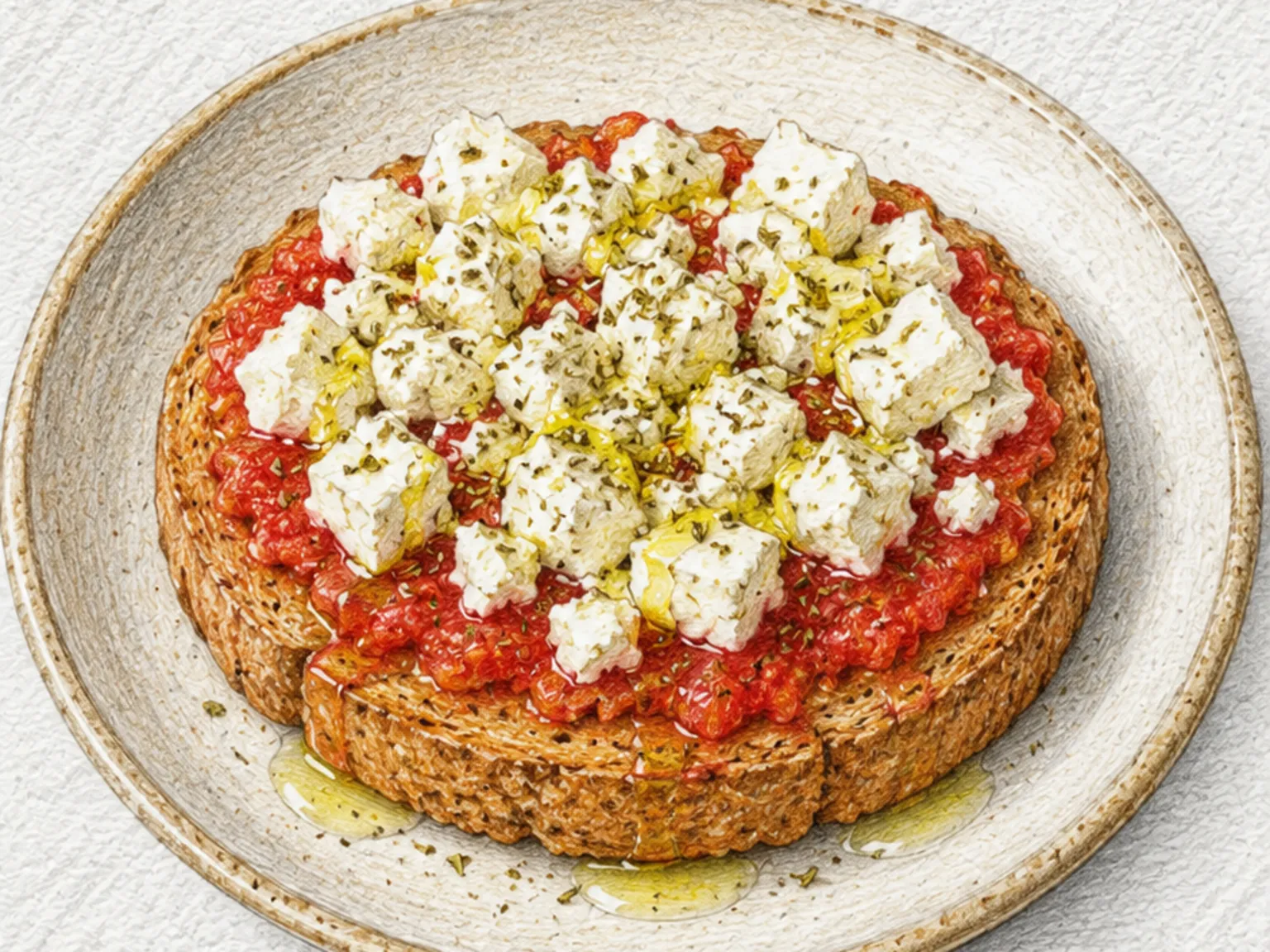
Dakos is a traditional salad from the Greek island of Crete, built on a base of dried barley rusks - thick, twice-baked rounds of bread that have been air-dried to a deep crunch. Ripe tomatoes are grated directly onto the rusk surface rather than sliced, so their juice immediately begins to soften the bread from the inside while the outer rim retains its crunch, creating a textural contrast of crisp edges and a moistened, dense center. Crumbled feta cheese piled on top adds a salty, tangy richness that balances the tomato's acidity, and a generous pour of good olive oil ties the components together. Dried oregano and whole or halved olives complete the dish. Dakos functions simultaneously as a bread course and a salad, and has been part of Cretan summer eating for centuries - a light, satisfying meal that requires no cooking and uses ingredients that thrive in the Mediterranean climate.
Instructions
Read the steps as a cooking flow: prep, heat, seasoning, doneness control, and finish.
- 1Prep
Keep the 250 g ripe tomatoes chilled, then halve them.
Grate the cut sides on the coarse side of a grater, collecting all pulp and juice in a bowl and discarding the skins left in your hand.
- 2Finish
Set the 2 barley rusks on a serving plate and spoon only 1 to 2 tbsp water over the top surface.
Do not soak them in a bowl; wait about 1 minute so they soften slightly but stay sturdy.
- 3Step
Spoon the grated tomato, including its juice, generously onto the center of the rusks.
Leave a little of the outer rim exposed so the middle absorbs moisture while the edges keep some crunch.
- 4Season
Crumble the 70 g feta by hand into coarse pieces and scatter it over the tomato.
Avoid mashing it into a paste; distinct salty pieces give better contrast against the juicy tomato.
- 5Step
Scatter the 40 g black olives over the feta, then rub 0.5 tsp dried oregano lightly between your fingers as you sprinkle it.
Spreading it widely prevents one bitter, herb-heavy bite.
- 6Finish
Drizzle 2 tbsp olive oil and 1 tsp red wine vinegar in a thin stream over the top.
Rest for about 3 minutes, then serve while the center is moist and the edges still have texture.
After the steps
Pick a recipe that fits this dish.
Continue with shared ingredients, meal pairings, or a similar method.
Recipes That Go Well With This
More Salads →Based on shared ingredients and meal pairing
Mediterranean Chickpea Salad
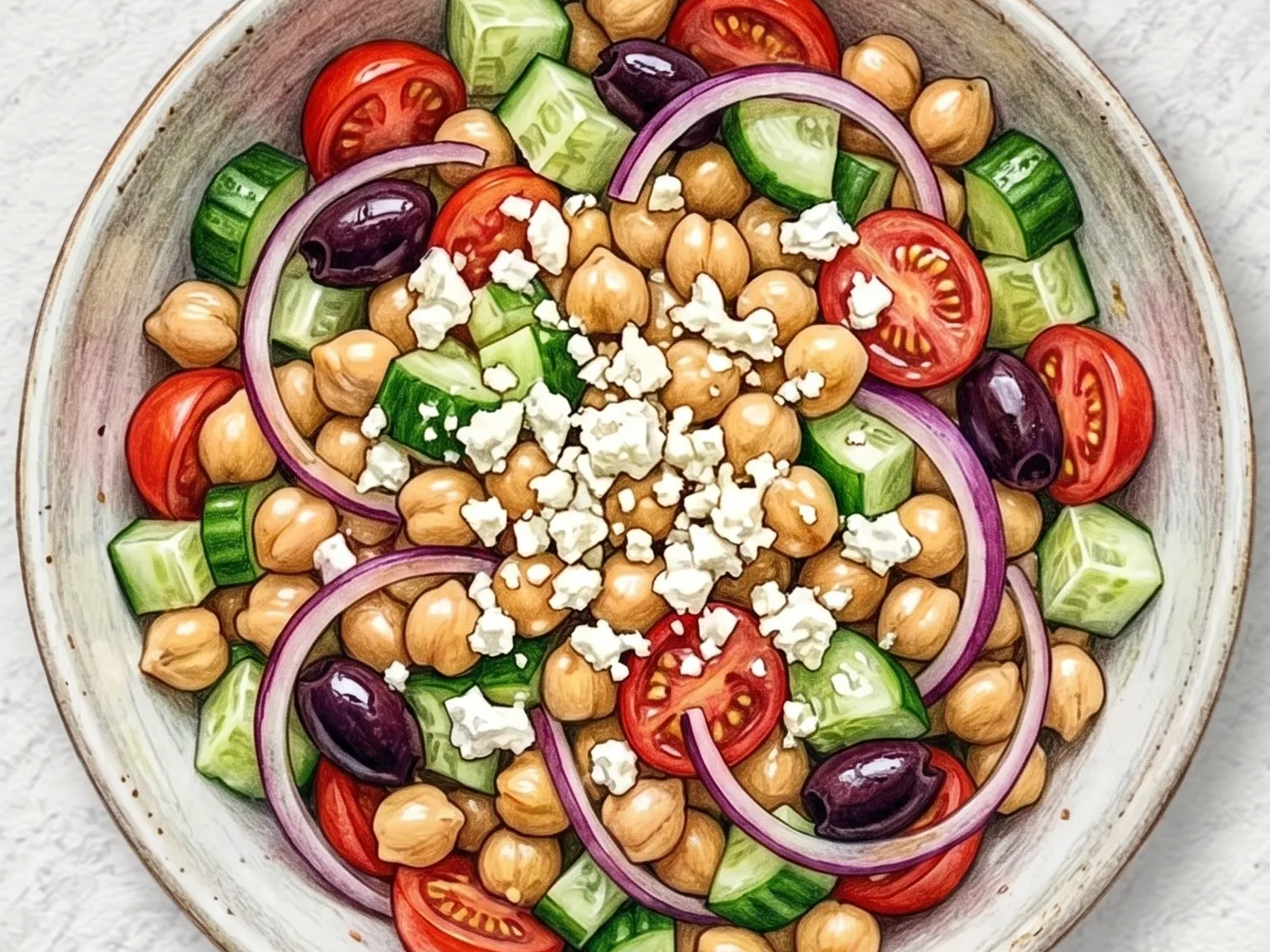
This Mediterranean salad centers on cooked chickpeas for their starchy, satisfying chew, surrounded by diced cucumber, halved cherry tomatoes, black olives, and thinly sliced red onion. A stripped-down vinaigrette of red wine vinegar and olive oil keeps the dressing from overpowering any single ingredient, and crumbled feta added at the end provides a salty, creamy contrast that pulls the whole bowl together. The red onion should soak in cold water for five minutes before going in so its sharpness softens and it blends smoothly with the milder components. No heat is needed anywhere in the preparation, and the whole salad takes about twelve minutes to assemble. A twenty-minute rest in the refrigerator allows the vinaigrette to distribute evenly and deepens the overall flavor. Pita bread for dipping or grilled chicken laid across the top turns this easily into a full meal.
Spanakopita (Greek Spinach and Feta Phyllo Pie)
Spanakopita is a Greek savory pie where spinach is sauteed with onion to drive off moisture, then combined with crumbled feta cheese, beaten eggs, and fresh dill to make a filling that is layered between sheets of buttered phyllo dough and baked at 190 degrees Celsius for thirty-five to forty minutes. Removing as much water from the spinach as possible is the single most important step - any residual moisture soaks through the thin pastry and prevents it from crisping. Phyllo sheets dry out within minutes of being exposed to air, so they must be kept under a damp towel and worked one at a time, each brushed with melted butter before stacking. Four layers on the bottom and four on top provide enough structure and crunch. Scoring the surface before baking allows steam to escape and helps the layers puff and separate into distinct, flaky sheets.
Greek Salad (Chunk-Cut Vegetable Toss with Feta)
Greek salad, known as horiatiki, is a traditional dish that arranges large-cut tomatoes, cucumber, bell pepper, and red onion with Kalamata olives, topped with a whole block of feta cheese and finished with extra virgin olive oil and dried oregano. The vegetables are intentionally cut into large chunks rather than finely diced, preserving each ingredient's distinct texture and flavor. The olive oil coats the fresh vegetables in richness, while a small amount of red wine vinegar adds a sharp acidity that balances the natural sweetness of the tomatoes. Feta is placed whole on top in the traditional Greek manner - diners break it themselves, and as the crumbled cheese mixes with the olive oil, it forms a natural dressing that clings to the vegetables.
Barley Grain Salad
Barley grain salad is a Mediterranean-inspired dish built around the chewy, nutty character of well-cooked pearl barley. The grain is boiled until tender but with a slight resistance, then cooled completely before it is tossed with diced bell pepper, cucumber, and red onion. Cooling the barley fully before adding the vegetables is important; warm grain draws moisture out of the fresh vegetables and dilutes the dressing. Olive oil forms the base of the lemon-herb dressing, providing a rounded richness that complements the earthy depth of the barley, while fresh lemon juice cuts through and lifts the whole bowl with clean, bright acidity. The raw vegetables add crunch and moisture, breaking up the density of the grain with each bite. Red onion contributes a sharp edge that sharpens the overall flavor profile. High in dietary fiber, the salad is genuinely filling for its size and works equally well as a standalone light meal or as a substantial side alongside grilled meat or fish.
Serve with this
Kongguksu-Style Cold Linguine
Kongguksu-style cold linguine reinterprets Korea's chilled soy noodle soup using Italian linguine in place of traditional wheat noodles. Unsweetened soy milk is blended with toasted sesame seeds and peanut butter into a thick, nutty cold broth poured directly over the pasta at serving. The linguine is cooked al dente and immediately shocked in ice water to firm up the texture and chill it completely before the broth goes on. Julienned cucumber and halved cherry tomatoes scatter on top for fresh crunch and color. Salt and sugar are adjusted at the end to balance the broth's natural bean flavor against the richness from the peanut butter. The full preparation takes about ten minutes, with stovetop time limited strictly to boiling the pasta, which makes it one of the more practical cold dishes to assemble in summer heat. Adding more peanut butter thickens the broth further, while extra sesame seeds push the nuttiness higher.
Cantonese Steamed Fish
Cantonese steamed fish - ching jing yu - is the clearest expression of the Cantonese philosophy of letting premium ingredients speak for themselves with minimal interference. The technique requires the freshest possible whole fish - sea bass, grouper, or pomfret are the standard choices - because steaming conceals nothing. Any fish that is even slightly past its peak will betray itself the moment it comes off the heat. The fish is scored on both sides to allow even heat penetration, placed on a plate with thin ginger slices tucked underneath and inside the cavity to neutralize any fishiness, then steamed over vigorously boiling water for exactly eight to ten minutes depending on thickness. Even one minute of overcooking transforms the silky, translucent flesh into something dry and dull - timing is the entire technique. The moment the fish leaves the steamer, all accumulated liquid on the plate must be poured off immediately, because that liquid carries concentrated fishiness that would spoil the clean finish. A generous pile of julienned scallion and fresh ginger is arranged on top, then a ladle of oil heated until just beginning to smoke is poured directly over the aromatics. The sizzling releases their fragrance in a single burst that infuses the fish. Seasoned soy sauce and a few drops of sesame oil complete the dish. In Cantonese banquet culture, the steamed fish course is typically the most expensive item on the table, with guests selecting a live fish directly from the restaurant tank.
Salt-Grilled Dokdo Shrimp
This dish features salt-grilled Dokdo shrimp, selecting flower or chicken shrimp caught near Dokdo island to highlight their natural flavor. The shrimp are rinsed, treated with rice wine to eliminate odor, and trimmed of long antennae while keeping the heads intact to preserve the rich umami flavor of the liver. A layer of coarse salt is spread over parchment paper in a pan and heated to distribute warmth evenly. The shrimp are arranged on the salt bed and cooked covered to trap moisture, preventing the flesh from drying. Once the shells turn bright red, they are turned and cooked briefly to ensure the meat remains tender instead of becoming tough. Squeezed lemon juice is applied before serving. The separated shrimp heads can be saved and stir-fried with butter to create an additional savory side dish.
Similar recipes
Tzatziki Salmon Bowl
This fresh grain bowl combines pan-seared salmon with a thick Greek tzatziki sauce. To prepare the dish, fresh cucumber is finely chopped, salted, and squeezed firmly to remove excess water, ensuring the yogurt sauce remains thick rather than watery. The strained cucumber is then mixed with Greek yogurt, minced garlic, chopped dill, and lemon juice. Fresh salmon is cut into bite-size pieces, seasoned, and seared in olive oil on medium heat until golden. The bowl is assembled with a warm base of either brown rice or quinoa, which allows control over carbohydrate density. It is topped with halved cherry tomatoes, the warm seared salmon, and a generous dollop of chilled tzatziki sauce. The herbal notes of dill help cut through the rich fat of the seared fish, providing a balanced flavor.
Chicken Gyro
Chicken gyro is a Greek pita wrap in which chicken thigh is marinated in olive oil, lemon juice, salt, pepper, and dried oregano before being grilled or pan-seared until the skin side develops a golden, crisp char. Chicken thigh withstands high-heat cooking far better than breast because its higher fat content keeps the meat moist and tender even when the exterior is well caramelized. Tzatziki is made by squeezing excess water out of grated cucumber and mixing it into plain Greek yogurt with minced garlic, fresh dill, a small pour of olive oil, and a pinch of salt. Its cold, sharp acidity is the necessary counterweight to the richness of the grilled meat, cooling every bite. Thinly sliced red onion adds a pungent crunch while halved cherry tomatoes or diced tomato bring bright juiciness inside the wrap. The pita should be warmed on a dry pan or grill for about thirty seconds per side immediately before assembling so it stays soft and pliable enough to wrap without cracking under the filling. Assembled and eaten immediately, the contrast between the hot, charred chicken and the cold sauce defines the dish.