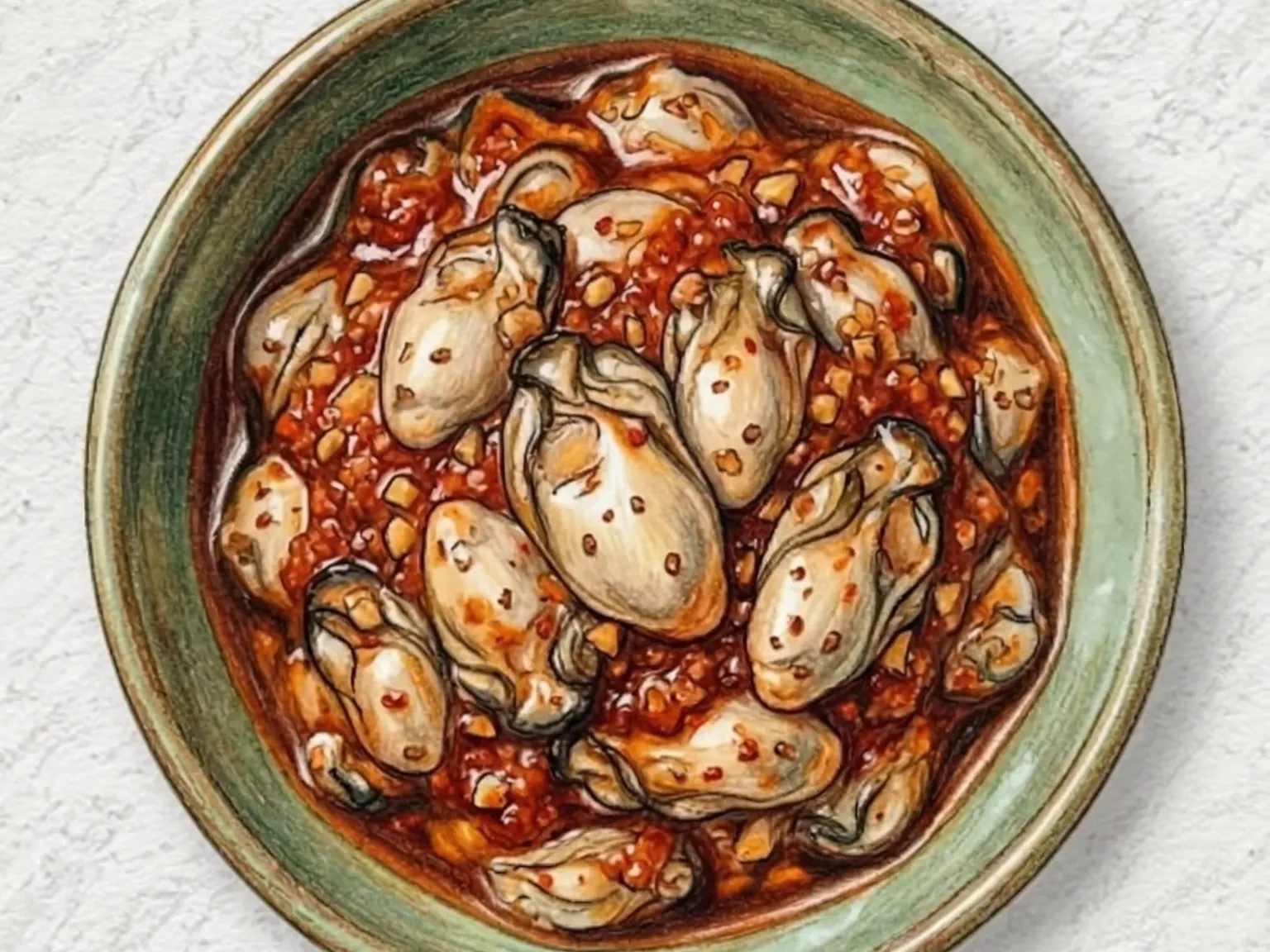
Korean Salted Oyster Jeotgal

Korean Salted Oyster Jeotgal

Quick answer

Gul jeotgal is a traditional Korean fermented condiment made by curing fresh winter oysters in coarse solar salt with gochugaru, minced garlic, ginger, and plum extract...

What makes this special

  • Fresh winter oysters ferment with solar salt and gochugaru to create briny Gul-jeotgal.
  • Sea salt draws moisture out, concentrating the oysters' briny depth
  • Maesil-cheong suppresses fermentation odor and balances acidity
Total time
25 min
Level
Hard
Servings
4 servings
Ingredients
7
Calories
90 kcal
Protein
10 g

Key ingredients

fresh oysterssea saltKorean chili flakesminced garlicminced ginger

Core cooking flow

  1. 1 Place 400 g fresh oysters in cold lightly salted water and swish them gently by hand.
  2. 2 Drain the washed oysters in a fine strainer for about 10 minutes.
  3. 3 In a bowl, first mix 28 g sea salt, 1 tablespoon gochugaru, 1 teaspoon mince...

Gul jeotgal is a traditional Korean fermented condiment made by curing fresh winter oysters in coarse solar salt with gochugaru, minced garlic, ginger, and plum extract, then aging the mixture at low temperature. As the salt draws moisture from the oyster tissue, the flesh contracts and its marine umami intensifies into something denser and more complex than a fresh oyster delivers. Gochugaru gives the condiment its characteristic red color and adds heat that balances the brininess. Plum extract plays a specific role during fermentation: it suppresses the fishy odor that naturally develops while contributing a mild acidity that keeps the overall flavor from turning flat or heavy. The longer gul jeotgal ages, the more layered and deep its character becomes. Eaten on its own over warm rice, it functions as a complete banchan, briny and bold against plain starch. Its more significant culinary role, however, is as a filling ingredient in baechu kimchi: folded into the seasoning paste, it introduces a richer source of umami than fish sauce alone provides, and the amino acids it releases during fermentation elevate the entire kimchi as it continues to ripen.

Prep 25min 0 4 servings

Instructions

Read the steps as a cooking flow: prep, heat, seasoning, doneness control, and finish.

6 steps
  1. 1
    Season

    Place 400 g fresh oysters in cold lightly salted water and swish them gently by hand.

    Pick out shell fragments and dark grit right away, keeping the oysters intact and avoiding hard rubbing.

  2. 2
    Season

    Drain the washed oysters in a fine strainer for about 10 minutes.

    Pat the surface dry with paper towels, because excess water can dilute the seasoning, soften the texture, and increase unwanted odors during curing.

  3. 3
    Season

    In a bowl, first mix 28 g sea salt, 1 tablespoon gochugaru, 1 teaspoon minced garlic, and 0.5 teaspoon minced ginger.

    Add rice wine and plum syrup, stirring until the paste is thick and evenly red.

  4. 4
    Season

    Add the drained oysters to the seasoning paste and fold from the bottom up with a rubber spatula.

    Use a light hand so the oysters stay whole while every surface becomes evenly coated in red seasoning.

  5. 5
    Control

    Pack the seasoned oysters tightly into an airtight container and press the surface to reduce trapped air.

    Refrigerate in the coldest stable area for 2 to 3 days, leaving the container undisturbed while the salt draws out moisture.

  6. 6
    Finish

    After curing, check that the oysters feel firmer and the red seasoning liquid has seeped through them.

    If the saltiness is strong, serve small amounts over warm rice or fold a little into kimchi filling.

After the steps

Pick a recipe that fits this dish.

Continue with shared ingredients, meal pairings, or a similar method.

Recipes That Go Well With This

More Kimchi →

Based on shared ingredients and meal pairing

Korean Salted Yellow Croaker Jeotgal
Shared ingredient: coarse sea salt Kimchi

Korean Salted Yellow Croaker Jeotgal

Jogi jeotgal is a Korean salted and fermented yellow croaker made by gutting the fish, layering it in coarse sea salt for an initial multi-day cure in the refrigerator, then folding in gochugaru, garlic, ginger, and rice wine for a second stage of aging. Over the extended fermentation, fish protein breaks down into a concentrated savory depth that bears no resemblance to the raw ingredient, while the sea salt continuously draws out moisture and causes the flesh to contract and firm. Gochugaru and ginger suppress the fermentation smell and add a mild heat and aromatic warmth, while rice wine smooths out the sharp, rough edges that develop early in the process. The finished jeotgal is used in small amounts, placed over rice or added to kimchi jjigae as a flavor amplifier, a condiment that delivers significant depth from a very small quantity.

Korean Spicy Salted Octopus Jeotgal
Shared ingredient: ginger Kimchi

Korean Spicy Salted Octopus Jeotgal

Nakji jeotgal is a Korean fermented octopus side dish made by packing cleaned octopus in coarse salt for at least forty minutes to draw out moisture and firm the flesh, then coating it thoroughly in a paste of gochugaru, minced garlic, minced ginger, anchovy fish sauce, and plum syrup before cold-aging in the refrigerator. The initial salt cure tightens the octopus's already springy muscle fibers, intensifying the chew, and the gochugaru paste forms a dense crimson coating that forces spicy, salty heat into every layer of flesh as the dish sits. Anchovy fish sauce builds the umami foundation while plum syrup counteracts any lingering marine smell and introduces a subtle fruit sweetness that rounds out the salt and chili. Ginger leaves a sharp, clean note at the back of the palate that keeps the overall flavor from becoming heavy. After two to three days of refrigeration, a slow fermentation sets in and the separate components fuse into a cohesive, deeply savory whole. Served over warm rice, each piece of octopus delivers a firm, elastic chew followed by a concentrated rush of ocean flavor, and a drop of sesame oil stirred in at serving adds a toasted, nutty finish.

Korean Pollock Jeon (Egg-Battered Pan-Fried Pollock)
Serve together Grilled

Korean Pollock Jeon (Egg-Battered Pan-Fried Pollock)

Dongtae-jeon is a Korean pan-fried pollock dish where thin slices of frozen-then-thawed pollock are seasoned with salt, pepper, and cheongju (rice wine), lightly dredged in flour, dipped in beaten egg, and fried in a thin layer of oil. Because frozen pollock releases significant moisture when thawed, pressing it thoroughly with paper towels is a critical step without it, the flour coating will not adhere and the oil will splatter. The flour layer should be thin enough that it barely coats the surface, preserving the fish's mild flavor, and cooking over medium-low heat gives the egg batter time to turn golden while keeping the fish inside soft and flaky. Mixing finely chopped green onion into the egg batter before dipping adds a subtle allium fragrance to the otherwise clean-tasting fish. A staple at Korean ancestral rites and holiday spreads, it is served with soy dipping sauce that draws out the savory, delicate flavor of the pollock.

Korean Salted Pollock Roe Jeotgal
Similar recipe Kimchi

Korean Salted Pollock Roe Jeotgal

Myeongran jeotgal is a Korean salted and fermented pollock roe where fresh roe sacs are meticulously cleaned of blood spots and membranes, brushed with rice wine to suppress fishiness, then packed in a curing blend of coarse sea salt, gochugaru, and minced garlic alongside a piece of kelp. Over three to five days in cold storage, salt draws moisture out of each tiny egg, concentrating their pop-and-burst texture while enzymatic breakdown generates a deep, layered umami that raw roe cannot produce on its own. The chili flakes introduce a gentle warmth that sits behind rather than over the roe's natural salinity. Sliced thin and arranged over hot steamed rice, each piece releases a salty, oceanic intensity with every bite - a condiment that disappears faster than any dish it accompanies.

Serve with this

Korean Steamed Thistle Greens with Perilla
Steamed Easy

Korean Steamed Thistle Greens with Perilla

Gondre deulkkae jjim is a steamed side dish of blanched thistle greens cooked down with ground perilla seeds, perilla oil, and soup soy sauce. The greens are seasoned with garlic and oil first, then covered and left to steam over low heat so the liquid is slowly absorbed into the fibrous leaves rather than evaporating away. Adding the perilla powder toward the end of cooking, rather than at the beginning, prevents the nutty flavor from turning bitter or chalky from prolonged heat exposure. The soft, absorbent fibers of the thistle greens hold the seasoning exceptionally well, meaning each bite carries a concentrated burst of savory, nutty flavor throughout. Pulling the pan off the heat while a little texture remains in the greens keeps the dish from turning mushy. Green onion cut into rough pieces is added on top at the end, and a final drizzle of perilla oil revives the aroma. The ingredient list is short, but the result is a deeply satisfying dish often piled over hot rice or served as a companion to gondre bibimbap.

🥗 Light & Healthy 🍱 Lunchbox
Prep 15min Cook 20min 2 servings
Korean Sashimi Rice Bowl (Flounder Sashimi with Cho-Gochujang)
Rice Medium

Korean Sashimi Rice Bowl (Flounder Sashimi with Cho-Gochujang)

Sliced flounder sashimi sits atop julienned cucumber, lettuce, and perilla leaves over slightly cooled rice, dressed with cho-gochujang just before eating. The rice must not be piping hot because residual heat softens the sashimi and dulls its clean texture, so resting it until just warm is essential. The vinegar tang and chili warmth in cho-gochujang lift the mild fish flavor, while sesame oil and seeds leave a nutty finish on the palate. Keeping the vegetables well chilled before assembly creates a temperature contrast against the warm rice that sharpens every bite. Adding the cho-gochujang right before eating rather than in advance prevents the vegetables from weeping moisture and going limp.

🎉 Special Occasion 🏠 Everyday
Prep 20min Cook 5min 2 servings
Korean Hard Clam Radish Stew
Stews Medium

Korean Hard Clam Radish Stew

Sweet radish broth meets briny hard clams in this clean, deeply flavored Korean stew that needs no stock -- just clams, radish, and 35 minutes. The radish goes into the pot first and boils for ten minutes to release its natural sweetness, building the foundation of the broth before the clams are added. Once the clams open, their concentrated marine flavor layers over the radish sweetness, creating a broth that is simultaneously clean and complex. Seasoning is kept minimal with soup soy sauce, and minced garlic is added only after the clams open so it cooks through without remaining sharp and raw. Thick-cut firm tofu absorbs the surrounding broth, acting as a sponge for the clam umami. Diagonally sliced cheongyang and red chilies go in last, contributing a mild heat and visual contrast to the pale liquid. Any clams that fail to open must be removed immediately to keep the broth free of grit. The stew demonstrates how two primary ingredients, clams and radish, can produce a layered, satisfying broth without anchovy or kelp stock. The cool, lingering aftertaste of the clams is a hallmark of this particular combination.

🏠 Everyday 🎉 Special Occasion
Prep 20min Cook 25min 4 servings

Similar recipes

Korean Spicy Fermented Squid Jeotgal
Kimchi Medium

Korean Spicy Fermented Squid Jeotgal

Ojingeo jeotgal is a Korean fermented squid preserve made by salting cleaned, finely chopped squid for one hour to firm the flesh and extract moisture, then dressing it in a paste of gochugaru, minced garlic, ginger, fish sauce, and corn syrup. The salt cure intensifies the squid's natural chewiness, and cutting the pieces small accelerates seasoning absorption during the two-to-three-day cold fermentation. Chili flakes coat every surface in a deep red layer that delivers steady heat, while corn syrup adds gloss and a mild sweetness that prevents the salt from dominating. Spooned over steamed rice, each piece offers a firm, springy chew followed by a wave of fermented umami. Mixing in a touch of sesame oil before serving softens the saltiness and adds a nutty fragrance that rounds out each mouthful.

🍱 Lunchbox 🏠 Everyday
Prep 30min 4 servings
Korean Seasoned Salted Pollock Stomach
Side dishes Easy

Korean Seasoned Salted Pollock Stomach

Changnanjeot, salt-fermented pollock stomach, belongs to Korea's jeotgal tradition, where seafood organs are packed in coarse salt and left to ferment for months until deep umami develops throughout. The stomach lining has a firm, slightly rubbery chew that sets it apart from softer jeotgal like salted shrimp; the longer it is chewed, the more the fermented savoriness emerges from beneath the saltiness. Drained of excess brine and dressed with gochugaru, garlic, scallion, and sugar, it becomes a high-concentration condiment banchan. A thumbnail-sized piece placed on plain rice delivers a burst of fermented marine salt and chili heat that carries an entire spoonful. Stored in the refrigerator, it keeps its character for more than two weeks, making it a practical staple side dish to prepare in advance.

🏠 Everyday 🍱 Lunchbox
Prep 8min 2 servings
Korean Oyster Rice (Winter Pot Rice with Plump Oysters)
Rice Medium

Korean Oyster Rice (Winter Pot Rice with Plump Oysters)

Gul-bap is a pot rice dish built around plump winter oysters, which are placed on top of the nearly-finished rice during the final resting stage rather than added at the beginning of cooking. This timing is deliberate. Oysters introduced too early shrink, toughen, and lose their sweetness to the surrounding liquid. Cooked only by residual steam, they remain tender, full-sized, and briny-sweet. Julienned Korean radish lines the bottom of the pot, serving two purposes: it keeps the rice from scorching, and it releases its own moisture and mild natural sweetness into the grains as they cook. The result is rice that is subtly enriched without any additional seasoning beyond the ingredients themselves. The dish is served alongside a dipping sauce of soy sauce, sesame oil, gochugaru, and chopped green onion. Mixed into the bowl, the sauce ties the clean oceanic flavor of the oysters to the savory, nutty dressing in a way that makes the whole thing hard to stop eating. The oysters should be cleaned gently with coarse salt and rinsed quickly to preserve their natural sweetness.

🎉 Special Occasion 🏠 Everyday
Prep 15min Cook 25min 2 servings

Tips

Use very fresh same-day oysters only.
Longer curing increases salt intensity.

Nutrition (per serving)

Calories
90
kcal
Protein
10
g
Carbs
3
g
Fat
4
g