Halloumi Persimmon Arugula Salad
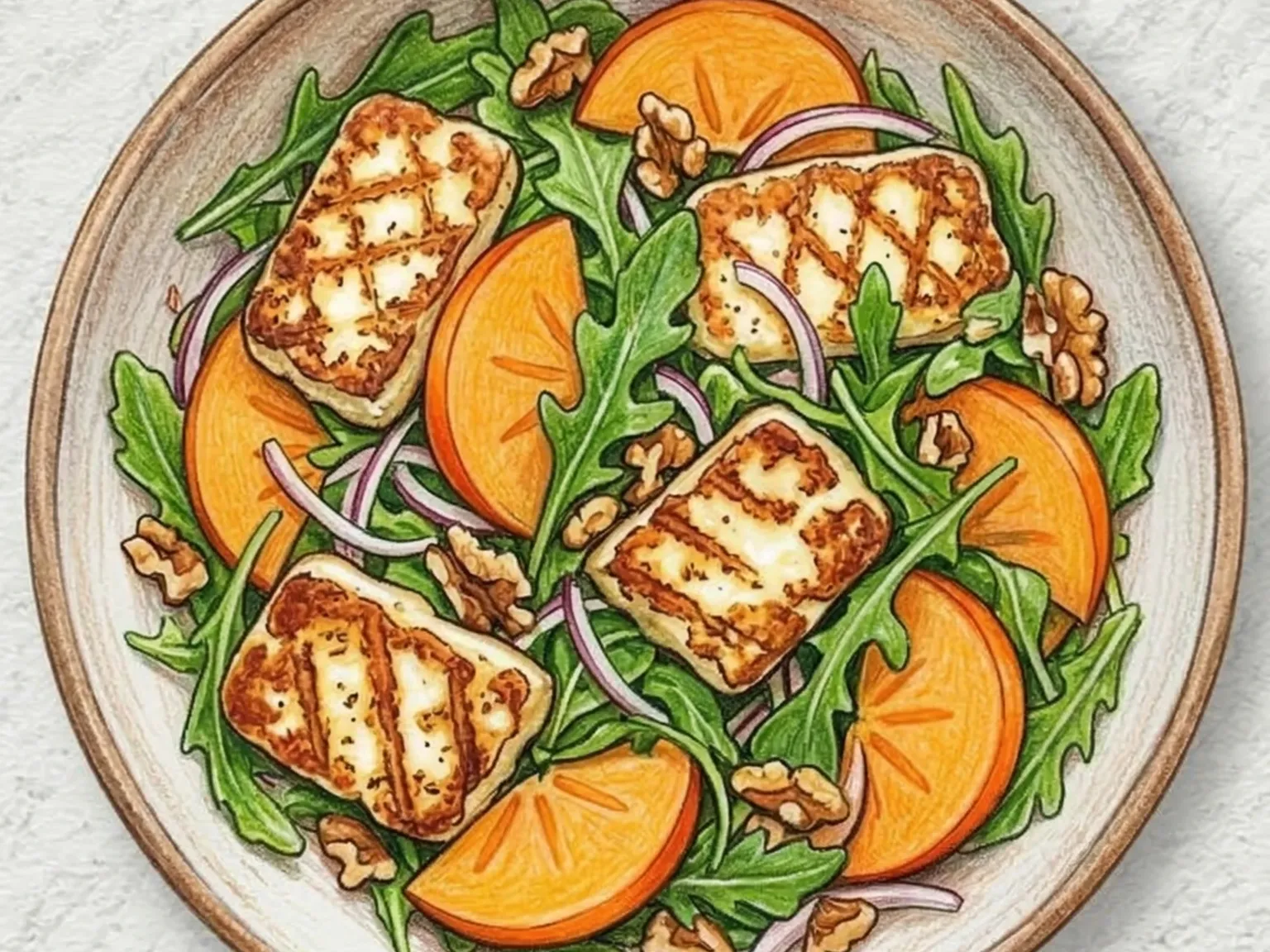
Halloumi persimmon arugula salad combines golden pan-seared halloumi cheese, thinly sliced sweet persimmon, peppery arugula, soaked red onion, and walnuts in a white balsamic dressing. Halloumi's unusually high melting point allows it to be seared directly in a dry pan without softening into a puddle; two to three minutes per side is the right window to build a golden, lightly crisp crust while keeping the interior dense and chewy. Cooking beyond that point makes the cheese rubbery and unpleasant. The natural fructose in sweet persimmon creates a pronounced sweet-salty contrast against the brined cheese, and arugula's sharp, peppery bite anchors the balance between those two poles. Red onion should be soaked in cold water for at least ten minutes before adding it, which draws out most of the bitterness and raw pungency while leaving behind a mild, fresh sweetness that does not overwhelm the other ingredients. The dressing of white balsamic vinegar, olive oil, honey, and black pepper is lighter in color and noticeably gentler in acidity than dark balsamic, so it ties all the components together without masking the persimmon's pale gold or the arugula's deep green.
Adjust Servings
Instructions
- 1
Slice halloumi into 1 cm pieces and pat dry.
- 2
Sear halloumi in a dry pan for 2-3 minutes per side.
- 3
Slice persimmon thinly and soak red onion in cold water for 5 minutes.
- 4
Whisk olive oil, white balsamic, honey, and pepper.
- 5
Toss arugula with half the dressing and plate it.
- 6
Top with persimmon, onion, halloumi, and walnuts, then drizzle remaining dressing.
As an Amazon Associate, we may earn from qualifying purchases.
Tips
Nutrition (per serving)
Goes Well With

Gazpacho
The secret to an authentic gazpacho lies in the interaction between stale bread and fresh garden vegetables. While tomatoes, cucumbers, and red bell peppers form the base, the addition of water-soaked bread creates a thick, velvety consistency that distinguishes this Andalusian specialty from a simple puree. Blending these ingredients with red onion, garlic, extra virgin olive oil, and red wine vinegar produces a smooth texture where the oil emulsifies the vegetable juices and the vinegar sharpens the natural sugars of the tomatoes. Patience is required after the blending is complete; the soup must rest in the refrigerator for at least two hours to allow the flavors to settle and integrate, a process that does not occur effectively at room temperature. Serving requires a final touch of drizzled olive oil and a handful of finely diced vegetables to create a crisp contrast against the liquid base. For the most refined results, passing the mixture through a fine-mesh sieve ensures a silky finish. Using fully ripened summer tomatoes provides the ideal acidity levels, and storing the leftovers in the fridge for a day or two often leads to a more developed profile.

Chamnamul Walnut Pesto Trofie
Chamnamul walnut pesto trofie is a fusion pasta that coats twisted trofie in a pesto made from Korean chamnamul (wild parsley), walnuts, Parmigiano, and olive oil. Chamnamul has a lighter, more herbaceous quality than basil, with a faintly bitter finish that gives the pesto a distinctly Korean aromatic character. Walnuts contribute a heavier, more assertive nuttiness than pine nuts, thickening the sauce and anchoring the savory depth together with the aged cheese. The spiral grooves of trofie hold the pesto in every ridge, releasing an even concentration of flavor with each bite. Adding sufficient olive oil during blending slows oxidation and prevents the chamnamul's green color from darkening too quickly. The pasta is best eaten immediately after tossing, when both the color and fragrance are at their peak.

Vietnamese Fresh Spring Rolls
Goi cuon, Vietnamese fresh spring rolls, are an uncooked hand-assembled dish from southern Vietnam. A sheet of rice paper softened in water serves as the wrapper for poached shrimp, sliced pork, rice vermicelli, lettuce, mint, cilantro, and garlic chives, all rolled tightly into a compact cylinder. Because the wrapper is translucent, the pink shrimp and bright herbs are visible through the exterior before the first bite, and that visual layer is part of the appeal. Two dipping sauces are standard: a thick peanut-hoisin blend whose richness suits the fatty pork, and nuoc cham, a light bright mixture of fish sauce, lime juice, sugar, and chili that works against the springy shrimp. Inside each roll, four distinct textures come together - the chewy rice paper, slippery vermicelli, firm shrimp, and leafy herbs - and none of them would work the same way if cooked. The dish requires no heat source to prepare, yet the balance of protein, starch, and fresh aromatics makes it nutritionally complete as a light meal. In Ho Chi Minh City, fresh spring rolls are sold from street carts alongside more elaborate restaurant preparations, and serving them at home means assembling at the table together, a format that brings a communal rhythm to the meal that plated dishes do not.

Korean Grilled Aged Kimchi
Well-aged napa kimchi is shaken free of excess marinade and placed directly onto a hot skillet or grill over medium-high heat. Both sides cook until the edges take on a light char. The longer the kimchi has fermented, the more pronounced its acidity becomes, and that sourness undergoes a caramelization reaction when it hits direct heat, converting into a mellow roasted sweetness that is distinct from fresh kimchi. Sprinkling a small amount of sugar onto the surface before or during grilling accelerates this reaction and deepens the color. Once both sides are grilled, sesame oil is brushed on and sesame seeds are scattered over the top, adding a nutty aromatic layer that complements the smoky, slightly bitter char. Only four ingredients are involved, but the quality of the kimchi matters significantly. Properly fermented kimchi with developed acidity produces far more complex flavor than fresh kimchi would. The contrast between the crisp, slightly caramelized exterior and the moist, tender interior is at its best immediately after cooking.
More Recipes

Tuna White Bean Salad (Mediterranean white bean salad)
Tuna white bean salad tosses drained canned tuna and cooked white beans with a dressing of olive oil and lemon juice - a no-cook Mediterranean dish that comes together in minutes. Both the tuna and beans must be drained thoroughly so the dressing clings to the ingredients rather than pooling at the bottom of the bowl. Finely chopped celery adds a crisp, watery crunch, and thinly sliced red onion provides a mild sharpness that contrasts with the soft, creamy beans. Parsley scattered throughout gives a fresh, grassy finish. The olive oil carries a smooth richness while the lemon juice sharpens the tuna's natural umami, producing a simple but protein-dense meal that works equally well served immediately or chilled.

Couscous Herb Salad
Couscous is hydrated in hot water for five minutes until each grain separates and fluffs up, then mixed with a generous quantity of flat-leaf parsley, diced cucumber, and halved cherry tomatoes. The dressing is intentionally sparse - lemon juice, olive oil, salt, and pepper - letting the grain absorb the citrus brightness without competing flavors getting in the way. Because herbs make up a significant portion of the volume, this reads more like a tabbouleh than a heavy grain salad, with a clean freshness that makes it easy to eat in large portions. Couscous holds its texture at room temperature better than most grains, meaning the salad does not go soggy in a packed lunch container or on a picnic spread. Adding fresh mint, a handful of chopped cilantro, or a pinch of lemon zest shifts the flavor toward something sharper and more aromatic, while crumbled feta adds a salty, creamy contrast that transforms it into a more substantial dish.

Quinoa Salad
Quinoa is boiled until fluffy and cooled to preserve its distinctive pop-when-bitten texture. Diced cucumber and halved cherry tomatoes mix in juicy crunch that energizes the mild grain base. Thinly sliced red onion adds sharpness, and generous chopped parsley pushes the herbal character forward. The dressing stays minimal - olive oil and lemon juice - letting raw ingredients speak clearly. As a complete protein containing all essential amino acids, quinoa makes this a nutritionally balanced light meal in a single bowl.

Watermelon Feta Salad
Watermelon feta salad combines chilled watermelon cubes with crumbled salty feta cheese, sliced cucumber, and fresh mint, dressed lightly with olive oil and lime juice. The watermelon's high water content and natural sugar create a sharp sweet-salty contrast against the feta, and the mint adds a cool, aromatic layer on top of that contrast. Thinly sliced cucumber in half-moon shapes introduces a different kind of crunch from the melon, and lime juice sharpens the fruit's sweetness to keep the finish clean rather than cloying. Crumbling the feta by hand rather than cutting it produces irregular surfaces that release more flavor on contact with the tongue. A light dusting of black pepper adds a quiet warmth that gives the salad a sense of direction.

Danza Noodle Soup (Tomato Chickpea Pasta Soup)
Danza noodle soup is a light Mediterranean-style soup that simmers diced tomatoes and chickpeas together in vegetable broth with dried oregano and thin pasta noodles. Sauteing onion in olive oil until translucent before adding the tomatoes builds a deeper, more aromatic base than starting with raw aromatics. Chickpeas soften gradually as the soup cooks, contributing a nutty richness and satisfying substance without making the broth heavy. Stirring in fresh parsley just before serving lifts the finished soup with a clean herbal brightness against the tomato backdrop. Cooking the pasta separately and adding it at serving keeps the broth clearer and prevents the noodles from absorbing too much liquid.

Gochu Oil Tuna Puttanesca Spaghetti
The foundation of this Gochu oil tuna puttanesca spaghetti is established by integrating the olive oil reserved from a can of tuna with a secondary portion of chili oil. This combined oil serves as the medium for sautéing sliced garlic and whole anchovy fillets over a consistently low heat. The process continues until the anchovies have fully dissolved into the warm fat, a step that allows their natural saltiness to permeate the base while eliminating any lingering traces of fishiness. Crushed tomatoes are then introduced to the pan and left to simmer for six minutes over medium heat. This period of simmering reduces the liquid content, which in turn concentrates the flavors and makes the natural acidity of the tomatoes more prominent. After this reduction, capers and black olives are added to provide distinct layers of brine and a characteristic hint of bitterness to the mixture. The solid pieces of tuna are folded in during the final two minutes of cooking. This short duration ensures that the tuna maintains its structure and provides a firm texture instead of disintegrating into the liquid. The cooked spaghetti and a small quantity of starchy pasta water are then combined with the sauce over high heat. This rapid tossing emulsifies the fats and liquids into a glossy coating that adheres uniformly to every surface of the pasta. To finish the dish, a handful of chopped parsley is scattered on top to introduce a fresh herbal quality that lightens the dense and salty profile of the sauce. Red chili flakes can be included at any stage of the process to allow for the precise adjustment of heat levels.