Panzanella Salad (Italian Ciabatta Bread Salad)
Quick answer
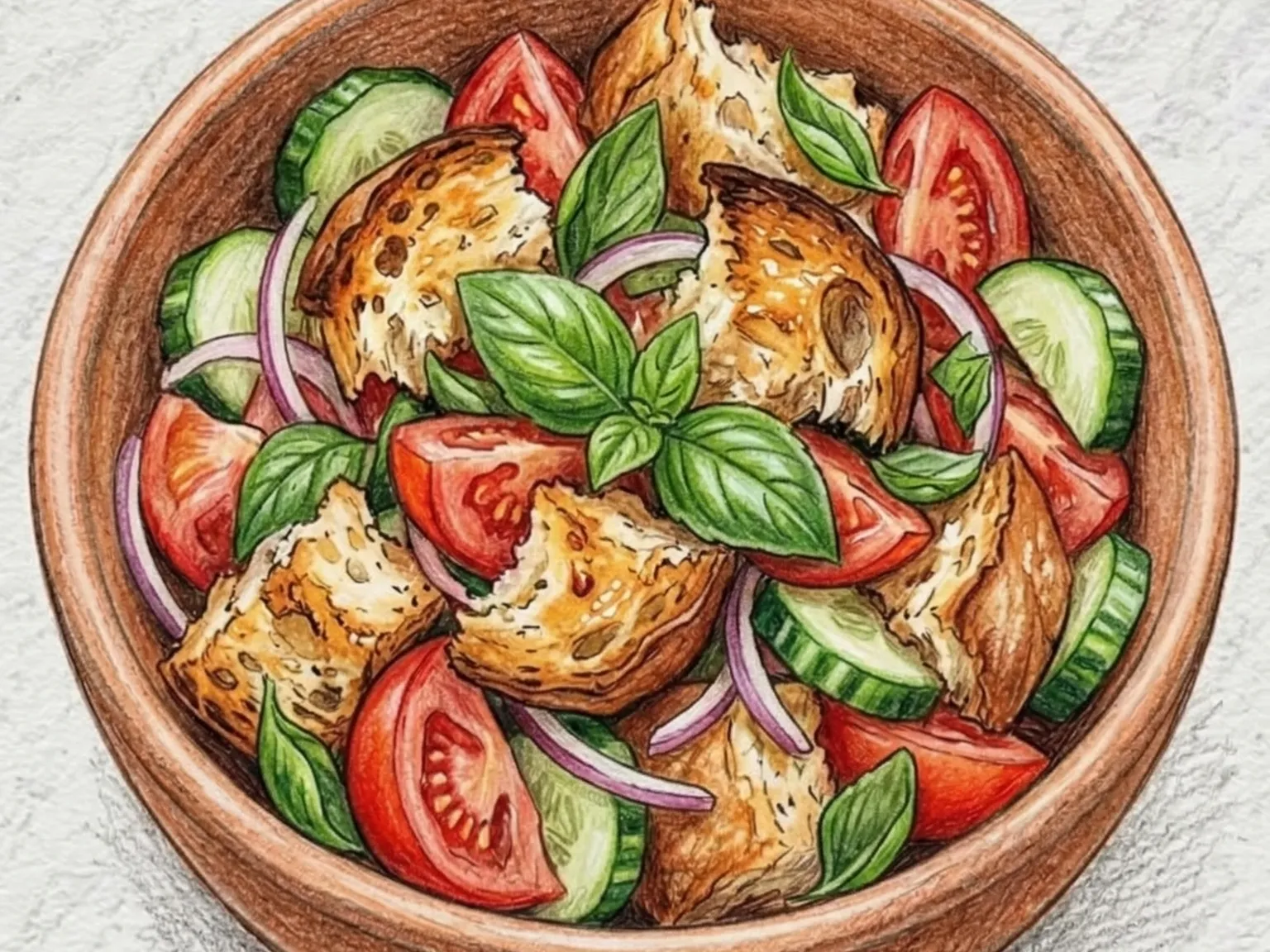
Stale ciabatta is torn into rough chunks, drizzled with olive oil, and toasted in the oven until the exterior is crisp while the interior remains slightly chewy.
What makes this special
- Panzanella Salad uses toasted ciabatta chunks to soak up juices from salted, ripe tomatoes.
- Salted tomato juice soaks into bread; that's panzanella's core
- Oven-toasted ciabatta crisps outside while staying chewy inside
Key ingredients
Core cooking flow
- 1 Preheat the oven to 180C. Tear the 180 g stale ciabatta into rough 2 cm chun...
- 2 Spread the bread in a single layer and toast for 8 to 10 minutes.
- 3 Cut the 250 g tomatoes into generous bite-size pieces and sprinkle with part of the 0.5 tsp salt.
Stale ciabatta is torn into rough chunks, drizzled with olive oil, and toasted in the oven until the exterior is crisp while the interior remains slightly chewy. Ripe tomatoes are cut into large pieces and salted briefly to draw out their juice, and that released liquid soaks into the bread and becomes the sweet-tart flavor that defines the dish. Cucumber and red onion add crunch and pungency, while torn basil leaves release their fragrance across the plate. A vinaigrette of red wine vinegar and good olive oil binds everything together. The salad reaches its best point after resting fifteen to twenty minutes, once the bread has absorbed enough dressing and tomato juice to soften slightly without going completely soggy, a balance that is the defining characteristic of a well-made panzanella. Using genuinely stale bread matters here: fresh bread soaks through too quickly and disintegrates, while properly dried ciabatta holds its structure and provides a textural contrast with the juicy tomatoes and crisp vegetables. Panzanella originated as a practical summer dish in Tuscany, where leftover bread was too valuable to discard, and it remains most rewarding when made with ripe summer tomatoes at the peak of the season.
Instructions
Read the steps as a cooking flow: prep, heat, seasoning, doneness control, and finish.
- 1Step
Preheat the oven to 180C.
Tear the 180 g stale ciabatta into rough 2 cm chunks, then coat it evenly with part of the extra virgin olive oil so the edges can crisp without drying out too hard.
- 2Step
Spread the bread in a single layer and toast for 8 to 10 minutes.
Pull it out when the edges are golden and crisp but the centers still feel slightly chewy, then let it cool so it holds its shape.
- 3Season
Cut the 250 g tomatoes into generous bite-size pieces and sprinkle with part of the 0.5 tsp salt.
Let them stand for about 10 minutes, keeping every bit of released juice because it will season and soften the bread.
- 4Prep
Cut the 120 g cucumber into bite-size pieces and slice the 50 g red onion very thinly.
Tear the 10 g basil by hand just before mixing so it releases aroma without bruising too much.
- 5Season
In a large bowl, whisk the 1.5 tbsp red wine vinegar with the remaining olive oil, remaining salt, and tomato juices.
Whisk until the oil breaks into small droplets so the dressing coats the vegetables evenly.
- 6Finish
Toss the tomatoes, cucumber, red onion, and basil with the dressing first, then fold in the toasted bread gently.
Rest for 15 to 20 minutes and serve while the bread is seasoned and slightly softened, not fully soggy.
After the steps
Pick a recipe that fits this dish.
Continue with shared ingredients, meal pairings, or a similar method.
Recipes That Go Well With This
More Salads →Based on shared ingredients and meal pairing
Antipasto Salad
Antipasto - literally 'before the meal' in Italian - is a first course of cured meats, cheeses, olives, and preserved vegetables, and this salad compresses that entire tradition into a single composed bowl. Crisp romaine or iceberg forms the base, layered with sliced salami, capicola, provolone, marinated artichoke hearts, roasted red peppers, and briny Kalamata olives. A red wine vinegar dressing built with dried oregano and minced garlic draws the components together with a sharp, herbal acidity that cuts through the fat of the cured meats. The salami is rolled into loose cylinders and the provolone cut into thick chunks so both hold their presence against the dressed greens rather than disappearing into the mix. The reason the salad works is the contrast in salt levels and textures: heavily cured meat against mild cheese, smoky-sweet pepper against bitter greens, silky olive against crunchy romaine - no two bites taste the same. Italian-American delis in New York and New Jersey popularized this format in the mid-twentieth century, and it has since become a reliable fixture of catered lunches, potlucks, and family gatherings across the United States.
Caprese Salad
Caprese salad alternates slices of ripe tomato, fresh mozzarella, and basil leaves of equal thickness, dressing them with nothing more than extra virgin olive oil and salt. The recipe excludes cooking entirely, so the tomato's ripeness and the mozzarella's fresh, milky quality carry the entire flavor of the dish - substituting underripe tomatoes or low-moisture mozzarella changes the result significantly. A thin drizzle of balsamic glaze over the top introduces a concentrated grape-vinegar sweetness that contrasts directly with the cheese's fat, while basil's volatile aromatic compounds release on contact with the oil rather than surviving any heat. Dressing the salad at the last possible moment prevents the salt from drawing moisture out of the tomatoes ahead of time, which dilutes the oil on the plate. The dish originates from the island of Capri and is recognized by the green, white, and red color arrangement that mirrors the Italian flag.
Spaghetti alla Puttanesca
Spaghetti alla puttanesca melts anchovy fillets into olive oil with sliced garlic over low heat, creating a deeply savory base before any tomato is added. Hand-crushed whole tomatoes, halved black olives, capers, and red pepper flakes go in next and simmer for eight minutes, during which the sauce reduces and the briny, salty, and spicy elements fuse into a bold, cohesive flavor. The anchovies dissolve completely, leaving no trace of fish but contributing an intense umami backbone. Because capers and anchovies are already heavily salted, seasoning is adjusted only at the very end by taste. The spaghetti is pulled one minute short of al dente and finished in the sauce pan with a splash of pasta water, which allows the starch to bind the sauce tightly to each strand.
Focaccia Bread
Focaccia is an Italian flatbread distinguished by its generous use of olive oil and a high-hydration dough that produces a distinctly open, irregular crumb. The simple mixture of flour, water, yeast, and salt is mixed with plenty of olive oil and given a long fermentation during which large air pockets develop throughout the dough, producing a texture that is simultaneously chewy, airy, and moist. The dough is spread into a well-oiled pan and dimpled deeply across the surface with fingertips, a step that gives focaccia its characteristic pitted appearance. These depressions collect pools of olive oil that effectively fry both the underside and the surface during baking, creating a golden, crisp crust all around while the interior stays tender. Flaky sea salt and fresh rosemary scattered over the top before baking add a fragrant, savory finish. The bread adapts to a wide range of toppings: olives, cherry tomatoes, red onion, thinly sliced potato, or sun-dried tomatoes all work well pressed into the surface before baking. Focaccia is at its absolute best in the minutes immediately after leaving the oven, when the crust is still crackling and the interior is warm and pillowy. Torn by hand into rough pieces, it is built for sharing at the table.
Serve with this
Heukimja Cream Bacon Rigatoni (Black Sesame Cream Pasta)
Black sesame cream bacon rigatoni is a fusion pasta that earns its crossover status through ingredient logic rather than novelty. Roasted black sesame ground to a fine powder and blended into heavy cream and milk produces a sauce with a deep, slightly bitter nuttiness - closer to a nut butter than a standard cream - with a grey-toned color that signals immediately this is not a conventional cream pasta. Bacon fried until crisp adds salt, smoke, and crunch at regular intervals throughout the dish, which is important because the sauce, however rich, stays uniform in texture without it. Rigatoni is the right format here: the tube shape traps sauce both inside each piece and on the outer ridges, so every forkful delivers the full flavor load. Finishing with grated Parmigiano or Pecorino deepens the salt and umami content, and a final dusting of black sesame powder over the plated dish reinforces the Korean ingredient that anchors the whole concept. The combination works because black sesame and cream are both fat-forward and round - they do not fight each other.
Cantonese Steamed Fish
Cantonese steamed fish - ching jing yu - is the clearest expression of the Cantonese philosophy of letting premium ingredients speak for themselves with minimal interference. The technique requires the freshest possible whole fish - sea bass, grouper, or pomfret are the standard choices - because steaming conceals nothing. Any fish that is even slightly past its peak will betray itself the moment it comes off the heat. The fish is scored on both sides to allow even heat penetration, placed on a plate with thin ginger slices tucked underneath and inside the cavity to neutralize any fishiness, then steamed over vigorously boiling water for exactly eight to ten minutes depending on thickness. Even one minute of overcooking transforms the silky, translucent flesh into something dry and dull - timing is the entire technique. The moment the fish leaves the steamer, all accumulated liquid on the plate must be poured off immediately, because that liquid carries concentrated fishiness that would spoil the clean finish. A generous pile of julienned scallion and fresh ginger is arranged on top, then a ladle of oil heated until just beginning to smoke is poured directly over the aromatics. The sizzling releases their fragrance in a single burst that infuses the fish. Seasoned soy sauce and a few drops of sesame oil complete the dish. In Cantonese banquet culture, the steamed fish course is typically the most expensive item on the table, with guests selecting a live fish directly from the restaurant tank.
Korean Salt-Grilled Pork (Pork Belly and Neck BBQ)
Doejigogi-gui is Korea's salt-grilled pork, made by seasoning thick-cut pork belly or pork neck with nothing but coarse salt and grilling over charcoal or on a cast iron pan. Because no marinade masks the flavor, the quality of the pork itself determines the outcome, and thick-cut belly requires patient cooking over medium heat so the fat layers render fully before the exterior chars -- rushing over high flame leaves the fat chewy and greasy rather than crisp. Blotting excess rendered fat from the pan with paper towels during cooking keeps the meat grilling rather than deep-frying and preserves the smoky char that defines the dish. Garlic slices cooked on the same pan alongside the pork add a mellow roasted note. The classic accompaniments -- sesame oil and salt for dipping, fresh lettuce or perilla leaves for wrapping, a dab of doenjang, and a sliver of cheongyang chili -- create the complete Korean barbecue experience, where a bite of rich pork, crunchy greens, and pungent condiments come together in one mouthful.
Similar recipes
Ribollita (Tuscan Bread and Bean Soup)
Ribollita is a traditional Tuscan soup that sautees cannellini beans, cabbage, carrot, tomato, celery, and onion in olive oil, simmers them in vegetable stock, and thickens the pot by tearing in stale baguette near the end of cooking. The name itself means 're-boiled,' reflecting its origin as leftover soup reheated with bread. Starch from the beans and the bread's absorption of broth create a hearty body without any roux or cream. The cabbage grows sweeter the longer it simmers, and a finishing drizzle of olive oil adds richness to the otherwise lean vegetable base. Reheating the next day allows the flavors to meld further, which is why this soup traditionally tastes better on the second day.
Citrus Fennel Salad (Orange & Shaved Fennel with Arugula)
Fennel is shaved thin to highlight its anise-scented crunch, then paired with segmented orange for juicy acidity. Arugula contributes a peppery bite that offsets the citrus sweetness, and sliced almonds add a toasted crunch. The dressing stays minimal - olive oil and white wine vinegar - so the raw ingredients come through clearly without interference. Dressing should be added just before serving to prevent the fennel from wilting. The salad works well before rich meat or fish courses, since the citrus and fennel combination opens the palate rather than dulling it.
Grilled Peach Burrata Basil Salad
The peaches are sliced into wedges and brushed with a thin layer of olive oil before they are placed into a grill pan. Each side requires between one and two minutes of contact with the heat to develop a charred surface. This method draws out a caramelized sweetness and a subtle smoky quality that is not present in raw fruit. The application of direct heat to the cut surfaces of the peaches concentrates their natural sugars, which results in a deeper flavor profile and a savory quality that supports the other ingredients. Preparation of the burrata involves removing it from the refrigerator ten minutes prior to assembly. This pause allows the cheese to lose its chill so that the creamy interior can soften. When the cheese is eventually torn apart and placed over the peaches, the center should be loose enough to flow freely, which ensures the full milky richness is distributed throughout the salad. The assembly includes a base of warm grilled peaches topped with the torn burrata, fresh arugula, and basil leaves. Arugula is chosen for its peppery bitterness, which provides a functional balance to the sweet peaches and the heavy cream of the cheese, preventing the dish from becoming one-dimensional. Lightly toasted walnuts are added to provide a specific textural contrast and a roasted nuttiness that complements the softer components. Finally, a thick balsamic glaze with a sweet and tart profile is drizzled over the top to bring the different elements together into a single cohesive dish. This salad is best prepared during the summer when peaches are at their peak ripeness and sweetness.