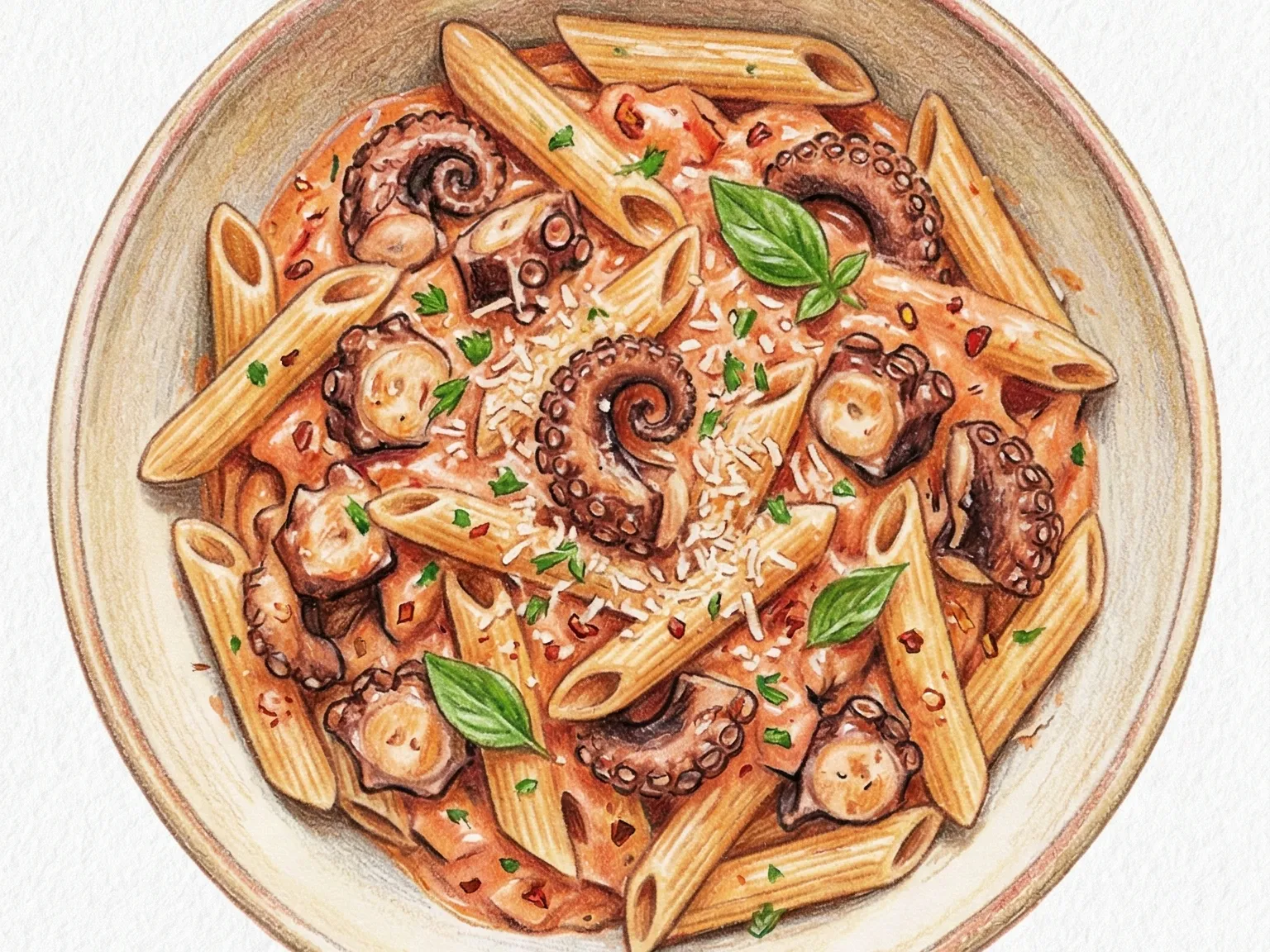
Spicy Octopus Rose Penne (Octopus Penne in Rose Sauce)
Pasta Medium

Spicy Octopus Rose Penne (Octopus Penne in Rose Sauce)

Quick answer

Spicy octopus rose penne starts with pre-cooked octopus that is seared in a very hot, dry pan to burn off surface moisture and trigger a Maillard crust on the skin.

What makes this special

  • Maillard-crusted octopus meets a spicy tomato and cream rose sauce and penne.
  • Pre-cooked octopus seared hard to trigger Maillard reaction and eliminate fishiness
  • Gochugaru bloomed in oil first to extract maximum color and heat
Total time
34 min
Level
Medium
Servings
2 servings
Ingredients
10
Calories
670 kcal
Protein
34 g

Key ingredients

pennecooked octopusoniongarlictomato passata

Core cooking flow

  1. 1 Cook 180g penne in salted boiling water for 1 minute less than the package time.
  2. 2 Cut 200g cooked octopus into bite-sized pieces (2-3cm).
  3. 3 Heat 1.5 tablespoons olive oil in a pan over high heat until very hot.

Spicy octopus rose penne starts with pre-cooked octopus that is seared in a very hot, dry pan to burn off surface moisture and trigger a Maillard crust on the skin. This step does more than remove water - it eliminates any residual fishiness and builds a firm outer layer that contrasts with the tender interior when you bite through. The rose sauce is built from tomato passata and heavy cream spiked with Korean gochugaru. The chili flakes are bloomed in oil for no more than 20 seconds, enough to coax out heat and color but not long enough to develop bitterness. Butter is added to the finished sauce to encourage emulsification, keeping the cream and tomato components cohesive and allowing the mixture to coat each piece of pasta evenly rather than pooling at the bottom of the pan. Penne holds this sauce particularly well because its tubular shape captures the thick liquid inside each piece, delivering cream and spice simultaneously with every bite. Fresh basil is stirred in off the heat at the very end, its volatile aromatics intact, providing an herbal lift that cuts the heaviness of the cream base. The natural salinity and sweetness of octopus from the sea add a briny depth that cream-only sauces cannot replicate on their own.

Prep 12min Cook 22min 2 servings

Instructions

Read the steps as a cooking flow: prep, heat, seasoning, doneness control, and finish.

7 steps
  1. 1
    Finish

    Cook 180g penne in salted boiling water for 1 minute less than the package time.

    Reserve 150ml pasta water.

  2. 2
    Heat

    Cut 200g cooked octopus into bite-sized pieces (2-3cm).

    Pat completely dry with paper towels to ensure a proper sear.

  3. 3
    Control

    Heat 1.5 tablespoons olive oil in a pan over high heat until very hot.

    Sear the octopus without moving for 1 minute 30 seconds, then remove.

  4. 4
    Heat

    In the same pan saute 70g diced onion and 2 sliced garlic cloves until softened.

    Add 1 tablespoon gochugaru and stir-fry for 20 seconds to bloom.

  5. 5
    Control

    Add 220ml tomato passata and simmer for 3 minutes.

    Add 120ml heavy cream and 15g butter to form the rose sauce.

  6. 6
    Season

    Add the cooked penne and seared octopus to the sauce.

    Toss for 1 minute, adding pasta water to adjust consistency.

  7. 7
    Finish

    Turn off the heat, tear 5g basil into the pan and let the residual heat draw out the fragrance.

    Plate and serve immediately.

After the steps

Pick a recipe that fits this dish.

Continue with shared ingredients, meal pairings, or a similar method.

Recipes That Go Well With This

More Pasta →

Based on shared ingredients and meal pairing

Gochujang Shrimp Cream Pasta
Shared ingredient: onion Pasta

Gochujang Shrimp Cream Pasta

Gochujang shrimp cream pasta merges fermented Korean chili paste with heavy cream into a single cohesive sauce. Shrimp are seared at high heat first to develop a caramelized crust, then folded into the gochujang-cream mixture along with milk and garlic. The fermented depth of gochujang operates differently from straightforward chili heat: it carries malty sweetness and umami that reinforce the dairy richness rather than cutting against it, building a layered flavor the sauce would not achieve with fresh chili alone. Parmesan grated into the pan adds salt and nuttiness that round out the finish, while reserved pasta water lets the cook dial in the consistency. The result coats each strand of pasta in a glossy, spiced cream. The entire dish comes together in around 20 minutes, keeping the shrimp firm and the sauce smooth.

Kkaennip Mushroom Cream Farfalle
Shared ingredient: onion Pasta

Kkaennip Mushroom Cream Farfalle

Kkaennip mushroom cream farfalle combines sliced button mushrooms and fresh perilla leaves in a cream sauce over bow-tie pasta. The mushrooms are sauteed in olive oil until their moisture cooks off and their flavor concentrates, with onion and garlic building the aromatic base. Heavy cream is then added to form the sauce, and shredded perilla goes in at the end so the leaves wilt just enough to release their fragrance without losing it to the heat. Parmesan contributes salt and a nutty underpinning, while farfalle's ridged and folded surface holds the sauce across every piece. The defining quality of the dish is the perilla itself, whose scent belongs to the sesame family and sits in entirely different territory from basil or mint - grassy, faintly resinous, and unmistakably Korean. Few other herbs could give a cream pasta this specific character.

Korean Ssanghwa Herbal Tea
Serve together Drinks

Korean Ssanghwa Herbal Tea

Ssanghwa-cha is a traditional Korean tonic tea made by slow-simmering astragalus root, angelica root, cinnamon bark, licorice, and jujube in approximately 1800 ml of water over low heat for more than fifty minutes. The prolonged extraction coaxes layered complexity from each herb, producing a brew that is simultaneously bitter, sweet, and warmly aromatic with cinnamon woven through every sip. Jujubes added during the simmer soften the sharpest herbal edges while contributing a mild natural sweetness that rounds the overall profile. Honey is stirred in after straining to let each person adjust the sweetness to taste. The tea is poured hot into a ceramic cup and finished with a small cluster of pine nuts whose oil blooms on contact with the steaming surface, releasing a gentle, nutty fragrance. The deep medicinal warmth lingers in the throat long after each sip, making the drink a reliable remedy for fatigue and cold weather.

Korean Spicy Octopus Stir-fry
Similar recipe Stir-fry

Korean Spicy Octopus Stir-fry

Muneo-bokkeum is a Korean stir-fry of pre-boiled octopus pieces cooked on high heat with onion, carrot, and scallion in a sauce built from gochujang and soy sauce. Because the octopus arrives already cooked, two to three minutes of high-heat stir-frying is the target window - enough time to heat the pieces through and coat them in the seasoning without pushing the texture past springy into tough. The sauce brings spice from the gochujang and saltiness from the soy sauce, and that combination lifts the naturally clean, mild flavor of the octopus without masking it. Vegetables are pulled from the pan while they still carry some bite, which sets up a textural contrast against the dense, elastic chew of the octopus. Sesame oil goes in at the very end as a finishing drizzle, adding a nutty, aromatic layer that ties the dish together. It works as a rice side dish or as an anju pairing alongside drinks.

Serve with this

Smoked Duck Chive Salad (Korean Chive Salad)
Salads Easy

Smoked Duck Chive Salad (Korean Chive Salad)

Smoked duck chive salad brings together pan-seared smoked duck and fresh Korean chives in a soy-mustard dressing that cuts through the meat's richness with precision. The duck is seared in a dry or lightly oiled pan for two to three minutes to render off the surface fat before it meets the other ingredients. Korean chives are cut to four-centimeter lengths and combined with shredded cabbage and sliced bell pepper, each element adding its own texture to the finished dish. A dressing of soy sauce, mustard, vinegar, honey, and sesame oil delivers a multi-layered hit of nose-clearing heat, sweet-sour acidity, and roasted depth that cleanses the palate after every fatty bite of duck. The cabbage provides firm, watery crunch against the chewy, smoke-infused meat, while toasted sesame seeds scatter a nutty fragrance across the top. Adding the chives at the very end keeps their herbal aroma vivid rather than grassy, and limiting the searing time prevents the duck from turning tough. The interplay between the dense smokiness of the duck and the sharp freshness of the chives is what gives this salad its character beyond a simple protein-and-greens combination.

🍺 Bar Snacks 🥗 Light & Healthy
Prep 15min Cook 8min 2 servings
Yuzu Poppy Seed Loaf Cake
Baking Easy

Yuzu Poppy Seed Loaf Cake

This loaf cake pairs the fragrant acidity of 80 grams of yuja marmalade with 12 grams of poppy seeds that add a subtle crunch to every slice. Creaming 120 grams of room-temperature butter with sugar traps air in the batter, producing a fine, tender crumb once baked. Eggs are added one at a time to maintain emulsion, and the dry ingredients are folded in gently to avoid toughening the gluten. Bits of yuja peel and pulp appear throughout the cross-section, releasing bursts of citrus when bitten. Baked at 175 degrees Celsius for 40 to 45 minutes, the loaf develops a golden crust on top while staying plush inside, holding its moisture well for a day or two after cooling.

🧒 Kid-Friendly 🎉 Special Occasion
Prep 20min Cook 45min 4 servings
Chicken Paprikash (Hungarian Paprika Chicken Stew with Sour Cream)
Western Medium

Chicken Paprikash (Hungarian Paprika Chicken Stew with Sour Cream)

Chicken paprikash is a Hungarian stew that starts by browning chicken thighs in a hot pan to develop color and fond, then builds a sauce around slowly cooked onion, sweet paprika, and tomato before finishing with sour cream. The onion is cooked low and slow until completely soft and sweet, and only then is the paprika added over reduced heat to bloom its color and release its earthy, lightly smoky aroma without any risk of scorching. Paprika forms the entire foundation of the sauce's flavor and its characteristic deep red hue, while tomato contributes the acid needed to balance the richness of dark meat through a 25-minute gentle simmer. The chicken stays submerged in the sauce throughout cooking, absorbing the paprika-infused liquid and becoming very tender. Sour cream must be added at the very end with the heat turned low; stirring it in while the pot is still at a boil causes it to curdle, whereas adding it gently over low heat integrates it into a smooth, creamy sauce with a mild tang. The traditional presentation ladles the sauce over wide egg noodles or spaetzle, whose tender chew is well suited to catching and holding the rich, paprika-scented sauce.

🎉 Special Occasion 🍺 Bar Snacks
Prep 15min Cook 40min 4 servings

Similar recipes

Dakgalbi Cream Rigatoni (Korean Spicy Chicken Gochujang Cream Pasta)
Pasta Medium

Dakgalbi Cream Rigatoni (Korean Spicy Chicken Gochujang Cream Pasta)

Dakgalbi cream rigatoni is a Korean-Italian fusion pasta that starts by marinating boneless chicken thighs in a sauce of gochujang, soy sauce, gochugaru, and sugar for at least twenty minutes, then stir-frying them at high heat with cabbage and sweet potato to build the bold, sweet-spicy flavor profile of traditional dakgalbi before finishing with heavy cream. The marinating step is not optional: the spiced paste needs time to penetrate the meat rather than staying on the surface, and the longer the chicken soaks, the more intensely savory it becomes when it hits the pan. Cooking over high heat drives the moisture out of the cabbage quickly, concentrating its natural sweetness and keeping the texture from turning watery. Sweet potato should either be pre-cooked or sliced thin enough to cook through during the stir-fry stage without holding the process up. Once the heavy cream is poured over and the heat is reduced to low, the red marinade and cream emulsify together without breaking, producing a thick, blush-pink sauce that coats everything in the pan. Rigatoni's short, wide hollow tubes are the ideal pasta shape for this preparation: the dense cream sauce fills the interior of each tube completely, so every bite delivers both the bold heat of the dakgalbi and the smooth richness of the cream together.

🎉 Special Occasion 🧒 Kid-Friendly
Prep 20min Cook 25min 4 servings
Gochujang Beef Ragu Rigatoni
Pasta Medium

Gochujang Beef Ragu Rigatoni

Gochujang beef ragu rigatoni builds depth in two stages: first, ground beef is seared undisturbed over high heat until a proper crust forms, then gochujang, tomato puree, and red wine are added and the whole pot simmers on medium-low heat for twenty minutes. The browning step is critical and non-negotiable-stirring too early releases steam and moisture from the meat, which prevents crust formation and produces braised ground beef instead of seared. Frying the gochujang in oil for a full minute before adding the tomato puree unlocks its fermented sweetness and blunts the raw edge of the paste; the acidity of the tomato then balances the gochujang's heat naturally. As the red wine reduces, it leaves behind layered fruit notes that add complexity the tomato alone cannot provide. Rigatoni is pulled from the water one minute before al dente and transferred to the sauce pan with a ladle of pasta water; the starch dissolves into the sauce and coats the tubes inside and out with a glossy, cohesive finish. Grated Parmesan stirred in at the end deepens the overall savory character of the ragu.

🎉 Special Occasion 🍺 Bar Snacks
Prep 15min Cook 35min 2 servings
Korean Octopus Pot Rice (Chewy Octopus Ocean-Scented Grain Pot)
Rice Medium

Korean Octopus Pot Rice (Chewy Octopus Ocean-Scented Grain Pot)

Muneo sotbap is a seafood pot rice dish in which chewy octopus tentacles are placed on top of uncooked rice and steamed together in a heavy pot so that the briny, oceanic aroma penetrates every grain as it cooks. Thin radish slices lining the bottom of the pot serve two purposes: they prevent the rice from sticking and transfer their natural sweetness into the grains during cooking. Simmering the octopus alongside radish also helps tenderize the meat. The pot starts over high heat to bring it to a boil, then the flame drops to low for a slow, gentle cook that keeps the octopus from turning rubbery. Resting the pot undisturbed after cooking allows the heat to distribute evenly throughout the rice. A dipping sauce of soy sauce, sesame oil, cheongyang chili, and sliced green onion is mixed in at the table, adding a spicy, clean finish. Scraping the crisp nurungji crust from the bottom of the pot is one of the distinct pleasures of this dish.

🎉 Special Occasion 🏠 Everyday
Prep 15min Cook 25min 2 servings

Tips

Sear octopus first to prevent excess moisture from thinning the sauce.
Bloom chili flakes briefly to avoid bitterness and muddiness.

Nutrition (per serving)

Calories
670
kcal
Protein
34
g
Carbs
70
g
Fat
27
g