Squid Ink Seafood Linguine
Quick answer
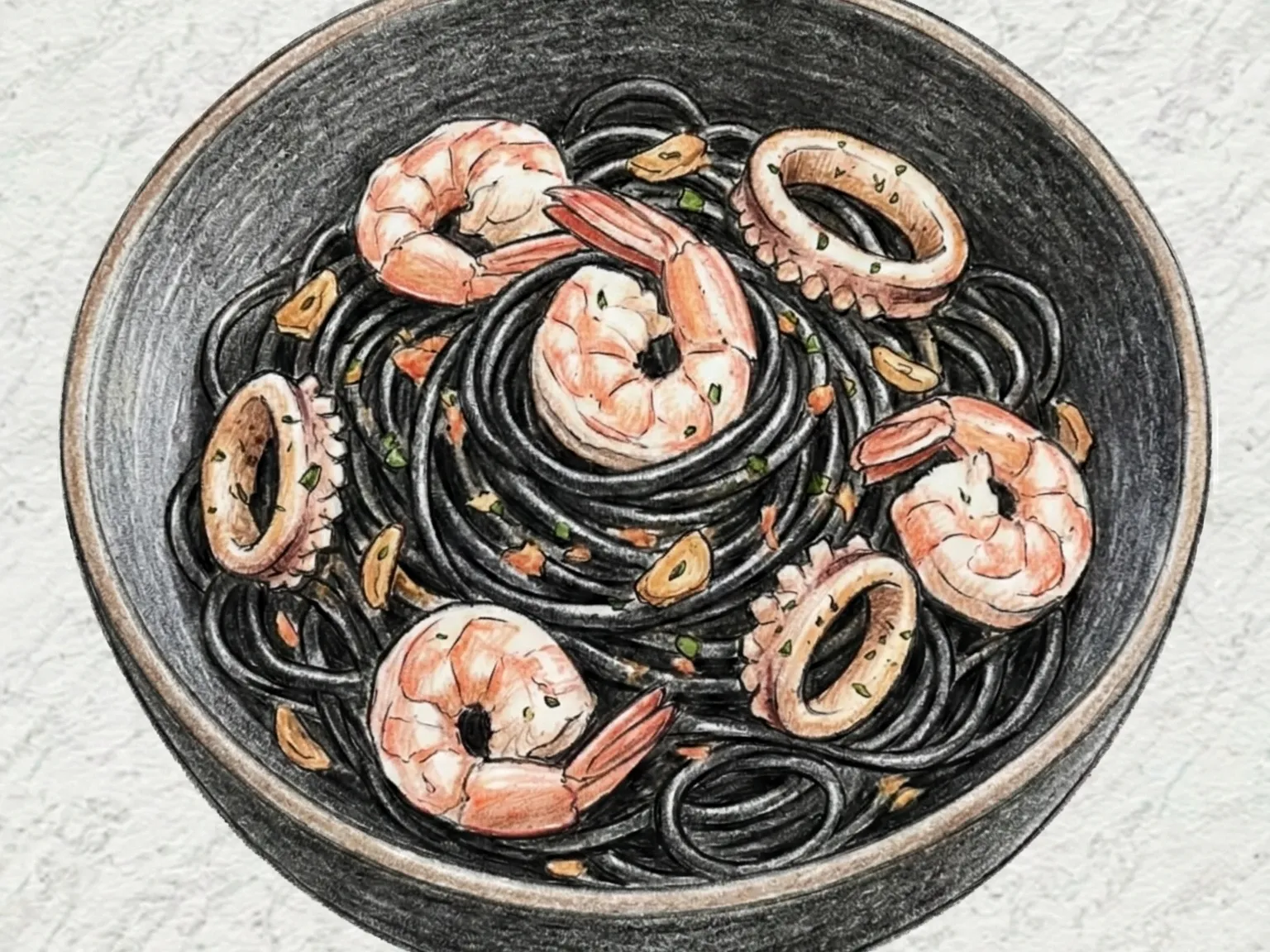
Squid ink seafood linguine dissolves squid ink in reserved pasta water before adding it to the pan, ensuring even distribution without clumping.
What makes this special
- Salty squid ink and reserved pasta water create a deep black coating for seafood linguine.
- Squid ink dissolved in pasta water first for even, clump-free black coating
- Garlic slices slow-infused in olive oil then white wine deglazes the pan
Key ingredients
Core cooking flow
- 1 Cook 180g linguine in salted boiling water for 1 minute less than the package time.
- 2 Heat 2 tablespoons olive oil in a pan over low heat.
- 3 Add 120g shrimp and 120g squid rings.
Squid ink seafood linguine dissolves squid ink in reserved pasta water before adding it to the pan, ensuring even distribution without clumping. Shrimp and squid rings are seared quickly over high heat to set their surfaces, then finished during the final emulsification step so they stay springy rather than rubbery. Sliced garlic infused slowly in olive oil forms the aromatic base, and white wine with halved cherry tomatoes introduces a gentle acidity once the alcohol cooks off. The ink coats linguine in a glossy black sauce that carries concentrated brininess, and chopped parsley scattered on top provides a fresh herbal contrast. A small squeeze of lemon juice added at the end brightens the deep, saline richness of the squid ink and makes the oceanic flavors more vivid with each bite.
Instructions
Read the steps as a cooking flow: prep, heat, seasoning, doneness control, and finish.
- 1Finish
Cook 180g linguine in salted boiling water for 1 minute less than the package time.
Reserve 150ml pasta water.
- 2Control
Heat 2 tablespoons olive oil in a pan over low heat.
Add 3 sliced garlic cloves and cook slowly for 1-2 minutes until fragrant.
- 3Control
Add 120g shrimp and 120g squid rings.
Cook over high heat for 1 minute 30 seconds until just cooked on the outside. Remove and set aside.
- 4Control
Add 80ml white wine and 120g halved cherry tomatoes.
Simmer over medium heat for 2 minutes to build acidity.
- 5Season
Dissolve 8g squid ink in 60ml pasta water and pour into the pan.
Stir until the sauce is evenly black.
- 6Finish
Add the cooked linguine and toss for 1 minute.
Season with 5g salt, return the seafood, and finish with 10g chopped parsley.
After the steps
Pick a recipe that fits this dish.
Continue with shared ingredients, meal pairings, or a similar method.
Recipes That Go Well With This
More Pasta →Based on shared ingredients and meal pairing
Porcini Truffle Mushroom Tagliatelle
Porcini truffle mushroom tagliatelle relies on the liquid left over from rehydrating dried porcini as the flavor engine of the entire dish. Soaking dried porcini for thirty minutes or more produces a deep brown, intensely earthy liquid that carries far more umami than any fresh mushroom can alone. Shallots and garlic are cooked slowly in butter and olive oil until soft, then white wine is added to deglaze the pan and lift the savory residue from the bottom. Rehydrated porcini and a selection of fresh mixed mushrooms go in next, followed by the strained soaking liquid, and the sauce is simmered down until concentrated and thick. Truffle paste is stirred in only after the pan is removed from heat - adding it while still on the flame burns off the volatile compounds responsible for its aroma. Grated Parmigiano-Reggiano and flat-leaf parsley are folded through at the end. Wide tagliatelle ribbons are the ideal carrier: their surface area and chewy structure hold the dense sauce without falling apart.
Spicy Seafood Tomato Pasta
Spicy seafood tomato pasta starts by building a chili-infused oil base - garlic, onion, and red pepper flakes sauteed in olive oil until fragrant. Shrimp and squid are seared briefly until just opaque on the outside, then hand-crushed whole tomatoes are added and the sauce simmers for six to seven minutes, during which the tomato reduces and absorbs the juices released by the seafood. Cooking the seafood only until the surface turns white is critical, as the residual heat from the simmering sauce finishes them gently without making them rubbery. The spaghetti is boiled one minute short of al dente and tossed in the sauce pan with a splash of pasta water over high heat, which emulsifies the sauce and binds it to each strand. The chili heat cuts cleanly through the tomato's acidity and the seafood's brininess, and chopped parsley adds a final fresh herbal note.
Tomato Basil Juice
Tomato basil juice is a cold savory drink made by blending ripe tomatoes with fresh basil leaves and straining the result through a fine sieve to remove seeds and skins. The ripeness of the tomato determines much of the flavor: fully ripe tomatoes carry free glutamates that produce a natural umami depth, whereas underripe fruit tastes predominantly sour without the sweetness and savory body that makes the juice satisfying. Basil should be added to the blender immediately before blending rather than sitting cut or torn, because the volatile oils that produce its aroma begin oxidizing quickly once the leaves are damaged. After blending to a smooth consistency, passing the juice through a fine-mesh strainer or cheesecloth removes the solids and produces a texture smooth enough to drink without resistance. Salt and black pepper season the juice, and fresh lemon juice raises the acidity in a way that brightens the overall flavor rather than making it sour. A small addition of olive oil emulsifies into the juice and activates fat-soluble aromatic compounds in both the tomato and the basil, producing a fuller, rounder flavor than the unstrained version. The juice must be thoroughly chilled before serving, as warmth mutes the herbal freshness. It works well as a brunch drink, a light non-alcoholic aperitif, or a base for savory cocktails.
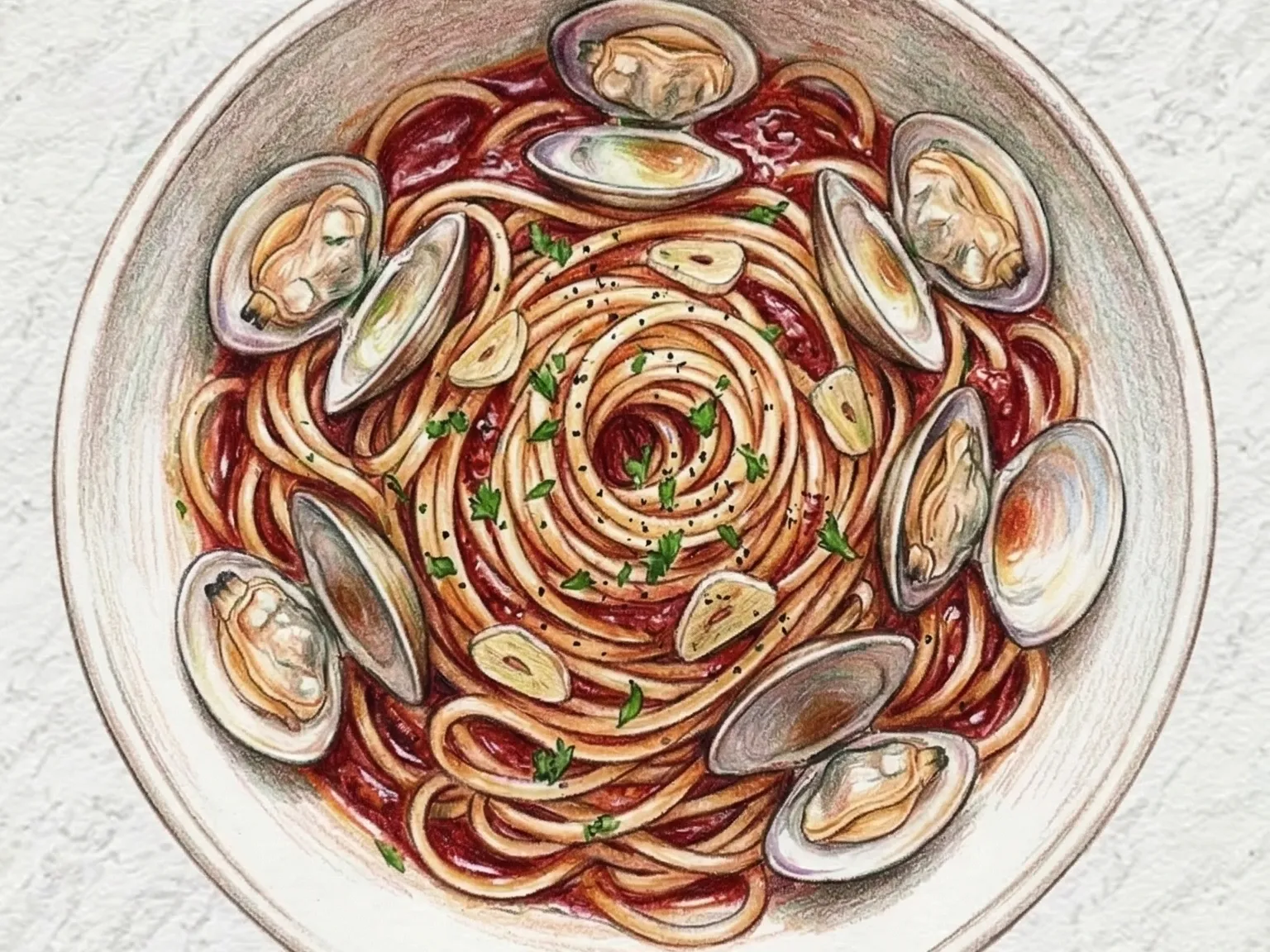
Spaghetti alle Vongole
Spaghetti alle vongole is an Italian pasta where clams are cooked in olive oil with sliced garlic, chili flakes, and dry white wine until they open and release their briny juices. The spaghetti is boiled one minute short of al dente, then finished in the clam pan with a few tablespoons of starchy pasta water to create an emulsified sauce. Vigorous tossing for about a minute binds the oil and clam liquid into a glossy coating around each strand. Fresh parsley is added at the end for color and herbal freshness.
Serve with this
Panettone
Studded with candied orange peel and raisins, this tall Italian holiday bread rises dramatically in a cylindrical mold to a dome that often extends above the rim. The crumb is open-textured and pulls apart in long, buttery strands, with pockets of dried fruit appearing at every tear. Orange peel contributes a bright, citrus fragrance that cuts through the richness of the egg-and-butter dough, while raisins add concentrated sweetness in scattered bursts. Cooling the baked loaf upside down, suspended by skewers, prevents the heavy dough from collapsing under its own weight and preserves the lofty height. Wrapped tightly, panettone stays moist for three to four days, and many consider it even better on the second day as the flavors meld.
Zucchini Noodle Salad
Zucchini noodle salad spiralizes or peels zucchini into long noodle strands and tosses them with halved cherry tomatoes and minced garlic in a lemon juice and olive oil dressing, finished with shaved Parmesan and fresh basil. Zucchini has a high water content that releases quickly once dressed, so the salad must be tossed immediately before serving to prevent the dressing from becoming diluted. Finely minced garlic dispersed through the olive oil distributes a sharp, pungent flavor evenly across every strand, and lemon juice gives the mild zucchini a defined, bright direction. The cherry tomatoes burst with juice that acts as a secondary dressing, and the Parmesan contributes salt and umami that pair with basil's herbaceous aroma to produce depth without any cooking.
Similar recipes
Roasted Pumpkin Alfredo Fettuccine
This pasta dish incorporates a smooth purée of kabocha squash roasted until the edges reach a caramelized state at 200 degrees Celsius. The roasting process concentrates the natural starches, providing a thick body to the sauce without additional thickening agents. Onions and garlic sautéed in butter form the aromatic base, which is then blended with the squash and heavy cream for a uniform texture. Grated Parmigiano-Reggiano introduces a salty, nutty profile, while a small measure of ground nutmeg provides a warm complexity that balances the sweetness of the squash. The wide ribbons of fettuccine are chosen specifically to hold the heavy sauce effectively. For improved efficiency, the squash can be prepared a day in advance and stored in the refrigerator. Using a ladle of starchy pasta water during the blending stage allows for precise control over the final consistency. To finish the plate, sage leaves fried in brown butter offer a bitter herbal contrast to the squash. White pepper adds a subtle heat while preserving the bright orange color of the sauce. Butternut squash serves as a functional substitute if kabocha is unavailable.
Spaghetti Carbonara
Carbonara is a Roman pasta whose sauce is built from egg yolks, Pecorino Romano or Parmesan, and coarsely ground black pepper emulsified with hot pasta water -- no cream is used at any stage. Guanciale or bacon is rendered slowly over low heat until its fat runs clear, and that rendered fat coats the drained spaghetti before anything else goes into the pan. With the heat fully off, the egg-cheese mixture is tossed in quickly; residual warmth from the pasta and the pan finishes cooking the eggs just enough to form a glossy, clinging sauce without scrambling. The starch dissolved in reserved pasta water acts as the emulsifier that binds the cheese protein and egg fat into a cohesive, velvety texture. Temperature control throughout is the defining technical challenge: too hot and the eggs seize, too cool and the emulsion breaks. Coarsely ground black pepper adds a sharp, aromatic counterpoint to the richness of the cheese and cured pork. Because the sauce continues to tighten as it cools, carbonara must be served immediately after plating. A properly made carbonara is one of the most technically demanding two-ingredient sauces in Italian cooking, rewarding precision with an extraordinarily silky result.
Spinach Ricotta Cannelloni
Spinach ricotta cannelloni fills tube-shaped pasta with a mixture of sautéed spinach, ricotta cheese, garlic, and Parmesan, then bakes them in tomato sauce topped with mozzarella. Removing as much moisture from the spinach as possible is the most important step - excess water thins the filling and causes the tubes to split during baking. Half the Parmesan goes into the filling for depth, while the rest is scattered on top with mozzarella to build a golden, bubbling crust. Baking covered at 190 degrees Celsius for the first 25 minutes lets the sauce steam the pasta through, and uncovering for the final 10 minutes crisps the cheese surface. Resting the dish for 10 minutes after it comes out of the oven allows the sauce to thicken and the filling to set, producing cleaner portions when sliced.