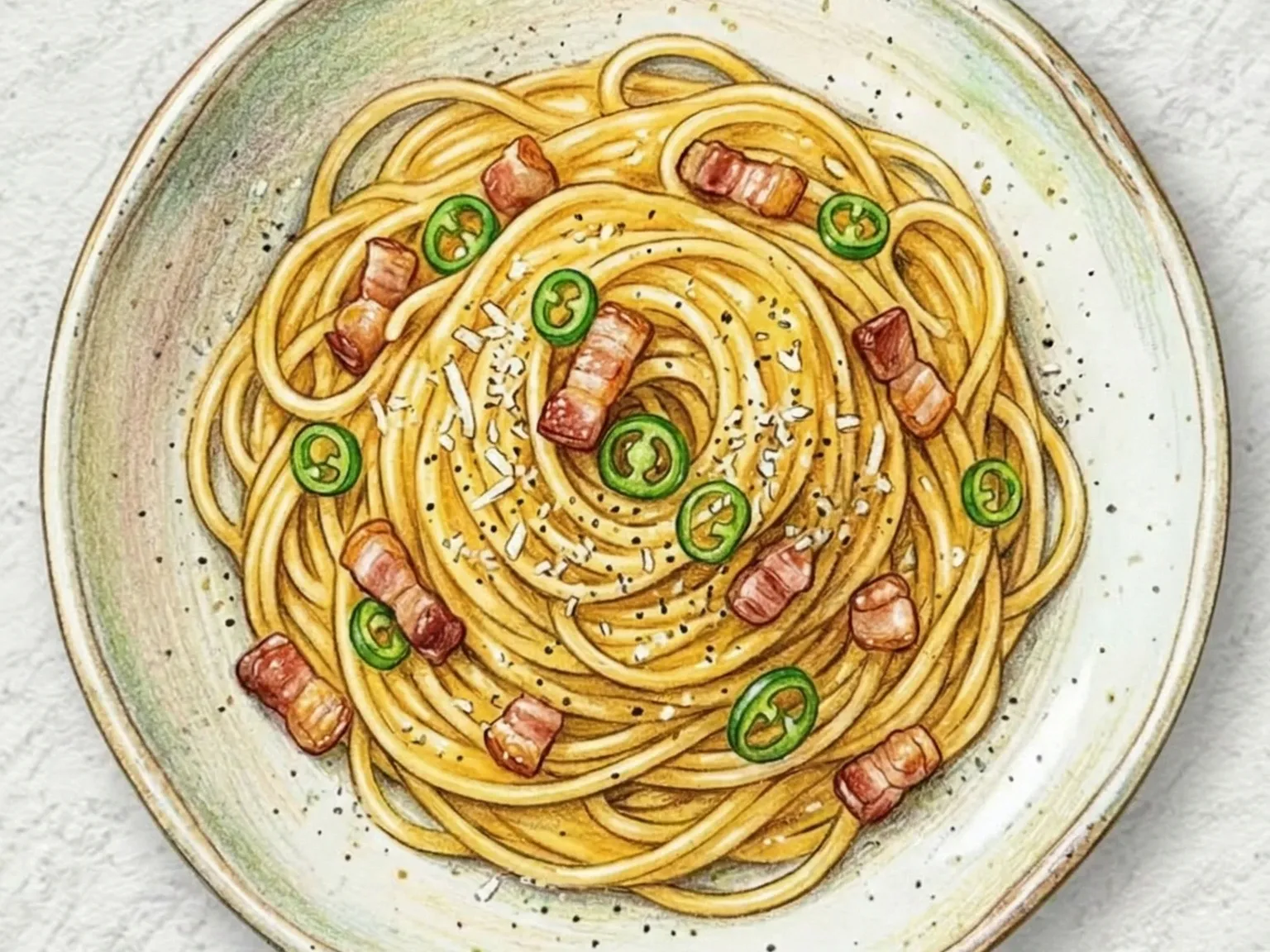
Cheongyang Chili Carbonara Spaghetti
Quick answer
Cheongyang chili carbonara spaghetti takes the classical Roman carbonara - built on egg yolks, Parmigiano-Reggiano, and Pecorino Romano emulsified with rendered pork fat...
What makes this special
- Sharp cheongyang chili heat cuts through a classic carbonara base of egg yolks and pancetta.
- Cheongyang chili bloomed 30 seconds in pancetta fat infuses spice into the oil
- Classic egg base uses both Parmigiano and Pecorino Romano
Key ingredients
Core cooking flow
- 1 Bring 2L of water to a boil with 6g coarse salt.
- 2 In a bowl whisk together 3 egg yolks, 45g grated Parmigiano, 25g grated Peco...
- 3 Fry 90g pancetta in a pan over medium-low heat for 3-4 minutes until crisp.
Cheongyang chili carbonara spaghetti takes the classical Roman carbonara - built on egg yolks, Parmigiano-Reggiano, and Pecorino Romano emulsified with rendered pork fat - and introduces the sharp, lingering heat of Korean cheongyang peppers. Pancetta is rendered slowly over medium-low heat until the fat is fully released and the meat turns crisp, and the sliced chili and garlic are added to the rendered fat for just thirty seconds - long enough to infuse the oil with heat and fragrance without scorching the garlic. The cheese-egg base is made by whisking yolks with finely grated cheese until smooth; a useful ratio is two yolks to 20 grams of Parmigiano-Reggiano and 10 grams of Pecorino. This mixture must be folded into the drained pasta off direct heat, using reserved pasta water to loosen and emulsify - the starch and salt in the pasta water are what allow the sauce to coat each strand evenly rather than clump. The cheongyang pepper's capsaicin cuts cleanly through the concentrated richness of the egg and cheese fat, providing a clean finish that the classic Roman version does not have. The chili quantity is easy to adjust upward or downward, and using fresh whole peppers instead of pre-cut pieces produces a sharper heat with more green, vegetal character.
Instructions
Read the steps as a cooking flow: prep, heat, seasoning, doneness control, and finish.
- 1Finish
Bring 2L of water to a boil with 6g coarse salt.
Cook 180g spaghetti for 1 minute less than the package time and reserve 200ml pasta water before draining.
- 2Step
In a bowl whisk together 3 egg yolks, 45g grated Parmigiano, 25g grated Pecorino, and the coarsely ground pepper until smooth.
Set aside.
- 3Control
Fry 90g pancetta in a pan over medium-low heat for 3-4 minutes until crisp.
Add 1 thinly sliced cheongyang chili and 5g minced garlic and cook for 30 seconds.
- 4Control
Add the cooked spaghetti to the pan and pour in 80ml pasta water.
Toss over medium heat for 1 minute until the starch from the water emulsifies with the fat.
- 5Season
Remove the pan from heat and wait 10-15 seconds to lower the temperature.
Add the egg base and stir rapidly to form a creamy sauce. If the eggs scramble the pan is too hot.
- 6Finish
Add remaining pasta water gradually to reach the desired consistency.
Plate and finish with an extra grind of coarse black pepper.
After the steps
Pick a recipe that fits this dish.
Continue with shared ingredients, meal pairings, or a similar method.
Recipes That Go Well With This
More Pasta →Based on shared ingredients and meal pairing
Spaghetti Carbonara
Carbonara is a Roman pasta built on four core ingredients: guanciale, egg yolks, Pecorino Romano, and black pepper. The guanciale is rendered until crisp, and its fat becomes the base of the sauce. Off the heat, a mixture of yolks and grated cheese is tossed with the hot pasta and starchy cooking water to form a glossy emulsion - no cream involved. The dish takes under 25 minutes from start to finish, though temperature control at the sauce stage is critical to avoid scrambling the eggs. The main ingredients are Spaghetti, Guanciale (or pancetta), Egg yolks, and Whole egg, and the recipe depends on careful handling of noodle cooking time and sauce thickness.
Gochujang Cream Pasta (Spicy Fermented Chili Cream Sauce)
Gochujang cream pasta is a fusion dish that incorporates the fermented heat of Korean red chili paste into an Italian-style cream sauce. Heavy cream forms the base and parmesan provides the sharp, aged umami, while gochujang contributes a slow-building spice and the complex fermented sweetness that sets it apart from using raw chili pepper. Bacon is rendered first to extract enough fat for sauteing the onion and garlic, and that combination of cured pork fat, aromatic vegetables, and fermented paste forms the flavor core of the sauce before any liquid is added. Gochujang should be added at a reduced heat and stirred in gradually rather than dropped in all at once, since the paste can scorch quickly when exposed to a high-temperature pan. A ladleful of starchy pasta water adjusts the consistency and acts as an emulsifier, helping the fat from the cream and bacon stay bound with the aqueous components rather than separating. The result is a glossy, clinging sauce that coats each strand of pasta evenly. The balance between the richness of the cream and the acidity and heat of the fermented paste is what has made this combination popular in Korean home kitchens and casual restaurants alike.
Penne all'Arrabbiata (Spicy Tomato and Garlic Pasta)
Arrabbiata, meaning angry in Italian, is a Roman pasta sauce whose heat comes from dried peperoncino chili flakes used in generous quantity. The sauce descends from the cucina povera tradition of Lazio, where tomatoes, garlic, olive oil, and chili were the four ingredients a working kitchen could reliably afford. Garlic is sliced thin and cooked in olive oil over moderate heat until fragrant and very lightly golden, then the chili flakes bloom in the hot fat for a matter of seconds, infusing the oil with their heat before crushed tomatoes are added. The sauce simmers uncovered for fifteen to twenty minutes, reducing until concentrated enough to coat each tube of penne without sliding off. The heat is slow-building rather than immediate: the first bite registers as mild, but the warmth accumulates with each subsequent forkful and persists at the back of the throat long after eating. Fresh parsley scattered at the end introduces a green, herbal brightness that modulates the lingering chili heat without diminishing it. In the purist version there is no cream and no cheese, only the clean interplay of tomato acidity, garlic depth, and chili fire. The sauce traces its origins to the villages outside Rome in the early twentieth century and reflects Southern Italian cooking's preference for restraint, directness, and heat over the dairy richness characteristic of the north.
Spaghetti alla Puttanesca
Spaghetti alla puttanesca melts anchovy fillets into olive oil with sliced garlic over low heat, creating a deeply savory base before any tomato is added. Hand-crushed whole tomatoes, halved black olives, capers, and red pepper flakes go in next and simmer for eight minutes, during which the sauce reduces and the briny, salty, and spicy elements fuse into a bold, cohesive flavor. The anchovies dissolve completely, leaving no trace of fish but contributing an intense umami backbone. Because capers and anchovies are already heavily salted, seasoning is adjusted only at the very end by taste. The spaghetti is pulled one minute short of al dente and finished in the sauce pan with a splash of pasta water, which allows the starch to bind the sauce tightly to each strand.
Serve with this
Farro Harvest Salad
Farro is an ancient Italian wheat variety that retains a satisfying chew even after boiling, making it a reliable foundation for grain salads that need to hold their texture over time. Roasting root vegetables such as butternut squash, beets, or sweet potatoes at high heat caramelizes their natural sugars and creates slightly crisp edges that contrast with the soft grain below. Toasted walnuts or pecans layered in add crunch and nutty depth. Bitter greens like arugula or kale interrupt the sweetness of the vegetables and prevent the salad from becoming one-dimensional. A dressing of apple cider vinegar, olive oil, and a small amount of honey ties the components together while allowing each ingredient to remain distinct. The salad carries enough fiber and protein to serve as a complete meal rather than a side. Farro's dense structure absorbs dressing gradually without turning soft, so the salad holds well in the refrigerator for two days, making it a practical choice for meal preparation.
Tomato Basil Juice
Tomato basil juice is a cold savory drink made by blending ripe tomatoes with fresh basil leaves and straining the result through a fine sieve to remove seeds and skins. The ripeness of the tomato determines much of the flavor: fully ripe tomatoes carry free glutamates that produce a natural umami depth, whereas underripe fruit tastes predominantly sour without the sweetness and savory body that makes the juice satisfying. Basil should be added to the blender immediately before blending rather than sitting cut or torn, because the volatile oils that produce its aroma begin oxidizing quickly once the leaves are damaged. After blending to a smooth consistency, passing the juice through a fine-mesh strainer or cheesecloth removes the solids and produces a texture smooth enough to drink without resistance. Salt and black pepper season the juice, and fresh lemon juice raises the acidity in a way that brightens the overall flavor rather than making it sour. A small addition of olive oil emulsifies into the juice and activates fat-soluble aromatic compounds in both the tomato and the basil, producing a fuller, rounder flavor than the unstrained version. The juice must be thoroughly chilled before serving, as warmth mutes the herbal freshness. It works well as a brunch drink, a light non-alcoholic aperitif, or a base for savory cocktails.
Rosemary Garlic Grissini
These Italian breadsticks are made from a simple yeasted dough enriched with olive oil, minced garlic, and fresh rosemary. After a forty-minute proof, the dough is rolled flat, cut into narrow strips, and twisted before baking at high heat until deeply golden and audibly crisp. The garlic infuses the crumb with a mellow, roasted warmth, while the rosemary contributes a piney, slightly resinous aroma that intensifies during baking. A dusting of grated Parmesan on top melts into a thin, salty crust that makes the first bite immediately savory. Keeping the strips uniform in thickness ensures even baking - thin ones will burn while thick ones stay pale if mixed on the same tray. The breadsticks cool to a firm snap and store well in an airtight container, maintaining their crunch for several days. They work equally well alongside a bowl of soup, a cheese board, or a glass of wine.
Similar recipes
Roasted Pumpkin Alfredo Fettuccine
This pasta dish incorporates a smooth purée of kabocha squash roasted until the edges reach a caramelized state at 200 degrees Celsius. The roasting process concentrates the natural starches, providing a thick body to the sauce without additional thickening agents. Onions and garlic sautéed in butter form the aromatic base, which is then blended with the squash and heavy cream for a uniform texture. Grated Parmigiano-Reggiano introduces a salty, nutty profile, while a small measure of ground nutmeg provides a warm complexity that balances the sweetness of the squash. The wide ribbons of fettuccine are chosen specifically to hold the heavy sauce effectively. For improved efficiency, the squash can be prepared a day in advance and stored in the refrigerator. Using a ladle of starchy pasta water during the blending stage allows for precise control over the final consistency. To finish the plate, sage leaves fried in brown butter offer a bitter herbal contrast to the squash. White pepper adds a subtle heat while preserving the bright orange color of the sauce. Butternut squash serves as a functional substitute if kabocha is unavailable.
Gochu Oil Tuna Puttanesca Spaghetti
The foundation of this Gochu oil tuna puttanesca spaghetti is established by integrating the olive oil reserved from a can of tuna with a secondary portion of chili oil. This combined oil serves as the medium for sautéing sliced garlic and whole anchovy fillets over a consistently low heat. The process continues until the anchovies have fully dissolved into the warm fat, a step that allows their natural saltiness to permeate the base while eliminating any lingering traces of fishiness. Crushed tomatoes are then introduced to the pan and left to simmer for six minutes over medium heat. This period of simmering reduces the liquid content, which in turn concentrates the flavors and makes the natural acidity of the tomatoes more prominent. After this reduction, capers and black olives are added to provide distinct layers of brine and a characteristic hint of bitterness to the mixture. The solid pieces of tuna are folded in during the final two minutes of cooking. This short duration ensures that the tuna maintains its structure and provides a firm texture instead of disintegrating into the liquid. The cooked spaghetti and a small quantity of starchy pasta water are then combined with the sauce over high heat. This rapid tossing emulsifies the fats and liquids into a glossy coating that adheres uniformly to every surface of the pasta. To finish the dish, a handful of chopped parsley is scattered on top to introduce a fresh herbal quality that lightens the dense and salty profile of the sauce. Red chili flakes can be included at any stage of the process to allow for the precise adjustment of heat levels.
Mala Chicken Alfredo Fusilli
Mala chicken Alfredo fusilli is a fusion pasta that brings Sichuan mala sauce -- built on the numbing tingle of Sichuan peppercorn and the heat of dried chili -- into a cream-and-Parmesan Alfredo base. Chicken thigh is cut into bite-sized pieces and pan-seared to build a browned crust, then garlic and onion are sautéed in the residual fat to form the aromatic foundation. The Alfredo sauce is assembled from heavy cream, milk, and Parmigiano-Reggiano, with mala sauce stirred in to layer the peppercorn numbness against the dairy's richness. The amount of mala sauce added can be adjusted freely, making it straightforward to dial the level of tingling heat to preference. Fusilli's spiral ridges trap the thick sauce deep into their grooves so each piece delivers an even coating of flavor, and butter acts as a bridge between the cream base and the assertive spice, pulling both into a cohesive, glossy whole.