Tofu Satay Salad Bowl
Quick answer
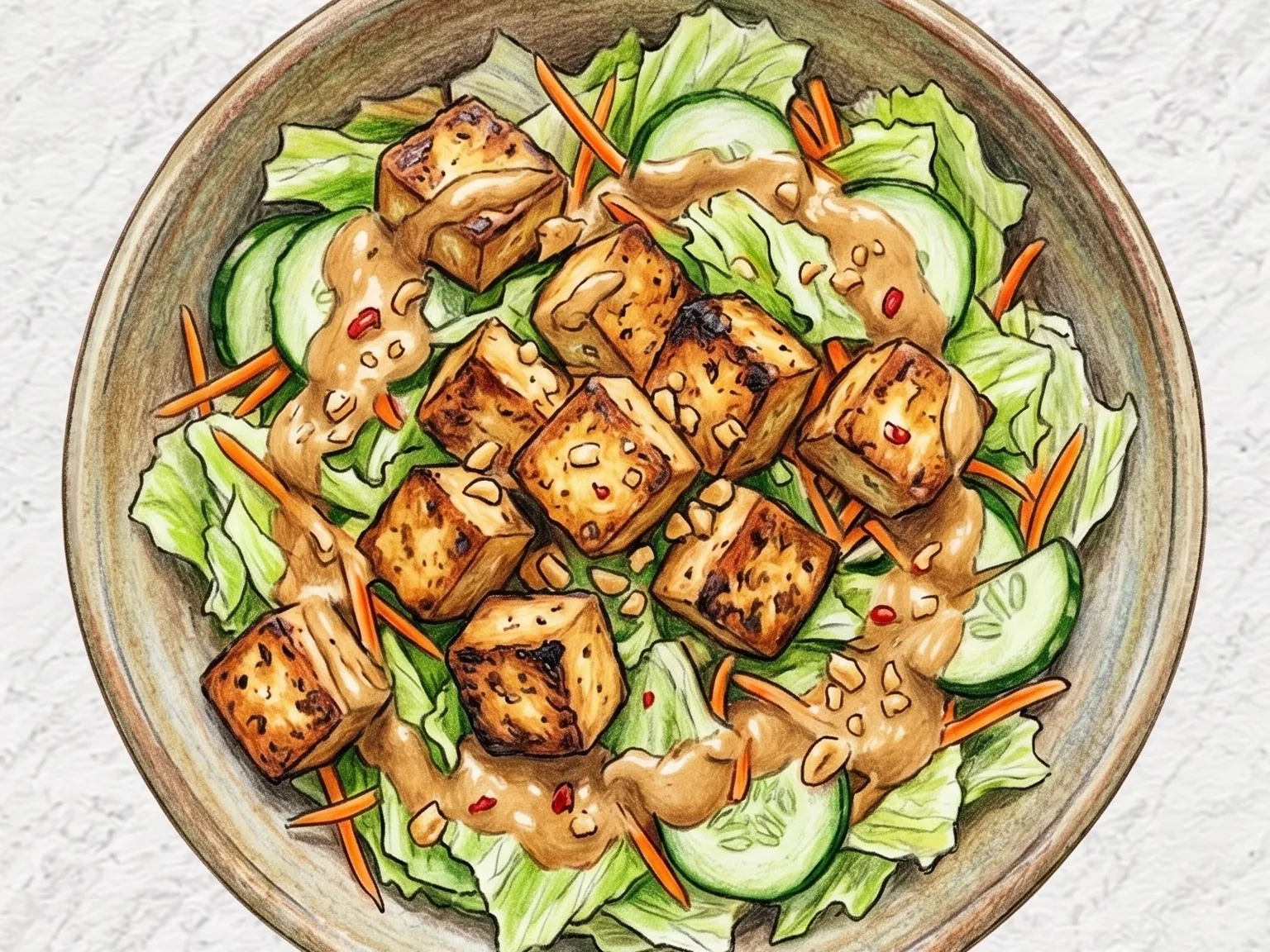
Tofu satay salad bowl combines pan-seared tofu with crisp lettuce, julienned carrot, and cucumber, all coated in a Thai-style peanut satay dressing.
What makes this special
- Rich peanut, soy, and lime-based satay sauce coats seared cubes in this tofu bowl.
- Peanut butter, soy, lime, and chili combine to elevate tofu into a full meal
- Pressing moisture out before pan-frying creates direct-heat crispness
Key ingredients
Core cooking flow
- 1 Wrap 250 g firm tofu in paper towels and press it for about 10 minutes to remove moisture.
- 2 Cut the tofu into thick pieces so they hold together after searing.
- 3 Preheat a pan over medium heat for about 1 minute, then place the tofu pieces in a single layer.
Tofu satay salad bowl combines pan-seared tofu with crisp lettuce, julienned carrot, and cucumber, all coated in a Thai-style peanut satay dressing. The dressing is built from peanut butter, soy sauce, lime juice, and chili sauce - the peanut fat provides body, while the lime and chili cut through it with bright acidity and heat. Pressing the tofu dry before searing ensures the surface browns rather than steams, producing a firm, golden exterior that holds up in the bowl. If the dressing is too thick to coat evenly, a tablespoon of water loosens it to the right consistency. The raw crunch and moisture from carrot and cucumber balance the dense richness of the peanut sauce.
Instructions
Read the steps as a cooking flow: prep, heat, seasoning, doneness control, and finish.
- 1Step
Wrap 250 g firm tofu in paper towels and press it for about 10 minutes to remove moisture.
If the surface stays wet, it will steam in the pan instead of developing a firm browned crust.
- 2Prep
Cut the tofu into thick pieces so they hold together after searing.
Tear 100 g lettuce into bite-size pieces, then cut the carrot and cucumber into thin strips and shake off excess surface water.
- 3Control
Preheat a pan over medium heat for about 1 minute, then place the tofu pieces in a single layer.
Sear for about 3 minutes per side, turning only when the underside looks golden and firm.
- 4Season
In a bowl, whisk 2 tbsp peanut butter with 1 tbsp soy sauce, 1 tbsp lime juice, and 1 tsp chili sauce.
If the dressing is too stiff to drizzle, loosen it with 1 tbsp water.
- 5Prep
Put the lettuce, carrot, and cucumber in the serving bowl first, then toss lightly with half of the dressing.
Avoid pressing or overmixing, so the lettuce stays crisp and the vegetables keep their crunch.
- 6Finish
Place the warm seared tofu over the dressed vegetables and drizzle the remaining dressing on top.
Serve right away while the tofu is still warm, so the peanut sauce coats it smoothly without making the salad heavy.
After the steps
Pick a recipe that fits this dish.
Continue with shared ingredients, meal pairings, or a similar method.
Recipes That Go Well With This
More Salads →Based on shared ingredients and meal pairing
Shrimp Mango Lime Salad
Shrimp mango lime salad is a Thai-style dish that combines briefly poached shrimp with ripe mango, cucumber, red onion, and roughly chopped cilantro, dressed with lime juice, fish sauce, and olive oil. The shrimp go into boiling water for exactly two minutes, which is just long enough to cook them through while keeping their natural snap; any longer causes the proteins to contract and the texture turns from tender to rubbery. Fish sauce contributes a fermented, savory depth that amplifies the shrimp's briny character, while lime's sharp acidity slices through the mango's sweetness and brings the dressing into balance. Thinly sliced red onion adds a raw, peppery heat that creates tension between the sweet fruit and the savory seafood, and cilantro releases a distinctive herbal fragrance with each bite. Cucumber stirred into the mix lightens the overall texture and keeps the salad from feeling too dense. Served cold immediately after dressing, every element stays distinct and the contrast between the yielding fruit, the crisp vegetables, and the firm shrimp comes through clearly.
Som Tam Thai (Thai Green Papaya Salad)
Som tam Thai shreds green papaya into thin strips and pounds them in a mortar with Thai chilies, palm sugar, lime juice, and fish sauce, bruising the fibers just enough to let the dressing seep in while keeping the crunch intact. The pounding technique drives flavor deeper than simple tossing, creating a salad where each strand carries the full range of sweet, salty, sour, and spicy in a single bite. Palm sugar's dark caramel sweetness, fish sauce's fermented brine, the sharp brightness of lime, and the direct burn of chili hold each other in a balance that defines the dish. Roasted peanuts scattered on top add a nutty crunch to finish. Without a mortar, a large bowl and a rolling pin work as a substitute by applying light pressure to bruise the papaya without crushing it. Halved cherry tomatoes pounded in alongside the papaya release their juice into the dressing and contribute a natural sweetness and extra moisture.
Gaeng Jued Tofu Soup (Thai Clear Tofu Soup)
Gaeng jued - literally 'bland soup' in Thai - is not tasteless despite its name; it is the one Thai dish that deliberately seeks gentleness in a cuisine famous for intensity. A clear broth simmered from pork bones or chicken holds soft tofu, small pork meatballs, glass noodles or squash. The meatballs are seasoned with garlic, white pepper, and coriander root - the aromatic trinity of Thai cooking - which infuse the clear broth with a subtle depth that belies the soup's transparent appearance. Fresh cilantro leaves and fried garlic are scattered on top for aroma and crunch, but the overall tone stays soothing and stomach-settling. On a Thai family table, gaeng jued sits alongside fiery dishes like som tam and tom yum, serving as a palate cleanser between bites of heat. It is the soup Thai parents make for children and for anyone feeling unwell - comfort food in its most literal sense.
Tofu Avocado Salad (Silken Tofu and Avocado Sesame Bowl)
Tofu avocado salad pairs pan-seared firm tofu with ripe avocado over a bed of mixed greens, dressed in soy sauce, sesame oil, and lemon juice. Pressing the tofu thoroughly before searing allows the surface to develop a golden Maillard crust that holds its shape even after tossing with the dressing. The avocado's creamy fat contrasts with the burst of juice from halved cherry tomatoes, creating textural variety in every bite. The dressing layers three dimensions - soy sauce for salinity, sesame oil for nuttiness, and lemon juice for acidity - giving depth to otherwise mild ingredients. Cutting the avocado just before serving prevents oxidation and keeps the color clean.
Serve with this
Korean Grilled Tteokgalbi Patties
Ground beef and ground pork are combined in a two-to-one ratio with finely diced onion (squeezed dry), soy sauce, sugar, minced garlic, sesame oil, and breadcrumbs, then kneaded for at least three minutes until the mixture develops a sticky, elastic consistency. Thick oval patties are seared four minutes per side on medium heat, then finished on low for three to four more minutes, resulting in a caramelized exterior and a moist center. The blend of beef and pork creates a more layered flavor than either meat alone - the beef brings depth while the pork adds fat and smoothness. These patties hold up well at room temperature, making them a staple for Korean lunch boxes.
Mortadella Pistachio Sandwich
This Italian sandwich features mortadella ham, burrata cheese, and pistachio paste on toasted ciabatta. The ciabatta is split and toasted until the edges are crisp. While warm, the inside is spread with pistachio paste, which sinks into the bread pores to form a creamy base. It is layered with fresh arugula and folded slices of mortadella, keeping the layers loose to preserve volume. A halved burrata cheese is placed on top, adding a chewy shell and a creamy, flowing interior. The sandwich is finished with crushed pistachios, olive oil, and a drizzle of balsamic glaze, which highlights the sweet undertones of the mortadella fat. After covering with the top bread, it is pressed gently, halved, and served. Fresh mozzarella can replace the burrata if desired.
Kimchi Tofu Alfredo Farfalle (Creamy Kimchi Bow-Tie Pasta)
Kimchi tofu Alfredo farfalle is a fusion pasta that counters the richness of a cream-and-Parmesan Alfredo sauce with the lactic acidity of well-fermented kimchi. Garlic bloomed in butter forms the aromatic base, then cream, milk, and Parmigiano are combined into the classic Alfredo sauce, after which chopped kimchi is folded in to introduce fermented tang and a layer of umami that a standard Alfredo lacks. Firm tofu cut into cubes and pan-fried until each side is golden provides a mild, neutral protein element with direct textural contrast against the smooth sauce. Farfalle's pinched center holds pockets of sauce against each piece of pasta, delivering a consistent hit of creaminess in every bite, and freshly ground black pepper draws a sharp line through the richness at the finish. The entire dish moves from pan to plate in about 15 minutes.
Similar recipes
Yam Woon Sen (Thai Glass Noodle Salad with Shrimp)
Yam woon sen is a Thai glass noodle salad where soaked and briefly boiled mung bean noodles are tossed with blanched shrimp, sliced red onion, diagonally cut celery, and chopped cilantro in a dressing of lime juice, fish sauce, and palm sugar. The noodles are soaked in warm water for ten minutes, then boiled for just two minutes to maintain their chewy, springy texture - rinsing in cold water immediately after removes surface starch and prevents clumping. The shrimp need only a two-minute blanch to reach a firm, bouncy doneness; any longer and they turn rubbery. The dressing builds three layers simultaneously - fish sauce for salty depth, lime juice for bright acidity, and palm sugar for a caramel sweetness - creating the complex balance characteristic of Thai cuisine. Cilantro provides a fresh, herbal finish.
Larb Gai (Thai Isan Minced Chicken Herb Salad with Lime)
Larb Gai is a traditional herb salad from the Isan region of northeastern Thailand, featuring minced chicken as its base. The preparation starts by cooking ground chicken with a small amount of water until it is no longer pink, ensuring the meat remains tender and crumbly. Once removed from the heat, the warm chicken is seasoned with lime juice, fish sauce, sugar, and chili flakes. Adding the lime juice off the heat preserves its natural acidity and bright aroma. Thinly sliced shallots and toasted rice powder are then folded into the mixture. The toasted rice powder acts as a binding agent that absorbs the juices while providing a distinct nutty crunch. Fresh mint leaves are tossed in at the very end to prevent them from darkening. The salad is served alongside sticky rice, lettuce, or cabbage cups.