Japanese Rice Soup Porridge
Quick answer
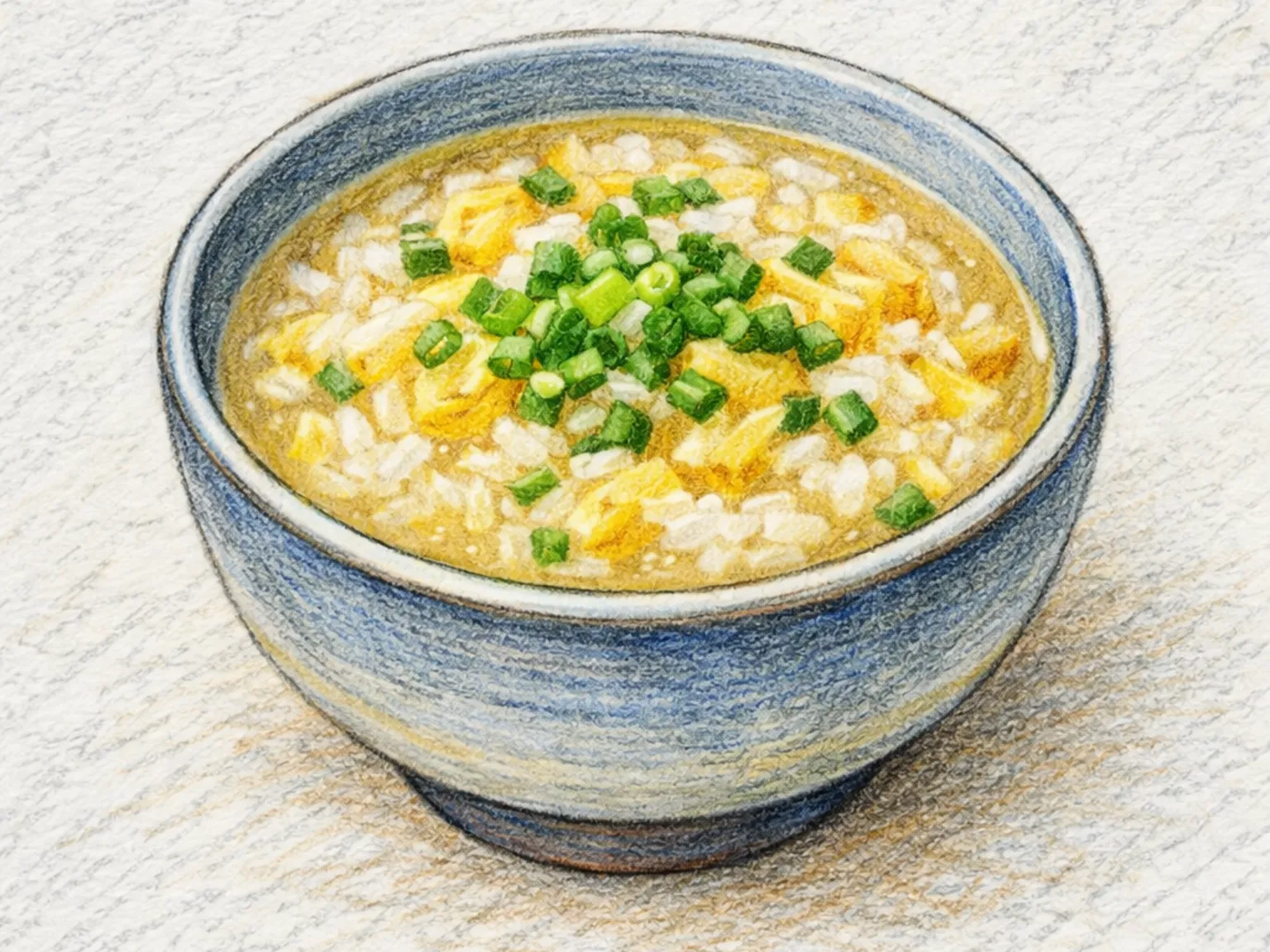
Zosui is a Japanese rice porridge made by simmering leftover cooked rice in dashi broth and finishing with beaten egg.
What makes this special
- Zosui concentrates dashi umami as leftover rice absorbs the broth before being set with soft egg.
- Dashi broth absorbed by leftover rice concentrates umami in every spoonful
- Egg swirled in and stirred gently after 30 seconds stays translucent and silky
Key ingredients
Core cooking flow
- 1 Rinse 1.5 cups of cooked rice once under cold water, then drain well so the broth stays clean.
- 2 Pour 700 ml dashi stock into a pot and heat it over medium heat.
- 3 Add the enoki mushrooms and simmer for about 2 minutes.
Zosui is a Japanese rice porridge made by simmering leftover cooked rice in dashi broth and finishing with beaten egg. The broth soaks into the rice grains, giving the porridge a deep umami base, while the egg sets into soft ribbons throughout. Enoki mushrooms add thin, delicate strands of texture, and chopped scallions contribute a fresh finish. Seasoning is kept minimal with just soy sauce and salt to let the broth flavor come forward. It is often served as the closing dish after a nabe hot pot, using the remaining broth as the cooking liquid.
Instructions
Read the steps as a cooking flow: prep, heat, seasoning, doneness control, and finish.
- 1Heat
Rinse 1.5 cups of cooked rice once under cold water, then drain well so the broth stays clean.
Trim the base from 80 g enoki mushrooms and loosen the strands before they go into the pot.
- 2Finish
Pour 700 ml dashi stock into a pot and heat it over medium heat.
When small bubbles appear around the edges, keep it from boiling too hard so the finished porridge stays clear and gentle.
- 3Control
Add the enoki mushrooms and simmer for about 2 minutes.
Move on when the strands soften slightly and the broth has taken on their delicate aroma, but do not cook them until limp.
- 4Control
Add the rinsed rice and simmer over medium-low heat for about 6 minutes.
Stir the bottom occasionally so the grains absorb the broth and soften without sticking or breaking down too much.
- 5Season
Season with 1 tablespoon soy sauce and 0.25 teaspoon salt, then taste the broth.
Keep the seasoning light so the dashi remains the main flavor, adding no extra salt unless it tastes flat.
- 6Finish
Beat 1 egg, pour it in a thin circle, and wait 30 seconds before stirring.
Stir only gently to form soft ribbons, then add 1 tablespoon green onion and serve right away while hot.
After the steps
Pick a recipe that fits this dish.
Continue with shared ingredients, meal pairings, or a similar method.
Recipes That Go Well With This
More Rice →Based on shared ingredients and meal pairing
Chicken and Egg Rice Bowl
Oyakodon simmers bite-size chicken thigh and sliced onion in a soy-mirin broth, then binds everything with a soft-set egg before sliding it over steamed rice. The name means 'parent and child,' referring to the chicken and egg sharing the same bowl. Onion goes into the broth first to release its natural sweetness, followed by the chicken, which cooks just until tender. Beaten eggs are poured in a circular motion and the lid goes on briefly, leaving the egg custardy rather than fully set. That half-cooked egg absorbs the savory-sweet broth and coats each grain of rice. Despite using only a handful of ingredients, the layered umami from soy sauce and mirin gives the dish a satisfying depth.
Classic Katsudon (Pork Cutlet Egg Rice Bowl)
Classic katsudon is a Japanese rice bowl that transforms a crispy pork cutlet into something altogether different by simmering it briefly with onion, egg, and seasoned dashi broth. Thinly sliced onion cooks first in a shallow pan of tsuyu -- a combination of soy sauce, mirin, and dashi -- until soft and sweet. The fried cutlet, sliced into strips, is laid into the onion broth, then lightly beaten egg is poured over the top and cooked just until it sets into a custard-like layer. This half-set egg clings to the panko crust, creating a contrast between the still-crunchy edges and the silky coating. The entire mixture is slid onto a bowl of steaming rice, where the savory broth soaks into the grains. In Japan, katsudon is traditionally eaten before exams or competitions as a good-luck ritual. Pulling the pan off the heat within thirty seconds of covering it keeps the egg in that soft, barely-set state -- overcooking turns the layer rubbery and loses the signature texture entirely.
Korean Scallion Egg Soup (Quick Two-Ingredient Clear Broth)
Daepa gyeran-guk is a Korean scallion and egg soup that comes together in under ten minutes with just two main ingredients. Adding the green onion in two separate stages is what gives the broth complexity: the first portion simmers for three minutes, sweetening and deepening the stock, while the second goes in raw at the very end for a sharp, grassy bite. The egg must be drizzled in a thin, steady stream over reduced heat and left completely undisturbed for thirty seconds - this produces silky, delicate ribbons rather than broken scrambled pieces. Adding the egg over high heat or stirring immediately causes the broth to turn cloudy and the egg to clump. Soup soy sauce seasons the broth cleanly without darkening it, and a single drop of sesame oil finishes the bowl with a subtle, nutty fragrance that underscores the sweetness of the green onion.
Korean Chicken Rice Porridge
Dakjuk is a Korean chicken rice porridge built from a straightforward foundation: a whole chicken breast poached in water until tender, then shredded along the grain and returned to the broth with soaked short-grain rice. The rice and minced garlic are first sauteed briefly in sesame oil so each grain takes on a faint nuttiness before the stock is added, which carries through into the finished porridge. As the rice simmers and slowly breaks down over twenty-five or more minutes of regular stirring, it releases starch that thickens the liquid into a smooth, flowing consistency without turning gluey. The chicken adds lean protein without weighing the dish down, and the garlic mellows from sharp to a quiet warmth. Sliced green onion scattered on top provides a fresh, grassy contrast to the mild, savory base. Dakjuk has been a household staple in Korea for generations, reached for when the body needs recovery, when the stomach asks for something gentle, or when a warm and undemanding breakfast is simply the right start to the morning.
Serve with this
Korean Beoseot Jjigae (Mushroom Stew)
Korean mushroom stew, or beoseot jjigae, is a clean and oil-free soup made by simmering three varieties of mushrooms with tofu and onions in a kelp-infused broth. The recipe uses oyster, shiitake, and enoki mushrooms to create layers of distinct textures and umami. Seasoned simply with soup soy sauce and minced garlic, the clear broth highlights the natural characteristics of the ingredients. The cooking process involves boiling sliced onions and garlic in kelp water first to build a sweet base, followed by adding the mushrooms. Oyster mushrooms are torn along the grain for a tender texture, shiitake mushrooms are sliced to provide bite, and enoki mushrooms are added during the final minute of cooking to maintain their crispness. Skimming the foam while boiling ensures the broth stays clear. It is a light, warming dish that serves as a gentle and easily digestible meal.
Korean Seasoned Mung Bean Jelly Salad
Cheongpo muk - mung bean jelly - is made by dissolving starch in water, boiling it until thick, then leaving it to set into a translucent, firm block. It has appeared in Joseon-era palace banquet records as a traditional food. The jelly is blanched briefly, cut into matchstick strips, and tossed with julienned cucumber and carrot. A dressing of soy sauce, vinegar, and sugar gives a clean, sharp edge. The jelly itself is nearly flavorless, functioning as a cool, slippery carrier for the seasoning. The crunch of the vegetables contrasts with the smooth jelly, and the vinegar keeps the whole dish light. Gentle tossing is essential to avoid breaking the blocks apart. Served well-chilled, this is a classic Korean summer banchan.
Korean Wild Chive Pickle (Spring Chive Soy Brine)
Dallae jangajji is a seasonal Korean pickle made by submerging spring wild chives in a brine of soy sauce, vinegar, and sugar alongside sliced Cheongyang chili and sesame seeds. Cleaning the soil from the bulb-like roots and cutting the chives to five-centimeter lengths prepares the main ingredient; the brine must then be cooled fully before pouring, because residual heat drives off the chives' volatile, peppery aroma rapidly. Pouring while still hot can strip much of the sharp fragrance in seconds. After one day of refrigeration the pickle is ready to eat, but by day three the brine penetrates the stalks fully and the flavor deepens. Served alongside grilled meat, the sharp garlicky bite of the chives and the tangy acidity of the brine cut through the fat cleanly -- a pairing that makes this a prized springtime side dish.
Similar recipes
Katsu Curry
Katsu curry is a Japanese single-plate meal of crisp deep-fried pork cutlet served beside a thick, glossy curry sauce over steamed rice. The pork loin is pounded to an even thickness, seasoned with salt and pepper, then coated in three layers: flour, beaten egg, and panko. Panko breadcrumbs have a coarser, more jagged texture than standard breadcrumbs, which creates more air pockets in the crust and produces a crunch that stays crisp longer after frying. The breaded cutlet is lowered into oil heated to 170 degrees Celsius and fried for four to five minutes until deep golden brown, then lifted onto a wire rack to rest for two minutes. The resting period allows the residual heat to finish cooking the center while the juices redistribute and the crust firms up. The curry sauce is built separately: onion and carrot are sauteed until their natural sweetness develops fully, then water is added and everything simmers until the vegetables are tender. The curry roux blocks are added and dissolved over low heat until the sauce reaches a thick, velvety consistency. Resting the curry overnight deepens its flavor as the vegetables continue to release sugars and the spices meld together. At the table, the curry fills one side of the plate and the sliced katsu occupies the other so the crust stays dry until deliberately pushed into the sauce, preserving the contrast between the two textures.
Pork Rice Bowl (Sweet-Salty Glazed Pork over Rice)
Butadon is a Japanese pork rice bowl that originated in Obihiro, Hokkaido, where thin slices of pork belly or shoulder are simmered with onion in a glaze of soy sauce, mirin, and sugar, then laid over a bowl of steamed rice. The soy salt and sugar sweetness balance precisely as the meat absorbs the sauce, while the onion dissolves gradually into the cooking liquid, contributing a natural sweetness that deepens the glaze. Where the pork meets the pan, the edges caramelize into a slightly charred coating that adds a roasted dimension to the otherwise clean, saucy topping. Hokkaido pork, with its firm texture and higher fat content, is traditional, though any well-marbled cut works. The preparation is genuinely simple - one pan, one sauce, no elaborate knife work - which is exactly why it became a staple weeknight meal across Japan.
Hayashi Rice (Japanese Beef and Onion Brown Sauce Rice)
Hayashi rice is a Japanese home-cooking dish in which thinly sliced onions are caramelized in butter for at least eight minutes until deeply golden, then simmered with thin-cut beef, tomato paste, Worcestershire sauce, and flour into a glossy, thick brown sauce served over warm rice. The caramelization of the onions is the single most important step in the recipe. Rushing this stage produces onions that have lost moisture but not developed sweetness, resulting in a flat sauce with no depth. Extended browning converts the onion's natural sugars into a rich, almost candy-like sweetness that forms the foundation of the entire dish and cannot be replicated by any shortcut. Tomato paste adds acidity and deepens the color, Worcestershire sauce contributes a layered spice complexity, and flour gives the sauce enough body to sit on top of the rice without running. The sauce is spooned generously over one side of the rice in the same manner as curry rice, and the complete absence of spicy heat makes it a mild, accessible dish that appeals to both children and adults.