Abura Soba (Soupless Noodles in Rich Soy Sesame Oil Sauce)
Quick answer
Abura soba is a noodle dish built entirely on what is in the bowl, not what surrounds it.
What makes this special
- Abura Soba features a concentrated soy and sesame oil sauce pooled beneath soupless ramen noodles.
- Sauce pools at the bowl's bottom and only activates when vigorously tossed
- A splash of rice vinegar cuts the sesame oil richness
Key ingredients
Core cooking flow
- 1 Finely slice 20g of green onion and cut the soft-boiled egg in half.
- 2 In the bottom of a wide serving bowl, add 2 tablespoons soy sauce, 1 tablesp...
- 3 Bring plenty of water to a full boil, then add 130g of ramen noodles.
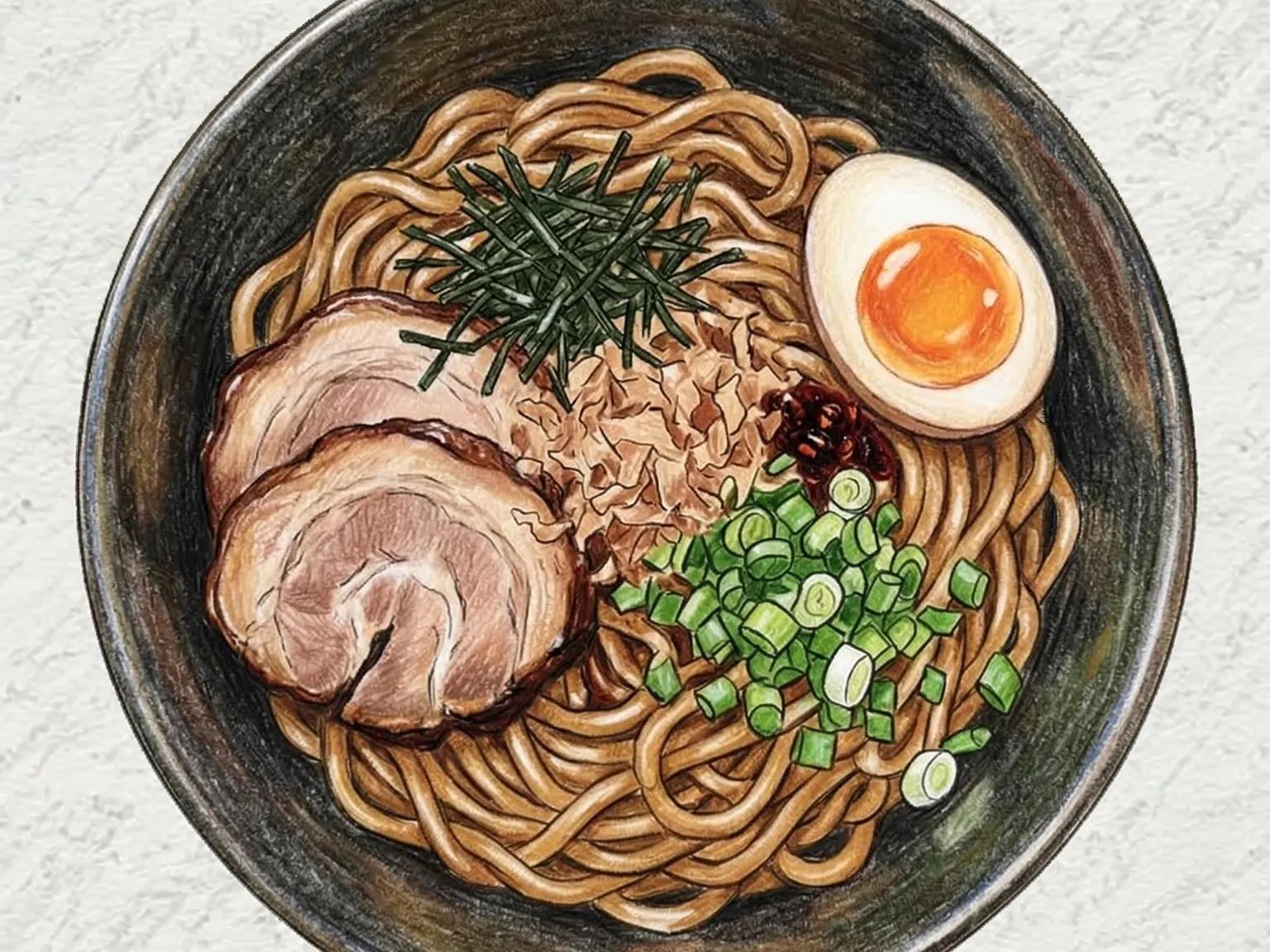
Abura soba is a noodle dish built entirely on what is in the bowl, not what surrounds it. No broth - just a concentrated sauce pooled at the bottom: soy sauce, sesame oil, oyster sauce, and a measured pour of vinegar. Cooked ramen noodles land on top, and the first task is mixing everything from below with chopsticks until each strand is fully coated. Where broth-based ramen dilutes its seasoning across liters of liquid, abura soba delivers the full flavor load directly onto the noodle. The technique developed in Tokyo's student districts in the 1950s as a cheaper, quicker option than ramen - no long broth to maintain meant faster service and lower overhead. Toppings follow the standard ramen template: chashu pork, a runny soft-boiled egg, nori, bonito flakes, and scallion add salt, fat, smoke, and freshness in sequence. The vinegar in the base sauce is not incidental - it cuts through the oil and keeps the dish from turning heavy halfway through. Adjusting the vinegar amount is considered part of eating abura soba, a small customization that regulars develop opinions about.
Instructions
Read the steps as a cooking flow: prep, heat, seasoning, doneness control, and finish.
- 1Finish
Finely slice 20g of green onion and cut the soft-boiled egg in half.
Keep the chashu pork, bonito flakes, and nori ready beside the bowl so the hot noodles can be finished without waiting.
- 2Season
In the bottom of a wide serving bowl, add 2 tablespoons soy sauce, 1 tablespoon sesame oil, 1 teaspoon oyster sauce, and 0.5 tablespoon vinegar. Stir until the oyster sauce is fully dissolved and the base looks glossy and even.
- 3Heat
Bring plenty of water to a full boil, then add 130g of ramen noodles.
Keep the heat high and loosen the strands with chopsticks, cooking for 2 to 3 minutes until the noodles are springy, not soft or swollen.
- 4Season
Drain the noodles in a strainer and shake hard, then let the steam escape for about 10 seconds.
Do not leave visible water on the noodles, because excess moisture will dilute the sauce before it coats properly.
- 5Season
Push the chopsticks to the bottom and toss upward for at least 30 seconds.
The noodles should turn evenly brown and glossy, with very little sauce left pooled in the bowl, rather than pale strands sitting above the seasoning.
- 6Heat
Top with 2 slices of chashu pork, the soft-boiled egg, green onion, 5g bonito flakes, and 1 sheet of nori.
If the oil feels heavy, toss once more so the vinegar spreads through the bowl, then eat while hot.
After the steps
Pick a recipe that fits this dish.
Continue with shared ingredients, meal pairings, or a similar method.
Recipes That Go Well With This
More Noodles →Based on shared ingredients and meal pairing
Dipping Ramen (Japanese Thick Noodles with Concentrated Dipping Broth)
Tsukemen is a Japanese dipping ramen where thick noodles and a concentrated broth are served separately. The broth - typically tonkotsu or seafood-soy based - is reduced to roughly double the intensity of standard ramen soup. Noodles are rinsed in cold water after boiling, which firms their texture and creates a temperature contrast when dipped into the hot broth. Toppings such as chashu pork, soft-boiled egg, and nori are arranged alongside the noodles. The recipe takes about 50 minutes, with most time spent building and reducing the dipping broth.
Cold Buckwheat Noodles
Mori soba is a Japanese cold noodle preparation where buckwheat noodles are boiled, rinsed under cold running water until firm, and served on a bamboo draining mat alongside a chilled tsuyu dipping broth. The nutty, slightly grainy character of buckwheat is the foundation of the dish, with each mouthful releasing an earthy, grain-forward fragrance. Tsuyu, concentrated from katsuobushi, kombu, soy sauce, and mirin and then chilled, is rich in umami and strong enough that a brief dip coats the noodles completely without drowning them. Wasabi and thin-sliced scallion stirred directly into the broth add sharp heat and a clean green note, while a pinch of shredded nori over the noodles introduces a subtle oceanic undertone. After boiling, the noodles must be cooled thoroughly in ice water to lock in their elasticity and prevent them from turning soft before serving.
Wafu Daikon Salad (Shredded Radish with Japanese Soy Dressing)
Wafu daikon salad shreds daikon radish into very fine julienne strips and dresses them with a Japanese wafu dressing made from soy sauce, rice vinegar, and sesame oil, finished with bonito flakes and torn nori. Soaking the shredded daikon in cold water for five minutes draws out excess starch and maximizes its crisp, snappy texture - draining and drying thoroughly afterward prevents the dressing from becoming diluted. The dressing layers soy salt over the gentle acidity of rice vinegar and the nuttiness of sesame oil, giving depth to the otherwise neutral radish. Bonito flakes placed on top wave gently in the residual heat and release a smoky umami that permeates the salad. Shredded nori adds a briny crunch that creates textural contrast throughout the bowl.
Mushroom Memil Soba (Warm Buckwheat Noodles in Mushroom Dashi)
Beoseot memil soba is a warm buckwheat noodle soup built on dashi stock seasoned with soy sauce and mirin, with shiitake and oyster mushrooms simmered for five minutes so their concentrated woodsy depth moves fully into the broth. Dried shiitake contributes far more umami than fresh, and oyster mushrooms torn along the grain absorb more liquid than sliced. The soba noodles are cooked separately and rinsed in cold water to strip off surface starch, which keeps the broth clear and prevents the noodles from turning soft. A small curl of yuzu zest placed on top just before serving sends a sharp citrus note across the broth's earthy weight, lifting the finish without overpowering it. Green onion scattered on top adds a layer of fresh aroma and color.
Serve with this
Korean Pickled Garlic (Soy-Vinegar Aged Whole Cloves)
Maneul-jangajji is whole garlic cloves pickled in a soy-vinegar brine, a traditional Korean preserved banchan that sits near-permanently in the kimchi refrigerator alongside kimjang kimchi. The customary practice is to make it during the June fresh garlic harvest and eat it throughout the year, replenishing the supply annually. After three or more months submerged in the brine, every trace of the raw garlic's sharp, pungent bite disappears, leaving behind a clove that has become almost translucent, with a jelly-firm texture and a clean salty-sweet flavor with no heat at all. The baseline ratio for the brine is two parts soy sauce to one part vinegar. Increasing the vinegar beyond that ratio tips the flavor too far toward sourness, making the pickles difficult to eat alongside rice as a general banchan. The brine must be brought to a full boil and cooled completely before it is poured over the garlic - never hot, which would partially cook the cloves. Repeating the cycle of draining the brine, reboiling it, cooling it, and returning it to the jar every three days for three complete cycles significantly extends shelf life and builds a more layered depth of flavor than a single pouring achieves. Skipping this process results in a noticeably flatter pickle. After three days at room temperature to initiate fermentation, the jar moves to the refrigerator, where the lower temperature slows the process and preserves the characteristic crunch for months. The finished pickles are eaten one clove at a time alongside grilled pork belly or short ribs, where their acidity cuts through the fat. Minced finely and stirred into fried rice, they contribute a concentrated umami that is difficult to replicate with raw garlic.
Korean Dried Radish Greens Pancake
Boiled dried radish greens are combined with doenjang and pan-fried into a dense, rustic jeon with deep fermented character. The fibrous texture of the radish greens gives the pancake a satisfying chew, and the soybean paste saturates the batter so thoroughly that no dipping sauce is necessary. Buckwheat flour adds an earthy coarseness that suits the greens well. Cheongyang chili provides a spicy accent throughout. Minced garlic benefits from a brief saute in oil before being mixed into the batter-the raw edge cooks off and the garlic's savory depth integrates fully into the finished pancake. Cooking over low heat lets the inside set without burning the outside, producing a crisp surface and a tender, flavorful center.
Korean Wild Chive Kimchi (Spring Quick Gochugaru)
Dallae kimchi is a quick spring kimchi made by salting wild chives for just eight minutes to barely soften them, then dressing them in gochugaru, sand lance fish sauce, plum extract, and Korean pear juice. The bulb-end roots carry the most concentrated aroma, so they should not be trimmed too short, and the seasoning should be applied starting from the roots so the flavor penetrates evenly along the entire stalk. Pear juice adds natural sweetness and a little moisture that softens the heat from the chili, while sand lance fish sauce provides a lighter, more delicate umami than standard anchovy sauce. This kimchi smells fresh and bright immediately after preparation, but one day in the refrigerator allows a mild fermented depth to develop that rounds out the flavors considerably. Wild chives are best purchased between early March and mid-April, when the roots are fat and the aroma is fully developed. Salting beyond eight minutes causes the grassy fragrance to dissipate rapidly, so timing matters. The finished kimchi pairs naturally with namul side dishes and fresh vegetable salads at a spring table.
Similar recipes
Okinawa Soba (Thick Wheat Noodles with Braised Pork Belly)
Okinawa soba is a regional Japanese noodle dish from Okinawa featuring thick wheat noodles in bonito-based broth, topped with braised pork belly. The pork belly is blanched for three minutes to remove impurities, then slowly simmered in soy sauce, mirin, and sugar until the fibers turn soft and the meat absorbs a sweet-salty glaze. The bonito dashi broth is clear and subtly savory, seasoned lightly with soy sauce to complement rather than compete with the rich pork. Rinsing the cooked noodles briefly in warm water removes excess starch so the broth stays clean when poured over them. Bonito flakes placed on top just before serving release a smoky, oceanic fragrance, and sliced scallion adds a fresh green accent to the warm, meaty bowl.
Sapporo Miso Ramen (Hokkaido-Style Rich Miso Broth Ramen with Pork)
Sapporo miso ramen is a Hokkaido specialty featuring a thick broth designed to provide warmth during cold winters. The cooking process begins by sautéing minced garlic and ginger, followed by ground pork to render its fat. Cabbage and bean sprouts are then stir-fried briefly over high heat to maintain their crisp texture. The base uses a chicken broth mixed with miso paste. The miso is dissolved into the hot liquid after turning off the heat, as boiling would disperse its aroma. The dish is assembled by pouring this rich broth over separately cooked thick, curly ramen noodles that trap the savory soup in their curves. It is finished with sweet corn kernels and a pat of butter placed in the center. As the butter melts into the hot broth, it adds a smooth texture and rich flavor.
Japanese Rice Soup Porridge
Zosui is a Japanese rice porridge made by simmering leftover cooked rice in dashi broth and finishing with beaten egg. The broth soaks into the rice grains, giving the porridge a deep umami base, while the egg sets into soft ribbons throughout. Enoki mushrooms add thin, delicate strands of texture, and chopped scallions contribute a fresh finish. Seasoning is kept minimal with just soy sauce and salt to let the broth flavor come forward. It is often served as the closing dish after a nabe hot pot, using the remaining broth as the cooking liquid.