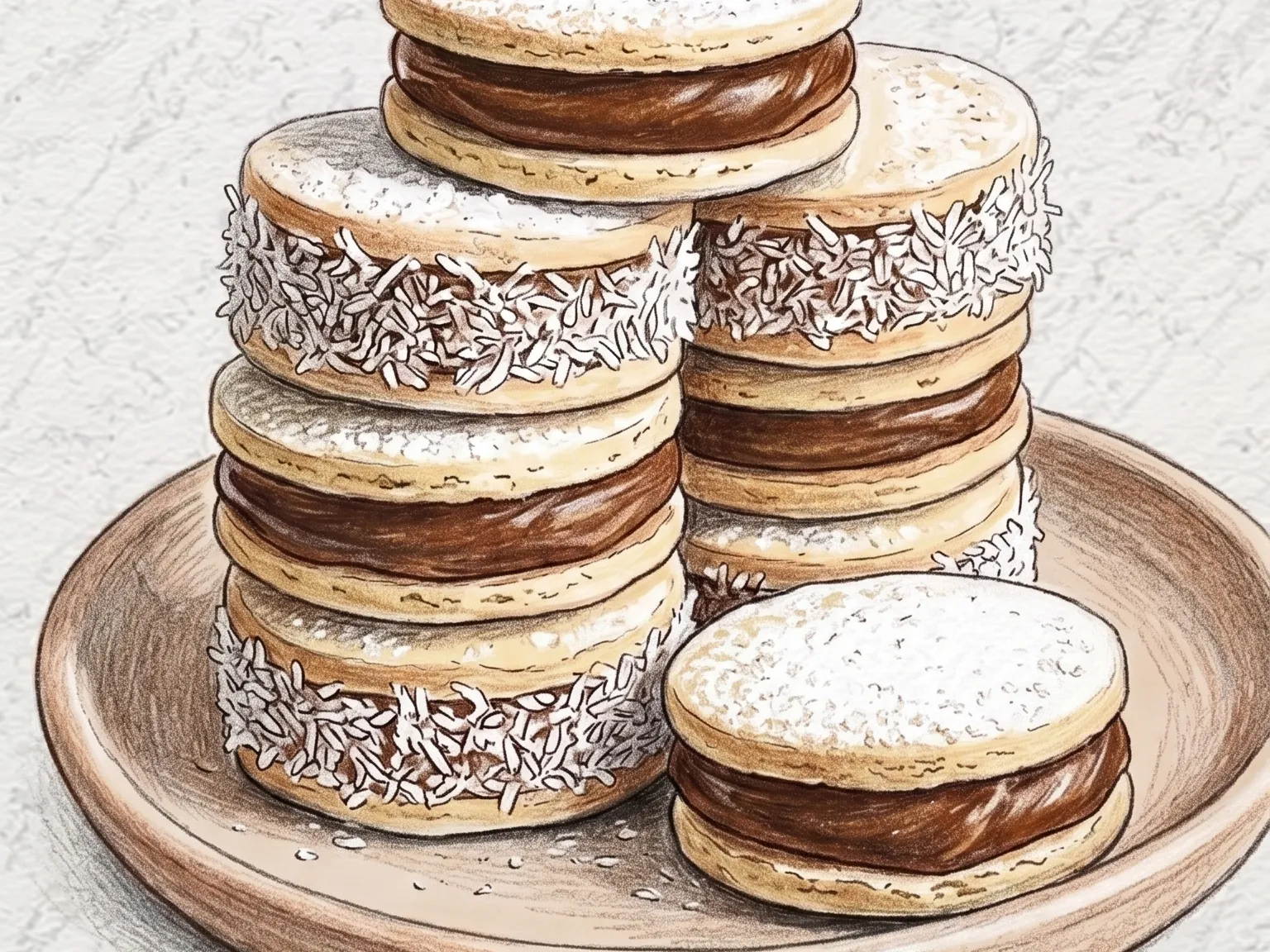
Alfajores (Argentine Dulce de Leche Sandwich Cookies)
Quick answer
Alfajores began as a medieval Andalusian sweet brought to Spain by Moorish confectioners, but the round, pillowy sandwich-cookie form that people recognize today was shap...
What makes this special
- Alfajores sandwich sweet dulce de leche between cornstarch cookies that crumble instantly.
- More cornstarch than flour gives a melt-on-the-tongue crumble
- Intentionally neutral cookie lets the dulce de leche dominate
Key ingredients
Core cooking flow
- 1 Soften 100g butter until it yields easily when pressed.
- 2 Add 2 egg yolks and 1 tsp vanilla extract, then mix on medium speed just until smooth.
- 3 Sift in 150g all-purpose flour and 100g cornstarch.
Alfajores began as a medieval Andalusian sweet brought to Spain by Moorish confectioners, but the round, pillowy sandwich-cookie form that people recognize today was shaped in 19th-century Argentina and Uruguay, where the recipe drifted far enough from its origins to become its own thing. The defining characteristic is the dough: heavily weighted with cornstarch relative to flour, it produces a cookie that does not snap or crunch but dissolves the moment it meets the tongue. Two rounds sandwich a thick layer of dulce de leche - slow-cooked milk caramel with a toffee depth and a consistency somewhere between fudge and butter - and the cookie itself is deliberately made plain so it does not compete with the filling. Rolling the exposed dulce de leche along the edge in shredded coconut adds a dry, fibrous contrast to the sticky center. A dusting of powdered sugar on top provides a brief, clean sweetness before the caramel asserts itself with each bite. In Buenos Aires, bakery windows stack them into towers, and the debate over which brand makes the best alfajor is treated with the seriousness Argentines reserve for football and steak.
Instructions
Read the steps as a cooking flow: prep, heat, seasoning, doneness control, and finish.
- 1Season
Soften 100g butter until it yields easily when pressed.
Beat it with 60g sugar for 2 to 3 minutes, stopping when the mixture looks paler, creamy, and no longer gritty against the bowl.
- 2Prep
Add 2 egg yolks and 1 tsp vanilla extract, then mix on medium speed just until smooth.
Scrape the sides of the bowl once or twice so the butter base stays even and does not separate.
- 3Prep
Sift in 150g all-purpose flour and 100g cornstarch.
Fold with a spatula using cutting motions, and stop as soon as the dry patches disappear so the dough stays tender instead of tough.
- 4Prep
Place the soft dough between plastic wrap or baking paper and roll it to 0.7cm thick.
Cut 5cm rounds, then lift them carefully onto the lined tray so the fragile edges stay round.
- 5Heat
Bake at 170C for 10 to 12 minutes, removing the cookies before they brown.
They are ready when the edges look set and the tops remain pale, since extra color makes them drier.
- 6Heat
Let the cookies cool completely on the tray until firm enough to handle.
Pipe or spoon 180g dulce de leche onto half of them, sandwich gently, and press just enough to spread the filling to the edge.
After the steps
Pick a recipe that fits this dish.
Continue with shared ingredients, meal pairings, or a similar method.
Recipes That Go Well With This
More Baking →Based on shared ingredients and meal pairing
Salted Doenjang Caramel Cookies
These unique cookies combine the rich umami of Korean fermented soybean paste, doenjang, with the sweetness of a brown sugar caramel dough. To prepare them, white sugar and heavy cream are heated to create a smooth caramel glaze. This mixture is cooled and combined with creamed butter, brown sugar, egg, and a small portion of strained doenjang, keeping the paste to about one or two percent of the total dough weight to ensure a subtle flavor. The dry ingredients are gently folded in before the dough is portioned into small balls and chilled for twenty minutes to control spreading during baking. Baking at 180 degrees Celsius results in cookies with crisp, toffee-like rims and soft, chewy centers. Pressing the centers slightly after baking enhances the texture. These treats offer a complex balance of sweet, salty, and savory notes that pair exceptionally well with espresso.
Gochujang Chocolate Crinkle Cookies
Gochujang chocolate crinkle cookies merge the fermented heat of gochujang with deep chocolate flavor in a single bite. The signature cracked surface forms when balls of dough rolled in powdered sugar expand in the oven, splitting the white coating to reveal the dark interior beneath. Gochujang, added in a modest amount, threads a low, lingering warmth and an umami undertone through the chocolate without overtly announcing itself. Most tasters sense something unexpected at the finish but cannot immediately identify the source. The exterior sets into a thin, lightly crisp shell while the inside stays dense and fudgy, occupying the territory between a brownie and a cookie. Using both cocoa powder and melted chocolate increases the chocolate intensity beyond what either ingredient achieves alone. A pinch of flaky sea salt on top before baking sharpens the contrast between sweet and spicy, making the flavor more defined. Chilling the dough for at least 30 minutes before rolling ensures the powdered sugar coating adheres evenly and produces the consistent cracking pattern that defines the cookie's appearance.
Black Sesame Pudding
Heukimja pudding is a chilled dessert made by warming milk and heavy cream on low heat with black sesame powder to extract its flavor, then setting the mixture with gelatin. The key to a silky consistency is stopping the heat when tiny bubbles appear at the edge of the pan, well before a full boil, which would cause the fat to separate. After seasoning with sugar and salt and straining once to remove any gritty particles, the liquid is divided into cups and refrigerated for at least two hours until set. A light dusting of black sesame powder on top before serving adds a visual accent and an extra layer of roasted, nutty fragrance. A small pinch of salt is worth adding because it subdues any residual bitterness from the sesame and makes the sweetness come through more cleanly. Gelatin sheets and powdered gelatin both work, but sheets tend to produce a smoother, cleaner result.
French Macarons
French macarons are small, round almond meringue sandwich cookies that demand precision at every single step of the process. The shells are made from finely ground almond flour, powdered sugar, and a meringue base, mixed using a technique called macaronage, which means folding the batter until it flows slowly off the spatula like lava and forms a smooth, glossy ribbon when piped. A properly baked macaron has a smooth domed top, a ruffled ring called the foot at its base, and a thin crisp shell that gives way to a chewy, lightly moist interior. The filling between the shells, whether buttercream, ganache, or fruit curd, carries the primary flavor of each variety. Classic options include vanilla and pistachio, while modern interpretations extend to raspberry, salted caramel, yuzu, and matcha. After assembly, macarons must rest in the refrigerator for at least twelve hours, during which moisture from the filling gradually softens the shells into a unified, melt-in-the-mouth texture that is impossible to achieve straight out of the oven. In Parisian patisseries, the quality of a single macaron shell is considered a reliable indicator of the entire shop's technical standard.
Serve with this
Burrito
A burrito layers seasoned ground beef, cooked rice, black beans, shredded cheese, and salsa inside a large flour tortilla that gets folded and rolled into a tight cylinder. Warming the tortilla briefly on a hot pan makes it pliable enough to wrap without tearing. The filling goes down the center in a long line, both ends fold inward first, then the whole thing rolls forward into a sealed package that holds together in the hand. Black beans add starchy substance and protein that make the burrito filling even without the meat at the center, and the tomato acidity in salsa cuts through the melted cheese and beef fat. A line of sour cream inside provides a cool, tangy buffer against the cumin-chili heat. For the cheese, Monterey Jack or cheddar melts evenly without clumping and binds the filling together well. Wrapping the finished burrito tightly in foil keeps the shape and makes it easier to eat on the go.
Korean Dalgona Coffee (Whipped Instant Coffee Foam Milk)
Dalgona coffee is made by whipping equal parts instant coffee, sugar, and hot water with a hand mixer for three to five minutes until stiff, caramel-colored peaks form, then spooning the foam over iced milk. The whipped layer carries a concentrated, bittersweet coffee flavor that gradually blends into the cold, neutral milk below as you stir. A light dusting of cocoa powder on top introduces a faint chocolate note, and increasing the sugar slightly helps the whipped cream hold its stiff structure longer.
Falafel Salad Bowl
A falafel salad bowl arranges crisp, herb-packed chickpea fritters over a bed of mixed greens or grains alongside chopped cucumber, tomato, red onion, and pickled vegetables. The falafel are made from soaked raw chickpeas blended with parsley, cilantro, cumin, and garlic, then fried or baked until the exterior turns deeply golden while the interior stays bright green and moist. A generous drizzle of tahini dressing ties the bowl together with its nutty, slightly bitter sesame character, and a squeeze of fresh lemon lifts the entire dish. Adding cooked quinoa, bulgur, or couscous underneath turns it into a filling one-bowl meal. Each bite moves between crispy falafel, crunchy raw vegetables, and creamy dressing, so no two forkfuls feel the same. Originating across the Middle East, falafel has become an internationally recognized symbol of plant-based cooking, and this bowl format balances protein and fiber in a well-rounded single serving.
Similar recipes
Rice Pudding
Rice pudding is made by simmering short-grain rice in milk over low heat, stirring regularly, until the grains swell and release their starch into the surrounding liquid. The result is a thick, porridge-like dessert with a creamy consistency that coats the back of a spoon. Vanilla extract infuses the dairy base with a warm, floral note, and a pour of heavy cream near the end pushes the richness further. A dusting of ground cinnamon on top adds an aromatic layer that greets the nose before the first spoonful reaches the mouth. The most common pitfall is scorching - rice and milk on a hot surface stick and burn quickly, so frequent scraping with a wooden spoon is non-negotiable. Because the pudding continues to thicken as it cools, pulling it off the heat when it looks slightly thinner than desired yields the best final texture. Served warm, it feels like a hug in a bowl; chilled overnight, it sets firmer and develops a denser, more custard-like character.
Korean Sweet Glutinous Rice
Glutinous rice is soaked, steamed, and dressed with a mixture of soy sauce, sesame oil, and honey, then studded with jujubes, chestnuts, and pine nuts before a second steaming. The double-steaming process gives the rice a dense, chewy stickiness while the soy sauce penetrates each grain and tints it a deep amber. Jujubes lend a natural caramel-like sweetness, chestnuts add a crumbly, starchy contrast, and pine nuts contribute a subtle oiliness that enriches the overall taste. Traditionally prepared for the first full moon festival, yakbap is equally enjoyable as an everyday snack or packed lunch.
Chestnut Sweet Jelly (Korean Agar-Set Chestnut White Bean Confection)
Bam yanggaeng is built from three components: chestnut puree, white bean paste, and agar powder. Boiled chestnuts are mashed fine and combined with the bean paste, then dissolved agar, sugar, and honey are stirred into the mixture before it is brought to a brief boil. Poured into a mold and left to cool at room temperature, the agar sets the block into firm, clean-slicing slabs - a texture that comes from agar's sharp recrystallization as it cools, which produces a harder and more abrupt snap than gelatin-based confections. The starchy density of chestnuts gives the cross-section a smooth, fine-grained quality that plain bean paste lacks. A small amount of salt is critical: it draws the sweetness into focus rather than muting it. Skimming air bubbles before pouring ensures a flat, even surface. Prepared as a holiday gift in Korean households for generations, the finished block keeps in the refrigerator for about a week without losing texture.