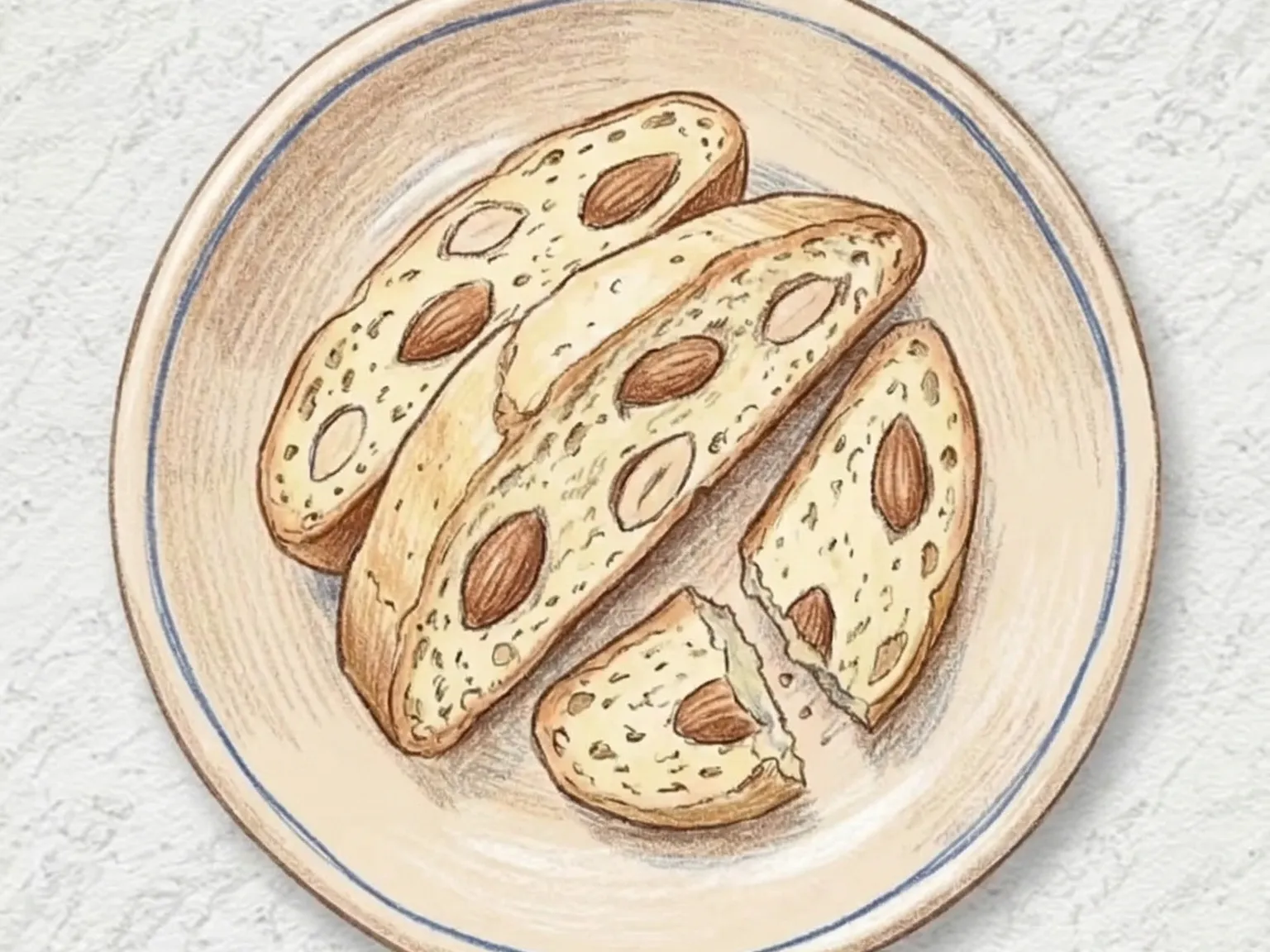
Almond Biscotti

Almond Biscotti

Quick answer

Biscotti - meaning 'twice-cooked' in Italian - originated in the Tuscan city of Prato, where they have been produced since at least the 14th century.

What makes this special

  • Almond Biscotti are twice-baked for a hard snap that holds up when dipped into hot coffee.
  • Double baking at 170 then 150 degrees drives out all moisture for snap
  • Whole almonds deliver nutty bitterness against vanilla-lemon dough
Total time
60 min
Level
Easy
Servings
24 servings
Ingredients
8
Calories
105 kcal
Protein
3 g

Key ingredients

all-purpose floursugareggsbaking powdersalt

Core cooking flow

  1. 1 Preheat the oven to 170°C and prepare a baking sheet.
  2. 2 Place 3 eggs and 150g sugar in a bowl and whisk lightly, avoiding excess foam.
  3. 3 Sift in the 250g all-purpose flour, baking powder, and salt.

Biscotti - meaning 'twice-cooked' in Italian - originated in the Tuscan city of Prato, where they have been produced since at least the 14th century. They were originally designed as provisions for long sea voyages: the double baking drives out nearly all moisture, producing a cookie that resists spoilage for weeks without refrigeration. The dough is shaped into a flat log and baked once until firm throughout, then sliced on the diagonal and returned to the oven at a lower temperature until each piece is completely dry and hard. Whole almonds embedded in the crumb provide a contrasting crunch and a toasted, slightly bitter quality that plays against the vanilla-scented dough. The result is deliberately too hard to eat comfortably on its own - biscotti are made to be dipped. Dunked into espresso, Vin Santo, or strong black coffee, the outer layer softens immediately while the dense interior holds its structure, creating a texture that alternates between giving and crisp with each bite. In Prato, where the cookie is also called 'cantuccini' or 'pratesi,' the traditional pairing is with locally produced Vin Santo dessert wine.

Prep 15min Cook 45min 24 servings

Instructions

Read the steps as a cooking flow: prep, heat, seasoning, doneness control, and finish.

6 steps
  1. 1
    Prep

    Preheat the oven to 170°C and prepare a baking sheet.

    Toast the 120g whole almonds for about 5 minutes, just until fragrant, then let them cool so they stay crisp in the dough.

  2. 2
    Season

    Place 3 eggs and 150g sugar in a bowl and whisk lightly, avoiding excess foam.

    Add the vanilla extract and lemon zest, then mix until the aroma is evenly distributed through the egg mixture.

  3. 3
    Season

    Sift in the 250g all-purpose flour, baking powder, and salt.

    Add the cooled almonds and fold with a spatula only until no dry flour remains, keeping the dough dense rather than elastic.

  4. 4
    Heat

    Divide the dough in two and shape each piece into a flat log about 5cm wide.

    Place them apart on the baking sheet and bake at 170°C for 25 minutes, until firm and pale golden.

  5. 5
    Prep

    Remove the logs and cool them for 10 minutes so the crumb stabilizes.

    Do not slice while very hot, or they may crumble; use a serrated knife to cut diagonal 1.5cm slices.

  6. 6
    Finish

    Arrange the slices again with the cut sides facing up.

    Bake at 150°C for 15-20 minutes to drive off moisture, then cool completely and serve with espresso or Vin Santo.

After the steps

Pick a recipe that fits this dish.

Continue with shared ingredients, meal pairings, or a similar method.

Recipes That Go Well With This

More Baking →

Based on shared ingredients and meal pairing

Bam Tiramisu (Chestnut Tiramisu)
Serve together Desserts

Bam Tiramisu (Chestnut Tiramisu)

Chestnut tiramisu is a variation of the traditional Italian dessert that incorporates chestnut puree into the mascarpone cheese filling. This modification transforms a standard cafe dessert into a preparation specifically associated with the autumn season in Korea. The fundamental elements of the recipe remain consistent with the classic version. It utilizes ladyfinger biscuits that have been soaked in espresso, a filling made of whipped mascarpone and cream, and a final layer of cocoa powder. However, the introduction of chestnut puree alters the profile of the cream. Instead of a simple dairy richness, the mixture takes on an earthy quality. Using a puree made from chestnuts boiled at home, rather than a store-bought paste, helps maintain the natural grain of the nut. This provides the cream with a specific texture that is noticeable in every spoonful. When preparing the ladyfingers, the espresso soak requires a high level of precision. Each biscuit should be dipped for approximately one to two seconds. If the ladyfingers are submerged for a longer duration, they absorb an excessive amount of liquid. This leads to a waterlogged consistency which can cause the structural layers of the dessert to collapse while it sits in the refrigerator. The assembly process follows a predictable sequence. A layer of soaked ladyfingers is placed at the bottom, followed by a layer of the chestnut cream. This pattern is repeated once more before the entire dish is placed in the refrigerator to rest for at least four hours. This period of refrigeration is essential to the final outcome. During these hours, the ladyfingers absorb moisture from both the espresso and the cream layer above them. This process changes the biscuits from a crunchy state to a soft texture similar to cake, which allows for clean slices. Just before the dessert is served, a thin layer of cocoa powder is applied to the top. This adds a bitter element that balances the sweetness of the chestnuts. Preparing the tiramisu in individual glass containers or cups ensures that the portions are easy to manage and allows the different layers of the dessert to be clearly visible from the side.

Gnocchi alla Sorrentina (Tomato Mozzarella Baked Gnocchi)
Serve together Western

Gnocchi alla Sorrentina (Tomato Mozzarella Baked Gnocchi)

Gnocchi alla Sorrentina is a southern Italian baked pasta dish from the Sorrento coast where soft potato gnocchi are tossed in tomato sauce, blanketed with torn mozzarella and grated Parmesan, then baked until the cheese melts and bubbles. Garlic is gently coaxed in olive oil before the tomato sauce goes in and simmers, drawing the garlic's mellow sweetness throughout the base. Gnocchi are boiled only until they float and then immediately drained to preserve their characteristic pillowy chew, before being folded into the sauce with half the basil and transferred to a baking dish. Eight minutes at 220 degrees Celsius transforms the cheese into a molten, pulling layer that unites the bright tomato acidity and the salty richness of the two cheeses into a single flavor. The remaining fresh basil scattered across the top at the end adds a fragrant lift that anchors the dish to its coastal Italian origins.

Tomato Basil Juice
Serve together Drinks

Tomato Basil Juice

Tomato basil juice is a cold savory drink made by blending ripe tomatoes with fresh basil leaves and straining the result through a fine sieve to remove seeds and skins. The ripeness of the tomato determines much of the flavor: fully ripe tomatoes carry free glutamates that produce a natural umami depth, whereas underripe fruit tastes predominantly sour without the sweetness and savory body that makes the juice satisfying. Basil should be added to the blender immediately before blending rather than sitting cut or torn, because the volatile oils that produce its aroma begin oxidizing quickly once the leaves are damaged. After blending to a smooth consistency, passing the juice through a fine-mesh strainer or cheesecloth removes the solids and produces a texture smooth enough to drink without resistance. Salt and black pepper season the juice, and fresh lemon juice raises the acidity in a way that brightens the overall flavor rather than making it sour. A small addition of olive oil emulsifies into the juice and activates fat-soluble aromatic compounds in both the tomato and the basil, producing a fuller, rounder flavor than the unstrained version. The juice must be thoroughly chilled before serving, as warmth mutes the herbal freshness. It works well as a brunch drink, a light non-alcoholic aperitif, or a base for savory cocktails.

Florentine Cookies (Caramel Almond Lace with Chocolate)
Similar recipe Baking

Florentine Cookies (Caramel Almond Lace with Chocolate)

Florentine cookies are thin, lace-like biscuits made by stirring sliced almonds, candied orange peel, and dried cherries into a hot caramel of sugar, butter, and heavy cream, then spooning small pools of the mixture onto a lined baking sheet. In the oven, the caramel re-liquefies and spreads, binding the nuts and fruit into flat, crisp discs with a translucent amber surface. The baked rounds are fragile and catch the light like stained glass when held up. Once cooled, one side is coated with tempered dark chocolate, and a fork is dragged through the surface just before setting to create the classic wave pattern. The texture sequence is distinctive: the first bite shatters the caramel shell cleanly, then gives way to chewy pockets of dried fruit embedded in the caramel. Flavor-wise, toasted caramel sweetness opens first, followed by the bitter note of orange peel, the nuttiness of almonds, and finally the deep bitterness of dark chocolate. The combination is considerably more layered than the cookies' fragile appearance suggests. Stored in an airtight container, they hold their snap well for several days, making them a reliable choice for gift boxes or holiday platters.

Similar recipes

Affogato
Baking Easy

Affogato

Affogato means drowned. A scoop of vanilla gelato, one shot of espresso pulled fresh, and that is the recipe. Its origins are placed in Milan's coffee bars around the mid-20th century, though the logic behind it is older - hot poured over frozen, bitter cut with sweet. What makes it work is physics as much as flavor: near-boiling espresso hits frozen cream and immediately begins melting the contact layer, creating a rapidly shifting border where coffee and vanilla blend before the temperatures equalize. The window for that state - two things at once, neither fully dominant - lasts roughly two minutes. The espresso must be poured at the table while the crema is still intact and the heat at its peak; a shot left sitting a minute loses both. Dark chocolate shaved on top introduces a dry cocoa note. Toasted almond slices give a crunch that holds briefly before the melting ice cream claims them too. Once everything is warm and uniform, it has become a coffee drink. The dessert lives in the transition.

🧒 Kid-Friendly ⚡ Quick
Prep 5min Cook 2min 2 servings
Dalgona Tiramisu (Korean Whipped Coffee Cream Layered Tiramisu)
Baking Medium

Dalgona Tiramisu (Korean Whipped Coffee Cream Layered Tiramisu)

This Korean variation of tiramisu incorporates the whipped dalgona coffee method that gained international popularity and integrates it into the traditional framework of a classic Italian dessert. To create the characteristic topping, instant coffee is combined with sugar and hot water, then whipped vigorously until the mixture transforms into a dense and aerated foam. This specific preparation method results in a coffee profile that is significantly more concentrated and prominent than the standard espresso soak typically used in such recipes. The dalgona foam is positioned between layers of smooth mascarpone cream and ladyfingers that have been briefly submerged in espresso. This addition provides both a deep intensity of flavor and a texture that resembles a light mousse throughout the dish. The dessert requires a minimum of four hours in the refrigerator to allow the various components to settle and merge properly. Once thoroughly chilled, each serving provides a combination of the softened biscuit, the creamy mascarpone, and the coffee foam in a single bite. A thin layer of cocoa powder is applied across the surface to provide a finished appearance and a subtle bitterness. If a version with less sweetness is preferred, the volume of dalgona syrup can be decreased to allow the natural bitter qualities of the coffee to become more apparent.

🎉 Special Occasion 🧒 Kid-Friendly
Prep 25min 4 servings
Pizza Dough
Baking Easy

Pizza Dough

Bread flour, instant yeast, olive oil, and water come together into a simple Italian pizza dough that is the foundation for any topping combination. Five to eight minutes of kneading develops enough gluten for a chewy, elastic crust that stretches easily without tearing. After a one-hour room-temperature rise, the dough is divided and shaped by hand into rounds. The highest possible oven temperature is the single most important factor for a crisp bottom, as intense heat sets the crust before moisture from the toppings can soften it. Preparing the dough a day ahead and cold-fermenting it in the refrigerator allows the yeast to work slowly, developing complex flavors that a quick rise cannot match. Each batch yields two pizzas roughly thirty centimeters in diameter.

🧒 Kid-Friendly 🌙 Late Night
Prep 15min Cook 12min 2 servings
Chicken Cacciatore
Western Medium

Chicken Cacciatore

Chicken cacciatore is an Italian countryside dish where chicken pieces are seared hard in olive oil until deeply browned, then braised over low heat for forty minutes with onion, garlic, canned tomatoes, black olives, capers, red wine, and thyme. The initial sear in a very hot pan triggers a Maillard reaction on the skin and surface of the meat; those browned flavors dissolve into the braising liquid and dramatically deepen the sauce as it simmers. Red wine is added and simmered for two minutes to cook off the alcohol before the remaining ingredients go in, leaving only the acidity and fruit character of the wine to layer with the tomato. The briny, savory taste of the olives and the tart, floral sharpness of the capers keep the sweetness of the canned tomatoes in check, while thyme runs as a steady, quiet herbal thread throughout. This dish improves substantially when reheated the next day, as the flavors penetrate further into the meat overnight. Leftover braising sauce is excellent tossed with pasta or spooned over soft polenta.

🎉 Special Occasion 🍺 Bar Snacks
Prep 15min Cook 55min 4 servings
Pasta Puttanesca (Neapolitan Anchovy Olive Caper Tomato Sauce)
Noodles Easy

Pasta Puttanesca (Neapolitan Anchovy Olive Caper Tomato Sauce)

Pasta puttanesca is a Neapolitan pasta sauce built from anchovies melted into olive oil, crushed whole tomatoes, black olives, capers, and peperoncino. The anchovies dissolve completely during cooking, leaving behind a deep umami foundation rather than a fishy taste. Olives and capers provide enough salt that additional seasoning is rarely needed. The entire sauce comes together in under twenty minutes using shelf-stable pantry ingredients.

🏠 Everyday ⚡ Quick
Prep 10min Cook 20min 2 servings

Tips

Toast almonds lightly before adding for extra nuttiness.
Reduce second bake time for a slightly chewy center.

Nutrition (per serving)

Calories
105
kcal
Protein
3
g
Carbs
16
g
Fat
3
g