Apple Crumble
Quick answer
Apple crumble was born from wartime constraint: during World War II, butter and sugar rationing in Britain made traditional double-crust pastry impractical, and bakers fo...
What makes this special
- Apple Crumble pairs a buttery oat topping with tender fruit for a crunchy and soft finish.
- Crumble top stays crisp while the layer touching fruit juice becomes soft
- Oat-flour topping creates a coarser, chewier crust than plain flour alone
Key ingredients
Core cooking flow
- 1 Preheat the oven to 180°C and set out a baking dish.
- 2 Toss the apples with 30g sugar and 1 teaspoon ground cinnamon until every surface looks lightly coated.
- 3 Mix 100g flour, 50g rolled oats, and the remaining 50g sugar in a bowl.
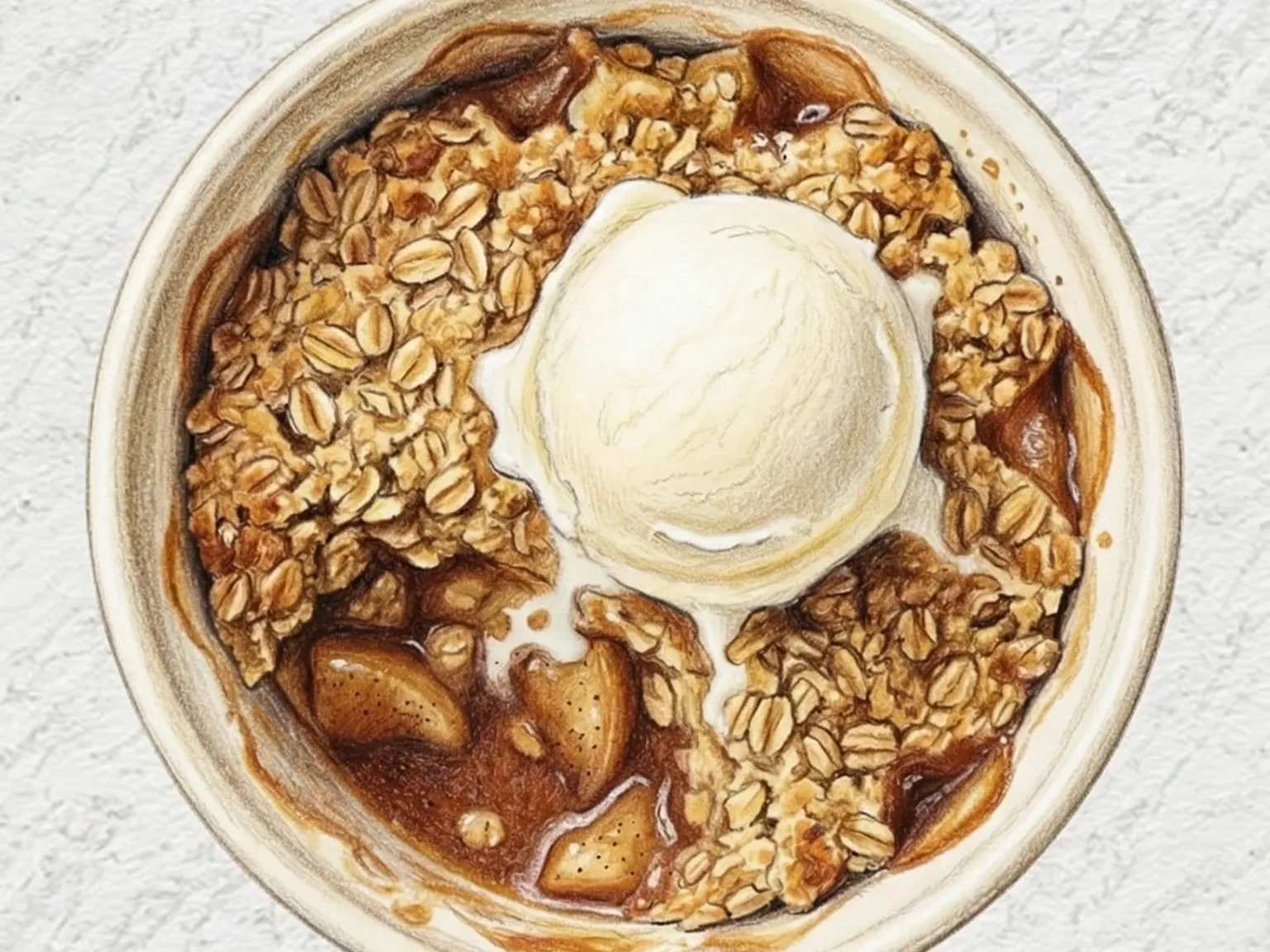
Apple crumble was born from wartime constraint: during World War II, butter and sugar rationing in Britain made traditional double-crust pastry impractical, and bakers found that rubbing a far smaller amount of fat into flour and oats produced a topping that required none of the skill or rolling that pastry demanded. Sliced apples are tossed with sugar, lemon juice, and cinnamon, then spread into a baking dish and covered with the rough, breadcrumb-like mixture. In the oven, the fruit collapses into a thick, bubbling sauce while the topping bakes unevenly: the peaks turn deeply crisp and golden, while the underside where the topping meets the fruit juices becomes slightly sticky and chewy. Tart apple varieties such as Granny Smith hold up better under oven heat than sweet ones, turning into a fragrant sauce that contrasts with the sandy crumble overhead. The tension between the hot, yielding apple beneath and the crunchy, butter-scented rubble on top is the structural logic of the dish. Served with cold vanilla ice cream or warm pouring custard, the contrast multiplies further as cold cream melts into the steaming fruit. It remains the default British home dessert precisely because it needs nothing beyond what a reasonably stocked cupboard can supply and comes together in under an hour.
Instructions
Read the steps as a cooking flow: prep, heat, seasoning, doneness control, and finish.
- 1Prep
Preheat the oven to 180°C and set out a baking dish.
Peel 4 apples and cut them into 2cm pieces, keeping the chunks large enough to soften in the oven without turning watery too quickly.
- 2Season
Toss the apples with 30g sugar and 1 teaspoon ground cinnamon until every surface looks lightly coated.
Spread them evenly in the dish so the fruit cooks at the same pace and the juices collect evenly.
- 3Season
Mix 100g flour, 50g rolled oats, and the remaining 50g sugar in a bowl.
Add 70g cold butter and rub it in with your fingertips, stopping while pea-sized buttery crumbs still remain.
- 4Control
Scatter the crumble over the apples instead of pressing it down.
Cover visible gaps, but keep the surface loose and uneven so heat can circulate and the peaks bake crisp rather than dense.
- 5Heat
Bake for about 35 minutes in the preheated oven.
It is ready when the top is deep golden and apple juices bubble around the edges, showing the fruit has softened underneath.
- 6Finish
Let the crumble rest for 5 minutes after baking so the bubbling juices settle slightly.
Serve it warm, when the apple layer is soft and spoonable while the crumble still keeps its crisp texture.
After the steps
Pick a recipe that fits this dish.
Continue with shared ingredients, meal pairings, or a similar method.
Recipes That Go Well With This
More Baking →Based on shared ingredients and meal pairing
Classic Apple Pie
Apple pie has been baked in America since the colonial era, though its origins lie in 14th-century English and Dutch recipes where apples were enclosed in pastry as a way to cook fruit without a proper oven. The filling is built from tart baking apples - Granny Smith or Braeburn - tossed with sugar, cinnamon, nutmeg, a squeeze of lemon, and a spoonful of flour or cornstarch to thicken the juices as they cook. The double crust is made from cold butter cut into flour until the dough resembles wet sand, producing flaky, shattering layers when baked. As the pie bakes, the apples soften and release their juice, which the starch captures into a syrupy glaze that holds the filling together when sliced. The top crust turns deep golden and pulls away slightly from the filling, creating a hollow where steam escapes. Served warm with a scoop of vanilla ice cream - a la mode - or a slice of sharp cheddar in the New England tradition, apple pie is as much a cultural symbol as it is a dessert.
Apple Turnover
Apple turnovers trace back to the medieval European practice of encasing fruit in pastry - a portable format that became a fixture at French and English market stalls by the 17th century. Puff pastry is rolled thin and cut into squares, then topped with apples briefly cooked down with cinnamon, sugar, and lemon juice to concentrate their flavor and reduce excess moisture. Folding the square into a half-moon and crimping the edges seals in steam during baking, which forces apart the laminated layers into a shatteringly crisp, deep-golden shell. Inside, the apples have collapsed into a jammy, soft mass. Cinnamon amplifies the fruit's sweetness, while lemon juice maintains enough acidity to prevent the filling from turning cloying. An egg wash brushed on before baking produces the lacquered, caramelized surface. The contrast between the brittle, flaking crust and the hot, syrupy interior is at its most vivid in the first few minutes out of the oven, before the pastry begins to soften.
Ssiat Hotteok (Korean Sweet Seed Pancake)
Ssiat-hotteok is a Korean street snack made from a yeast-leavened dough stuffed with a mixture of brown sugar, cinnamon, sunflower seeds, and pumpkin seeds, then pressed flat in an oiled pan until the outside crisps and the inside turns molten. The dough must proof until it doubles in size before dividing into eight portions; each portion is filled and the seam pinched shut firmly, because a loose seal allows the melted sugar to escape and burn against the pan. Slow cooking on low heat develops a thin, crisp crust on the exterior while the brown sugar inside dissolves into a sticky syrup that carries the warmth of the cinnamon and the crunch of the seeds. Activating the yeast in warm milk rather than water adds a subtle dairy richness to the dough, producing a softer, more rounded result than versions made with water alone.
Rum Balls
Rum balls are a no-bake confection made by combining crushed chocolate cookie crumbs with dark rum, cocoa powder, powdered sugar, and melted butter, then rolling the mixture into compact spheres and coating them in cocoa. The absence of baking keeps the process fast and the result dense - each ball has a fudge-like firmness that yields slowly on the tongue, releasing waves of cocoa bitterness followed by the warm, boozy bloom of rum. The low moisture content means the crumb mixture binds tightly, holding its shape without refrigeration, though chilling overnight allows the rum to permeate every particle of cookie and cocoa for a more unified flavor. Stored in an airtight container, they keep for well over a week. Rolling some in chopped pistachios or rainbow sprinkles instead of cocoa adds color and textural variety, which makes them suitable for gift boxes or party platters. Despite their simplicity, the interplay between chocolate and rum gives these small bites a sophistication that belies the ten-minute preparation.
Serve with this
Calzone
Calzone rolls pizza dough into a circle, fills one half with ricotta, mozzarella, diced ham, and fresh basil, then folds into a half-moon shape, seals the edges with a fork, and bakes until golden at 220 degrees Celsius. Leaving a two-centimeter border free of filling is critical -- overstuffing causes steam pressure to burst the seam during baking. Brushing a thin line of water along the edge before pressing firmly with a fork creates a tighter seal that holds through the full bake. Fifteen to twenty minutes in a well-preheated oven produces a crisp, burnished exterior while the interior heats the ricotta into a soft cream and melts the mozzarella into long, stretchy strings. Brushing olive oil on the surface before baking adds a richer color and a slight nuttiness to the crust. Tomato sauce served on the side for dipping provides an acidic counterpoint that cuts through the dense cheese filling and keeps each bite feeling balanced.
Einspanner (Espresso with Vanilla Whipped Cream)
The Einspanner is a coffee beverage originating from Austria that features a distinct layered structure consisting of espresso at the bottom and a dense portion of whipped cream on top. This cream is typically seasoned with a small amount of sugar and vanilla extract to provide a subtle sweetness that complements the coffee. A primary characteristic of this drink is the sharp visual and textural contrast between the dark espresso base and the thick, pale cream that rests on the surface. Proper preparation of the cream is essential for the beverage to function as intended. It must be whipped until it reaches a specific consistency of approximately seventy percent stiffness, which allows it to remain fluid enough to float and spread evenly across the entire surface of the espresso. If the cream is over-whipped and becomes too firm, it will form clumps and fail to integrate naturally with the coffee as the person drinks it. The assembly process involves cooling the espresso for a short period before pouring it into a glass containing ice. The whipped cream is then added slowly by using the back of a spoon to guide it onto the surface of the coffee. This specific technique is used to ensure that the two layers remain separate and do not mix prematurely. To finish the preparation, a fine layer of cocoa powder is dusted over the top of the cream. This addition provides a light chocolate flavor that serves as a bridge between the bitter notes of the espresso and the sweet taste of the whipped cream. Customarily, an Einspanner is consumed without the use of a straw. The standard method is to sip the coffee directly through the layer of cream so that both components reach the palate at the same time. This allows for the simultaneous experience of the concentrated coffee and the flavored cream in every mouthful.
Beet and Goat Cheese Salad
Beet and goat cheese salad begins with whole beets wrapped in foil and roasted at 200°C for forty-five to sixty minutes, long enough for their raw, earthy undertone to convert almost entirely into a concentrated, caramel-adjacent sweetness. Peeling the skins while the beets are still warm requires only the pressure of a paper towel - they slip off cleanly - and slicing them before they cool preserves the vivid crimson-purple cross-section that makes the dish visually striking. Crumbled goat cheese placed on the warm slices softens slightly, and its tangy acidity cuts through the dense sweetness of the roasted root rather than competing with it. Walnuts toasted briefly in a dry pan lose much of their raw bitterness, developing a nuttiness that bridges the mineral quality of the beet and the dairy sharpness of the cheese. Balsamic reduction does more than dress the plate: its concentrated sweet-tart intensity ties the separate components into a coherent whole. Arugula underneath the beet slices provides a peppery bitterness that sharpens the contrast against the sweetness, giving the salad a complexity well beyond what its short ingredient list suggests. A simple dressing of extra-virgin olive oil and lemon juice over the greens keeps the balance light and clear.
Similar recipes
Challah Bread (Jewish Braided Egg Enriched Bread)
Challah is a traditional Jewish enriched bread made with eggs and oil, which give it a golden crumb, a tender, slightly chewy texture, and a faint sweetness that stops well short of being dessert-like. The dough is built from bread flour, yeast, sugar, eggs, and oil, divided into long strands, braided together, and then proofed before going into the oven. Brushing the loaf with egg wash before baking produces a deeply bronzed, glossy crust that contrasts visually and texturally with the pillowy interior. The braiding is not purely decorative; the interlocked strands provide structural support during proofing and help heat distribute evenly through the loaf while baking. Despite the eggs and sugar in the dough, challah eats like bread rather than cake and works equally well as a sandwich loaf, a dinner table bread, or sliced and toasted with butter and jam. It is traditionally prepared for Shabbat and Jewish holidays, but there is no practical reason to limit it to those occasions. Day-old challah absorbs custard deeply and evenly because of its tight, even crumb, making it one of the best breads for French toast.
Clafoutis (French Baked Cherry Custard Dessert)
Clafoutis is a traditional French dessert from the Limousin region made by arranging fresh cherries in a buttered baking dish, then pouring over a thin batter of eggs, sugar, milk, and flour and baking at 180 degrees Celsius for thirty to thirty-five minutes. The batter is considerably thinner than pancake batter, and the result when baked is a texture that sits between a creamy custard and a light sponge -- the edges puff and turn golden while the center around the cherries stays moist and yielding. Using unpitted cherries is the traditional method: the pits release a faint almond scent during baking that perfumes the surrounding batter in a way that pitted fruit cannot replicate. The cherries also hold their shape better with the pits in. Vanilla extract deepens the egg-and-milk base, and the cherries' own tart juice seeps into the batter during baking, creating concentrated pockets of fruit flavor that balance the overall sweetness. Clafoutis is served directly from the baking dish, typically dusted with powdered sugar and brought to the table while still warm, because the custard texture softens and loosens slightly as it cools, making the warm version noticeably more appealing. Made with blueberries, plums, or apricots instead of cherries, the dessert takes a different name -- flaugnarde -- though the technique remains identical.
Bibingka (Filipino Coconut Rice Cake)
Bibingka is a Filipino baked rice cake that belongs almost entirely to the Christmas season, sold warm from clay-pot stalls outside churches after Simbang Gabi, the nine-day series of dawn masses leading up to Christmas Day. For Filipinos, the smell of bibingka cooking over charcoal at four in the morning is inseparable from the feeling of the holiday itself. The batter is made from ground rice flour mixed with coconut milk, eggs, and sugar, then poured into a clay pot lined with fresh banana leaves. The pot sits between two layers of live charcoal - one below and one held above on a metal lid - so both surfaces cook simultaneously. This top-and-bottom heat is what gives bibingka its characteristic crust: lightly charred and fragrant on the outside from the banana leaves, moist and tender within. As the batter cooks, the banana leaves release a vegetal green fragrance that infuses into the rice cake and leaves faint dark marks on the underside. Midway through cooking, slices of salted duck egg are pressed into the surface alongside fresh coconut shavings, then a brush of butter is applied and the cake returns to the heat. During this final pass the sugars in the butter and batter caramelize at the edges, producing a triple wave of banana leaf, coconut, and butter aromas. The finished texture sits somewhere between a glutinous rice cake and a sponge cake - slightly sticky and chewy yet airy and soft. The salted egg cuts through the sweetness and gives each bite a complexity that plain sweetness alone cannot provide. Bibingka vendors outside Philippine churches in December, tending glowing braziers in the pre-dawn darkness, are one of the country's most enduring Christmas images.