Apple Turnover
Quick answer
Apple turnovers trace back to the medieval European practice of encasing fruit in pastry - a portable format that became a fixture at French and English market stalls by...
What makes this special
- Apple Turnovers enclose spiced fruit in flaky puff pastry that shatters with every bite.
- 200 degree heat vaporizes moisture between pastry layers, creating golden flakes
- Lemon acidity restrains cinnamon sweetness so the filling stays balanced
Key ingredients
Core cooking flow
- 1 Peel 2 apples, remove the cores, and dice them into 1cm pieces.
- 2 Melt 20g butter in a pan over medium heat, then add the apples, 30g sugar, and 1 teaspoon ground cinnamon.
- 3 Spread the apple filling out and let it cool completely.
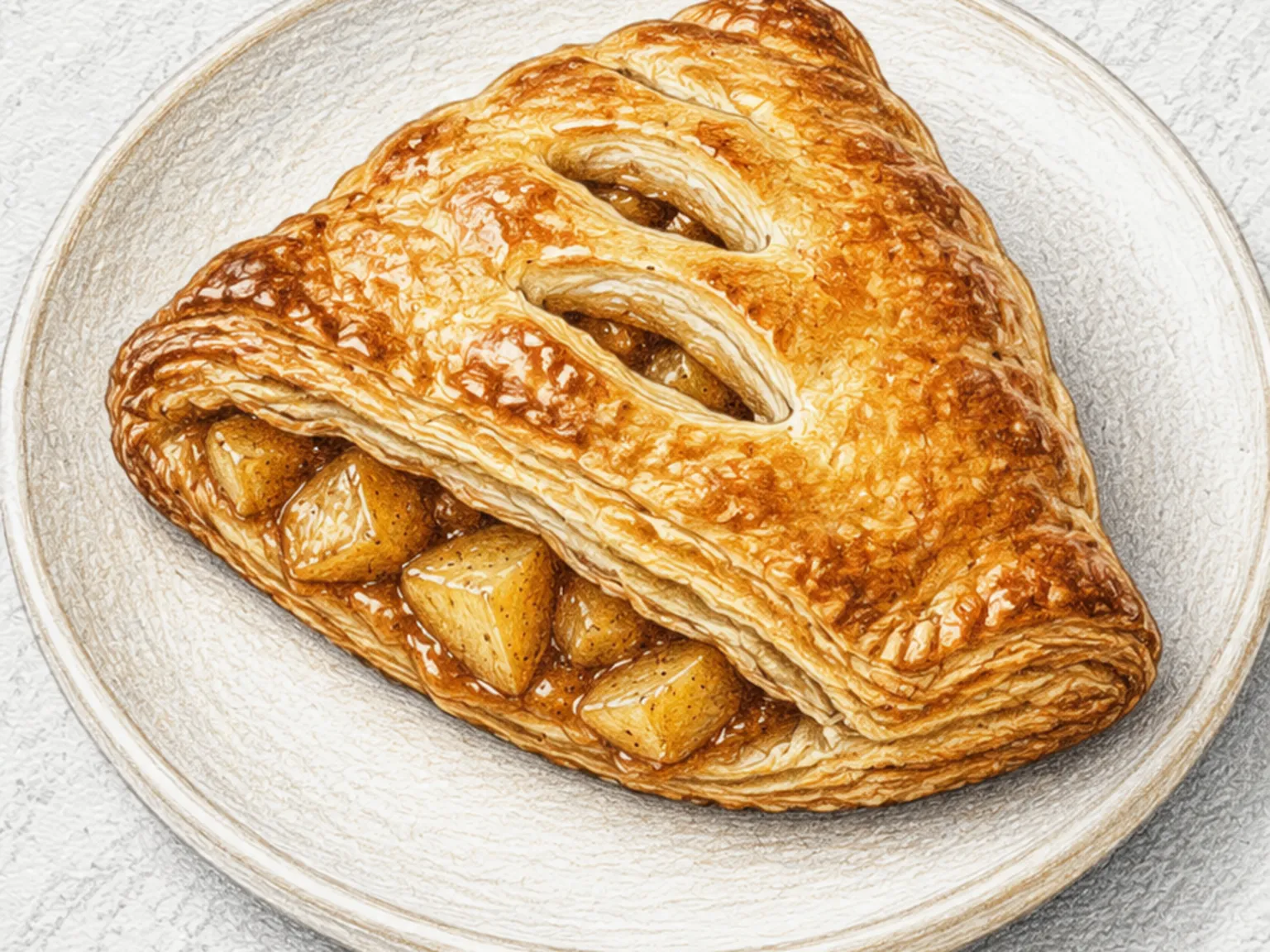
Apple turnovers trace back to the medieval European practice of encasing fruit in pastry - a portable format that became a fixture at French and English market stalls by the 17th century. Puff pastry is rolled thin and cut into squares, then topped with apples briefly cooked down with cinnamon, sugar, and lemon juice to concentrate their flavor and reduce excess moisture. Folding the square into a half-moon and crimping the edges seals in steam during baking, which forces apart the laminated layers into a shatteringly crisp, deep-golden shell. Inside, the apples have collapsed into a jammy, soft mass. Cinnamon amplifies the fruit's sweetness, while lemon juice maintains enough acidity to prevent the filling from turning cloying. An egg wash brushed on before baking produces the lacquered, caramelized surface. The contrast between the brittle, flaking crust and the hot, syrupy interior is at its most vivid in the first few minutes out of the oven, before the pastry begins to soften.
Instructions
Read the steps as a cooking flow: prep, heat, seasoning, doneness control, and finish.
- 1Step
Peel 2 apples, remove the cores, and dice them into 1cm pieces.
Keep the pieces even so they soften at the same rate and do not leave hard bits in the filling.
- 2Control
Melt 20g butter in a pan over medium heat, then add the apples, 30g sugar, and 1 teaspoon ground cinnamon.
Cook for 5 to 7 minutes, stirring, until glossy and almost no loose juice remains.
- 3Step
Spread the apple filling out and let it cool completely.
Warm filling melts the butter layers in the 2 puff pastry sheets, which can make the bottom damp and prevent proper puffing.
- 4Prep
Cut the chilled puff pastry sheets into 15x15cm squares.
If the dough becomes soft or sticky while working, chill it briefly so the edges stay sharp and the layers do not collapse.
- 5Step
Place cooled filling in the center of each square, then fold diagonally to make triangles.
Press the edges firmly with a fork, check for gaps, and wipe away any filling that leaks outside.
- 6Heat
Cut 2 to 3 small vents on top and brush lightly with 1 beaten egg.
Bake at 200°C for 20 to 22 minutes, until deeply golden and puffed, then rest 5 minutes before serving.
After the steps
Pick a recipe that fits this dish.
Continue with shared ingredients, meal pairings, or a similar method.
Recipes That Go Well With This
More Baking →Based on shared ingredients and meal pairing
Cream Horn Pastry (Spiral Puff Pastry Cone with Cream Filling)
Cream horns are made by wrapping thin strips of puff pastry around conical metal molds in a tight spiral and baking until the laminated layers separate into a crisp, golden shell. The hundreds of butter-and-dough layers in the pastry open and puff apart in the oven's heat, producing a horn that is structurally firm yet delicate enough to shatter on first bite. Once the horns cool, the metal cone is removed to reveal a hollow pastry ready for filling. A mixture of cream cheese and whipped cream is piped generously inside, delivering smooth, lightly tangy sweetness that plays against the brittle exterior. A final dusting of powdered sugar completes the presentation. The critical rule is timing - filling the horns only just before serving preserves the crispness, as the cream introduces moisture that softens the pastry rapidly.
Mille-Feuille (Layered Puff Pastry with Vanilla Cream)
Mille-feuille stacks three sheets of puff pastry with layers of vanilla pastry cream between them, creating a dessert defined by the tension between crisp and soft. The pastry itself is built through repeated folding with cold butter, generating hundreds of paper-thin layers that puff apart in the oven into shatteringly flaky sheets. Pastry cream - egg yolks, sugar, milk, and a touch of flour cooked to a thick custard - fills the gaps with a smooth richness that yields immediately to the fork. The top is typically dusted with powdered sugar or glazed with fondant, sometimes decorated with a feathered chocolate pattern. Timing matters: once assembled, moisture from the cream migrates into the pastry, so the window for peak crispness is roughly one to two hours. When eaten fresh, each bite collapses with an audible crunch before the cream takes over.
Clafoutis (French Baked Cherry Custard Dessert)
Clafoutis is a traditional French dessert from the Limousin region made by arranging fresh cherries in a buttered baking dish, then pouring over a thin batter of eggs, sugar, milk, and flour and baking at 180 degrees Celsius for thirty to thirty-five minutes. The batter is considerably thinner than pancake batter, and the result when baked is a texture that sits between a creamy custard and a light sponge -- the edges puff and turn golden while the center around the cherries stays moist and yielding. Using unpitted cherries is the traditional method: the pits release a faint almond scent during baking that perfumes the surrounding batter in a way that pitted fruit cannot replicate. The cherries also hold their shape better with the pits in. Vanilla extract deepens the egg-and-milk base, and the cherries' own tart juice seeps into the batter during baking, creating concentrated pockets of fruit flavor that balance the overall sweetness. Clafoutis is served directly from the baking dish, typically dusted with powdered sugar and brought to the table while still warm, because the custard texture softens and loosens slightly as it cools, making the warm version noticeably more appealing. Made with blueberries, plums, or apricots instead of cherries, the dessert takes a different name -- flaugnarde -- though the technique remains identical.
Cronut
The cronut is a hybrid pastry invented in New York in 2013 by pastry chef Dominique Ansel, created by frying laminated croissant dough in a doughnut shape. Within days of its debut, the shop had lines stretching around the block before dawn, and the cronut was named one of Time magazine's best inventions of the year. The process demands traditional croissant dough built over three days: flour and yeast are combined into a basic dough, then cold butter is folded in through repeated lamination turns that create dozens of distinct layers. That laminated dough is then cut into rings and deep-fried in oil held at a precise temperature, a step that produces the signature result of a flaky, layered interior like a croissant combined with the crisp, light shell of a doughnut. A flavored cream is piped inside and the exterior is coated in a thin glaze. A single bite delivers a sequence of experiences: the crack of the glaze, the crunch of the exterior, the airy pull-apart of buttery layers, and finally the cool richness of the cream filling. Oil temperature is critical, as oil that is too hot burns the outside while leaving the interior raw, and oil that is too cool soaks into the dough and turns it heavy. The three-day lamination process cannot be shortened without compromising the layered structure that defines the pastry.
Serve with this
Beet and Goat Cheese Salad
Beet and goat cheese salad begins with whole beets wrapped in foil and roasted at 200°C for forty-five to sixty minutes, long enough for their raw, earthy undertone to convert almost entirely into a concentrated, caramel-adjacent sweetness. Peeling the skins while the beets are still warm requires only the pressure of a paper towel - they slip off cleanly - and slicing them before they cool preserves the vivid crimson-purple cross-section that makes the dish visually striking. Crumbled goat cheese placed on the warm slices softens slightly, and its tangy acidity cuts through the dense sweetness of the roasted root rather than competing with it. Walnuts toasted briefly in a dry pan lose much of their raw bitterness, developing a nuttiness that bridges the mineral quality of the beet and the dairy sharpness of the cheese. Balsamic reduction does more than dress the plate: its concentrated sweet-tart intensity ties the separate components into a coherent whole. Arugula underneath the beet slices provides a peppery bitterness that sharpens the contrast against the sweetness, giving the salad a complexity well beyond what its short ingredient list suggests. A simple dressing of extra-virgin olive oil and lemon juice over the greens keeps the balance light and clear.
Korean Sweet Corn Latte (Butter Sauteed Corn Milk Drink)
Sweet corn latte begins by sauteing cooked corn kernels in butter until fragrant, then simmering them in milk to draw out the corn's natural sugars before blending everything smooth. The butter amplifies the starchy, roasted aroma during the initial saute, coating each kernel so that the fat-soluble flavor compounds dissolve fully into the milk during the five-minute simmer. Blending the mixture until completely smooth and then straining it through a fine sieve removes any remaining hull pieces, producing a texture as silky as a custard sauce. This straining step makes a noticeable difference in the final quality. Condensed milk adds a rounded sweetness, and a small amount of white pepper introduces a faint spiced warmth that gives the drink depth beneath the sweetness. It works equally well served hot in a ceramic mug or chilled and poured over ice; the corn aroma remains vivid in both versions.
Gaeseong Juak (Honey Fried Rice Cake)
Gaeseong juak is a traditional Korean confection made from a dough of glutinous rice flour and wheat flour, fried slowly in oil at a deliberately controlled temperature to cook the interior evenly before the exterior develops color. The two-stage frying process begins at 150 degrees Celsius to set the inside through without burning the outside, then the temperature rises to 170 degrees to develop a light golden crust on the surface. Separating the temperature stages solves a specific frying problem: high heat from the start produces a darkened exterior while the chewy glutinous core remains underdone, while insufficient heat makes the exterior soft and oily. The result is a thin crisp shell surrounding a genuinely chewy, sticky interior. After frying, each piece is rolled through a warm syrup made from honey and rice syrup heated together over low heat, which leaves a glossy, fragrant sweetness coating the surface. A finishing dusting of ground cinnamon and chopped pine nuts adds aromatic spice and contrasting crunch. Historical records trace the confection to the Gaeseong region of the Goryeo dynasty, and it remains a standard presence on Korean ceremonial and holiday tables to this day.
Similar recipes
Fruit Clafoutis (Baked Custard with Fresh Fruit)
Clafoutis is a rustic French baked dessert that suspends fresh seasonal fruit in a thin custard batter and bakes it until the edges puff golden and the center sets to a silky cream. The batter, close to crepe batter in consistency, is made from eggs, milk, flour, and sugar whisked until smooth. Traditionally, unpitted cherries are used because the pits release a faint almond-like fragrance during baking that deepens the overall flavor. Strawberries, blueberries, and plums work equally well, their juices concentrating in the oven heat and creating pockets of intense sweetness against the mild custard. Because the method is little more than mixing and pouring, it requires no special technique. Served warm with a dusting of powdered sugar, the contrast between the crisp rim and the soft interior is what makes this dessert memorable.
Salmon in Puff Pastry
Salmon en croute wraps a salmon fillet spread with a mixture of cream cheese, wilted spinach, dill, and lemon zest inside puff pastry and bakes it until golden. Patting the salmon completely dry with paper towels is crucial - any surface moisture will make the pastry soggy. The spinach must also be squeezed thoroughly to prevent a wet filling. Cream cheese and Dijon mustard form a barrier between the fish and the dough, blocking the salmon's moisture from softening the pastry. Baking at 200 degrees Celsius for twenty-five to thirty minutes puffs the pastry into flaky, crisp layers while the salmon inside stays tender and moist, delivering both textures in every slice. Chilling the assembled package for ten minutes before baking re-firms the butter in the pastry, producing sharper layers after baking.