Korean Steamed Napa Cabbage Rolls
Steamed Medium

Korean Steamed Napa Cabbage Rolls

Quick answer

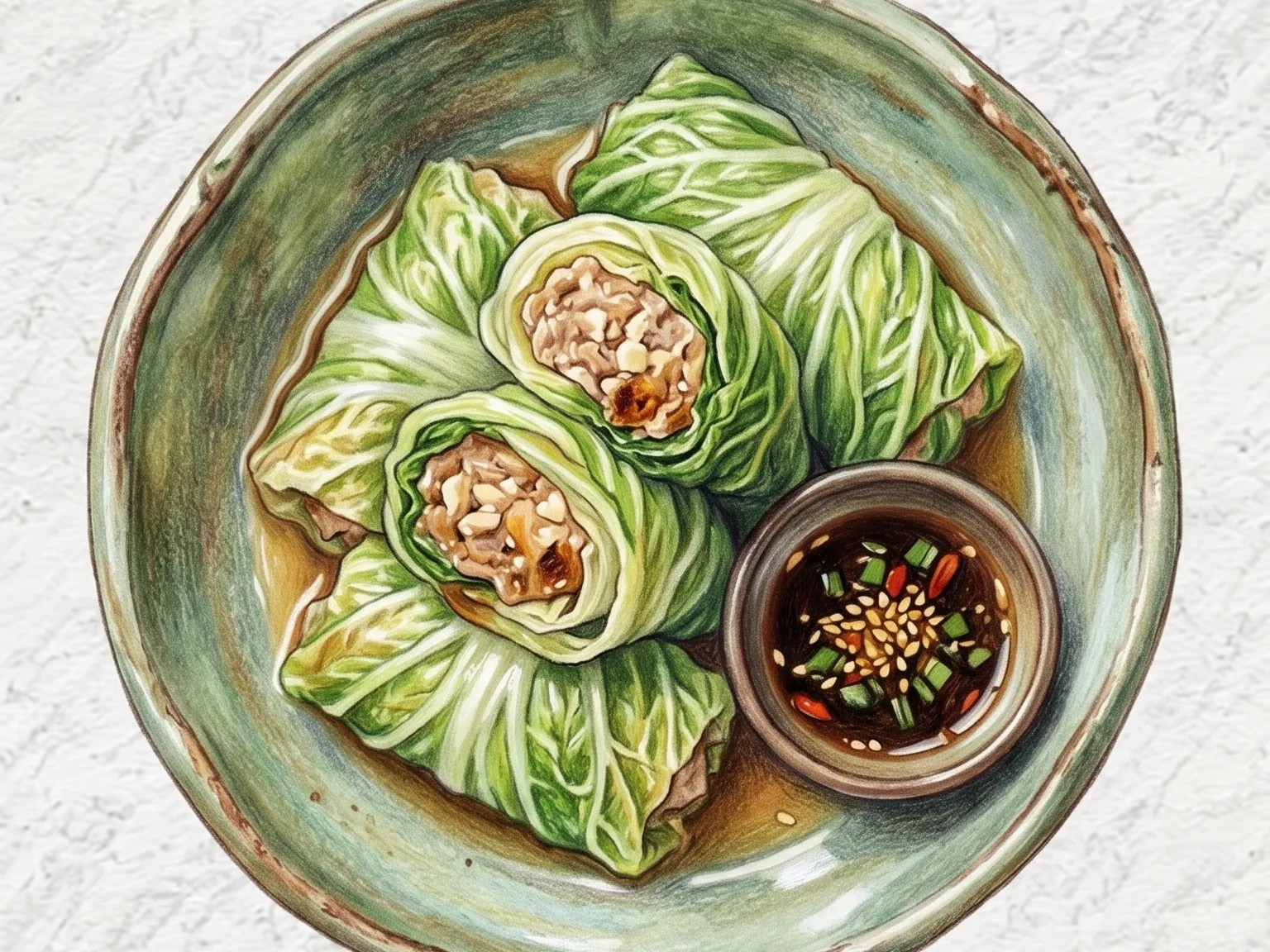
Baechu jjim consists of blanched napa cabbage leaves wrapped tightly around a filling of minced pork and mashed tofu, then steamed until fully cooked through.

What makes this special

  • Baechu jjim requires a 2:1 pork and tofu filling wrapped in napa cabbage leaves for steaming.
  • Pork and tofu at 2:1, kneaded until binding to keep the filling intact when steamed
  • Cabbage blanched 30 seconds keeps stems pliable for tight rolling
Total time
52 min
Level
Medium
Servings
4 servings
Ingredients
8
Calories
310 kcal
Protein
19 g

Key ingredients

napa cabbage leavesground porktofuonionsoy sauce

Core cooking flow

  1. 1 Blanch the 12 napa cabbage leaves in boiling water for only 30 seconds, just until the stems bend easily.
  2. 2 Squeeze the cooled cabbage leaves firmly to remove excess water, then flatte...
  3. 3 Place 250 g ground pork, 150 g mashed tofu, and 100 g minced onion in a bowl.

Baechu jjim consists of blanched napa cabbage leaves wrapped tightly around a filling of minced pork and mashed tofu, then steamed until fully cooked through. The filling uses pork and tofu at a 2:1 ratio, seasoned with soy sauce, sesame oil, and minced garlic, then kneaded until the mixture develops enough cohesion to stay intact during steaming. Tofu serves a functional purpose here beyond flavor - its moisture content prevents the pork from drying out over the extended steaming time, while the pork fat renders slowly into the surrounding cabbage leaf, adding richness to every bite. The cabbage leaves are blanched for thirty seconds to soften the stems, then squeezed dry and rolled from the stem end toward the tip with the filling placed at the base. In the steamer, rolls are arranged seam-side down so they hold their shape without any fastening, and cooked over vigorous steam for twelve to fifteen minutes. During this time, the meat juices work their way outward into the cabbage. The natural sweetness of napa cabbage - more pronounced after blanching - envelops the savory filling without sharpness, producing a mellow, layered result. A soy-based dipping sauce adds the saltiness needed to anchor the dish as a proper rice accompaniment, and leftovers reheat well without significant textural loss.

Prep 30min Cook 22min 4 servings

Instructions

Read the steps as a cooking flow: prep, heat, seasoning, doneness control, and finish.

6 steps
  1. 1
    Heat

    Blanch the 12 napa cabbage leaves in boiling water for only 30 seconds, just until the stems bend easily.

    Rinse them in cold water, then spread them out separately so they cool without continuing to cook.

  2. 2
    Step

    Squeeze the cooled cabbage leaves firmly to remove excess water, then flatten any thick stem sections with the back of a knife.

    Keep the leafy tips intact, because torn edges make the rolls harder to seal.

  3. 3
    Season

    Place 250 g ground pork, 150 g mashed tofu, and 100 g minced onion in a bowl.

    Add the soy sauce, minced garlic, and sesame oil, keeping the seasoning together so it disperses evenly while mixing.

  4. 4
    Step

    Knead the filling for 2 to 3 minutes with your hand or a spatula until it becomes sticky and cohesive.

    If it looks watery, drain more moisture; if it feels dry, avoid pressing it too hard.

  5. 5
    Step

    Place 2 to 3 tablespoons of filling on the stem end of each cabbage leaf, then fold in both sides.

    Roll toward the leafy tip with light tension and set each roll seam-side down to hold its shape.

  6. 6
    Control

    Arrange the rolls in the pot without stacking and pour 300 ml water along the edge.

    Cover and steam-braise over medium heat for 15 minutes, then check that the pork filling is fully cooked through before serving.

After the steps

Pick a recipe that fits this dish.

Continue with shared ingredients, meal pairings, or a similar method.

Recipes That Go Well With This

More Steamed →

Based on shared ingredients and meal pairing

Korean Steamed Shrimp
Shared ingredient: onion Steamed

Korean Steamed Shrimp

Saeu jjim is a traditional Korean method for preparing steamed shrimp by utilizing a specific layering technique within a steamer. The process begins by creating a foundation of sliced onions, green onions, and garlic cloves across the steamer basket. Whole shrimp are then carefully arranged directly on top of this bed of aromatic vegetables. As the water boils below, the rising steam carries the volatile oils and scents of the onion and garlic upward, allowing these fragrances to penetrate the shrimp through their shells. A small amount of rice wine is applied to the shrimp before the lid is closed to neutralize any strong briny odors that may be present. Leaving the shells intact during the steaming process is a deliberate step to minimize the loss of internal moisture. This protective layer ensures the meat remains firm and juicy while preserving the natural sugars found in the seafood. Precision regarding the cooking duration is a critical factor for success. The shrimp typically require only eight to nine minutes of exposure to the steam once the water has reached a steady boil. If the cooking time exceeds this window, the proteins in the flesh will contract and cause the texture to become noticeably tough and dry. When the time is up and the lid is lifted, it should be tilted to the side rather than pulled straight up. This prevents the heavy condensation collected on the underside of the lid from dripping back down onto the shrimp, which would otherwise dilute the seasoning on the surface of the shells. Just before the dish is served, a light squeeze of fresh lemon juice is applied to provide a bright acidity that complements the inherent sweetness of the shrimp. While the dish is sufficiently flavorful to be eaten without any dipping sauce, it is often accompanied by cho-ganjang, which is a mixture of soy sauce and vinegar. Alternatively, a sweet chili sauce can be provided as a condiment for individuals who prefer an additional flavor profile alongside the seafood.

Korean Napa Cabbage Pancake
Shared ingredient: napa cabbage leaves Grilled

Korean Napa Cabbage Pancake

Baechu jeon is a Korean pan-fried pancake made with napa cabbage leaves coated in a thin flour batter. The simplicity of the recipe makes it a practical use-up dish during kimchi-making season, when salted outer cabbage leaves are on hand and need to be eaten quickly before they deteriorate. Outer leaves of medium size work best; the stem end, if too thick, needs to be flattened with the back of a knife so that the batter adheres uniformly and the leaf lies flat during cooking without curling or buckling. The batter is mixed thin - roughly equal parts buchim flour and water - so it forms a light coating rather than a thick shell. A heavy batter masks the cabbage entirely and produces a texture that is doughy rather than crisp. Generous oil in a well-heated pan and steady medium heat are what produce the characteristic result: a thin, crackling exterior while the cabbage inside softens and its natural sweetness intensifies. Napa cabbage's sweetness becomes more pronounced with heat than in its raw state, which is why this pancake, despite its simplicity, tastes distinctly of the vegetable. Each side must be fully golden before flipping - attempting to turn it early, before the batter sets, breaks the pancake. The standard accompaniment is a dipping sauce of soy sauce sharpened with rice vinegar and sliced cheongyang chili, whose acidity and heat provide contrast to the mild, faintly sweet pancake.

Korean Seasoned Bellflower Root
Serve together Side dishes

Korean Seasoned Bellflower Root

Doraji -- balloon flower root -- has been used in Korean cooking since the Goryeo dynasty, valued as both a medicinal herb and a staple namul ingredient. Unlike doraji-bokkeum, which stir-fries the root with gochujang and heat, this cold muchim preserves the characteristic firm, snappy crunch that makes doraji distinctive. The roots are shredded along the grain into thin strips, then vigorously rubbed with salt to draw out the saponins responsible for their sharp bitterness, and rinsed multiple times until the water runs clear. A seasoning of gochujang, vinegar, sugar, and sesame oil works into each fibrous strand, layering sweet, sour, and spicy notes over the residual earthiness of the root. This banchan appears on both Chuseok and Seollal holiday tables as one of the five-color namul, where the white of the doraji root represents the metal element in the five-phase system. Because the root holds its crunch well, this dish can be prepared ahead of time without losing texture, making it a practical choice for large gatherings.

Korean Steamed Tofu with Spinach
Similar recipe Steamed

Korean Steamed Tofu with Spinach

Sigeumchi dubu jjim is a Korean steamed side dish of firm tofu, spinach, and shiitake mushrooms seasoned with soy sauce and soup soy sauce, then covered and cooked over gentle heat until everything is just done. Pressing the tofu firmly between layers of kitchen paper to remove excess moisture is a necessary first step; water left in the tofu dilutes the seasoning and turns the cooking liquid murky. When the spinach and mushrooms are arranged alongside the tofu and the seasoning is spooned over everything before the lid goes on, the steam released by the vegetables cooks the dish evenly without any added water. Shiitake mushrooms bring a concentrated umami that gives unexpected depth to what is otherwise a very simple soy-based seasoning. A drizzle of perilla oil and a scattering of sesame seeds at the end add a distinctly nutty, aromatic finish that lifts the entire dish. Low in calories and rich in plant protein, it fits naturally into a light weeknight dinner as a side dish that is as nourishing as it is unfussy.

Serve with this

Korean Cockle & Water Parsley Mixed Rice
Rice Medium

Korean Cockle & Water Parsley Mixed Rice

Kkomak-minari bibimbap is a seasonal rice bowl that comes together when cockles are at their peak in early spring, pairing the ocean sweetness of briefly blanched cockle meat with the clean, grassy sharpness of raw water parsley (minari). The cockle meat is rinsed in light salt water to remove any residual sand, then blanched for no more than thirty seconds in boiling water so the flesh stays springy rather than contracting into a rubbery texture. Julienned carrot and zucchini are each stir-fried separately, controlling moisture and flavor independently, then set aside to cool before assembly. A bowl of well-steamed rice is layered with the blanched cockles, the sauteed vegetables, and the raw minari placed on top last to protect its volatile fragrance from the heat below. A bibimbap sauce made from gochujang, sesame oil, minced garlic, and a touch of vinegar ties everything together when mixed, balancing the briny umami of the cockles against the brightness of the parsley. Sesame oil and toasted sesame seeds added at the end round the flavors and give the bowl a warm, nutty finish.

🎉 Special Occasion 🍱 Lunchbox
Prep 20min Cook 15min 2 servings
Korean Rice Cake Soup (New Year Sliced Rice Cake Beef Broth)
Soups Easy

Korean Rice Cake Soup (New Year Sliced Rice Cake Beef Broth)

Tteokguk is the soup that marks the Korean New Year - eating a bowl is said to add one year to your age, and no Lunar New Year table is complete without it. Thinly sliced oval rice cakes made from garaetteok, a long cylindrical rice cake, are dropped into a clear beef broth that has been carefully skimmed of fat until it gleams. In the hot liquid, the rice cake surfaces soften just enough to release a faint starch that gives the broth the barest hint of body, while the interiors hold a dense, satisfying chew. The broth itself is kept deliberately simple - brisket simmered low and slow, seasoned only with soup soy sauce and salt - so that the rice cakes and their subtle sweetness remain the focus. Beaten egg swirled into the boiling soup forms wispy threads that add a delicate texture, and strips of egg garnish, crushed seaweed, and sometimes sliced scallion complete the bowl. Despite its apparent simplicity, tteokguk carries deep cultural weight: the white color of the rice cakes symbolizes purity and a fresh start, and the round shape of the slices represents coins and wishes for prosperity.

🏠 Everyday 🎉 Special Occasion
Prep 20min Cook 20min 2 servings
Korean-Style Cabbage Pickle
Kimchi Easy

Korean-Style Cabbage Pickle

Yangbaechu pickle is a quick Korean-style vinegar pickle made by pouring a hot brine of vinegar, sugar, salt, and whole black peppercorns over bite-sized pieces of cabbage and carrot. The hot liquid wilts the vegetables just enough to help them absorb the brine while they retain a firm, snappy crunch throughout. Whole peppercorns contribute a subtle, aromatic heat that gives the finished pickle more depth than a plain vinegar soak would produce. After a single day of refrigeration the pickle is ready to eat, and it pairs especially well alongside fried cutlets, burgers, or any dish that benefits from a bright, acidic counterpoint to cut through richness. The carrot adds a note of natural sweetness and keeps the color vivid. Kept in a sealed container, the pickle is at its crunchiest within the first week, though the flavors become more rounded and pronounced as the vegetables continue to absorb the brine over time.

🍱 Lunchbox 🏠 Everyday
Prep 15min Cook 8min 4 servings

Similar recipes

Korean Napa Cabbage Tofu Porridge
Rice Easy

Korean Napa Cabbage Tofu Porridge

A gentle Korean rice porridge built from napa cabbage and soft tofu - mild enough for a recovering stomach, substantial enough to be a proper meal. The rice is first stir-fried in sesame oil, coating each grain in a thin film of fat that releases a quiet, nutty fragrance as the grains slowly swell and break down. Minced garlic is added at this stage and cooked through so its raw sharpness disappears into the base. Vegetable stock and finely chopped cabbage follow, and the pot simmers at medium heat, stirring occasionally, until the grains dissolve completely into a thick, uniform porridge. During this process, the cabbage sheds its moisture into the broth, gently sweetening it without any added sugar. Tofu crumbled by hand is stirred in during the last five minutes, dispersing evenly to create a smooth, soft protein layer throughout. Seasoning is deliberately light - just guk-ganjang and salt - to let the cabbage sweetness and the tofu's quiet richness carry the flavor. No heavy oils or pungent spices. This is porridge for days when the body needs something undemanding, or when plain, clean food is exactly what the moment calls for.

🥗 Light & Healthy 🏠 Everyday
Prep 15min Cook 25min 2 servings
Korean Steamed Abalone (Whole Shell Soy Sesame)
Steamed Medium

Korean Steamed Abalone (Whole Shell Soy Sesame)

Jeonbok-jjim is Korean steamed abalone prepared by scrubbing each shell clean, scoring the flesh to promote even cooking, and steaming with green onion and ginger for ten to twelve minutes. The scored cuts allow heat to penetrate the thickest parts of the meat, preserving the abalone's signature texture that is simultaneously chewy and tender. During steaming, the inky innards melt into the condensed liquid and deepen its briny, mineral flavor. Any remaining innards can be set aside for porridge or dipping sauce. Seasoning is deliberately restrained - a light drizzle of soy sauce, rice wine, and sesame oil applied just before serving is all that is needed to frame the abalone's oceanic aroma without obscuring it. The dish has long been associated with formal dining, ancestral rites, and holiday celebrations, where its premium standing among Korean seafood commands attention at the table.

🎉 Special Occasion
Prep 20min Cook 18min 2 servings
Korean Steamed Tofu with Soy Sauce
Steamed Easy

Korean Steamed Tofu with Soy Sauce

Dubu-jjim is firm tofu steamed and topped with a seasoning sauce of soy sauce, gochugaru, chopped green onion, garlic, and sesame oil. Cutting the tofu into thick slabs before steaming lets heat penetrate evenly, producing pieces with slight resistance on the outside and a silky interior. The soy and chili sauce drizzled over the warm tofu seeps into each slice, delivering salty and mildly spicy flavors throughout. Sesame oil and seeds finish with a toasted aroma. Cooked without any added oil, it is a clean, protein-rich banchan that fits well on a vegetarian spread. Lightly salting the tofu before steaming draws out excess moisture, which allows the seasoning sauce to absorb more deeply and firms up the texture.

🥗 Light & Healthy 🏠 Everyday
Prep 8min Cook 10min 2 servings

Tips

Flatten thick stem parts with a knife back for easier rolling.
Thicken leftover broth with starch for a quick sauce.

Nutrition (per serving)

Calories
310
kcal
Protein
19
g
Carbs
12
g
Fat
20
g