French Baguette

French Baguette

Quick answer

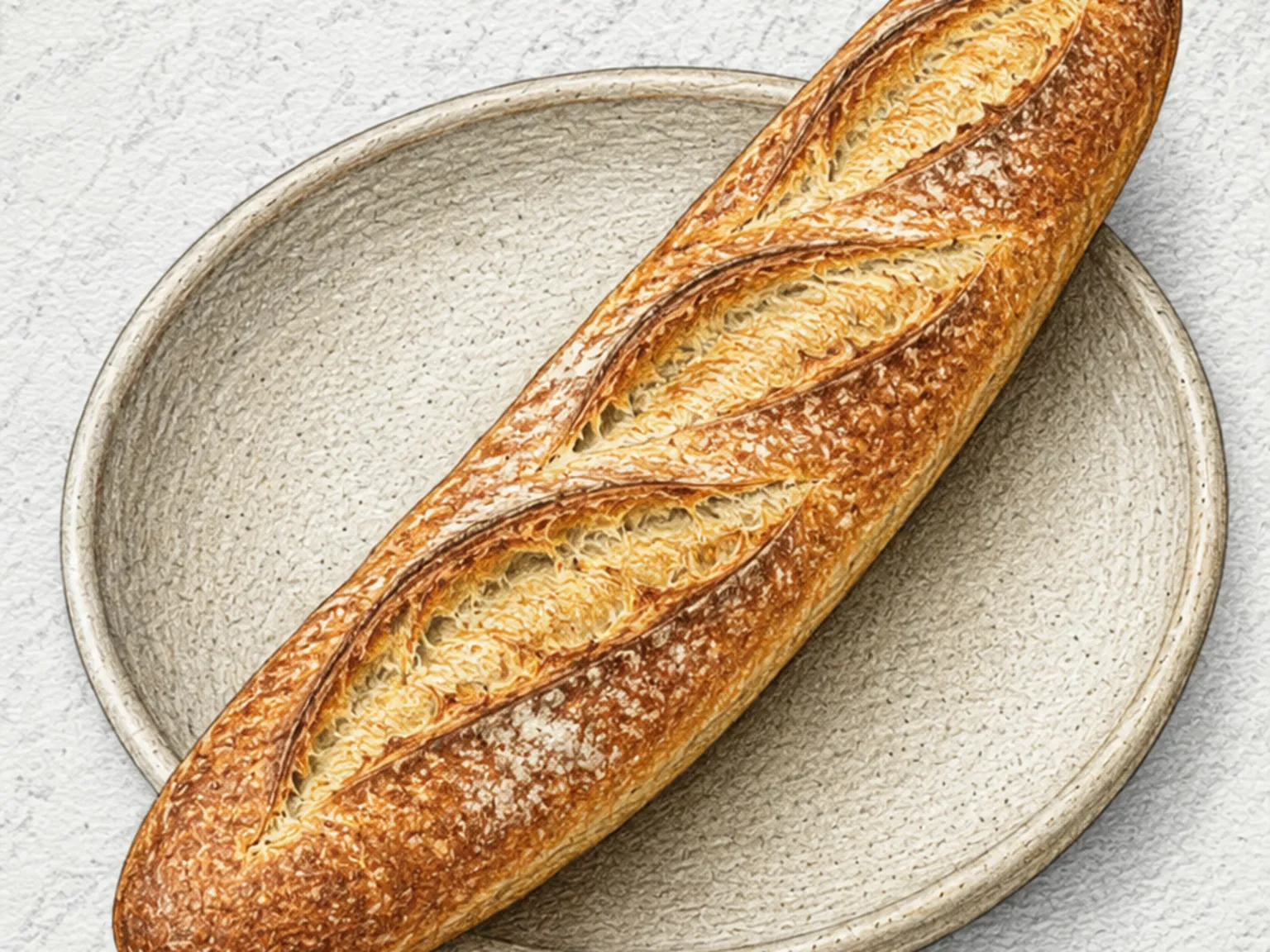
A baguette is a traditional French bread made from only four ingredients: bread flour, water, yeast, and salt.

What makes this special

  • French Baguettes employ high hydration dough to produce a thin, crisp crust and airy interior.
  • Over 70% hydration dough develops an irregular, open crumb structure
  • Scoring with a lame controls oven spring direction without tearing
Total time
55 min
Level
Hard
Servings
2 servings
Ingredients
4
Calories
180 kcal
Protein
6 g

Key ingredients

bread flourwaterinstant yeastsalt

Core cooking flow

  1. 1 Mix 250g bread flour, 5g salt, and 2g instant yeast, then add 170ml water an...
  2. 2 Knead for about 10 minutes until the surface turns smoother and the dough sl...
  3. 3 Cover the dough and bulk ferment for 90 minutes.

A baguette is a traditional French bread made from only four ingredients: bread flour, water, yeast, and salt. Because the formula strips away every variable beyond technique, the final quality is determined almost entirely by the precision of fermentation management and the confidence of the baker at each stage. A hydration level of seventy percent or higher is required to develop the open, irregular crumb structure that defines the interior; dough that is too dry will close up in the oven and produce a dense, uniform crumb with none of the characteristic airy pockets. A long first fermentation builds layers of acidity and deep wheat flavor that a short rise simply cannot provide, and during shaping the dough should be handled with restraint, using only gentle folds that preserve the large gas bubbles rather than pressing them out. Scoring lines, known as coupes, cut along the top surface control the direction of oven spring; the blade must be sharp enough and the movement decisive enough that the dough does not drag and tear beneath it. Introducing steam into the oven during the first ten to fifteen minutes of baking prevents the crust from setting prematurely, giving the loaf room to expand fully before the surface dries and crisps into its signature crackling shell. A well-made baguette crackles audibly when squeezed and, when sliced, reveals an interior cross-section showing holes of varied sizes scattered unevenly through the crumb. The day it is baked is the day it should be eaten; once the crust begins to soften as it cools, something irreplaceable is lost.

Prep 30min Cook 25min 2 servings

Instructions

Read the steps as a cooking flow: prep, heat, seasoning, doneness control, and finish.

6 steps
  1. 1
    Control

    Mix 250g bread flour, 5g salt, and 2g instant yeast, then add 170ml water and combine until no dry flour remains.

    Cover the rough dough and let it rest at room temperature for 30 minutes to hydrate before kneading.

  2. 2
    Step

    Knead for about 10 minutes until the surface turns smoother and the dough slowly springs back when pressed.

    If it feels sticky, handle it with slightly wet hands instead of adding much extra flour, which can close the crumb.

  3. 3
    Control

    Cover the dough and bulk ferment for 90 minutes.

    Every 30 minutes, stretch one side up and fold it over twice total, then continue when the dough has grown at least 1.5 times and small bubbles appear on the surface.

  4. 4
    Step

    Divide the fermented dough into two pieces without pressing out all the gas.

    Pat each piece into a rectangle, fold the top and bottom toward the center, and roll into a cylinder while keeping some larger air pockets intact.

  5. 5
    Heat

    Place each seam side down and roll gently with your palms to lengthen it to 40 to 45cm.

    Set the loaves on a couche or baking sheet, proof for 60 minutes, and bake only when a light finger mark returns slowly.

  6. 6
    Heat

    Preheat the oven fully to 250°C and create steam by adding water to the bottom at the start of baking.

    Score diagonal cuts 2 to 3cm apart, bake for 25 minutes, and check for a deep golden crust and a hollow sound underneath.

After the steps

Pick a recipe that fits this dish.

Continue with shared ingredients, meal pairings, or a similar method.

Recipes That Go Well With This

More Baking →

Based on shared ingredients and meal pairing

Brioche Loaf
Shared ingredient: bread flour Baking

Brioche Loaf

Brioche loaf is a French enriched bread defined by a high ratio of eggs and butter to flour. Softened butter is added in stages during kneading, small amounts at a time, until the fat is fully absorbed and the gluten has developed enough for the dough to stretch into a thin, nearly translucent sheet without tearing. The extended mixing time and the cold retard during overnight proofing give the final crumb its extraordinarily fine structure. Baked in a loaf pan, brioche comes out with a deep golden crust that is thin and slightly brittle, enclosing an interior that tears into long, cotton-soft strands. The butter flavor runs through every layer, so the bread is rich enough to eat on its own without any spread. Once sliced and lightly toasted, the contrast between the crisp outer face and the soft, moist center becomes more pronounced. Brioche absorbs custard quickly and holds its shape under heat, which makes it a preferred base for French toast and bread pudding.

Crunchy Chocolate Chip Baguette
Shared ingredient: bread flour Baking

Crunchy Chocolate Chip Baguette

This baking recipe explains how to make a chocolate baguette featuring a crispy crust and a bittersweet crumb. The dough combines bread flour, cocoa powder, sugar, salt, and instant dry yeast, which is kneaded with lukewarm water until smooth and elastic. Chocolate chips are folded into the dough at the end of kneading to distribute them evenly without melting. After a one-hour first fermentation, the dough is divided and shaped into long ovals, then left to rise again for thirty minutes. Before baking, the loaves are scored to expose the chocolate chips during the oven spring and sprayed with water. Baking at 220°C with steam creates a firm, crispy crust while keeping the inside soft. The finished baguette offers a rich cocoa aroma and sweet pockets of melted chocolate chips in every bite.

Clafoutis (French Baked Cherry Custard Dessert)
Serve together Western

Clafoutis (French Baked Cherry Custard Dessert)

Clafoutis is a traditional French dessert from the Limousin region made by arranging fresh cherries in a buttered baking dish, then pouring over a thin batter of eggs, sugar, milk, and flour and baking at 180 degrees Celsius for thirty to thirty-five minutes. The batter is considerably thinner than pancake batter, and the result when baked is a texture that sits between a creamy custard and a light sponge -- the edges puff and turn golden while the center around the cherries stays moist and yielding. Using unpitted cherries is the traditional method: the pits release a faint almond scent during baking that perfumes the surrounding batter in a way that pitted fruit cannot replicate. The cherries also hold their shape better with the pits in. Vanilla extract deepens the egg-and-milk base, and the cherries' own tart juice seeps into the batter during baking, creating concentrated pockets of fruit flavor that balance the overall sweetness. Clafoutis is served directly from the baking dish, typically dusted with powdered sugar and brought to the table while still warm, because the custard texture softens and loosens slightly as it cools, making the warm version noticeably more appealing. Made with blueberries, plums, or apricots instead of cherries, the dessert takes a different name -- flaugnarde -- though the technique remains identical.

Dark Chocolate Baguette
Similar recipe Baking

Dark Chocolate Baguette

This rustic chocolate baguette features a crisp crust filled with dark chocolate chips. The dough is prepared by combining bread flour, cocoa powder, dry yeast, salt, sugar, and lukewarm water. Once the dough becomes elastic after kneading, dark chocolate chips are folded in gently. After the first rise, the dough is divided and rested before being shaped into long, tapered ovals. This shaping helps retain moisture in the thicker crumb during baking. The loaves are proofed a second time, scored diagonally, and sprayed generously with water. Baking them at 220 degrees Celsius with oven steam creates a distinct double-layered crispy crust. High-quality cocoa powder and dark chocolate chips ensure a deep cacao flavor throughout the bread, offering a subtle sweetness inside a crusty exterior.

Serve with this

Beet and Goat Cheese Salad
Salads Medium

Beet and Goat Cheese Salad

Beet and goat cheese salad begins with whole beets wrapped in foil and roasted at 200°C for forty-five to sixty minutes, long enough for their raw, earthy undertone to convert almost entirely into a concentrated, caramel-adjacent sweetness. Peeling the skins while the beets are still warm requires only the pressure of a paper towel - they slip off cleanly - and slicing them before they cool preserves the vivid crimson-purple cross-section that makes the dish visually striking. Crumbled goat cheese placed on the warm slices softens slightly, and its tangy acidity cuts through the dense sweetness of the roasted root rather than competing with it. Walnuts toasted briefly in a dry pan lose much of their raw bitterness, developing a nuttiness that bridges the mineral quality of the beet and the dairy sharpness of the cheese. Balsamic reduction does more than dress the plate: its concentrated sweet-tart intensity ties the separate components into a coherent whole. Arugula underneath the beet slices provides a peppery bitterness that sharpens the contrast against the sweetness, giving the salad a complexity well beyond what its short ingredient list suggests. A simple dressing of extra-virgin olive oil and lemon juice over the greens keeps the balance light and clear.

🥗 Light & Healthy 🎉 Special Occasion
Prep 15min Cook 35min 2 servings
Candied Tangerine Peel (Korean Citrus Honey Confection)
Desserts Medium

Candied Tangerine Peel (Korean Citrus Honey Confection)

Gyul jeonggwa is a traditional Korean confection made by cutting tangerine peels into 0.8 cm strips with a moderate amount of white pith left on, blanching the strips twice in salted water to eliminate bitterness, then cooking them low and slow in a syrup of sugar, honey, and cinnamon for thirty-five to forty minutes. Keeping the pith is deliberate: it holds the essential citrus oils that define the candy's fragrance, so trimming too much away produces a noticeably flatter result. The longer the peels simmer, the more completely they turn translucent, pulling syrup into every layer of fiber until the texture becomes dense and springy, close to a firm fruit jelly. Lemon juice added toward the end of cooking performs two functions: it inhibits crystallization of the syrup as it cools, and its acidity trims back the sweetness for a cleaner finish. Draining the pieces and resting them on a rack for an hour produces a dry, non-tacky surface that holds its shape well.

🧒 Kid-Friendly 🎉 Special Occasion
Prep 25min Cook 70min 4 servings
Korean Sweet Corn Latte (Butter Sauteed Corn Milk Drink)
Drinks Easy

Korean Sweet Corn Latte (Butter Sauteed Corn Milk Drink)

Sweet corn latte begins by sauteing cooked corn kernels in butter until fragrant, then simmering them in milk to draw out the corn's natural sugars before blending everything smooth. The butter amplifies the starchy, roasted aroma during the initial saute, coating each kernel so that the fat-soluble flavor compounds dissolve fully into the milk during the five-minute simmer. Blending the mixture until completely smooth and then straining it through a fine sieve removes any remaining hull pieces, producing a texture as silky as a custard sauce. This straining step makes a noticeable difference in the final quality. Condensed milk adds a rounded sweetness, and a small amount of white pepper introduces a faint spiced warmth that gives the drink depth beneath the sweetness. It works equally well served hot in a ceramic mug or chilled and poured over ice; the corn aroma remains vivid in both versions.

🍺 Bar Snacks 🧒 Kid-Friendly
Prep 8min Cook 10min 2 servings

Similar recipes

Olive Herb Flat Bread (Leaf-Shaped Provencal Bread)
Baking Hard

Olive Herb Flat Bread (Leaf-Shaped Provencal Bread)

Fougasse is a flatbread from Provence in southern France, shaped with decorative slashes that resemble a leaf or wheat sheaf. The dough is enriched with olive oil and studded with Kalamata olives, rosemary, and thyme, distributing pockets of briny, herbal flavor throughout the bread. The distinctive cuts serve more than an aesthetic purpose - they increase the crust-to-crumb ratio dramatically, so thinner sections bake to a crackling crispness while thicker areas remain soft and chewy. This variation in texture within a single piece is what makes fougasse more interesting than a uniform loaf. The surface is brushed with olive oil before baking, which produces a golden, glossy finish. Best eaten warm, when the aromatic oils from the herbs and olives are most volatile. It pairs naturally with southern French dishes, charcuterie boards, or a simple bowl of good olive oil for dipping.

🎉 Special Occasion 🧒 Kid-Friendly
Prep 30min Cook 20min 4 servings
Jambon-Beurre (Classic Butter and Ham Baguette)
Western Easy

Jambon-Beurre (Classic Butter and Ham Baguette)

The jambon-beurre is a staple French sandwich designed for daily consumption, consisting of a baguette, butter, and ham. Because the recipe uses only three primary ingredients, the specific characteristics of each component are fundamental to the assembly. A traditional version utilizes a baguette characterized by a crust that breaks easily and a crumb that provides a chewy texture. The butter chosen is typically a cultured unsalted variety. It is necessary to bring the butter to room temperature to ensure it is soft enough to spread across the bread without damaging the soft interior. The ham used is jambon blanc, which is prepared in thin slices to build the layers of the sandwich. A light application of Dijon mustard on one side of the bread provides a sharp and peppery flavor profile. This ingredient serves to balance the heavy fat content of the butter against the natural saltiness found in the ham. Sliced cornichons are included inside the bread to add a level of tart acidity. These pickles help to reduce the overall weight of the sandwich ingredients and maintain a consistent balance of flavors in every bite.

⚡ Quick 🏠 Everyday
Prep 8min 2 servings
Beef Tartare
Western Medium

Beef Tartare

Beef tartare is a French preparation of premium tenderloin hand-chopped with a knife, never passed through a grinder, so that each small piece stays intact and delivers a clean, juicy bite rather than a pasty mouthfeel. The chopped meat is mixed with capers, anchovies, shallots, and cornichons, then bound with egg yolk and Dijon mustard. Capers and anchovies provide a salty, briny depth that makes raw beef compelling as a dish, while the Dijon adds a sharp, direct mustard heat that brings focus to every forkful. The egg yolk coats each morsel in a silky, rich film that holds the mixture together without masking the meat itself. Freshness is non-negotiable here - the quality of the tenderloin is the entire foundation of the dish, and there is no technique or seasoning that compensates for inferior beef.

🍺 Bar Snacks 🎉 Special Occasion
Prep 20min 2 servings

Tips

Steam in the oven creates a thin, crispy crust.

Nutrition (per serving)

Calories
180
kcal
Protein
6
g
Carbs
36
g
Fat
1
g