Bak Kut Teh (Malaysian Pork Rib Herbal Pepper Broth Soup)
Asian Medium

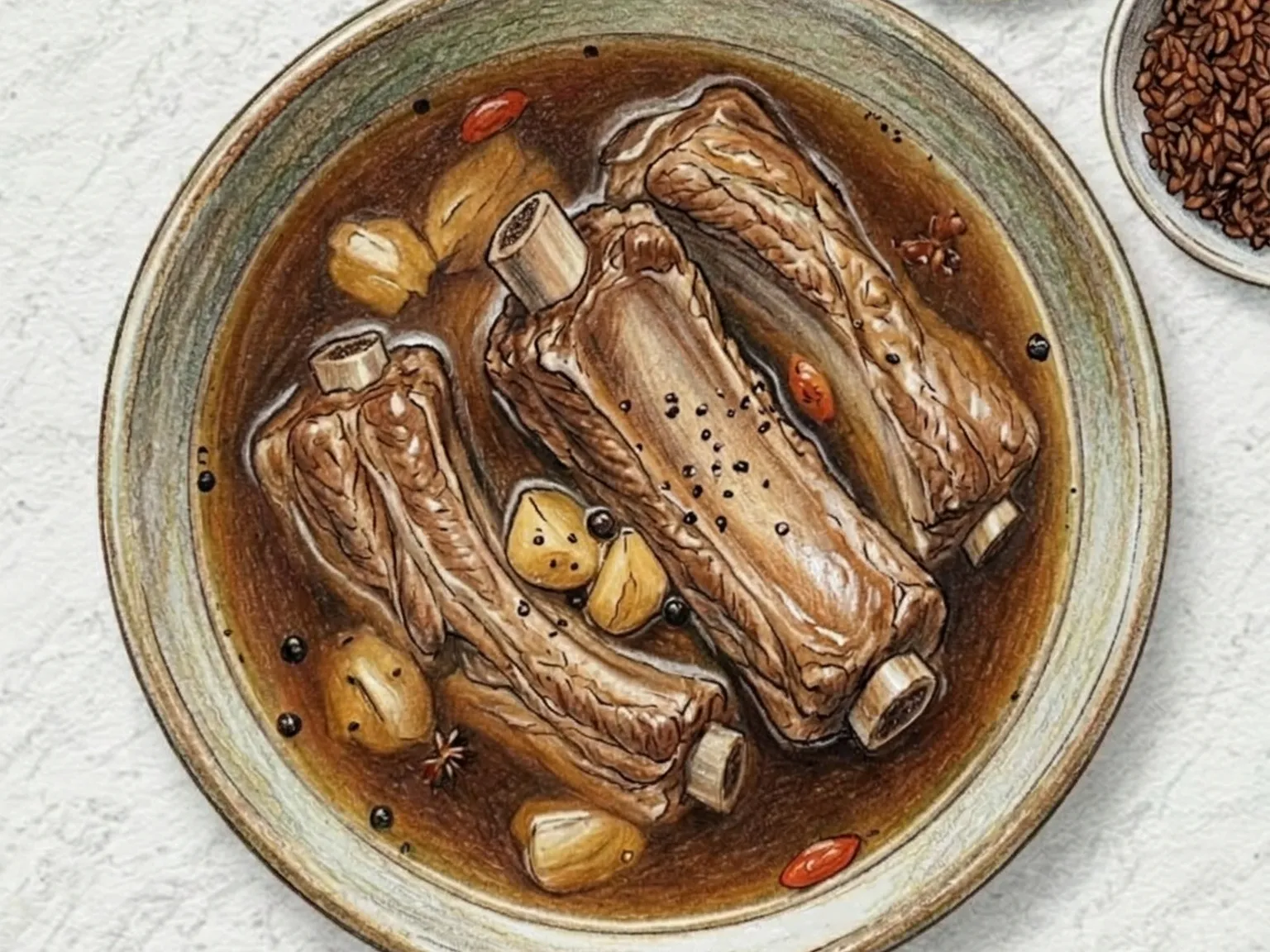
Bak Kut Teh (Malaysian Pork Rib Herbal Pepper Broth Soup)

Quick answer

Bak kut teh, 'meat bone tea' in Hokkien, traces its origins to Chinese laborers in colonial Malaya who slow-simmered pork ribs with medicinal herbs to recover strength th...

What makes this special

  • White pepper and whole garlic heads build the clear, peppery broth of Malaysian Klang-style Bak Kut Teh.
  • Whole garlic heads dissolve into the broth, contributing sweetness over hours
  • Klang Valley style: white pepper and garlic dominate over herbal notes
Total time
95 min
Level
Medium
Servings
4 servings
Ingredients
7
Calories
510 kcal
Protein
33 g

Key ingredients

pork ribswhole garlicwhite peppercornsoy saucecinnamon stick

Core cooking flow

  1. 1 Soak 900 g pork ribs in cold water for 20 minutes to draw out blood.
  2. 2 Bring a separate pot of water to a strong boil, add the ribs, and blanch for 3 minutes.
  3. 3 Put 1800 ml water, the rinsed ribs, and 2 whole garlic heads into a clean pot.

Bak kut teh, 'meat bone tea' in Hokkien, traces its origins to Chinese laborers in colonial Malaya who slow-simmered pork ribs with medicinal herbs to recover strength through long working days. The Klang Valley style, now most widely recognized, puts garlic and white pepper at the center of the flavor rather than Chinese herbal notes, producing a clear, pale-colored broth with a sharp peppery heat that travels from the throat downward. Whole heads of garlic dissolve to a paste-like sweetness over the extended simmer, while the pork ribs release their collagen until the meat separates cleanly from the bone. The traditional way to eat it is to pour the broth over rice or dip fried dough sticks (youtiao) directly into the soup. In Kuala Lumpur's Klang district, dedicated bak kut teh shops open before dawn and serve it as a sustaining breakfast.

Prep 15min Cook 80min 4 servings
Recipes by ingredient → soy sauce

Instructions

Read the steps as a cooking flow: prep, heat, seasoning, doneness control, and finish.

6 steps
  1. 1
    Finish

    Soak 900 g pork ribs in cold water for 20 minutes to draw out blood.

    If the water turns very red, change it once so the finished broth stays clearer and has less pork odor.

  2. 2
    Heat

    Bring a separate pot of water to a strong boil, add the ribs, and blanch for 3 minutes.

    When the outside turns gray, drain and rinse each piece well to remove bone dust, foam, and clinging impurities.

  3. 3
    Step

    Put 1800 ml water, the rinsed ribs, and 2 whole garlic heads into a clean pot.

    Lightly crush 2 tablespoons white peppercorns, then add them with 2 star anise pods and the cinnamon stick for a stronger aroma.

  4. 4
    Control

    Start over high heat and skim off foam as it rises to the surface.

    Once the broth boils, lower to medium-low so it barely ripples rather than roars, which keeps the soup clearer and prevents harsh spice extraction.

  5. 5
    Control

    Simmer gently for at least 70 minutes, adding a little hot water only if the level drops too much.

    The garlic should mash easily, and the pork should pull away from the bone with little resistance.

  6. 6
    Finish

    Add 2 tablespoons soy sauce and simmer 3 minutes more so the seasoning blends into the broth.

    Serve very hot, pouring the clear broth over rice or setting out youtiao for dipping while the white pepper aroma is vivid.

After the steps

Pick a recipe that fits this dish.

Continue with shared ingredients, meal pairings, or a similar method.

Recipes That Go Well With This

More Asian →

Based on shared ingredients and meal pairing

Mee Rebus (Noodles in Sweet Potato Curry Gravy)
Serve together Noodles

Mee Rebus (Noodles in Sweet Potato Curry Gravy)

Mee rebus is a Malaysian noodle dish where springy yellow noodles are topped with a thick gravy built from mashed sweet potato, curry powder, peanut butter, and chicken stock. The sweet potato dissolves into the stock to form a naturally thick base, and the curry powder and peanut butter contribute layers of spice and nuttiness that make the sauce unlike any other noodle topping. Soy sauce adds fermented depth and ties the sweetness and spice together. If the gravy becomes too thick during cooking, extra stock loosens it without diluting the flavor. A halved boiled egg and a squeeze of fresh lime just before eating cut through the richness, bringing the bright acidity that is a hallmark of Southeast Asian noodle dishes.

Beet and Goat Cheese Salad
Serve together Salads

Beet and Goat Cheese Salad

Beet and goat cheese salad begins with whole beets wrapped in foil and roasted at 200°C for forty-five to sixty minutes, long enough for their raw, earthy undertone to convert almost entirely into a concentrated, caramel-adjacent sweetness. Peeling the skins while the beets are still warm requires only the pressure of a paper towel - they slip off cleanly - and slicing them before they cool preserves the vivid crimson-purple cross-section that makes the dish visually striking. Crumbled goat cheese placed on the warm slices softens slightly, and its tangy acidity cuts through the dense sweetness of the roasted root rather than competing with it. Walnuts toasted briefly in a dry pan lose much of their raw bitterness, developing a nuttiness that bridges the mineral quality of the beet and the dairy sharpness of the cheese. Balsamic reduction does more than dress the plate: its concentrated sweet-tart intensity ties the separate components into a coherent whole. Arugula underneath the beet slices provides a peppery bitterness that sharpens the contrast against the sweetness, giving the salad a complexity well beyond what its short ingredient list suggests. A simple dressing of extra-virgin olive oil and lemon juice over the greens keeps the balance light and clear.

Korean Crispy Potato Pancake
Serve together Drinks

Korean Crispy Potato Pancake

Gamja-jeon is a Korean potato pancake made by finely grating raw potatoes, letting the starch settle out of the liquid for at least ten minutes, discarding the water, and folding the settled starch back into the pulp to improve binding. Waiting long enough for full starch separation is what gives the batter enough cohesion to hold together when the pancake hits the hot pan. Spreading the batter as thinly as possible produces glass-crisp edges while the center retains a chewy, starchy bite characteristic of potato starch. The first side must cook all the way through and the underside must firm up completely before any attempt to flip, and using two spatulas simultaneously makes the turn fast enough to keep the pancake intact. Frying both sides over medium heat until evenly golden delivers a crust that is crisp on the outside while the center stays moist. A dipping sauce of soy sauce, vinegar, and minced cheongyang green chili cuts through the oily richness with sharpness and heat.

Roti Canai (Malaysian Flaky Ghee Flatbread with Curry Dip)
Similar recipe Asian

Roti Canai (Malaysian Flaky Ghee Flatbread with Curry Dip)

Roti canai is a flaky, pan-fried flatbread served at mamak stalls across Malaysia from dawn until late at night. The dough is enriched with ghee and stretched by hand until nearly translucent, then folded back onto itself multiple times to create dozens of paper-thin layers. On a well-oiled griddle, the bread puffs and crisps on the outside while the interior stays chewy and layered. Each tear reveals the laminated structure inside. The standard pairing is a bowl of dhal curry for dipping, though sardine curry and chicken curry are equally common. Variations abound: roti telur folds in a beaten egg, roti pisang wraps sliced banana inside, and roti bom is a thicker, butterier version dusted with sugar. The bread is torn by hand, never cut, and the best versions leave a faint sheen of ghee on the fingers.

Similar recipes

Tamarind Fish Noodle Soup
Asian Medium

Tamarind Fish Noodle Soup

Asam laksa is Penang's defining noodle soup, recognized by UNESCO as one of Malaysia's intangible cultural heritage items. Where Singapore's curry laksa builds its richness on coconut milk, this version draws its entire character from a tamarind-soured fish broth that is tart, briny, and aggressively aromatic in a way that coconut-based versions never are. Whole mackerel is poached until it flakes, then removed and broken apart by hand; the remaining liquid is blended with torch ginger flower, lemongrass, and galangal pounded into a coarse paste to build the broth's layered fragrance. Tamarind sourness arrives first and dominates the initial impression, followed by a slow build of chili heat and the ocean depth of fish sauce. Thick rice noodles sit at the bottom of the bowl, their chewy resistance offering physical contrast to the sharp, lean broth that pours over them. The table condiments - julienned cucumber, fresh mint leaves, thinly sliced onion, and a spoonful of belacan-enriched prawn paste - are not optional garnishes but integral components: the fermented prawn paste in particular adds a dimension of umami that rounds the broth's acidity into something far more complex. Every hawker stall in Penang has its own spice ratios handed down through family lines, which is why no two bowls taste exactly alike.

🎉 Special Occasion 🌙 Late Night
Prep 25min Cook 35min 4 servings
Nasi Kandar (Penang Indian-Muslim Rice with Mixed Curries)
Asian Medium

Nasi Kandar (Penang Indian-Muslim Rice with Mixed Curries)

Nasi kandar is a Penang-born rice dish rooted in the culinary traditions of Malaysia's Indian-Muslim community. A mound of steamed white rice is doused with multiple curry gravies and accompanied by a choice of protein and vegetable sides. The defining technique is kuah campur - the deliberate mixing of different curry sauces so they pool together and soak into the rice, creating a layered complexity no single curry could achieve alone. Coconut milk lends a gentle richness, curry powder supplies aromatic depth, and chili brings lingering warmth. Diners select their own combination from a counter full of dishes, making each plate unique.

🎉 Special Occasion
Prep 20min Cook 35min 2 servings
Mee Bandung (Malaysian Johor Shrimp Tomato Gravy Noodles)
Asian Medium

Mee Bandung (Malaysian Johor Shrimp Tomato Gravy Noodles)

Mee bandung is a traditional noodle dish from the Johor region of Malaysia, featuring yellow wheat noodles served in a thick, reddish-orange shrimp and tomato gravy. The base is prepared by stir-frying finely minced onions and garlic, followed by tomato paste and chili paste to create a concentrated aromatic paste. Shrimp stock and soy sauce are poured in and simmered before fresh shrimp are added and cooked briefly to maintain a tender texture. A starch slurry is stirred into the hot liquid to thicken it, producing a gravy that coats the noodles and sits between a soup and a stir-fry in consistency. The resulting sauce delivers a balanced profile of sweet, spicy, and savory flavors. The dish is finished by ladling the warm gravy over boiled noodles and topping them with shrimp and boiled eggs.

🎉 Special Occasion 🌙 Late Night
Prep 20min Cook 20min 2 servings
Galbitang (Clear Korean Beef Short Rib Soup)
Soups Medium

Galbitang (Clear Korean Beef Short Rib Soup)

Galbitang is a clear Korean soup built from long-simmered beef short ribs, extracting a deep, clean beef flavor without the milky opacity of seolleongtang or gomtang. Before cooking, the ribs are soaked in cold water for one to two hours to draw out blood, which is what allows the finished broth to stay clear and free of off-flavors. The radish goes in from the beginning, slowly releasing a gentle sweetness as it absorbs the surrounding broth and becomes fully saturated with beef flavor. The ribs need time - the measure of doneness is the meat sliding cleanly off the bone with minimal pressure from chopsticks. Unlike bone-based broths that turn white from emulsified collagen and fat, galbitang remains translucent because the fat from the rib meat dissolves more gently, leaving a subtle richness rather than heaviness. Seasoning is deliberately restrained, using only salt and white pepper at the table so nothing interferes with the honest taste of the beef. Garnishes of sliced egg crepe and green onion add color and a fresh note. The soup is served year-round in Korean restaurants, always arriving steaming hot alongside a bowl of plain rice.

🏠 Everyday 🎉 Special Occasion
Prep 60min Cook 120min 4 servings
Korean Spicy Seafood Noodle Soup
Noodles Medium

Korean Spicy Seafood Noodle Soup

Jjamppong is a Korean-Chinese noodle soup where seafood and vegetables are stir-fried in chili oil at very high heat before broth is added, a sequence that fundamentally shapes the soup. Blooming gochugaru in hot oil instead of adding it directly to liquid extracts fat-soluble compounds that carry a smoky, toasted depth the raw powder cannot contribute. Squid, mussels, and shrimp release their own juices during the fry stage, and those juices dissolve into the chicken stock when the liquid hits the pan. Cabbage and onion caramelize in the residual oil and give off natural sugars that temper the chili heat. Soy sauce binds the seasoning and gives the broth its reddish-brown depth. Springy fresh wheat noodles absorb the concentrated broth, and by the time they reach the table the noodles are already carrying the full flavor of the soup in every strand.

🏠 Everyday 🌙 Late Night
Prep 20min Cook 20min 2 servings

Tips

Crush peppercorns slightly for stronger aroma.
Flavor deepens after resting and reheating.

Nutrition (per serving)

Calories
510
kcal
Protein
33
g
Carbs
6
g
Fat
38
g