Beignet (New Orleans Square Fried Dough with Powdered Sugar)
Baking Medium

Beignet (New Orleans Square Fried Dough with Powdered Sugar)

Quick answer

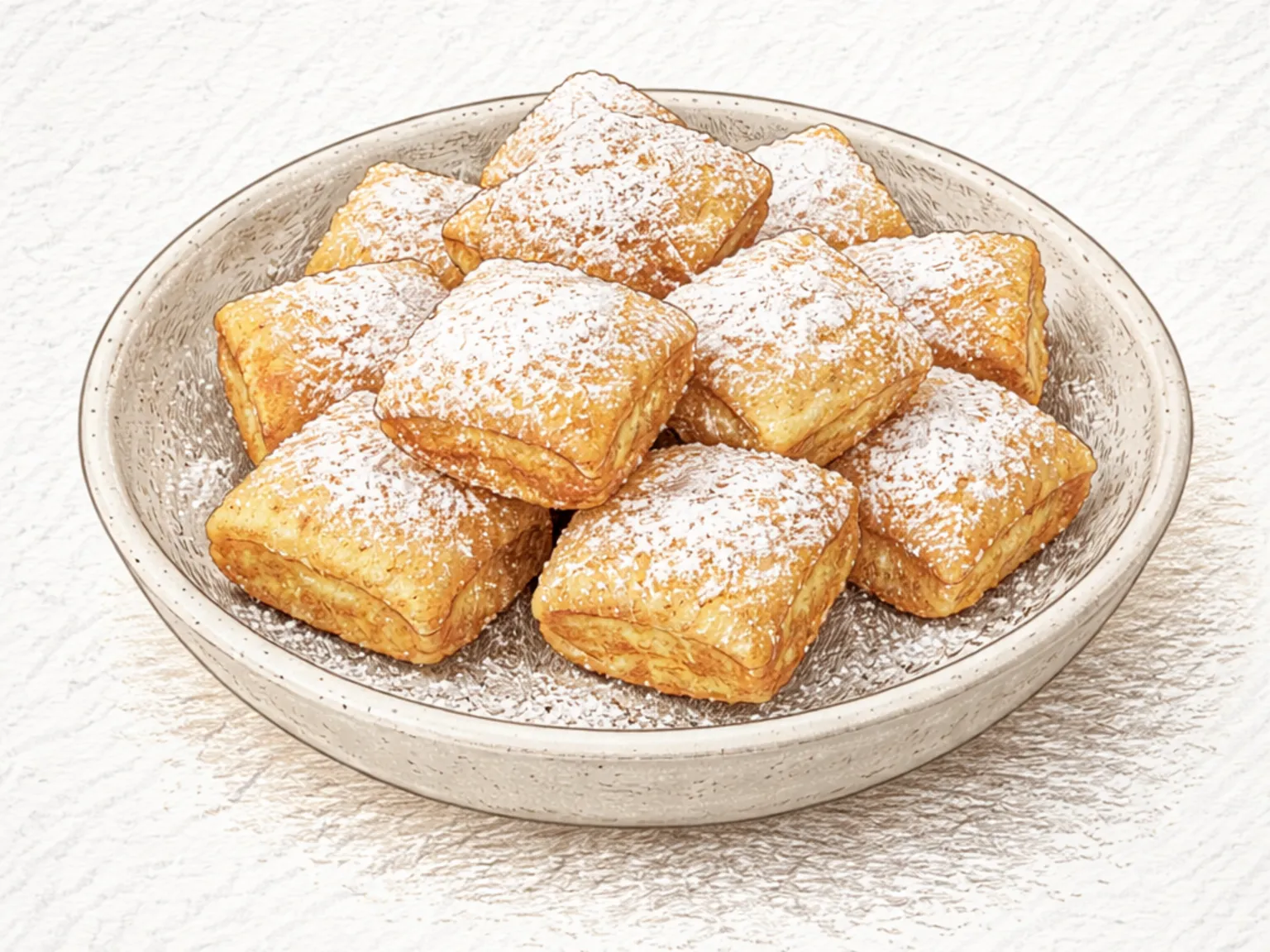
Beignets are square fried dough pastries that arrived in Louisiana with French colonists and became a defining food of New Orleans.

What makes this special

  • Beignets consist of square pillows of fried yeast dough covered in thick powdered sugar.
  • Square-cut dough puffs in 170 degree oil instantly, soft inside and lightly crisp outside
  • Yeast-leavened batter is lighter than cake donuts; paired with chicory coffee for a century
Total time
45 min
Level
Medium
Servings
4 servings
Ingredients
7
Calories
360 kcal
Protein
7 g

Key ingredients

all-purpose flourmilkinstant yeastsugaregg

Core cooking flow

  1. 1 Let 140ml milk lose its chill, then mix 280g all-purpose flour, 5g instant yeast, and 35g sugar first.
  2. 2 Add 30g softened butter and knead for at least 10 minutes.
  3. 3 Place the dough in a bowl, cover it, and proof in a warm spot for about 1 hour.

Beignets are square fried dough pastries that arrived in Louisiana with French colonists and became a defining food of New Orleans. A yeast-leavened dough of flour, milk, sugar, egg, and butter rises until airy, then is rolled and cut into rough squares before being dropped into hot oil. Each piece puffs up rapidly as it fries - the center becomes pillow-soft while the outside sets into a thin, light golden shell. Pulled from the oil, the beignets are immediately buried under a heavy dusting of powdered sugar that begins to melt against the warm surface. At Cafe du Monde in the French Quarter they have been served three to a plate with chicory coffee for over a century. In New Orleans, beignets are eaten at any hour of the day, morning through midnight.

Prep 30min Cook 15min 4 servings

Instructions

Read the steps as a cooking flow: prep, heat, seasoning, doneness control, and finish.

6 steps
  1. 1
    Season

    Let 140ml milk lose its chill, then mix 280g all-purpose flour, 5g instant yeast, and 35g sugar first.

    Add 1 egg and stir until a shaggy dough forms, with no dry flour pockets left in the bowl.

  2. 2
    Step

    Add 30g softened butter and knead for at least 10 minutes.

    Stop when the dough looks smoother, stretches with some resistance, and feels elastic, even if it remains slightly tacky to the hands.

  3. 3
    Control

    Place the dough in a bowl, cover it, and proof in a warm spot for about 1 hour.

    It is ready when doubled in size and a fingertip mark slowly springs back instead of closing immediately.

  4. 4
    Heat

    Lightly flour the work surface and gently press out excess gas from the dough.

    Roll it to 1cm thickness and cut into 5cm squares, avoiding a thin sheet so the centers stay fluffy after frying.

  5. 5
    Control

    Set the cut pieces apart, cover with a kitchen towel, and rest for 15 minutes.

    When they puff slightly again, heat the oil to 170°C and keep the temperature steady before adding dough.

  6. 6
    Finish

    Lower the dough carefully into the oil and fry for 1 to 2 minutes per side.

    Remove when golden, drain briefly on kitchen paper, then dust immediately with 40g powdered sugar and serve while warm and crisp.

After the steps

Pick a recipe that fits this dish.

Continue with shared ingredients, meal pairings, or a similar method.

Recipes That Go Well With This

More Baking →

Based on shared ingredients and meal pairing

Choux Cream Puffs (French Hollow Pastry with Vanilla Custard)
Shared ingredient: milk Baking

Choux Cream Puffs (French Hollow Pastry with Vanilla Custard)

Choux cream puffs are built around pate a choux, a paste cooked directly on the stovetop by combining water, butter, and flour over heat, then beating in eggs one at a time until the dough is smooth, glossy, and just thick enough to hold a piped shape. Once mounds are piped onto a baking sheet and slid into a hot oven, the water content in the dough converts rapidly to steam, inflating each piece into a hollow shell while the exterior sets into a crisp, deep-golden crust. The key to a reliably hollow interior is patience with the eggs: adding them too quickly or all at once produces uneven expansion, while a gradual approach allows the structure to develop properly. Once completely cooled - cooling fully is not optional, as residual heat will melt the filling - a small hole is pierced in the bottom of each shell and pastry cream is piped inside. The contrast upon biting is what makes the pastry compelling: the thin, shattering shell breaks to release cool, silky custard against the palate. The pastry cream itself is made by simmering milk with a split vanilla bean, then whisking the infused milk into egg yolks, sugar, and cornstarch, cooking until thick, and chilling until cold and set. Filled puffs should be consumed within two to three hours, as moisture from the cream migrates into the pastry over time, softening the crust and eliminating the textural contrast that defines the experience.

Gougeres (Gruyère Cheese Choux Puffs)
Shared ingredient: egg Western

Gougeres (Gruyère Cheese Choux Puffs)

Gougeres are savory cheese puffs from Burgundy, France, made by folding grated Gruyere cheese into choux pastry and baking until golden and hollow inside. Water, butter, and salt are brought to a boil, then flour is added all at once and stirred over low heat until the starches gelatinize and the dough pulls away from the pan in a smooth ball. Eggs are beaten in one at a time - the dough breaks apart and re-forms with each addition, building the elastic structure that allows the puffs to rise. Folding in the cheese and pepper, then piping rounds onto a tray and baking at 200 degrees Celsius turns the moisture in the dough to steam, which inflates each puff into a crisp shell with a hollow, airy center. Opening the oven door during baking releases the steam prematurely, which can cause the puffs to collapse.

French Toast
Serve together Western

French Toast

French toast soaks thick bread slices in a mixture of beaten eggs, milk, sugar, vanilla extract, and cinnamon until both sides absorb the custard evenly. The soaked bread is then cooked in melted butter over medium-low heat until each side turns golden brown and lightly caramelized on the surface while staying soft and moist inside. Slightly stale bread works better than fresh because its drier crumb absorbs more of the egg mixture without falling apart. Warm cinnamon and vanilla fragrance fills the kitchen during cooking. A drizzle of maple syrup and a dusting of powdered sugar finish the dish, and adding whipped cream or fresh fruit elevates it further.

Cream Horn Pastry (Spiral Puff Pastry Cone with Cream Filling)
Similar recipe Baking

Cream Horn Pastry (Spiral Puff Pastry Cone with Cream Filling)

Cream horns are made by wrapping thin strips of puff pastry around conical metal molds in a tight spiral and baking until the laminated layers separate into a crisp, golden shell. The hundreds of butter-and-dough layers in the pastry open and puff apart in the oven's heat, producing a horn that is structurally firm yet delicate enough to shatter on first bite. Once the horns cool, the metal cone is removed to reveal a hollow pastry ready for filling. A mixture of cream cheese and whipped cream is piped generously inside, delivering smooth, lightly tangy sweetness that plays against the brittle exterior. A final dusting of powdered sugar completes the presentation. The critical rule is timing - filling the horns only just before serving preserves the crispness, as the cream introduces moisture that softens the pastry rapidly.

Serve with this

Apple Fennel Walnut Salad
Salads Easy

Apple Fennel Walnut Salad

This salad pairs three ingredients whose textures and flavors run in different directions - crisp apple, anise-scented fennel, and bitter walnuts - and unifies them with a honey-lemon dressing. Thinly sliced fennel bulb contributes a licorice-like fragrance that is more aromatic than sweet, while its celery-crisp texture holds a firm contrast against the apple's softer flesh. Toasted walnuts add a crunchy, tannic bitterness that anchors the lighter elements and keeps the salad from reading as merely sweet. The dressing is deliberately minimal - fresh lemon juice, honey, a small amount of olive oil, and a pinch of salt - so the ingredients carry the flavor rather than the sauce. Assembling just before serving prevents the apple from browning. Salads of this type appear on autumn and winter tables in France and Italy when local apples and fennel come into season together, and can be served as a standalone starter or alongside roasted poultry, where the anise note in the fennel cuts through the meat's richness. Fennel has a long association with digestive support in Mediterranean cooking, which is partly why it has traditionally been served alongside fatty meats, and this salad draws on the same pairing logic.

🥗 Light & Healthy ⚡ Quick
Prep 15min 2 servings
Einspanner (Espresso with Vanilla Whipped Cream)
Drinks Medium

Einspanner (Espresso with Vanilla Whipped Cream)

The Einspanner is a coffee beverage originating from Austria that features a distinct layered structure consisting of espresso at the bottom and a dense portion of whipped cream on top. This cream is typically seasoned with a small amount of sugar and vanilla extract to provide a subtle sweetness that complements the coffee. A primary characteristic of this drink is the sharp visual and textural contrast between the dark espresso base and the thick, pale cream that rests on the surface. Proper preparation of the cream is essential for the beverage to function as intended. It must be whipped until it reaches a specific consistency of approximately seventy percent stiffness, which allows it to remain fluid enough to float and spread evenly across the entire surface of the espresso. If the cream is over-whipped and becomes too firm, it will form clumps and fail to integrate naturally with the coffee as the person drinks it. The assembly process involves cooling the espresso for a short period before pouring it into a glass containing ice. The whipped cream is then added slowly by using the back of a spoon to guide it onto the surface of the coffee. This specific technique is used to ensure that the two layers remain separate and do not mix prematurely. To finish the preparation, a fine layer of cocoa powder is dusted over the top of the cream. This addition provides a light chocolate flavor that serves as a bridge between the bitter notes of the espresso and the sweet taste of the whipped cream. Customarily, an Einspanner is consumed without the use of a straw. The standard method is to sip the coffee directly through the layer of cream so that both components reach the palate at the same time. This allows for the simultaneous experience of the concentrated coffee and the flavored cream in every mouthful.

🍺 Bar Snacks 🧒 Kid-Friendly
Prep 10min Cook 5min 2 servings
Chapssal Kkwabaegi (Glutinous Rice Twist Donuts)
Desserts Medium

Chapssal Kkwabaegi (Glutinous Rice Twist Donuts)

Chapssal-kkwabaegi are Korean twisted donuts made from a yeasted dough of glutinous rice flour and bread flour, proofed until nearly doubled, shaped by twisting pairs of ropes together, and fried at 170 degrees Celsius. The high ratio of glutinous rice flour gives the interior a notably chewy pull that sets these apart from standard wheat donuts, though over-proofing turns that chew tough rather than springy. Maintaining oil temperature at 170 degrees keeps the shell golden and crisp while minimizing grease absorption, so the finished donut stays light in hand. Tossing them in cinnamon sugar immediately after draining lets the residual heat partially melt the crystals into a thin, clinging sweet crust.

🧒 Kid-Friendly 🎉 Special Occasion
Prep 35min Cook 20min 4 servings

Similar recipes

Classic Croissant
Baking Hard

Classic Croissant

A classic croissant is built through lamination: a process of folding cold butter into yeast-leavened dough in successive turns to create dozens of alternating layers. Three sets of folds produce a structure so layered that when baked, the butter melts and releases steam, forcing each layer apart from within. Keeping the butter at a similar temperature to the dough throughout is critical because if the block grows too hard it shatters through the layers and if it grows too soft it merges with the dough and the lamination collapses. The exterior caramelizes into a shell so thin and crisp it shatters at the slightest pressure, scattering golden flakes. The interior, by contrast, is a honeycomb of soft, airy strands held together by the ghost of dissolved butter. Tearing a warm croissant apart releases a rush of butter fragrance, and the dough itself carries a faint sweetness from sugar and milk.

🎉 Special Occasion 🧒 Kid-Friendly
Prep 120min Cook 18min 8 servings
Olive Herb Flat Bread (Leaf-Shaped Provencal Bread)
Baking Hard

Olive Herb Flat Bread (Leaf-Shaped Provencal Bread)

Fougasse is a flatbread from Provence in southern France, shaped with decorative slashes that resemble a leaf or wheat sheaf. The dough is enriched with olive oil and studded with Kalamata olives, rosemary, and thyme, distributing pockets of briny, herbal flavor throughout the bread. The distinctive cuts serve more than an aesthetic purpose - they increase the crust-to-crumb ratio dramatically, so thinner sections bake to a crackling crispness while thicker areas remain soft and chewy. This variation in texture within a single piece is what makes fougasse more interesting than a uniform loaf. The surface is brushed with olive oil before baking, which produces a golden, glossy finish. Best eaten warm, when the aromatic oils from the herbs and olives are most volatile. It pairs naturally with southern French dishes, charcuterie boards, or a simple bowl of good olive oil for dipping.

🎉 Special Occasion 🧒 Kid-Friendly
Prep 30min Cook 20min 4 servings
Salmon in Puff Pastry
Western Hard

Salmon in Puff Pastry

Salmon en croute wraps a salmon fillet spread with a mixture of cream cheese, wilted spinach, dill, and lemon zest inside puff pastry and bakes it until golden. Patting the salmon completely dry with paper towels is crucial - any surface moisture will make the pastry soggy. The spinach must also be squeezed thoroughly to prevent a wet filling. Cream cheese and Dijon mustard form a barrier between the fish and the dough, blocking the salmon's moisture from softening the pastry. Baking at 200 degrees Celsius for twenty-five to thirty minutes puffs the pastry into flaky, crisp layers while the salmon inside stays tender and moist, delivering both textures in every slice. Chilling the assembled package for ten minutes before baking re-firms the butter in the pastry, producing sharper layers after baking.

🎉 Special Occasion
Prep 25min Cook 30min 4 servings

Tips

Low oil temperature causes greasy beignets.
Do not roll too thin if you want a fluffy center.

Nutrition (per serving)

Calories
360
kcal
Protein
7
g
Carbs
49
g
Fat
14
g