Black Sesame Tangyuan (Glutinous Rice Balls with Sesame Paste Filling)
Quick answer
Black sesame tangyuan are Chinese glutinous rice dumplings filled with a dense, jet-black sesame paste and traditionally served in a light ginger broth during Yuanxiao Fe...
What makes this special
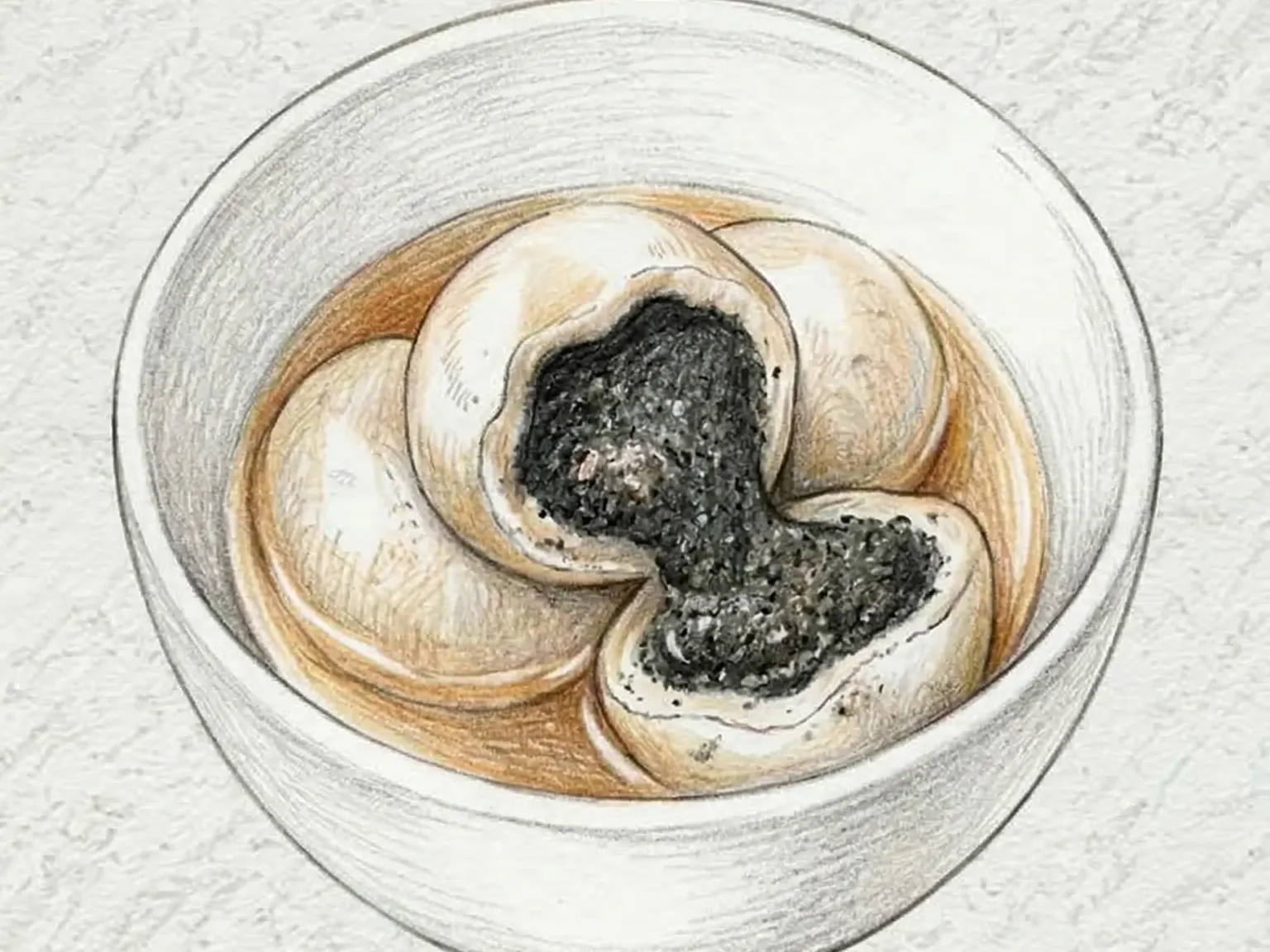
- Biting through chewy Black Sesame Tangyuan releases a molten filling of dense, jet-black sesame paste.
- Biting through chewy glutinous skin releases molten black sesame filling
- Ginger syrup's sharp warmth contrasts the rich, nutty sesame interior
Key ingredients
Core cooking flow
- 1 Rub together 80g black sesame powder, 50g sugar, and 40g melted butter until...
- 2 Pour 160ml warm water into 220g glutinous rice flour a little at a time, mix...
- 3 Keep the dough covered with a damp cloth whenever you are not shaping it, be...
Black sesame tangyuan are Chinese glutinous rice dumplings filled with a dense, jet-black sesame paste and traditionally served in a light ginger broth during Yuanxiao Festival and the Winter Solstice -- occasions when eating round dumplings represents family reunion and wholeness. The filling is made by grinding toasted black sesame seeds and mixing them with sugar and softened butter until a thick, almost solid paste forms; chilling this paste before wrapping makes it much easier to handle and prevents it from oozing out during shaping. The outer dough is shaped from glutinous rice flour mixed with just enough boiling water to create a smooth, pliable skin that seals without cracking. Dropped into boiling water, the dumplings are ready when they float to the surface, at which point they should be transferred promptly to avoid overcooking and tearing. A single bite breaks through the springy, chewy exterior and releases the molten sesame filling, which flows out with concentrated nuttiness. Served in a ginger syrup made by simmering fresh ginger slices with rock sugar, the warmth and mild spice of the broth complement the heavy richness of the sesame, making the bowl feel balanced despite its density. The textural contrast between the elastic skin and the flowing interior is what makes tangyuan distinctly satisfying.
Instructions
Read the steps as a cooking flow: prep, heat, seasoning, doneness control, and finish.
- 1Season
Rub together 80g black sesame powder, 50g sugar, and 40g melted butter until no dry powder remains and the mixture holds when pressed. Pack it together firmly, then chill for at least 30 minutes so the filling becomes easy to portion.
- 2Prep
Pour 160ml warm water into 220g glutinous rice flour a little at a time, mixing first with your fingertips.
Once it gathers into one mass, knead for about 3 minutes until soft, smooth, and pliable.
- 3Control
Keep the dough covered with a damp cloth whenever you are not shaping it, because dry dough cracks quickly.
Divide the chilled filling into 15g pieces, roll them into balls, and chill again briefly if they soften or smear.
- 4Step
Pinch off dough pieces slightly larger than the filling balls, press the center, and shape each piece into a thin cup.
Place the filling inside, gather the edges, pinch them closed, then roll gently until the surface looks smooth.
- 5Control
Bring 500ml water to a full boil, then lower to medium heat before adding the tangyuan.
Stir once gently so they do not stick to the bottom, cook until they float, then give them 1 more minute and lift them out.
- 6Finish
Thinly slice 10g ginger and simmer it in the tangyuan cooking water over medium-low heat for 5 minutes.
When the ginger aroma is clear, place the dumplings in bowls and pour the hot ginger syrup over them to serve.
After the steps
Pick a recipe that fits this dish.
Continue with shared ingredients, meal pairings, or a similar method.
Recipes That Go Well With This
More Baking →Based on shared ingredients and meal pairing
Sesame Spicy Tantanmen (Chinese Creamy Sesame Chili Oil Noodle Soup)
Tantanmen is a noodle soup of Chinese origin that is defined by the combination of a creamy sesame-based broth and the sharp heat of chili oil. This pairing creates a bowl of noodles that features nutty, spicy, and savory characteristics all at once. The preparation of the broth starts with a base of chicken stock. To this base, sesame paste is added and whisked thoroughly until it has fully dissolved into the liquid. The result of this process is a thick, tan-colored soup base that emits a prominent fragrance of roasted nuts. The meat topping for the dish is prepared separately by frying ground pork with minced garlic and fresh ginger. During this cooking process, doubanjiang, which is a paste made from fermented chili beans, is stirred into the pork to add saltiness and depth. The meat is cooked until it is well-browned and has a crumbly consistency, after which it is spooned over the noodles to provide a rich component to the final assembly. To balance the density of the broth, bok choy is blanched and added to the bowl, offering a crisp and vegetal element that provides a contrast to the liquid. Just before serving, a final drizzle of chili oil is applied to the surface of the soup, where it gathers in small pools and releases its aroma with the heat. The noodles are generally cooked until they are just short of being fully done, which allows them to maintain a firm and chewy texture while they remain submerged in the hot liquid. Each individual ingredient, from the sesame and chili to the fermented beans and pork, contributes its own specific layer of flavor. As these different elements gradually merge together in the bowl, the taste of the soup continues to develop and change while the meal is consumed slowly.
Yu Sheng Prosperity Salad
Yu sheng prosperity salad arranges thinly sliced sashimi-grade salmon and finely julienned daikon, carrot, and cucumber in a ring on a large platter, dressed with plum sauce, lemon juice, and sesame oil, then tossed vigorously just before eating. The salmon must be sashimi-grade for food safety, and patting it dry before slicing thin allows the sweet-tart plum sauce to cling more effectively to the fish surface. Cutting all vegetables as finely as possible maximizes the surface area in contact with the dressing, ensuring every chopstick-full carries the full spectrum of flavors. Keeping the prepared vegetables chilled maintains the freshness of the raw fish once assembled. Sesame seeds sprinkled on top add a nutty aroma that layers over the fruity plum sauce, completing the festive character of the dish.
Sweet Chestnut Confection
Yulran is a traditional Korean chestnut confection that is prepared by boiling 300 grams of chestnuts in water for a duration of 20 minutes. Once the boiling process is complete, the chestnut flesh is removed from the shells and pressed through a fine sieve. This manual pressing continues until the texture becomes perfectly smooth. The purpose of using a sieve is to eliminate any grainy bits, which results in a chestnut paste with an even and velvety consistency. This puree is then kneaded together with a combination of honey and ground cinnamon. After the ingredients are thoroughly mixed, the paste is shaped into small, bite-sized rounds. The honey used in this recipe serves as both a source of moisture and a necessary adhesive. Its sticky property provides the strength required for the confection to hold its molded shape effectively without crumbling into pieces. Ground cinnamon is included to provide a warm spice note. This flavor is chosen because it complements the starchy and earthy sweetness of the chestnut rather than competing with the natural profile of the nut. Following the shaping process, each piece is rolled in ground pine nuts. This step coats the exterior in a mild nuttiness and introduces a subtle textural contrast against the smooth paste contained within. For a final visual touch, thin slices of jujube are placed on top as a garnish to provide a stroke of red color. The finished rounds are then placed in the refrigerator to chill for 15 minutes. This cooling period firms the surface of the paste just enough so that the confections can be picked up cleanly with the fingers without sticking to the skin. Historically, Yulran was a common fixture on the ceremonial and banquet tables of the Joseon court. It was valued for its clean and understated sweetness, which allows the natural flavor of the chestnut to remain the central focus.
Yangchunmian (Shanghai Clear Soy Broth Noodle Soup)
Yangchunmian is one of the most stripped-down noodle soups in Chinese cuisine, where a clear soy-seasoned broth and fresh wheat noodles are the entire focus. Chicken stock forms the base, seasoned with light soy sauce, a drizzle of sesame oil, and a dusting of white pepper. Chopped scallions float on top and blanched bok choy sits alongside the noodles - there is no meat, no elaborate garnish, nothing to distract from the broth itself. The critical finishing touch is a spoonful of scallion oil ladled over the surface, spreading an aromatic warmth across each bite. It has been a staple breakfast in Shanghai for generations.
Serve with this
Kasespatzle (German Alpine Cheese Dumpling Noodles)
Kasespatzle is an Alpine comfort dish from southern Germany and Austria, made by boiling a thick batter of flour, eggs, and milk into small dumplings, then tossing them with melted Emmental cheese and caramelized onions. The batter must maintain a thick consistency rather than being runny - this is what gives the spaetzle their characteristic chew when boiled and drained. Sliced onion is slowly cooked in butter over low heat until deeply browned, transforming the raw sharpness into a concentrated sweetness. The cooked spaetzle and grated cheese are combined in a hot pan so the cheese melts and coats every dumpling. Topped with the caramelized onions and black pepper, the dish is served immediately while the cheese is still molten and stretchy.
Black Tea Milk Tea (British Condensed Milk Sweet Tea)
Milk tea is prepared by steeping black tea bags in boiling water for exactly four minutes to extract a strong, tannic base, then combining it with whole milk and condensed milk over low heat. Steeping shorter than four minutes leaves the tea pale and thin; longer than four minutes introduces bitterness and astringency that no amount of milk can fully mask. The milk rounds out the tea's sharpness and adds a creamy body, while condensed milk layers on a dense, caramel-like sweetness that sets this version apart from tea simply sweetened with sugar. Regular sugar dissolved early provides the baseline sweetness, and the condensed milk fine-tunes the richness and texture in the final moments. Warming the milk before combining it with the brewed tea helps both blend more smoothly. For an iced version, the mixture must be cooled completely before pouring over ice, since adding hot liquid directly to ice dilutes the drink and washes out the flavor.
Similar recipes
Zongzi (Chinese Bamboo-Wrapped Sticky Rice Dumplings)
Zongzi are traditional Chinese sticky rice dumplings wrapped in bamboo leaves and simmered for hours. Glutinous rice is soaked overnight, then bundled around a filling of soy-braised pork belly and rehydrated shiitake mushrooms seasoned with oyster sauce. The bamboo leaves are folded into a tight shape and secured with kitchen twine before being submerged in boiling water for two hours or more. During this cooking, the rice absorbs the rendered fat and seasoning from the pork, becoming dense, sticky, and deeply flavored. The bamboo leaves impart a subtle grassy fragrance that permeates every grain. While traditionally eaten during the Dragon Boat Festival, zongzi are available year-round across southern China.
Guilin Rice Noodles (Silky Rice Noodles in Beef Brisket Broth)
Guilin rice noodles are the signature noodle dish of Guilin in Guangxi, China, built on a clear beef brisket broth that has been simmered until the collagen fully dissolves and the liquid turns deeply savory without becoming heavy. The slender rice noodle strands are smooth and slightly springy, and they absorb the broth as the bowl sits. Soy sauce seasons the soup with a salty, round undertone rather than any sharp edge. Pickled daikon radish is added as a topping for its crisp bite and vinegary tang, which cuts through the richness of the beef broth and resets the palate between mouthfuls. A drizzle of chili oil introduces a warm, slow-building heat that spreads through the soup. Fresh cilantro placed on top at the end adds a bright, citrus-forward herbal fragrance that ties the Southeast Asian-influenced profile of the bowl together. The combination of broth, noodles, and contrasting toppings is what makes Guilin rice noodles a dish people return to repeatedly.
Hokkien Lor Mee (Braised Gravy Noodles)
Hokkien lor mee is a thick-gravy noodle dish from the Chinese communities of Singapore and Malaysia, built on chicken stock seasoned with dark soy sauce and five-spice powder. The dark soy gives the broth its deep mahogany color and intense saltiness, while five-spice, with its blend of star anise and cinnamon, layers in aromatic complexity. A cornstarch slurry is added gradually to thicken the broth to a glossy, almost sauce-like consistency that coats the yellow noodles completely. Bean sprouts are blanched for just one minute to retain their crunch, and halved boiled eggs provide a creamy element. The traditional finishing touch is raw minced garlic and a splash of black vinegar, both of which cut through the heavy gravy and keep each spoonful from becoming monotonous.
Lotus Seed Mooncake (Sweet Lotus Paste in Golden Syrup Crust)
Lotus seed paste is wrapped in a thin dough of golden syrup, neutral oil, alkaline water, and flour, then pressed into decorative molds and baked to produce this iconic Chinese Mid-Autumn Festival pastry. The syrup-based dough remains pliable and moist even after baking, unlike a standard pie crust, creating a skin that yields softly under the teeth before giving way to the dense, sweet filling. The ratio of filling to dough is intentionally high, so each bite delivers concentrated lotus seed flavor. Mooncake molds stamp intricate patterns onto the surface, but a heavy-handed egg wash blurs those details; a single thin coat preserves the design while adding a glossy, amber sheen. Baking in two stages at 190 degrees Celsius, with the egg wash applied between them, ensures even coloring without over-browning. The crucial final step is resting: sealed in an airtight container for at least one day, the dough absorbs oil from the filling in a process called hui-you, softening its texture and harmonizing the flavors into a cohesive whole.