Bo La Lot (Vietnamese Grilled Beef Wrapped in Betel Leaves)
Quick answer
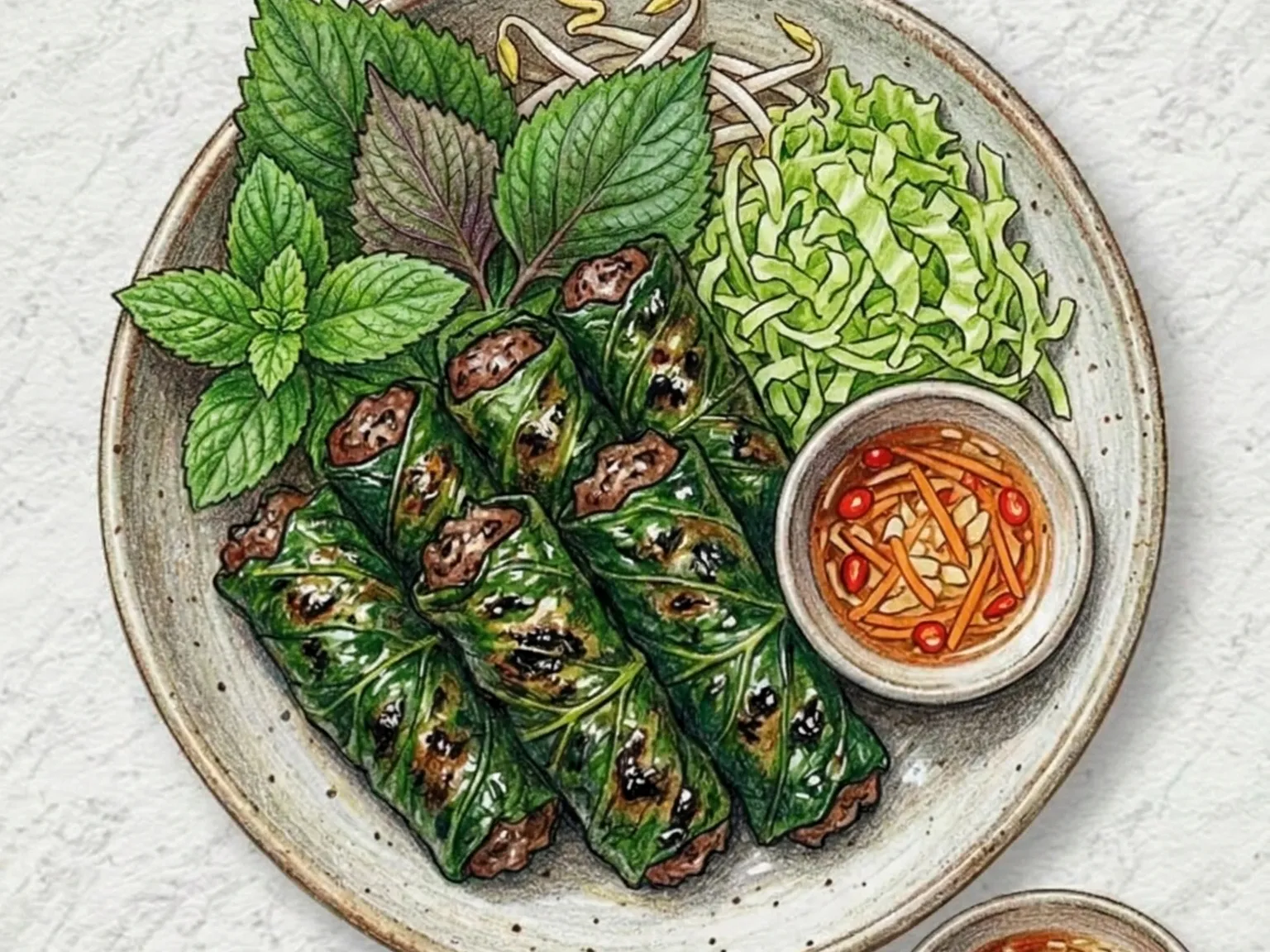
Bo la lot is a southern Vietnamese dish that transforms seasoned ground beef into something aromatic and layered through the medium of la lot, the wild betel leaf (Piper...
What makes this special
- Bo La Lot consists of seasoned ground beef wrapped in betel leaves and grilled for a peppery aroma.
- Charred betel leaf edges infuse peppery, herbal notes into the beef
- Crisp leaf exterior contrasts with juicy, seasoned minced beef inside
Key ingredients
Core cooking flow
- 1 Combine 300 g ground beef with 40 g minced shallot, 1 tablespoon minced garl...
- 2 Knead the beef mixture by hand or with a sturdy spatula for 8 to 10 minutes.
- 3 Wash 20 la lot leaves and dry both sides completely with paper towels.
Bo la lot is a southern Vietnamese dish that transforms seasoned ground beef into something aromatic and layered through the medium of la lot, the wild betel leaf (Piper lolot) - a broad, heart-shaped leaf with a peppery, faintly medicinal fragrance found nowhere else in the Vietnamese herb repertoire. The beef is combined with lemongrass, garlic, fish sauce, sugar, and five-spice powder, then wrapped tightly in individual leaves and threaded onto skewers. Over a charcoal grill, the leaf edges char and turn crisp while the rendered fat from the beef migrates into the leaf's porous surface, bonding the meat's juices with the leaf's volatile aromatic oils. The resulting bite carries multiple simultaneous impressions: char smoke from the grill, pepper heat from the leaf, savory sweetness from the spiced beef, and a faint numbing tingle from the la lot's natural compounds. The standard way to eat it is wrapped in lettuce and rice paper with fresh herbs and a bowl of nuoc cham for dipping, and it functions as a staple snack at the casual outdoor beer halls known as bia hoi across Vietnam.
Instructions
Read the steps as a cooking flow: prep, heat, seasoning, doneness control, and finish.
- 1Season
Combine 300 g ground beef with 40 g minced shallot, 1 tablespoon minced garlic, 1.5 tablespoons fish sauce, 1 teaspoon sugar, and 0.5 teaspoon black pepper. Mix until the seasoning is evenly distributed through the meat.
- 2Prep
Knead the beef mixture by hand or with a sturdy spatula for 8 to 10 minutes.
Stop when it turns sticky, clings lightly to the hand, and holds together as one cohesive mass.
- 3Heat
Wash 20 la lot leaves and dry both sides completely with paper towels.
Set aside torn leaves, because they can leak filling during grilling, or use them only with a smaller amount of meat.
- 4Step
Place each leaf with the rough, matte side facing up and lay a narrow strip of beef near one end.
Roll tightly without leaving air pockets, then press the leaf tip into the meat to secure it.
- 5Control
Brush a pan or grill with 1 tablespoon cooking oil and preheat over medium-high heat.
Place the rolls seam side down first so the heat seals the leaf before the rolls are turned.
- 6Finish
Grill for 4 to 6 minutes, turning often so the leaves char lightly instead of burning.
Serve when the edges are crisp and the beef juices run clear, with herbs, rice paper, and nuoc cham.
After the steps
Pick a recipe that fits this dish.
Continue with shared ingredients, meal pairings, or a similar method.
Recipes That Go Well With This
More Asian →Based on shared ingredients and meal pairing
Bo Kho (Vietnamese Lemongrass Beef Shank Stew)
Bo kho is Vietnam's beef stew, born in the southern kitchens of Saigon where French colonial influence introduced slow-braised preparations and Vietnamese cooks adapted them with local aromatics. Beef shank and tendon are cut into large chunks and braised with lemongrass, star anise, cinnamon, and annatto oil - the annatto tinting the broth a vivid orange-red that sets bo kho apart from the darker tones of Western stews. Tomato paste and a spoonful of curry powder go in early, building a base that is simultaneously sweet, earthy, and warm. The stew simmers for two hours or more until the beef is fork-tender and the tendon has turned gelatinous, releasing its collagen into the broth and giving it a lip-coating richness. Carrots and daikon radish soften in the liquid during the final thirty minutes, absorbing the concentrated aromatics as they cook. Bo kho is eaten two ways - ladled over steamed rice, or alongside a crusty baguette torn for dipping into the broth. Street vendors in Ho Chi Minh City serve it from dawn, when the morning air carries the scent of star anise from their simmering pots across the alleyways.
Hanoi-Style Pho Bo (Vietnamese Northern Clear Beef Noodle Soup)
Hanoi-style pho bo is the original northern Vietnamese beef noodle soup, distinguished from its southern counterpart by a leaner, clearer broth and restrained garnishing. Beef bones and brisket simmer for hours with a modest hand of spices - star anise, cinnamon bark, and a few cloves - so the beef flavor leads rather than the aromatics. The broth is repeatedly skimmed until it runs nearly transparent, with no trace of grease on the surface. Paper-thin slices of raw beef placed in the bowl cook to a pale pink the moment the scalding broth is ladled over them. In Hanoi, the bowl arrives with only chopped scallion and cilantro; bean sprouts, hoisin sauce, and sriracha - common in southern and overseas versions - are absent by tradition.
Vietnamese Grilled Pork Vermicelli
Charcoal-grilled pork is placed over cold rice vermicelli and eaten mixed with nuoc cham in this southern Vietnamese noodle bowl. The pork marinates in fish sauce, sugar, and garlic before grilling, so direct heat caramelizes the surface sugars into a deep brown crust while the interior holds its moisture. Fresh mint, cilantro, and coarsely crushed roasted peanuts are scattered on top, layering herbal fragrance with crunch. Nuoc cham, built from lime juice, sugar, fish sauce, and chili, is the sweet-sour-salty binding agent that pulls together the warm meat, cool noodles, and raw herbs into a single coherent bowl. The temperature contrast between hot pork and chilled vermicelli is central to the eating experience. Pickled daikon and carrot add a final note of acidity that keeps each bite clean. No broth is needed; the bowl is filling and bright.
Bo Luc Lac (Vietnamese Shaking Beef Sirloin Wok Stir-Fry)
Bo luc lac takes its name from the shaking motion that defines how the dish is cooked. Cubed beef tenderloin or sirloin, marinated in soy sauce, oyster sauce, garlic, and sugar, goes into a wok heated to the point of smoking. The cook shakes the wok vigorously to toss the cubes through the oil, searing each face in seconds while the tossing motion keeps steam from building up and stewing the meat. The result is a dark, caramelized crust on the outside while the center stays pink and rare. The dish emerged from Vietnamese-French fusion cooking in colonial Saigon, when Western beef cuts became available and Vietnamese cooks applied their own techniques to them. The beef is plated over watercress dressed with lime juice and cracked black pepper; the sharpness of the watercress and the acidity of the lime cut through the rich, soy-glazed exterior. A dipping sauce of salt, pepper, and lime juice accompanies the plate. The contrast between the charred, deeply savory meat and the cool raw greens beneath has kept this one of Saigon's most recognizable dishes for decades.
Serve with this
Vietnamese Lotus Stem Shrimp Salad
Goi ngo sen is a traditional Vietnamese salad of thinly sliced lotus stem, blanched shrimp halved lengthwise, julienned carrot, and cilantro dressed in a fish sauce and lime vinaigrette. Soaking the lotus stem in diluted vinegar water for ten minutes is not optional: it removes the astringent edge while keeping the crisp, snapping texture that defines the dish, and skipping this step leaves a rough, bitter aftertaste no amount of good dressing can fix. Blanching the shrimp for two to three minutes and splitting them open lengthwise exposes more cut surface for the dressing to penetrate. The dressing combines fish sauce, lime juice, and sugar in a ratio that hits salty, sour, and sweet simultaneously, making the natural umami of the seafood stand out rather than recede. Letting the salad rest for at least five minutes after tossing gives the dressing time to soak into each ingredient and allows the flavors to settle into one another.
Clear Korean Rice Wine (Traditional Fermented Yakju)
Yakju is a traditional Korean clear rice wine produced by steaming soaked glutinous rice for 35 minutes, then fermenting it with crushed nuruk starter, dry yeast, and water for seven to ten days at room temperature. Daily stirring distributes the yeast culture evenly, and sliced ginger and jujube are added during fermentation to suppress off-flavors and contribute subtle aromatics. After fermentation, the solids are allowed to settle completely so only the clear upper liquid is carefully decanted, giving yakju its transparent appearance and refined taste distinct from cloudy makgeolli. Two days of cold aging in the refrigerator rounds off the sharp alcohol edge, bringing forward a smooth, grain-forward character.
Korean Grilled Eel Rice Bowl
Jangeeo deopbap is a bowl of grilled freshwater eel over steamed rice, where the key technique is building up a thick, lacquered glaze through multiple applications of a sweet-salty sauce reduced from soy sauce, mirin, sugar, and ginger juice. The eel starts skin-side down on the grill over medium heat for around five minutes to crisp the skin, then is flipped and basted repeatedly with the sauce as it finishes cooking. A single coat of sauce produces a pale, thin color, so at least two applications and ideally three or more are needed to build the characteristic glossy surface. With each additional coat, the sugars in the sauce react with heat through both Maillard browning and caramelization, layering flavor with every pass. Because freshwater eel is naturally fatty, fat drips during grilling can cause flare-ups, so heat control is important throughout the process. Sansho pepper dusted on at the end cuts through the eel's inherent richness with a sharp, numbing fragrance that balances the sweet glaze and keeps the dish from feeling heavy.
Similar recipes
Banh Xeo (Vietnamese Sizzling Turmeric Rice Crepe with Shrimp)
Banh xeo takes its name from the sizzling sound the batter makes when it hits a hot, oiled pan. A thin pour of rice flour, coconut milk, and turmeric crisps into a lacy, golden shell with a shatteringly crisp edge. Shrimp, sliced pork, and bean sprouts fill one half before the crepe folds over. In southern Vietnam, banh xeo are plate-sized and served with a tall pile of lettuce, fresh herbs, and pickled carrots. How you eat matters as much as how it is cooked: tear off a piece, wrap it in a lettuce leaf with mint and perilla, dip in nuoc cham, and eat in one bite. The contrast between the hot, oily crunch of the crepe and the cool, raw freshness of the herbs is what makes this dish worth eating. Northern versions are smaller and more compact, but the principle remains the same.
Vietnamese Beef Pho
Vietnamese beef pho begins with a broth made by simmering beef bones for eight hours or more to extract a clear yet deeply flavored stock. The defining step is dry-toasting whole spices - star anise, cinnamon sticks, and cloves - in a pan until fragrant, then charring halved onion and ginger over open flame to develop smoky sweetness before adding them to the pot. Skimming impurities from the surface throughout the cooking process is essential for maintaining the broth's signature clarity and golden transparency. Blanched rice noodles are placed in a bowl with paper-thin slices of raw beef on top, and the boiling broth is poured over to partially cook the meat, leaving it tender and faintly pink. Fish sauce adjusts the salinity, and a plate of fresh bean sprouts, lime wedges, Thai basil, and sliced chili allows each diner to customize their bowl.
Vietnamese Spicy Beef Noodle Soup
Bun bo Hue is a spicy beef rice noodle soup from the central Vietnamese city of Hue, distinguished from northern-style pho by the defining combination of lemongrass and fermented shrimp paste that gives the broth its assertive, layered character. Beef shank simmers for hours at low heat to yield a rich, collagen-heavy stock, and it is into this base that dried chilies, lemongrass stalks, and a measured quantity of mam ruoc, the fermented shrimp paste specific to central Vietnam, are introduced, building a spiciness that is complex rather than simply hot. A bright-red slick of chili oil floating on the surface signals the heat level before the first sip, and that first spoonful delivers the deep umami of the shrimp paste layered beneath the citrusy, grassy brightness of lemongrass, a combination unlike anything in other Vietnamese noodle soups. The noodles, called bun, are thick, round rice noodles chewier and more substantial than the flat strands in pho, with enough body to stand up to the heavy, assertive broth without becoming waterlogged. Bean sprouts, shredded raw banana flower, and a squeeze of lime are served alongside and added at the table, where their crisp textures and sharp acidity cut directly through the richness and temper the heat. Sliced pork blood sausage and braised pig's knuckle are the traditional additions that bring the bowl into full alignment with what is served in the street stalls of Hue itself.