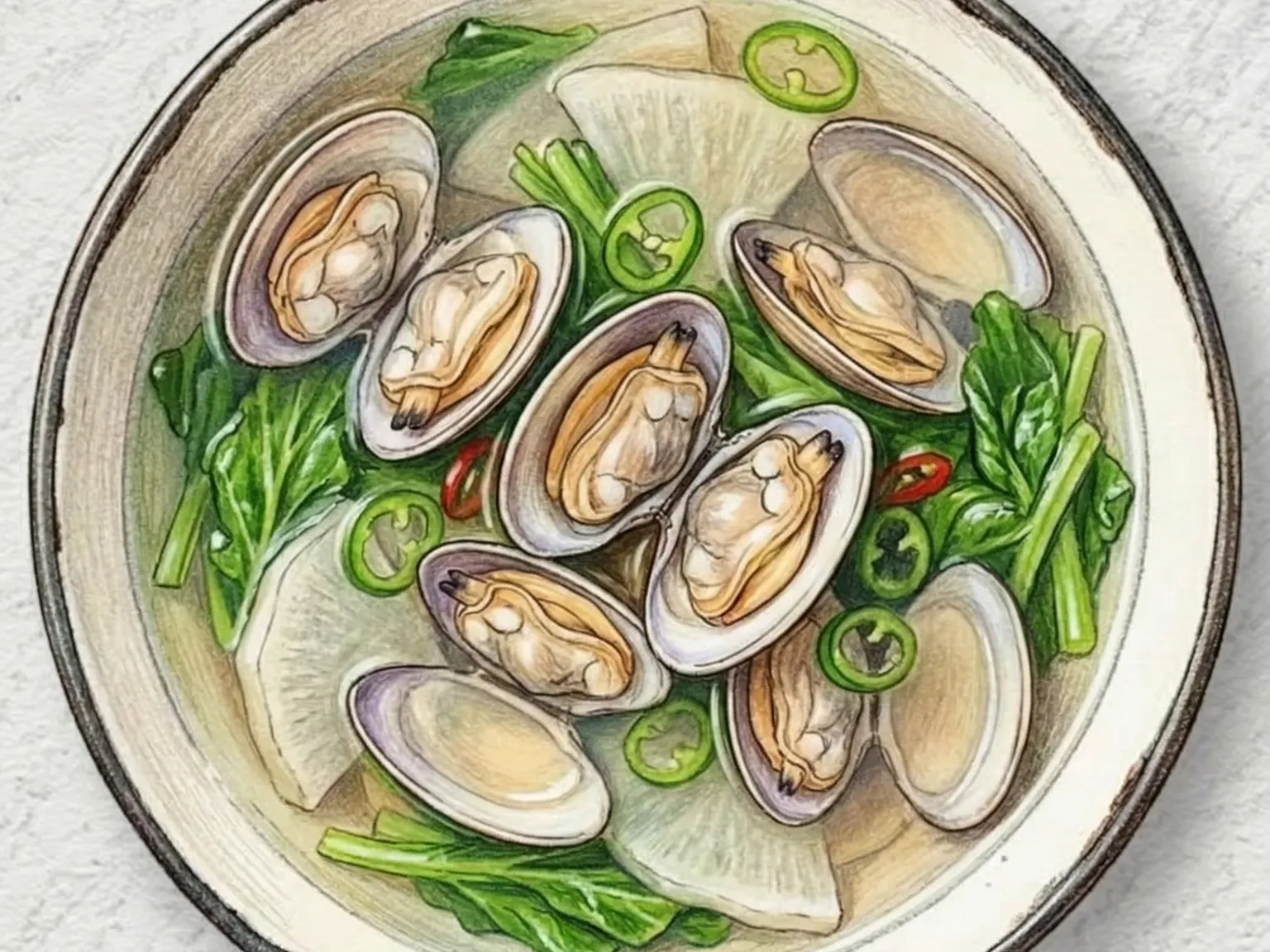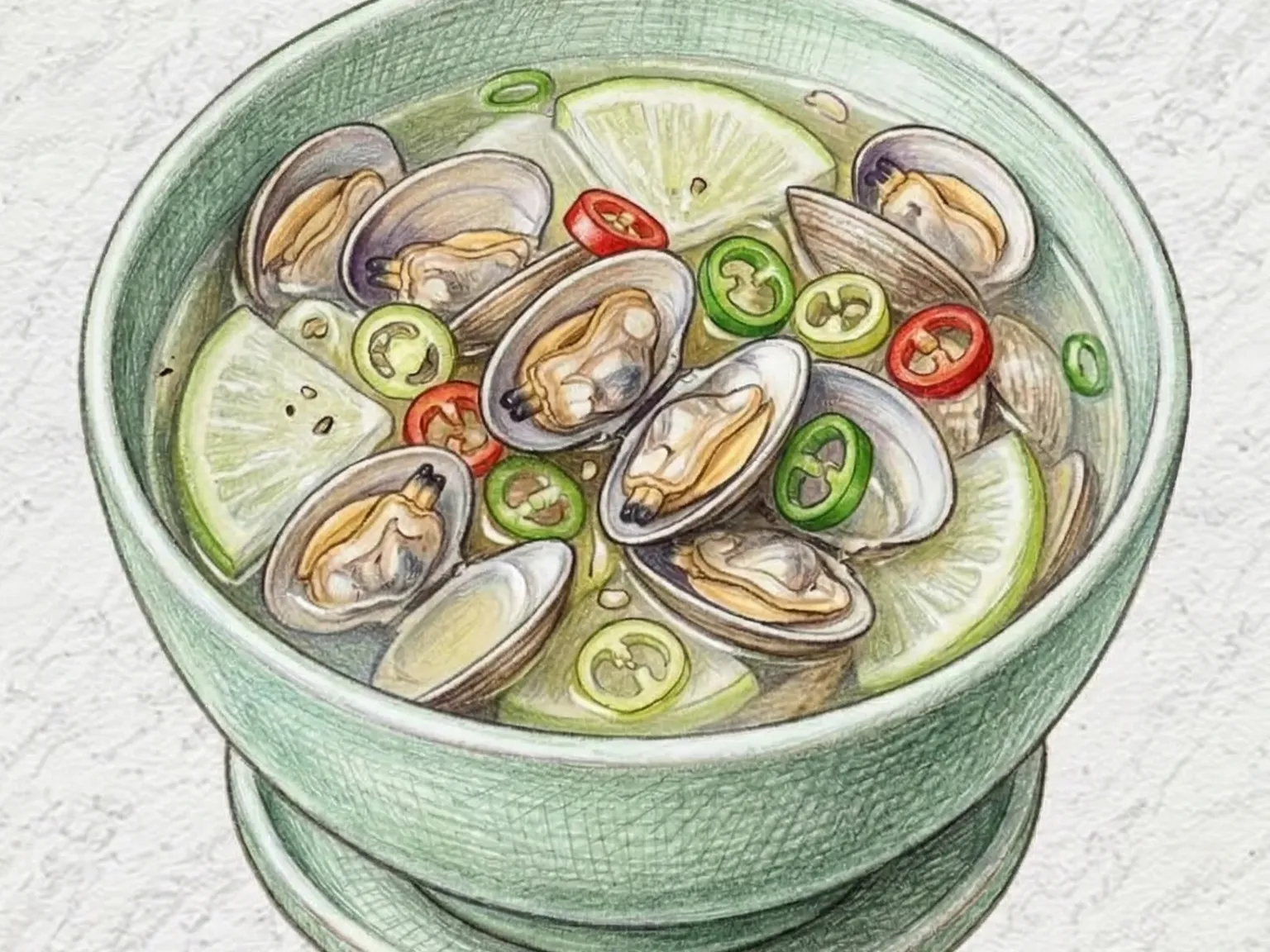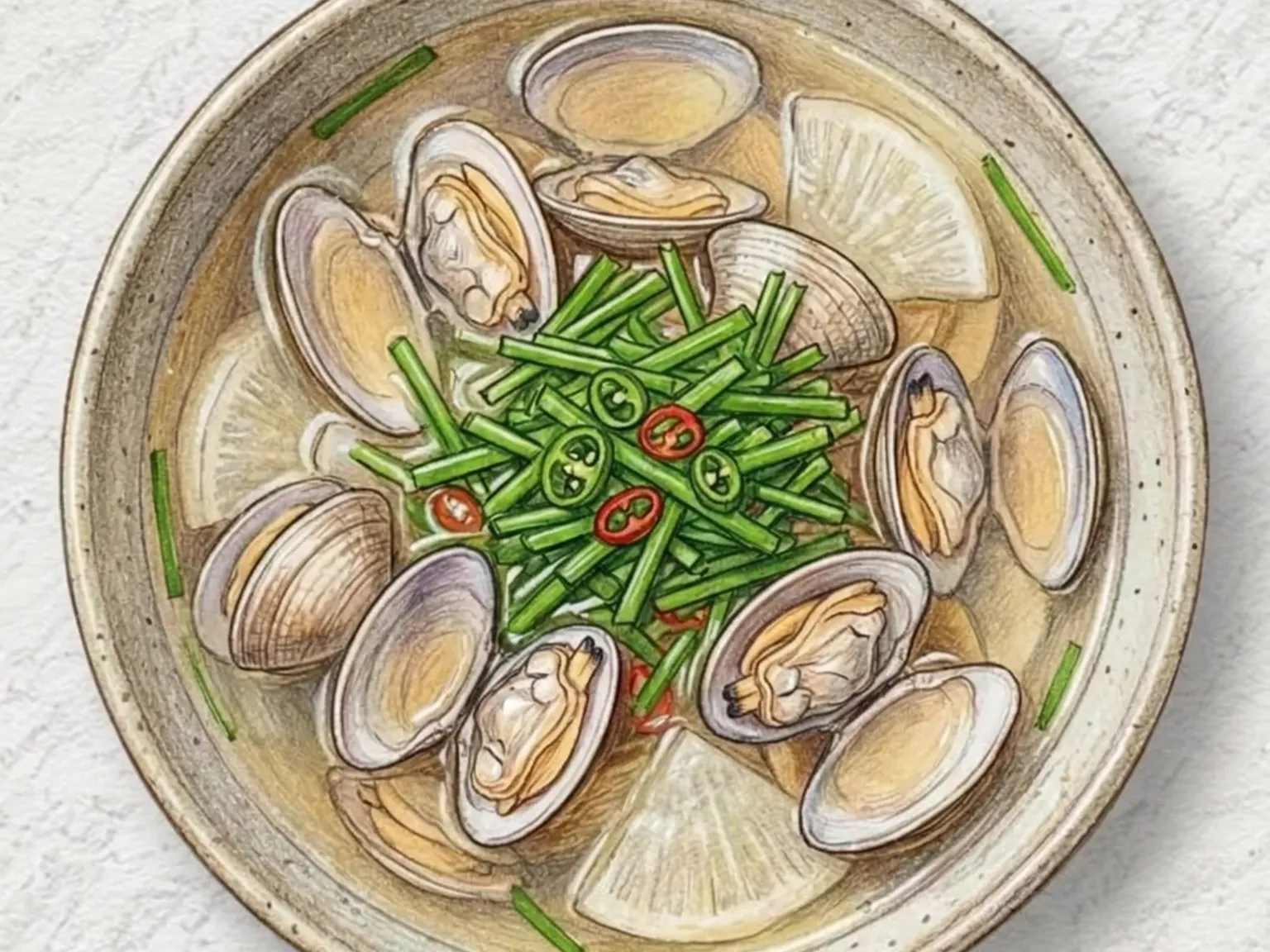
Korean Chive Clam Soup (Briny Clam Broth with Garlic Chives)
Soups Easy

Korean Chive Clam Soup (Briny Clam Broth with Garlic Chives)

Quick answer

Purged clams cook with Korean radish to produce a refreshing, clean broth, then garlic chives and cheongyang chili go in near the end for fragrance and heat.

What makes this special

  • Buchu bajirak guk layers aromatic garlic chives over a sweet daikon and briny manila clam foundation.
  • Daikon pre-cooked 5 minutes to lay a sweet layer that naturally balances clam saltiness
  • Garlic chives added just before turning off to preserve their bright green color and herbal scent
Total time
35 min
Level
Easy
Servings
2 servings
Ingredients
8
Calories
170 kcal
Protein
19 g

Key ingredients

clamsgarlic chivesradishwaterminced garlic

Core cooking flow

  1. 1 Soak 500 g clams in salted water for at least 20 minutes so they release sand.
  2. 2 Cut 80 g garlic chives into 4 cm lengths and slice 120 g radish into thin, flat rectangles.
  3. 3 Put 1 L water and the radish in a pot and bring it to a boil over medium heat.

Purged clams cook with Korean radish to produce a refreshing, clean broth, then garlic chives and cheongyang chili go in near the end for fragrance and heat. Simmering the radish alone for five minutes first establishes a mild sweetness in the base that balances the natural salinity of the clam liquor. The chives are added only after the heat is cut, preserving their vivid color and grassy scent. Any clam that does not open during cooking is removed before serving. Because the clam broth itself carries substantial umami, seasoning should be kept light with just a pinch of salt or a small measure of gukganjang.

Prep 20min Cook 15min 2 servings

Instructions

Read the steps as a cooking flow: prep, heat, seasoning, doneness control, and finish.

6 steps
  1. 1
    Season

    Soak 500 g clams in salted water for at least 20 minutes so they release sand.

    Rub the shells under running water several times, then drain well so grit does not cloud the broth.

  2. 2
    Prep

    Cut 80 g garlic chives into 4 cm lengths and slice 120 g radish into thin, flat rectangles.

    Slice 1 cheongyang chili into small rounds and keep the chives separate for the final step.

  3. 3
    Control

    Put 1 L water and the radish in a pot and bring it to a boil over medium heat.

    Once bubbling, simmer for 5 minutes, until the radish turns slightly translucent and sweetens the broth.

  4. 4
    Heat

    Add the clams and 1 tsp minced garlic, keeping the heat at medium.

    Skim off foam as it rises and cook about 3 minutes, just until most clam shells open.

  5. 5
    Season

    Season with 1.5 tbsp soup soy sauce, then taste the broth before adding anything more.

    Clam liquor can already be salty, so adjust only if the soup tastes flat.

  6. 6
    Finish

    Just before turning off the heat, add the chives and cheongyang chili and cook for only 1 minute.

    Remove any unopened clams, sprinkle with 0.2 tsp black pepper, and serve immediately while the chives stay bright.

After the steps

Pick a recipe that fits this dish.

Continue with shared ingredients, meal pairings, or a similar method.

Recipes That Go Well With This

More Soups →

Based on shared ingredients and meal pairing

Korean Water Parsley Clam Stew
Shared ingredient: clams Stews

Korean Water Parsley Clam Stew

Minari-bajirak-jjigae pairs the clean, briny broth of littleneck clams with the sharp, herbal fragrance of Korean water parsley. Korean radish and zucchini simmer in the base and contribute a gentle natural sweetness, while a whole cheongyang chili and a small measure of gochugaru add a crisp heat that does not overpower the delicate shellfish. The restrained use of chili powder keeps the broth clear and allows the clams' distinct umami to come through without interference. Clams must be thoroughly purged of sand before cooking - any residual grit will ruin the broth. Once the shells open, the clams should be eaten promptly as continued heat toughens the meat. Minari goes in only at the very end, just before the heat is turned off, to preserve its bright green color and volatile fragrance. With prep time dominated by clam purging, the active cooking takes under ten minutes.

Korean Spinach Clam Soup (Light Shellfish and Greens Broth)
Shared ingredient: clams Soups

Korean Spinach Clam Soup (Light Shellfish and Greens Broth)

Sigeumchi-bajirak-guk pairs manila clams and spinach in a clean, transparent broth that lets both ingredients speak without interference from heavy seasoning or separately prepared stock. The clams are purged of sand and started in cold water, then brought slowly to a boil so each shell opens at its own pace, releasing a naturally briny, mineral-rich liquor that forms the entire foundation of the soup. No additional stock is needed, because the clam liquid is the stock. Spinach enters only in the final thirty to sixty seconds of cooking, which is the narrow window where the leaves soften just enough to be palatable while their vivid green color and delicate grassy flavor remain intact. Soup soy sauce and a small amount of garlic provide the only seasoning, and this restraint is deliberate: any stronger flavoring would bury the subtle sweetness of fresh clam broth. The grassy undertone in the spinach quietly neutralizes any sharp seafood edge, leaving the soup tasting clean and deeply refreshing. The nutritional logic behind this combination is frequently cited in Korean households: spinach is among the most iron-dense vegetables, and clams supply taurine and zinc in meaningful amounts, making the soup a regular recommendation for children in growth phases and for pregnant women. From first clam into the pot to finished bowl takes no more than fifteen minutes, which helps explain its steady presence on weeknight dinner tables throughout Korea.

Korean Chicken Breast Perilla Porridge
Serve together Rice

Korean Chicken Breast Perilla Porridge

Dakgaesal deulkkae juk is a traditional style of Korean porridge that utilizes shredded chicken breast alongside finely chopped onions and carrots as its primary components. The preparation begins by stir-frying these ingredients together, after which they are simmered slowly with a combination of soaked rice and chicken stock. As the cooking process nears its conclusion, perilla seed powder is incorporated into the pot. This specific ingredient dissolves thoroughly into the liquid to produce a final texture that is notably thick and creamy. The aroma produced by the perilla seeds is deeply nutty and serves as the most prominent characteristic of the dish. While sesame seeds are known for a sharp and roasted quality, perilla seeds offer a flavor that is more round and carries an herbaceous nuttiness. This gives the porridge a unique profile that is common in Korean cuisine. The inclusion of shredded chicken breast provides a source of lean protein that does not feel heavy, ensuring the meal remains nourishing and simple for the body to digest. Because of these qualities, this porridge is often used as a recovery meal for individuals after they have finished exercising or for anyone whose energy levels feel low. It also serves as a functional choice when a gentle meal is required for a sensitive stomach. Adjusting the final result is possible by increasing the quantity of perilla powder, which results in a more intense fragrance and an even thicker consistency for people seeking a richer bowl.

Korean Buchu Honghap Guk (Chive Mussel Soup)
Similar recipe Soups

Korean Buchu Honghap Guk (Chive Mussel Soup)

Debearded mussels are simmered with radish in water to draw out a briny, full-bodied stock, with rice wine added early to neutralize any fishy off-notes while keeping the oceanic depth intact. Soup soy sauce and garlic season the broth through the middle of cooking, and Korean chives plus black pepper go in at the very end so their fresh fragrance carries through to the bowl. Cooking uncovered lets off-flavors escape with the steam. Any mussel that stays closed after five minutes of simmering must be removed. Starting the radish alongside the mussels from the beginning allows its natural sweetness to dissolve into the stock and support the briny umami from below.

Serve with this

Korean Konjac Noodle Salad
Side dishes Easy

Korean Konjac Noodle Salad

Silgonyak-chae-muchim tosses 250 grams of blanched konjac noodles with julienned cucumber, carrot, and onion in a gochujang-based dressing spiked with vinegar, sugar, soy sauce, and garlic. Blanching the noodles for two minutes removes their faint alkaline smell and softens their rubbery chew to a pleasant springiness. The vegetables provide crisp contrast - cucumber adds a cool snap, carrot a mild sweetness, and onion a sharp bite. The dressing clings to the translucent noodles, turning them a vivid reddish hue. At only 95 calories per serving, this banchan relies on texture and bold seasoning rather than fat for its appeal. Chilling for 10 minutes before serving firms up the noodles and intensifies the tangy-spicy flavor profile.

🥗 Light & Healthy 🏠 Everyday
Prep 12min Cook 3min 2 servings
Korean Chamnamul Kimchi (Pimpinella Kimchi)
Kimchi Medium

Korean Chamnamul Kimchi (Pimpinella Kimchi)

Chamnamul kimchi is a spring kimchi made by salting chamnamul greens for just ten minutes to wilt them slightly, then dressing with gochugaru, anchovy fish sauce, and salted shrimp without rinsing. Skipping the rinse allows the residual salt to convert into umami during fermentation rather than being washed away, deepening the overall flavor. Pureed Korean pear and onion blended with sweet rice paste form the seasoning base, contributing a natural sweetness that rounds off the sharp edges of the chili heat. After three hours of initial fermentation at room temperature followed by refrigeration, the kimchi reaches its best balance within one to two days, when the grassy herbal aroma of chamnamul aligns with the fermented depth of the fish sauce. Because chamnamul has a high moisture content, fermentation moves quickly, and the kimchi softens past its peak if left too long. Best consumed within three to four days for optimal texture and fragrance.

🍱 Lunchbox 🏠 Everyday
Prep 30min Cook 5min 4 servings
Korean Seaweed Oyster Pancake
Pancakes Medium

Korean Seaweed Oyster Pancake

Fresh oysters and rehydrated seaweed folded into a pancake batter and pan-fried into a jeon packed with ocean flavor. As the oysters cook, they release their briny juices into the batter, spreading their concentrated umami through every bite. The seaweed provides a soft, slightly slippery contrast in texture against the crisp outer surface. Soup soy sauce seasons the batter cleanly without competing with the seafood, while minced red chili adds color and a measured heat. Garlic deepens the marine aroma. This jeon is at its best during winter when oysters are plump and full in flavor.

🍺 Bar Snacks 🍱 Lunchbox
Prep 20min Cook 16min 4 servings

Similar recipes

Korean White Clam Clear Soup
Soups Easy

Korean White Clam Clear Soup

Baekhap jogae tang is a clear Korean clam soup built entirely on the flavor of hard clams, with no additional stock of any kind. The clams are soaked in salted water until fully purged of sand, then transferred to cold water in the pot and heated gradually. This slow climb from cold allows the clams to release their maximum flavor into the surrounding liquid before they even open, producing a more richly flavored broth than rapid boiling ever could. Daikon radish simmers in the same water, lending a cool, clean sweetness that tempers the clams inherent saltiness while absorbing broth flavor itself, softening into bite-sized pieces that are worth eating alongside the shellfish. A tablespoon of cheongju, Korean clear rice wine, is added early to neutralize any briny off-notes that might otherwise linger, leaving a cleaner, lighter finish. Garlic appears in small amounts only, deliberately restrained so it does not compete with the delicate shellfish flavor that is the whole point of the dish. Scallion and red chili are placed on top at the very end, contributing color and fragrance rather than direct seasoning. Salt is kept to an absolute minimum since the clam liquor itself provides all the salinity required. The soup is a lesson in simplicity: no anchovy, no kelp, no premade stock. The clams do all the work, and the result is a broth that is simultaneously light and deeply satisfying.

🥗 Light & Healthy 🏠 Everyday
Prep 20min Cook 15min 2 servings
Korean Garlic Chive Egg Soup
Soups Easy

Korean Garlic Chive Egg Soup

This simple home-style soup combines garlic chives, egg, and tofu in a light broth seasoned with soup soy sauce and garlic. Tofu cubes go in first to warm through for two minutes, then beaten egg is poured in a slow, circular stream and left undisturbed for thirty seconds to form silky ribbons. Chives and sesame oil are added in the final half-minute so their aroma stays vivid in the finished bowl. Because the ingredient list is short, cutting the tofu into even cubes and managing the heat carefully are what separate a polished result from a cloudy one. Pouring the egg too forcefully or stirring immediately breaks up the ribbons and muddies the broth.

🏠 Everyday ⚡ Quick
Prep 10min Cook 10min 2 servings
Korean Mallow & Clam Stew
Stews Easy

Korean Mallow & Clam Stew

Auk-bajirak-jjigae is a thick, meal-weight stew that takes the logic of the milder auk-bajirak-guk and pushes it further: more doenjang, a denser ingredient list, and cheongyang chili for heat. The clams go in first while the water is still cold, then the pot comes to a boil so the shells open slowly and release their concentrated sea juice into the base. Doenjang and gochugaru dissolve into the liquid together, creating a foundation that is simultaneously earthy, saline, and warm with chili. Cubed tofu and sliced zucchini fill out the pot and convert what might have been a soup into something substantial enough to anchor a meal with rice. Mallow leaves added at the end bring their natural mucilage, which thickens the broth and gives it a cling that plain stews lack. Sliced cheongyang chili on top cuts through the richness with a sharp, direct heat. On a cold evening eaten alongside steamed rice, this jjigae sits at the dense, deeply layered end of the Korean stew spectrum.

🥗 Light & Healthy 🏠 Everyday
Prep 15min Cook 18min 2 servings

Tips

Discard unopened clams to avoid off flavors.
Add chives at the end to keep aroma and color fresh.

Nutrition (per serving)

Calories
170
kcal
Protein
19
g
Carbs
11
g
Fat
5
g