Korean Busan-Style Stir-fried Fish Cake
Quick answer
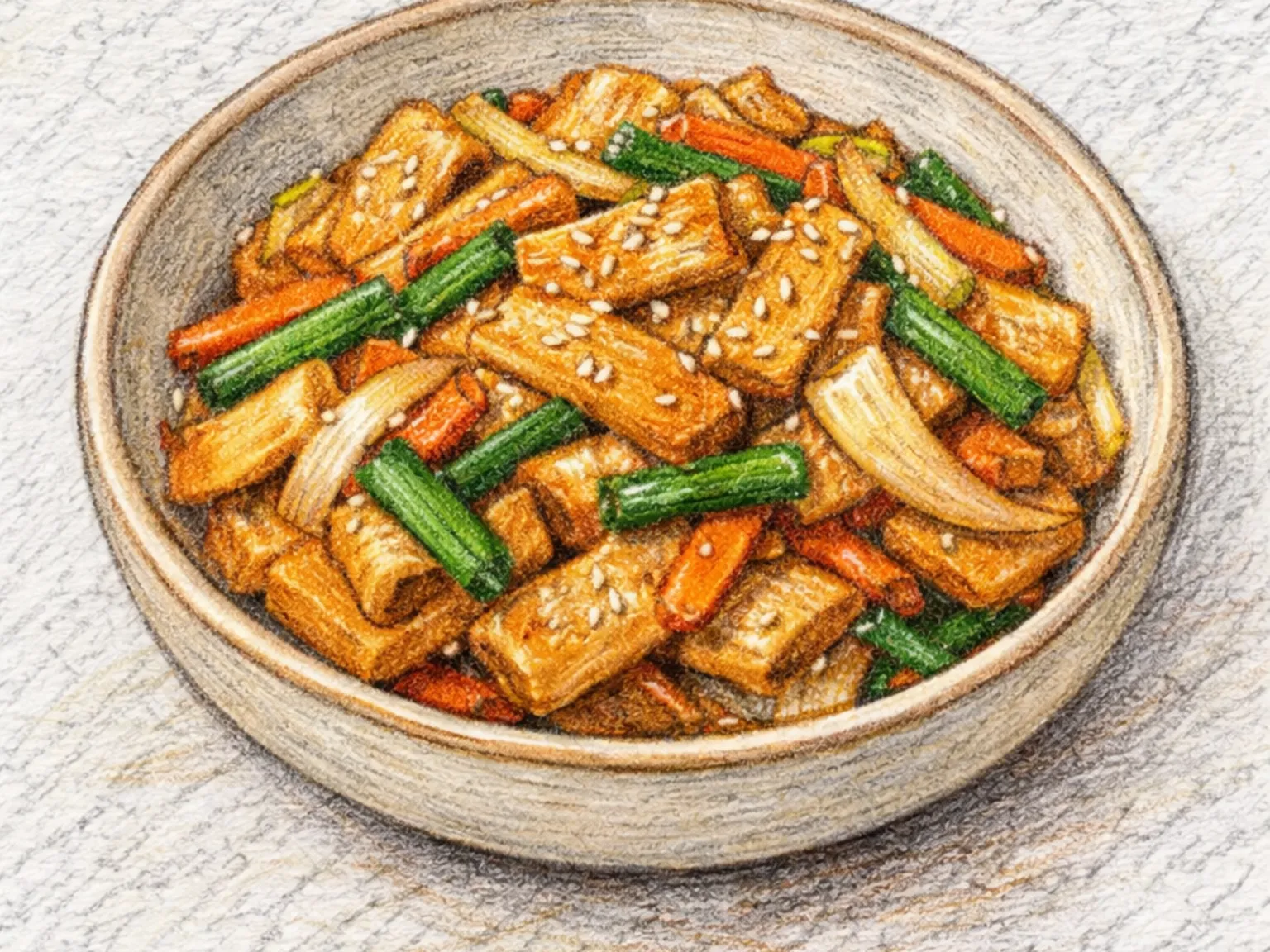
Busan-style stir-fried fish cake begins with a step that separates it from rushed versions: square fish cake sheets are blanched for twenty seconds in boiling water to re...
What makes this special
- Blanched square fish cakes stir-fried without greasy residue for a clean, savory banchan.
- 20-second boiling blanch removes factory oil from fish cake, preventing a greasy aftertaste
- Soy glazes the hot pan surface; oligosaccharide caramelizes into a sweet-salty layer
Key ingredients
Core cooking flow
- 1 Soak 320 g of fish cake in boiling water for 20 seconds to remove excess oil...
- 2 Shred the fish cake into 5 mm strips, slice 1 onion and 80 g of carrot to th...
- 3 Heat 1 tablespoon of cooking oil in a pan over medium heat, add 1 teaspoon o...
Busan-style stir-fried fish cake begins with a step that separates it from rushed versions: square fish cake sheets are blanched for twenty seconds in boiling water to remove the residual processing oil from manufacturing. Skipping this produces a flat, industrial greasiness in the finished dish that no amount of seasoning corrects. Oil goes into a hot pan, minced garlic is fried briefly until fragrant, and julienned onion and carrot are added next and cooked for two minutes until their natural sugars begin to release. The blanched fish cake strips go in, followed by soy sauce and oligosaccharide syrup. As the soy sauce hits the hot pan surface, it reduces almost instantly into a thin, glossy glaze that coats every surface; the oligosaccharide syrup caramelizes in the residual heat, building a sweet-salty layer underneath. High heat and a total cook time of three minutes or less is essential - fish cake left on the stove beyond that loses its moisture and turns rubbery. Diagonally sliced green onion goes in at the very end, added off the heat to preserve its fresh bite. A scatter of sesame seeds finishes the dish. Because the flavors are stable at room temperature and do not deteriorate as the dish cools, it is a reliable and practical side dish for packed lunches.
Instructions
Read the steps as a cooking flow: prep, heat, seasoning, doneness control, and finish.
- 1Heat
Soak 320 g of fish cake in boiling water for 20 seconds to remove excess oil, then lift out and shake off the water.
Skipping this step leaves a greasy aftertaste even after stir-frying.
- 2Prep
Shred the fish cake into 5 mm strips, slice 1 onion and 80 g of carrot to the same thickness, and cut 1 scallion stalk diagonally.
- 3Control
Heat 1 tablespoon of cooking oil in a pan over medium heat, add 1 teaspoon of minced garlic, and stir-fry for 20 seconds to infuse the oil with garlic aroma.
- 4Control
Add onion and carrot and stir-fry over medium heat for 2 minutes.
When the onion turns translucent and a sweet aroma rises, it is ready for the fish cake.
- 5Control
Add fish cake, 2 tablespoons of soy sauce, and 1 tablespoon of oligosaccharide syrup, then stir-fry briskly over high heat for 2 minutes. The dish is ready when the soy sauce coats evenly and gives a uniform brown tint.
- 6Finish
Add scallion and stir-fry 1 more minute.
Once the scallion aroma rises, turn off the heat and finish with 1 teaspoon of whole sesame seeds.
After the steps
Pick a recipe that fits this dish.
Continue with shared ingredients, meal pairings, or a similar method.
Recipes That Go Well With This
More Stir-fry →Based on shared ingredients and meal pairing
Korean Stir-fried Potato Strips
Gamja-bokkeum is a fundamental Korean side dish made by stir-frying julienned potatoes until they are just tender with a remaining crunch, and it belongs on almost any Korean table regardless of what else is being served. Soaking the julienned potatoes in cold water for five to ten minutes removes the surface starch that would otherwise cause the pieces to stick together in the pan and clump into a mass. The drained potatoes go into an oiled pan over medium heat with garlic, which provides a gentle aromatic backdrop without competing with the potato's mild natural flavor, and salt is the only seasoning needed to let that flavor come through. The key to the right texture is restraint: the potatoes are ready when they have turned translucent and the edges have picked up a faint golden color, and cooking past that point makes them soft rather than crisp. A finishing drizzle of sesame oil and a scattering of sesame seeds add a warm nuttiness that elevates the simple seasoning into a complete flavor. Thinly sliced cheongyang chili added during cooking produces a spicier variation, and a small amount of bell pepper or carrot adds color without changing the character of the dish. It is the kind of banchan that disappears from the table quickly despite its simplicity.
Korean Spicy Stir-Fried Fish Cake
Square sheets of fish cake are sliced into uniform, bite-size pieces before being stir-fried in a seasoned glaze that balances spicy heat with a clear sweetness. One specific technique used in this recipe involves blanching the fish cake pieces in boiling water for a very short period before they enter the pan. This process serves two functions: it removes the excess oil from the manufacturing process and causes the surface of the fish cake to open up. This allows the sauce to adhere more consistently to each piece during the cooking process. When stir-fried over high heat, the edges of the fish cake undergo a light caramelization. This results in a subtle smoky flavor that adds a layer of complexity to the overall dish. The base of the sauce consists of gochujang, soy sauce, and oligodang. Oligodang is a Korean corn syrup that is used to give the dish a shiny, glossy finish while simultaneously tempering the sharp intensity of the fermented chili paste. During the cooking process, sliced onions are added and allowed to soften. The moisture released by the onions helps to deglaze the pan, which reintegrates concentrated flavors into the sauce and contributes a natural sweetness. Green onions are added just before the heat is turned off so they retain their fresh aroma and provide a crisp texture that contrasts with the rich sauce. To finish the dish, toasted sesame seeds are scattered over the top to provide a mild nutty flavor. This side dish is frequently included in packed lunches because the glaze maintains its integrity and the flavors become more concentrated as the dish cools.
Korean Cheesy Dakgalbi Rice Bowl
Cheese dakgalbi deopbap is a rice bowl built on the flavors of Chuncheon-style spicy chicken stir-fry, finished with a blanket of melted mozzarella. Chicken thighs are marinated in gochujang, gochugaru, soy sauce, and sugar for at least thirty minutes, then stir-fried in a ripping-hot pan with rough-cut cabbage and onion until the sauce reduces and coats every surface. The heat must be high enough to evaporate moisture quickly; if the pan is too cool, the ingredients steam and the sauce turns thin. Thigh meat stays moist throughout cooking because of its higher fat content, making it far more forgiving than breast meat in a fast stir-fry. Cabbage cooked at high heat for a short time keeps enough crunch to stand against the richness of the cheese and sauce. Mozzarella laid over the top melts in the residual heat into long, stretchy strands that soften the chili sharpness with every bite. The whole dish comes together in under fifteen minutes with pantry staples, which makes it a natural choice for a quick solo dinner or late-night meal.
Korean Stir-fried Fish Cake with Vegetables
Eomuk-yachae-bokkeum is a Korean stir-fry that brings together fish cake sheets with onion, carrot, and green bell pepper in a soy-based glaze. Square eomuk is cut into bite-sized rectangles without any further preparation, and the vegetables are sliced to roughly matching dimensions so everything cooks through at the same rate. The textural contrast between the chewy fish cake and the crisp-tender vegetables is the defining quality of this dish - both elements are present in each chopstickful, preventing either from becoming monotonous. Soy sauce and oligosaccharide syrup form the base glaze, producing a glossy, lightly sweet and salty coating that clings evenly to each piece. Sesame oil and toasted sesame seeds stirred in at the end add a nutty finish. Adding a sliced cheongyang chili during the stir-fry introduces a sharp heat that prevents the overall flavor from reading as too sweet. The entire dish comes together in under ten minutes from prep to plate, making it a reliable candidate for packed lunches and weeknight tables that need a quick, universally liked side dish.
Serve with this
Manduguk (Korean Dumpling Clear Broth Soup)
Manduguk is a Korean dumpling soup in which hand-folded dumplings stuffed with ground pork, tofu, scallion, and garlic are dropped into a clear, simmering broth, typically anchovy-kelp stock or beef broth, and cooked until they float. As the dumplings cook, their thin wheat-flour wrappers release a subtle starch that gives the broth a barely perceptible body, while the filling leaks savory juices that enrich the liquid gradually. A thin drizzle of beaten egg stirred in near the finish creates silken wisps on the surface of the broth and gives the bowl a more finished appearance. Shredded egg strips and crumbled dried seaweed scattered on top add a pleasant contrast in color and a faint oceanic note to the flavor. Many Korean households serve manduguk on Lunar New Year as an alternative to tteokguk, and some combine the two by adding sliced rice cakes alongside the dumplings. Dumplings can be made in large batches and frozen raw, which means this soup can be pulled together quickly on weeknights without sacrificing any of the flavor that comes from homemade filling. A small dish of soy-vinegar dipping sauce served alongside lets each person adjust the seasoning at the table, and the light acidity of the sauce cuts through the mild broth in a way that makes the contrast between the two worth trying.
Korean Pickled Garlic Scapes
Maneuljjong-jangajji is a preserved side dish of garlic scapes pickled in a boiled soy sauce, vinegar, and sugar brine. The preservation principle is identical to that of whole garlic jangajji, but the scape, meaning the flowering stalk of the garlic plant, is used instead of the bulb, and there is one crucial technique difference. The scapes are cut into 4 cm lengths, packed tightly into glass jars, and covered with the brine immediately while it is still boiling hot. The heat partially cooks the outer layer of each scape, which creates a clean, crisp snap when the scape is bitten, unlike the soft texture that results from the cold-pour method used for whole garlic. Whole black peppercorns included in the jar release their warmth and spicy aroma slowly into the liquid during the aging period, adding a dimension beyond the straightforward salt-and-acid base. The pickles are ready after a single day, but day three is when seasoning has penetrated to the center while the scapes still push back satisfyingly under the teeth. The brine can be drained, reboiled, and poured back over the scapes once during storage, which significantly extends shelf life by suppressing bacterial growth. On the Korean table, these sharp, vinegary pickles serve as a natural counterbalance to fatty meat dishes, cutting through richness and clearing the palate between bites.
Korean Kimchi Mandu Jjigae (Kimchi Dumpling Stew)
Kimchi mandu jjigae drops whole frozen kimchi dumplings straight into a simmering pot of aged kimchi, tofu, and anchovy stock. The dumpling wrappers absorb the broth as they cook, swelling plump and moist, while the kimchi filling inside echoes the stew's tangy base and doubles the fermented depth. Gochugaru and soup soy sauce add a clean chili heat, and firm tofu cubes absorb the spiced broth for a softer textural contrast. Because the dumplings themselves carry seasoning, it is better to start with less sauce and adjust after tasting the broth. This is a filling, no-fuss meal that needs nothing more than a bowl of steamed rice alongside it.
Similar recipes
Korean Busan-Style Soy Fish Cake Stir-Fry
Busan, Korea's largest port city, is closely identified with eomuk: thick, pressed fish cake sold at stalls around Gukje-sijang market. This Busan-style stir-fry slices the fish cake into strips and cooks it with onion and cheongyang chili in soy sauce, cooking wine, sugar, and minced garlic over high heat. Onion goes into the pan first to caramelize and release its sugars, creating a sweet base before the fish cake joins and absorbs the glaze into its porous interior. Cheongyang chili adds a sharp, lingering heat that sets this version apart from the milder soy-braised fish cake common in Seoul. The dish holds its flavor well after cooling, making it a reliable lunchbox side that tastes just as good a few hours later.
Korean Soy-Braised Fish Cake
Eomuk-jorim is a braised Korean fish cake banchan in which triangles or rectangles of eomuk are simmered in a mixture of soy sauce, rice syrup, garlic, and water. Korean eomuk is a processed fish product made by grinding white fish flesh with starch and shaping the paste into flat sheets or molded forms -- denser and chewier than Japanese kamaboko, with a texture that holds its structure through the long braise without turning soft. As the liquid reduces by roughly half over ten minutes of steady simmering, the sauce concentrates into a thick, sticky glaze that adheres to each piece. Adding a sliced cheongyang chili near the end of cooking introduces a subtle heat that cuts through the sweetness of the rice syrup and gives the banchan a sharper edge that pairs well with plain rice. One of the most practical side dishes in the Korean repertoire, eomuk-jorim keeps in the refrigerator for up to a week and, like many braised preparations, deepens in flavor as the soy seasoning continues to penetrate the fish cake over subsequent days. Its low cost and the ease of making large batches in a single pan explain its decades-long presence in school cafeterias, packed lunchboxes, and the everyday home kitchen.
Korean Stir-fried Dried Pollock Strips
Hwangtae-chae-bokkeum is a Korean side dish of shredded dried pollock strips soaked until fully soft, then stir-fried in a gochujang, oligosaccharide syrup, and soy sauce glaze. Hwangtae is a specific type of dried pollock produced by repeated freeze-thaw cycles in cold mountain air over winter, which gives it a lighter, spongier texture than ordinary dried pollock -- that porosity is what allows it to absorb the seasoning so completely during cooking. Soaking the dried strips in cold water for at least twenty minutes is necessary to rehydrate the flesh fully; squeezing out the excess moisture before adding them to the pan helps the glaze cling evenly rather than diluting in the pan. As the pollock fries, it drinks in the seasoning and turns chewy and moist, with the gochujang's heat and the syrup's sweetness working together to neutralize any residual fishiness. A finishing drizzle of sesame oil and a scatter of sesame seeds rounds out the flavor. The dish keeps well in the refrigerator for four to five days, making it a practical banchan to prepare in advance for lunchboxes or as a casual snack alongside drinks.