Korean Beoteo Ojingeo Gui (Butter Grilled Squid)

Korean Beoteo Ojingeo Gui (Butter Grilled Squid)

Quick answer

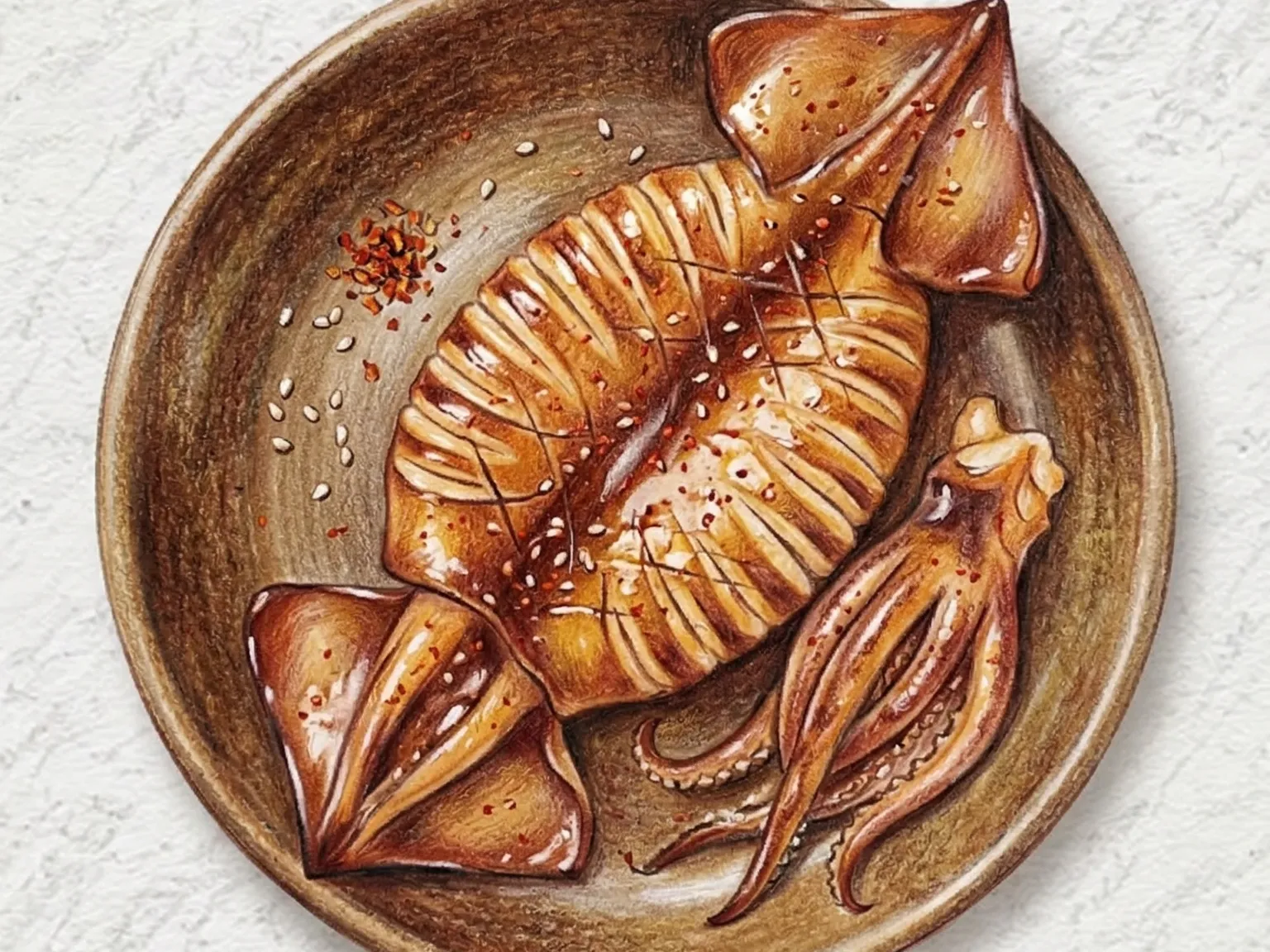
Butter ojingeo gui is a Korean street snack of semi-dried squid scored with shallow cuts, seared in butter on a flat iron griddle, then coated in a glaze of soy sauce, ol...

What makes this special

  • Semi-dried squid develops concentrated umami when seared in butter and a sweet soy-chili glaze.
  • Semi-dried squid has concentrated umami that intensifies with butter Maillard
  • Scored cuts let the soy-oligosyrup glaze penetrate into the flesh
Total time
22 min
Level
Easy
Servings
2 servings
Ingredients
8
Calories
265 kcal
Protein
24 g

Key ingredients

semi-dried squidbuttersoy sauceoligosaccharide syrupgochugaru

Core cooking flow

  1. 1 Score the inside of 2 semi-dried squid bodies at 1cm intervals with shallow cuts.
  2. 2 Combine 18ml soy sauce, 20ml oligosaccharide syrup, 3g chili powder, and 8g...
  3. 3 Heat 10ml oil in a pan over medium heat and add the squid with the scored side facing down.

Butter ojingeo gui is a Korean street snack of semi-dried squid scored with shallow cuts, seared in butter on a flat iron griddle, then coated in a glaze of soy sauce, oligosaccharide syrup, and gochugaru. Semi-dried squid has less moisture than fresh and a more concentrated chew, which means it develops a toasty crust from the butter quickly without steaming through. The scoring allows the glaze to penetrate into the flesh rather than sitting only on the surface. Over high heat, the soy-and-syrup mixture caramelizes fast, coating the squid in a glossy, sweet-salty lacquer. Gochugaru adds a round, lingering heat at the finish. A scatter of sesame seeds goes on last, releasing a nutty aroma with each bite. The combination of butter richness, soy glaze, and chile heat has made this one of the most recognizable items at Korean pojangmacha stalls.

Prep 10min Cook 12min 2 servings

Instructions

Read the steps as a cooking flow: prep, heat, seasoning, doneness control, and finish.

6 steps
  1. 1
    Prep

    Score the inside of 2 semi-dried squid bodies at 1cm intervals with shallow cuts.

    Cut the tentacles into 5 to 6cm pieces and slice the body into 4 to 5cm wide pieces.

  2. 2
    Control

    Combine 18ml soy sauce, 20ml oligosaccharide syrup, 3g chili powder, and 8g minced garlic in a bowl and mix well.

    The balanced ratio of soy sauce to syrup is key to preventing the sauce from burning when reduced.

  3. 3
    Control

    Heat 10ml oil in a pan over medium heat and add the squid with the scored side facing down.

    Cook uncovered for 2 minutes to lightly dry the surface and get some browning.

  4. 4
    Control

    Add 25g butter and let it melt, coating the squid as it does.

    Once fully melted, pour in the sauce and stir-fry over medium-high heat for 2 to 3 minutes, turning the pieces frequently.

  5. 5
    Control

    Remove from heat when the sauce clings glossily to the squid and has reduced to a small amount of liquid.

    Overcooking at this point causes burning - pull it while a little sauce remains.

  6. 6
    Finish

    Sprinkle with 3g sesame seeds and serve skewered on sticks or in paper cups street-vendor style.

    Squid toughens as it cools, so serve immediately.

After the steps

Pick a recipe that fits this dish.

Continue with shared ingredients, meal pairings, or a similar method.

Recipes That Go Well With This

More Street food →

Based on shared ingredients and meal pairing

Cabbage Ham Korean Street Toast
Shared ingredient: butter Street food

Cabbage Ham Korean Street Toast

Cabbage ham street toast is a Korean griddled sandwich built by stacking a thin shredded cabbage-and-carrot egg omelet and pan-seared ham between slices of bread toasted golden in butter. The bread develops a crisp outer surface while staying soft inside, and the egg layer holds the vegetables in place, giving both structure and textural contrast to every bite. Sprinkling sugar directly onto the bread before assembly is the signature detail that defines Korean street toast, and when combined with ketchup and mayonnaise it produces the sweet-savory balance the dish is known for. The ingredients are simple and the preparation is fast enough for a weekday breakfast or an impromptu snack.

Korean Tteok Kkochi Yangnyeom Gui (Grilled Rice Cake Skewers)
Shared ingredient: toasted sesame seeds Grilled

Korean Tteok Kkochi Yangnyeom Gui (Grilled Rice Cake Skewers)

Cylinder rice cakes are threaded onto skewers, lightly brushed with oil, and rolled on a grill pan over medium heat for six to seven minutes until the exterior turns golden. A sauce of gochujang, ketchup, oligosaccharide syrup, soy sauce, and minced garlic is applied in two rounds, building a glossy red glaze that clings to the surface. The outer layer develops a slight crispness while the inside remains stretchy and dense - that textural duality is the hallmark of this dish. A light dusting of cheese powder turns it into a kid-friendly snack, and it stands as one of the most iconic items in Korean street-food culture.

Korean Honeycomb Candy (Caramel Sugar Disc with Baking Soda Puff)
Serve together Desserts

Korean Honeycomb Candy (Caramel Sugar Disc with Baking Soda Puff)

Ppopgi dalgona is a Korean street candy made by melting white sugar in a small ladle over low heat, then stirring in baking soda to trigger a rapid foaming expansion. When the sugar reaches a pale amber stage, the heat is cut and baking soda with a pinch of salt is mixed in quickly: carbon dioxide releases immediately, puffing the molten sugar to two or three times its original volume within seconds. The expanded mixture is poured onto parchment and pressed flat to roughly 5 mm with an oiled plate or press, then stamped with a shape cutter before it sets. Once fully cool and rigid, the candy snaps crisply when tapped - the hallmark texture. The caramel's color at the moment the heat is removed determines the final flavor: pull it too early and the candy stays flat-sweet; let it darken a shade too far and bitterness overtakes the sweetness. The narrow window of pale amber is where the sweet-bitter balance lands correctly.

Korean Fried Squid
Similar recipe Street food

Korean Fried Squid

Cleaned squid is cut into 1 cm rings, dipped in a light batter of frying mix, cold water, and egg, then deep-fried at 170 degrees Celsius for three to four minutes until golden and crisp. Cold water is essential for the batter -- warm water activates the gluten in the flour and produces a thick, doughy coating instead of the thin, shatter-crisp shell this dish depends on. The batter should be mixed just enough to combine, leaving a few lumps intact, because those uneven patches fry up with irregular texture that adds to the crunch. Scoring the squid rings lightly with a knife or pounding them briefly helps them stay flat and allows the batter to adhere without sliding off. Frying in small batches matters, since crowding the pan drops the oil temperature and causes the rings to absorb fat rather than fry. The defining quality of this dish is the contrast between the springy, chewy squid and the airy, crisp coating that surrounds it, a contrast that only exists in the first few minutes after frying. Served with a pinch of salt or a soy-vinegar dipping sauce, these rings are a fixture at street food stalls and snack shops across Korea.

Serve with this

Korean Job's Tears Walnut Latte
Drinks Easy

Korean Job's Tears Walnut Latte

Yulmu-hodu latte is a traditional Korean grain-based beverage prepared by combining job's tears and walnuts with milk to create a thick and consistent texture. The preparation begins by soaking the job's tears in water for a minimum of two hours. This extended soaking period is necessary to soften the grains thoroughly, ensuring they pulverize completely during the blending process to avoid a gritty or sandy mouthfeel. Once softened, the job's tears are dry-toasted along with the walnuts in a pan. This heat application serves to caramelize the starches within the grains, which effectively removes the scent of raw grain and replaces it with a concentrated, roasted aroma. After the toasted ingredients are blended with milk, the liquid is passed through a fine strainer to achieve a smooth and silky finish. Sweetness is added using honey, accompanied by a small amount of salt to highlight the deep profile of the roasted nuts. A light sprinkle of ground cinnamon is applied to the surface to provide a subtle spice that balances the grounded flavor of the grain base. For cold servings, it is important to dissolve the honey while the liquid is still warm to ensure it distributes thoroughly throughout the drink instead of settling at the bottom of the container. The resulting beverage offers a depth of flavor and a rounded profile that is far more prominent than what is found in mass-produced, packaged versions of similar grain drinks.

🍺 Bar Snacks 🧒 Kid-Friendly
Prep 10min Cook 18min 2 servings
Korean Sweet Spicy Pollock Floss Stir-fry
Side dishes Easy

Korean Sweet Spicy Pollock Floss Stir-fry

Myeongyeopchae-bokkeum stir-fries finely shredded dried pollock floss in gochujang and oligosaccharide syrup until each fiber strand is evenly coated and moist. Myeongyeopchae is thinner and softer-fibered than hwangtaechae, the wider dried pollock strips, arriving in a dense cotton-like bundle that must be loosened strand by strand before cooking. Running your fingers along the grain separates the fibers cleanly, allowing the seasoning to penetrate evenly and preventing the finished banchan from clumping together in the mouth. A dry toast of thirty seconds in an oil-free pan drives off residual moisture and coaxes out a toasted fish aroma before gochujang, gochugaru, oligosaccharide syrup, soy sauce, and minced garlic go in over the lowest heat for a rapid coating. The fine fibers absorb the sauce almost immediately and turn pliant and glistening, but heat held too long draws the moisture back out, leaving them tough and stiff, so the entire stir-fry must be completed within two minutes. A finishing drizzle of sesame oil and a scatter of sesame seeds deepen the nutty aroma. The resulting banchan occupies a middle ground between the chewier, more aggressively seasoned hwangtaechae-muchim and the bolder jinmichae-bokkeum, its mild sweet-spicy profile approachable enough for children. The relatively dry finish means the seasoning does not bleed into adjacent items in a lunchbox, and stored in an airtight container in the refrigerator the flavor holds well for up to five days.

🏠 Everyday 🧒 Kid-Friendly
Prep 5min Cook 7min 4 servings
Korean Kimchi Bulgogi Udon
Noodles Easy

Korean Kimchi Bulgogi Udon

Kimchi bulgogi udon is a Korean stir-fried noodle dish that brings together the sharp acidity of well-fermented kimchi and the sweet, savory depth of thinly sliced bulgogi beef, all coating thick, round udon strands. The beef is seared quickly over high heat to develop browning on the surface before onion and kimchi join the pan and cook until nearly all their moisture evaporates, concentrating both flavor and color. A sauce of soy sauce, gochujang, and sugar goes in next, followed by briefly blanched udon noodles that get tossed on maximum heat for about one minute so every strand absorbs the sauce while retaining a firm bite. The thick cross-section of udon holds bold, clingy sauces better than thinner noodles and creates a satisfying, filling meal without any broth. When kimchi is especially sour, a small addition of sugar or a quick rinse of the kimchi before cooking brings the acidity back into proportion. Finishing with sliced scallion and toasted sesame seeds adds color and a nutty lift that completes the dish.

🏠 Everyday 🌙 Late Night
Prep 15min Cook 12min 2 servings

Similar recipes

Korean Sweet Spicy Dakgangjeong
Street food Medium

Korean Sweet Spicy Dakgangjeong

Yangnyeom dakgangjeong is Korean sweet-spicy fried chicken made by cutting boneless thigh meat into bite-size pieces, dredging them in potato starch, and running them through a two-stage fry. The first fry at 170 degrees Celsius cooks the meat through; the second fry at 185 degrees drives off the residual moisture the crust absorbed during the first pass, hardening the exterior into a shell that can withstand sauce tossing without collapsing. The glaze is a reduction of gochujang, gochugaru, corn syrup, and soy sauce, simmered down until the mixture is thick enough to coat a spoon without dripping off. Tossing the finished chicken in the hot glaze must happen off the heat and within twenty seconds, because the steam trapped between sauce and crust will turn the coating soggy if the process drags on. When done correctly, the result is a glossy, sticky exterior that crackles audibly at first bite even after the dish has cooled to room temperature, surrounding thigh meat that stays juicy inside.

🧒 Kid-Friendly 🌙 Late Night
Prep 25min Cook 20min 4 servings
Korean Sausage Skewers
Street food Easy

Korean Sausage Skewers

Sosiji kkochi are Korean sausage skewers made by scoring Vienna sausages deeply along their length and threading two or three onto wooden sticks, then pan-frying them until golden brown all over. The score marks serve a functional purpose: as the sausages heat, the cuts open up, allowing heat to penetrate to the center more evenly and creating edges that caramelize slightly and turn crisp. A thin film of oil in a medium-heat pan and steady rotation ensures even color across the entire surface, producing a skin that snaps on the outside while the inside stays juicy and springy. Ketchup and mustard are the classic accompaniments, with the tomato sweetness and the sharp, pungent bite of the mustard complementing the salt and fat of the sausage. Threading rice cakes between the sausage pieces transforms the skewer into a sotteok-sotteok style, a widely popular Korean street food variation. The dish comes together in under fifteen minutes and requires no special equipment beyond a pan and wooden skewers, making it a practical choice for a quick snack, a children's side dish, or a lunchbox item that holds up well at room temperature.

🧒 Kid-Friendly 🌙 Late Night
Prep 5min Cook 10min 2 servings
Korean Grilled Corn with Soy Butter
Grilled Easy

Korean Grilled Corn with Soy Butter

Corn-gui is Korean grilled corn on the cob brushed with a glaze of soy sauce, melted butter, sugar, and minced garlic, then turned slowly over medium heat until the kernels develop a caramelized, salty-sweet crust. The corn is pre-cooked by boiling or microwaving before grilling, so time on the grill is dedicated entirely to building flavor through caramelization and char. Grilling over too-high heat burns the sugar before the corn colors evenly, so patience and repeated thin coats of glaze at every turn are essential. The result layers the corn natural starch sweetness with the richness of butter and the deep savoriness of fermented soy sauce, all in one bite.

🍺 Bar Snacks ⚡ Quick
Prep 5min Cook 20min 2 servings

Tips

Squid turns tough if overcooked; finish quickly over high heat.
If too sweet, add 1 tsp soy sauce to rebalance flavor.

Nutrition (per serving)

Calories
265
kcal
Protein
24
g
Carbs
11
g
Fat
13
g