Caponata (Sicilian Sweet and Sour Eggplant Stew)

Caponata (Sicilian Sweet and Sour Eggplant Stew)

Quick answer

Caponata is a Sicilian sweet-and-sour vegetable dish centered on eggplant, with a flavor profile built around the concept of agrodolce - a deliberate balance of vinegar t...

What makes this special

  • Sicilian Caponata balances fried eggplant with an agrodolce blend of vinegar and brown sugar.
  • The agrodolce balance of vinegar and sugar is the Sicilian principle behind every bite
  • Eggplant absorbs enough olive oil to turn silky rather than spongy or mushy
Total time
50 min
Level
Easy
Servings
4 servings
Ingredients
8
Calories
260 kcal
Protein
4 g

Key ingredients

eggplantceleryonioncanned tomatoesgreen olives

Core cooking flow

  1. 1 Cut 500g eggplant into 3cm cubes and spread it on paper towels.
  2. 2 Heat most of the 3 tablespoons olive oil in a wide pan over medium-high heat.
  3. 3 Leave each batch untouched for about 2 minutes, until the bottom side turns golden brown.

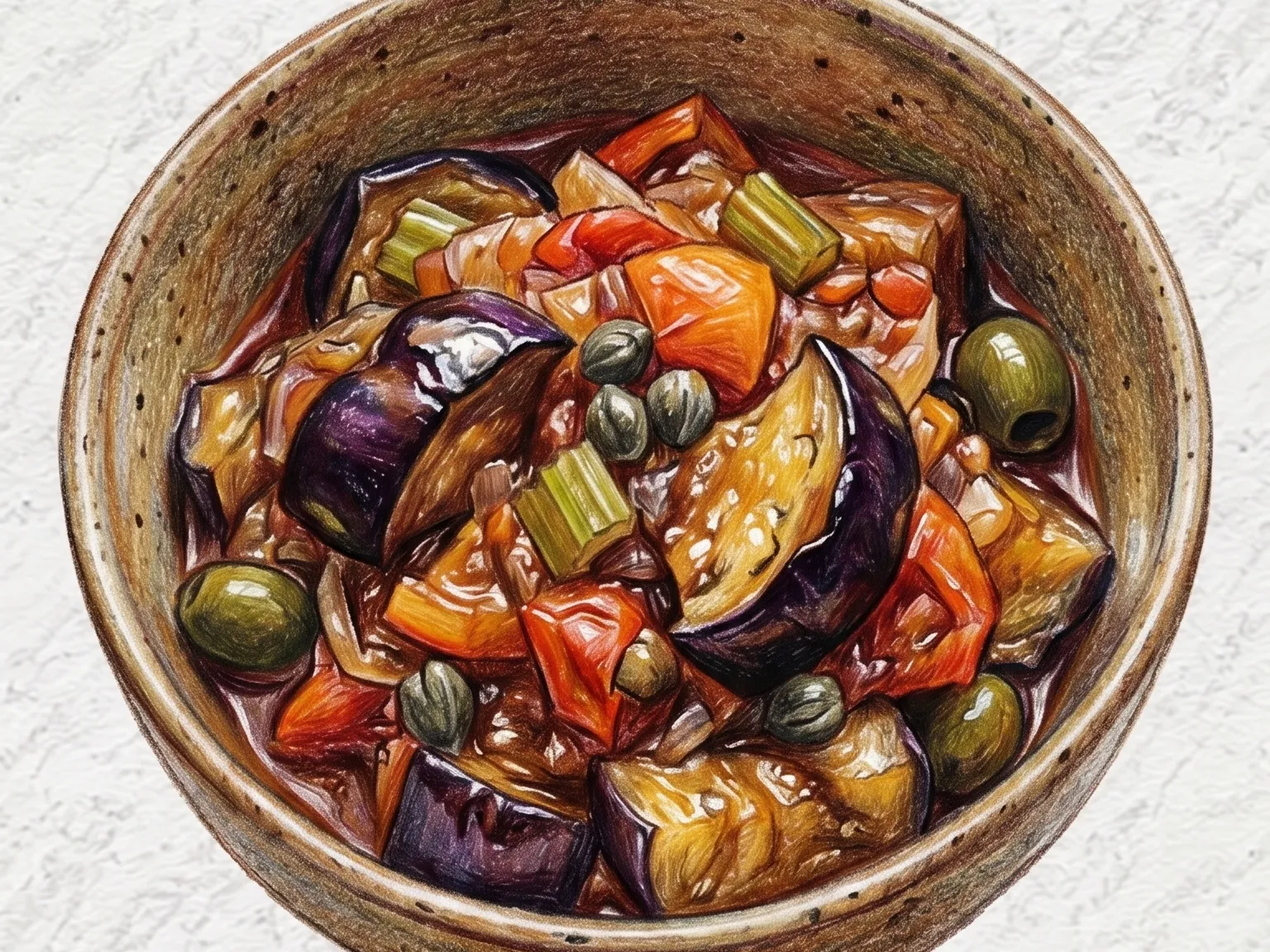
Caponata is a Sicilian sweet-and-sour vegetable dish centered on eggplant, with a flavor profile built around the concept of agrodolce - a deliberate balance of vinegar tartness and sugar sweetness that defines much of southern Italian cooking. Diced eggplant is fried in generous amounts of olive oil until the edges color and the interior becomes silky, having absorbed enough fat to create a soft, yielding texture. Celery, added later and cooked only briefly, stays crisp throughout, providing a textural contrast that keeps the dish from becoming uniformly soft. Tomatoes, capers, and green olives go in together, forming the braising base into which the fried eggplant is returned and simmered until the liquid thickens. Red wine vinegar and sugar are stirred in at the end and adjusted to taste - the vinegar should be assertive but not sharp, the sugar present but not sweet. The briny depth from the olives and capers layers over the tomato acidity, producing a complexity that would seem to require more ingredients than it actually does. Like most braises and marinades, caponata is considerably better after an overnight rest in the refrigerator, when the separate flavors meld into a unified whole. Serve at room temperature on toasted bread as an antipasto, or alongside grilled meat or fish as a condiment.

Prep 20min Cook 30min 4 servings
Recipes by ingredient → onion olive oil

Instructions

Read the steps as a cooking flow: prep, heat, seasoning, doneness control, and finish.

6 steps
  1. 1
    Season

    Cut 500g eggplant into 3cm cubes and spread it on paper towels.

    Sprinkle lightly with salt, rest for 10 minutes, then press dry firmly so the eggplant browns instead of steaming.

  2. 2
    Control

    Heat most of the 3 tablespoons olive oil in a wide pan over medium-high heat.

    Add the eggplant in 2-3 batches, keeping the cubes in one layer so they sear evenly.

  3. 3
    Step

    Leave each batch untouched for about 2 minutes, until the bottom side turns golden brown.

    Turn the pieces, brown the other side the same way, then remove before the cubes collapse.

  4. 4
    Control

    Add the remaining olive oil to the same pan if it looks dry, then cook 1 roughly diced onion over medium heat for 4 minutes.

    Add 100g celery cut into 1cm pieces and cook 3 minutes more.

  5. 5
    Control

    Stir in 300g canned tomatoes, 80g halved green olives, and 1 tablespoon capers.

    Add 2 tablespoons red wine vinegar and 1 tablespoon sugar, then simmer over medium heat for 10 minutes until lightly thickened.

  6. 6
    Finish

    Return the browned eggplant and simmer over low heat for 5 minutes, folding gently so the pieces absorb the sauce without breaking.

    Season with salt and pepper, cool, and serve at room temperature or chilled.

After the steps

Pick a recipe that fits this dish.

Continue with shared ingredients, meal pairings, or a similar method.

Recipes That Go Well With This

More Western →

Based on shared ingredients and meal pairing

Eggplant Parmesan
Shared ingredient: eggplant Western

Eggplant Parmesan

Eggplant Parmesan starts by salting one-centimeter-thick rounds of eggplant and leaving them for ten minutes so that bitterness and excess moisture draw out before cooking. Each slice is then patted dry, dredged through flour, dipped in beaten egg, and pressed into breadcrumbs before pan-frying in olive oil until the coating turns golden and crisp on both sides. In a baking dish, layers of tomato sauce, fried eggplant, torn mozzarella, and grated Parmesan are stacked twice in succession, then baked at 200 degrees Celsius for twenty minutes until the cheese has melted, bubbled up, and browned at the edges. The eggplant contributes a dense, meaty softness that holds the weight of the sauce and cheese above it. The tomato's bright acidity cuts through the richness of two cheeses, and the sharp, granular edge of Parmesan sharpens each layer where the milder mozzarella melts smoothly. Over-saucing is the main hazard: too much tomato makes the layers collapse and turns the eggplant waterlogged, so measuring the sauce with a restrained hand protects both texture and structure. Assembling the dish a day ahead and refrigerating before baking lets the flavors develop further, producing a noticeably richer result the following day.

Chicken Cacciatore
Shared ingredient: onion Western

Chicken Cacciatore

Chicken cacciatore is an Italian countryside dish where chicken pieces are seared hard in olive oil until deeply browned, then braised over low heat for forty minutes with onion, garlic, canned tomatoes, black olives, capers, red wine, and thyme. The initial sear in a very hot pan triggers a Maillard reaction on the skin and surface of the meat; those browned flavors dissolve into the braising liquid and dramatically deepen the sauce as it simmers. Red wine is added and simmered for two minutes to cook off the alcohol before the remaining ingredients go in, leaving only the acidity and fruit character of the wine to layer with the tomato. The briny, savory taste of the olives and the tart, floral sharpness of the capers keep the sweetness of the canned tomatoes in check, while thyme runs as a steady, quiet herbal thread throughout. This dish improves substantially when reheated the next day, as the flavors penetrate further into the meat overnight. Leftover braising sauce is excellent tossed with pasta or spooned over soft polenta.

Soy-Braised Mushroom Ragu Pappardelle
Serve together Pasta

Soy-Braised Mushroom Ragu Pappardelle

Soy-braised mushroom ragu pappardelle builds a meat-free ragu from finely chopped shiitake and button mushrooms cooked low and slow with aromatics and soy sauce. Onion and carrot are sweated first to develop sweetness, then the minced mushrooms go in and are cooked until their moisture fully evaporates, creating a dense, chewy texture that rivals meat-based ragu. Tomato paste adds acidity and color, dry white wine lifts the complexity, and soy sauce provides the fermented backbone that gives this vegetarian ragu its depth. Thyme brings a subtle herbal note, and wide pappardelle ribbons carry the thick, chunky sauce well. The 28-minute cook time is mostly hands-off simmering.

Pasta alla Norma (Sicilian Fried Eggplant Tomato Pasta)
Similar recipe Noodles

Pasta alla Norma (Sicilian Fried Eggplant Tomato Pasta)

Pasta alla Norma originates from Catania in Sicily and combines fried eggplant cubes with a simple tomato passata sauce. Salting the eggplant beforehand draws out moisture and bitterness, resulting in firmer pieces that absorb less oil during cooking. Garlic provides aromatic depth, while fresh basil added off-heat preserves its fragrance. The dish is named after Vincenzo Bellini's opera Norma, a tribute to its status as a Sicilian culinary masterpiece. It can be served as a noodle dish, with simple accompaniments chosen to match the sauce, broth, or topping.

Serve with this

Tomato Basil Juice
Drinks Easy

Tomato Basil Juice

Tomato basil juice is a cold savory drink made by blending ripe tomatoes with fresh basil leaves and straining the result through a fine sieve to remove seeds and skins. The ripeness of the tomato determines much of the flavor: fully ripe tomatoes carry free glutamates that produce a natural umami depth, whereas underripe fruit tastes predominantly sour without the sweetness and savory body that makes the juice satisfying. Basil should be added to the blender immediately before blending rather than sitting cut or torn, because the volatile oils that produce its aroma begin oxidizing quickly once the leaves are damaged. After blending to a smooth consistency, passing the juice through a fine-mesh strainer or cheesecloth removes the solids and produces a texture smooth enough to drink without resistance. Salt and black pepper season the juice, and fresh lemon juice raises the acidity in a way that brightens the overall flavor rather than making it sour. A small addition of olive oil emulsifies into the juice and activates fat-soluble aromatic compounds in both the tomato and the basil, producing a fuller, rounder flavor than the unstrained version. The juice must be thoroughly chilled before serving, as warmth mutes the herbal freshness. It works well as a brunch drink, a light non-alcoholic aperitif, or a base for savory cocktails.

🍺 Bar Snacks ⚡ Quick
Prep 10min 2 servings
Bam Tiramisu (Chestnut Tiramisu)
Desserts Medium

Bam Tiramisu (Chestnut Tiramisu)

Chestnut tiramisu is a variation of the traditional Italian dessert that incorporates chestnut puree into the mascarpone cheese filling. This modification transforms a standard cafe dessert into a preparation specifically associated with the autumn season in Korea. The fundamental elements of the recipe remain consistent with the classic version. It utilizes ladyfinger biscuits that have been soaked in espresso, a filling made of whipped mascarpone and cream, and a final layer of cocoa powder. However, the introduction of chestnut puree alters the profile of the cream. Instead of a simple dairy richness, the mixture takes on an earthy quality. Using a puree made from chestnuts boiled at home, rather than a store-bought paste, helps maintain the natural grain of the nut. This provides the cream with a specific texture that is noticeable in every spoonful. When preparing the ladyfingers, the espresso soak requires a high level of precision. Each biscuit should be dipped for approximately one to two seconds. If the ladyfingers are submerged for a longer duration, they absorb an excessive amount of liquid. This leads to a waterlogged consistency which can cause the structural layers of the dessert to collapse while it sits in the refrigerator. The assembly process follows a predictable sequence. A layer of soaked ladyfingers is placed at the bottom, followed by a layer of the chestnut cream. This pattern is repeated once more before the entire dish is placed in the refrigerator to rest for at least four hours. This period of refrigeration is essential to the final outcome. During these hours, the ladyfingers absorb moisture from both the espresso and the cream layer above them. This process changes the biscuits from a crunchy state to a soft texture similar to cake, which allows for clean slices. Just before the dessert is served, a thin layer of cocoa powder is applied to the top. This adds a bitter element that balances the sweetness of the chestnuts. Preparing the tiramisu in individual glass containers or cups ensures that the portions are easy to manage and allows the different layers of the dessert to be clearly visible from the side.

🧒 Kid-Friendly 🌙 Late Night
Prep 20min Cook 5min 2 servings
Panzanella Salad (Italian Ciabatta Bread Salad)
Salads Easy

Panzanella Salad (Italian Ciabatta Bread Salad)

Stale ciabatta is torn into rough chunks, drizzled with olive oil, and toasted in the oven until the exterior is crisp while the interior remains slightly chewy. Ripe tomatoes are cut into large pieces and salted briefly to draw out their juice, and that released liquid soaks into the bread and becomes the sweet-tart flavor that defines the dish. Cucumber and red onion add crunch and pungency, while torn basil leaves release their fragrance across the plate. A vinaigrette of red wine vinegar and good olive oil binds everything together. The salad reaches its best point after resting fifteen to twenty minutes, once the bread has absorbed enough dressing and tomato juice to soften slightly without going completely soggy, a balance that is the defining characteristic of a well-made panzanella. Using genuinely stale bread matters here: fresh bread soaks through too quickly and disintegrates, while properly dried ciabatta holds its structure and provides a textural contrast with the juicy tomatoes and crisp vegetables. Panzanella originated as a practical summer dish in Tuscany, where leftover bread was too valuable to discard, and it remains most rewarding when made with ripe summer tomatoes at the peak of the season.

🥗 Light & Healthy ⚡ Quick
Prep 15min Cook 10min 2 servings

Similar recipes

Arancini (Crispy Sicilian Risotto Balls with Melted Cheese)
Western Hard

Arancini (Crispy Sicilian Risotto Balls with Melted Cheese)

Arancini - 'little oranges' in Sicilian dialect - trace back to 10th-century Arab-ruled Sicily, where leftover rice was shaped, filled, and fried as portable food for travelers and field workers. Day-old risotto is packed around a core of mozzarella, and sometimes ragu, then coated in sequence: flour, egg wash, fine breadcrumbs. Deep-fried at 180 degrees Celsius until the shell reaches a deep amber. The breadcrumb crust fractures on first bite, revealing a dense, saffron-tinted rice layer, and then the molten center pulls into long strings of melted cheese. Regional disagreement over the correct shape persists: Palermo forms them round, while Catania insists on a pointed cone. At the markets in Catania, vendors stack hundreds in glass cases each morning and sell them still warm from the fryer.

🎉 Special Occasion 🍺 Bar Snacks
Prep 25min Cook 25min 4 servings
Vitello Tonnato (Classic Italian dish)
Western Medium

Vitello Tonnato (Classic Italian dish)

Vitello Tonnato is a classic Italian appetizer consisting of chilled, thinly sliced veal topped with a creamy sauce made from tuna, anchovies, and capers. The veal loin is slowly cooked over low heat in a covered pot with sliced onions and white wine. Once cooked, the meat must be chilled completely to allow for neat, thin slices of about three millimeters without tearing the fibers. The sauce is prepared by blending canned tuna, mayonnaise, capers, anchovy fillets, and lemon juice. The thickness is adjusted using the strained cooking liquid from the veal, creating a texture that coats a spoon smoothly. To serve, the cold veal slices are arranged on a plate, covered generously with the tuna sauce, and garnished with extra capers to add a contrast of briny acidity to the creamy, savory meat.

🍺 Bar Snacks 🎉 Special Occasion
Prep 20min Cook 60min 4 servings
Antipasto Salad
Salads Easy

Antipasto Salad

Antipasto - literally 'before the meal' in Italian - is a first course of cured meats, cheeses, olives, and preserved vegetables, and this salad compresses that entire tradition into a single composed bowl. Crisp romaine or iceberg forms the base, layered with sliced salami, capicola, provolone, marinated artichoke hearts, roasted red peppers, and briny Kalamata olives. A red wine vinegar dressing built with dried oregano and minced garlic draws the components together with a sharp, herbal acidity that cuts through the fat of the cured meats. The salami is rolled into loose cylinders and the provolone cut into thick chunks so both hold their presence against the dressed greens rather than disappearing into the mix. The reason the salad works is the contrast in salt levels and textures: heavily cured meat against mild cheese, smoky-sweet pepper against bitter greens, silky olive against crunchy romaine - no two bites taste the same. Italian-American delis in New York and New Jersey popularized this format in the mid-twentieth century, and it has since become a reliable fixture of catered lunches, potlucks, and family gatherings across the United States.

🥗 Light & Healthy ⚡ Quick
Prep 15min 2 servings

Tips

Let it rest overnight for deeper sweet-sour balance.

Nutrition (per serving)

Calories
260
kcal
Protein
4
g
Carbs
18
g
Fat
19
g