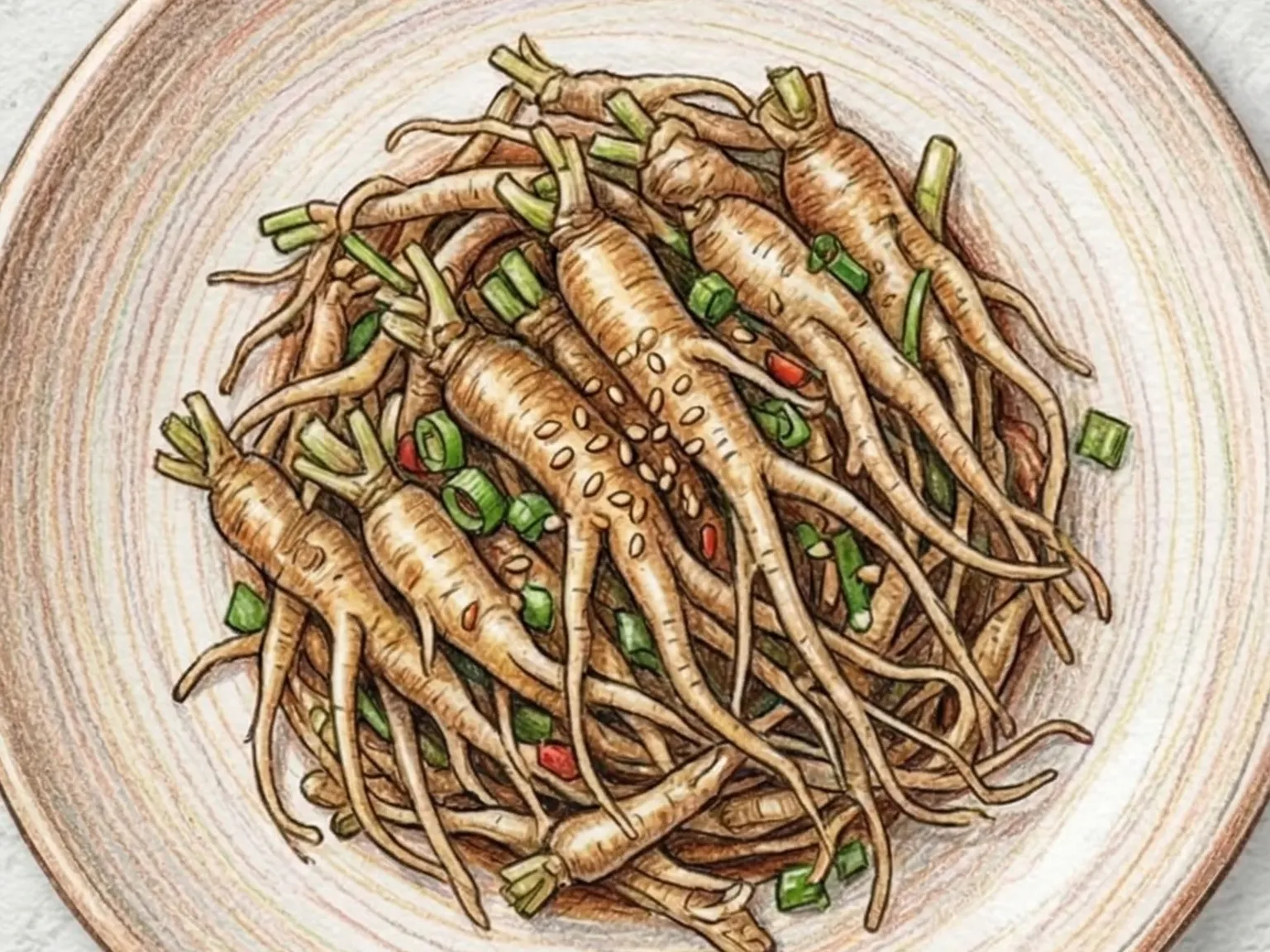
Korean Seasoned Cedrela Shoots
Cedrela shoots appear for barely two weeks each April, making chamjuk one of Korea's most fleeting spring ingredients. The young tips carry a resinous, walnut-like scent found in no other wild green. A 40-second blanch in salted water softens fibrous stems while locking in that fragrance. Dressed with just soy sauce, garlic, and sesame oil, the dish lets the shoots' natural perfume lead. Gathered from mountainside groves, it appears on spring holiday tables beside other foraged greens.
Adjust Servings
Instructions
- 1
Wash cedrela shoots and trim thick stems.
- 2
Blanch briefly in salted boiling water for about 40 seconds.
- 3
Rinse in cold water and squeeze dry.
- 4
Toss with soy sauce, garlic, and sesame oil.
- 5
Sprinkle sesame seeds and serve.
As an Amazon Associate, we may earn from qualifying purchases.
Tips
Nutrition (per serving)
More Recipes

Korean Seasoned Radish Greens Namul
Dried radish greens are soaked, boiled until pliable, and dressed in a seasoning anchored by doenjang and ground perilla seeds. The drying process concentrates the fiber in the greens, giving them a satisfying chew that persists even after boiling: the outer layer turns silky while the inner stem retains a springy resistance. Doenjang supplies the salty, fermented backbone, and ground perilla seeds melt into a creamy coating that softens the roughness of the greens on the palate. A generous pour of perilla oil ties the dressing together, adding a glossy sheen and a rich, nutty fragrance. Minced garlic and chopped green onion introduce a sharp aromatic layer that cuts through the heaviness. Each bite releases more of the siraegi's own deep, vegetal flavor, a taste that builds rather than fades. Paired with steamed rice, the doenjang's salinity and the perilla's richness draw out the natural sweetness of the grain.

Korean Seasoned Coastal Hogfennel Greens
Coastal hogfennel - bangpung - is a wild herb from Korea's seaside cliffs, prized for its pungent, celery-like aroma. Blanched one minute in salted water to tame bitterness while preserving herbal fragrance, the greens are dressed simply with doenjang, garlic, and sesame oil. Minimal seasoning lets the herb's character lead. A seasonal specialty from spring markets in coastal regions like Gangwon-do and Jeju.

Korean Seasoned Chili Leaves
Gochuip - chili pepper leaves - are harvested after the peppers themselves have been picked, a practice rooted in Korean rural frugality where nothing from the kitchen garden goes to waste. The leaves are at their most tender and fragrant in August and September, after the main pepper harvest. Blanched for one minute to temper bitterness, squeezed dry, and dressed with soy sauce, gochugaru, garlic, sesame oil, and sesame seeds. The leaves carry a distinctive faintly bitter, herbaceous note that overlaps with the gochugaru's heat in a way no other Korean green replicates. Because the thin leaves absorb seasoning rapidly, this namul is fully flavored from the moment it is dressed.

Seasoned Korean Wild Lettuce
A bold, bitter-meets-spicy Korean side dish that wakes up the entire meal - foraged wild lettuce tossed in a fiery gochujang-vinegar dressing. Godeulppaegi (Ixeris dentata) is blanched briefly, then soaked in cold water for at least thirty minutes to tame its sharp bitterness. Dressed in gochujang, gochugaru, vinegar, sugar, garlic, and sesame oil, the remaining edge transforms into a complex, layered flavor. In season from spring through early summer, this is a prized banchan at rural markets across southern Korea.

Korean Bitter Herb Kimchi
Sseumbagwi kimchi is a traditional Korean fermented side dish made from sseumbagwi, a wild bitter herb harvested in spring. The herb is soaked in cold water for twenty minutes to temper its pronounced bitterness, salted for fifteen minutes, then dressed in a thick paste of gochugaru, sand lance fish sauce, minced garlic, ginger, sweet rice paste, and plum syrup alongside scallion pieces. The rice paste gives the seasoning enough body to cling to the thin stems and leaves, and the plum syrup smooths out both the bitterness and the salt's sharpness. Five hours of room-temperature fermentation followed by refrigeration allows lactic acid to develop gradually, layering a tangy depth over the herb's inherent bitter-green character. The flavor is most complex around day three. If the bitterness is too strong, an additional change of soaking water before seasoning brings it under control.

Korean Radish Greens Kimchi
Mucheong kimchi is a Korean radish greens kimchi made by trimming tough parts, cutting greens into 5 cm pieces, brining in coarse salt, then dressing them in a paste of sweet rice flour, gochugaru, anchovy fish sauce, garlic, ginger, and onion. The fibrous stems absorb the seasoning deeply while retaining a substantial chew, and the rice paste acts as a binding agent that keeps the coating even throughout fermentation. Anchovy fish sauce contributes a deep seafood umami, and onion buffers the chili heat with natural sweetness. Beyond serving as a standalone side dish, this kimchi adds concentrated flavor when torn and stirred into siraegi soup or doenjang jjigae.