Chicken Korma (Creamy Cashew Curry)
Quick answer
Chicken korma developed in the kitchens of the Mughal courts, where cooks built dishes around layered subtlety rather than raw heat.
What makes this special
- Chicken Korma incorporates a creamy cashew and almond paste to create a velvety sauce.
- Cashew paste base gives velvety body without cream alone
- Whole spices marinated in yogurt build layered warmth
Key ingredients
Core cooking flow
- 1 Soak 40g cashews in hot water for 10 minutes, then drain them well.
- 2 Cut 700g chicken thighs into bite-size pieces.
- 3 Heat oil in a pan and cook 2 thinly sliced onions over medium-low heat for 25-30 minutes.
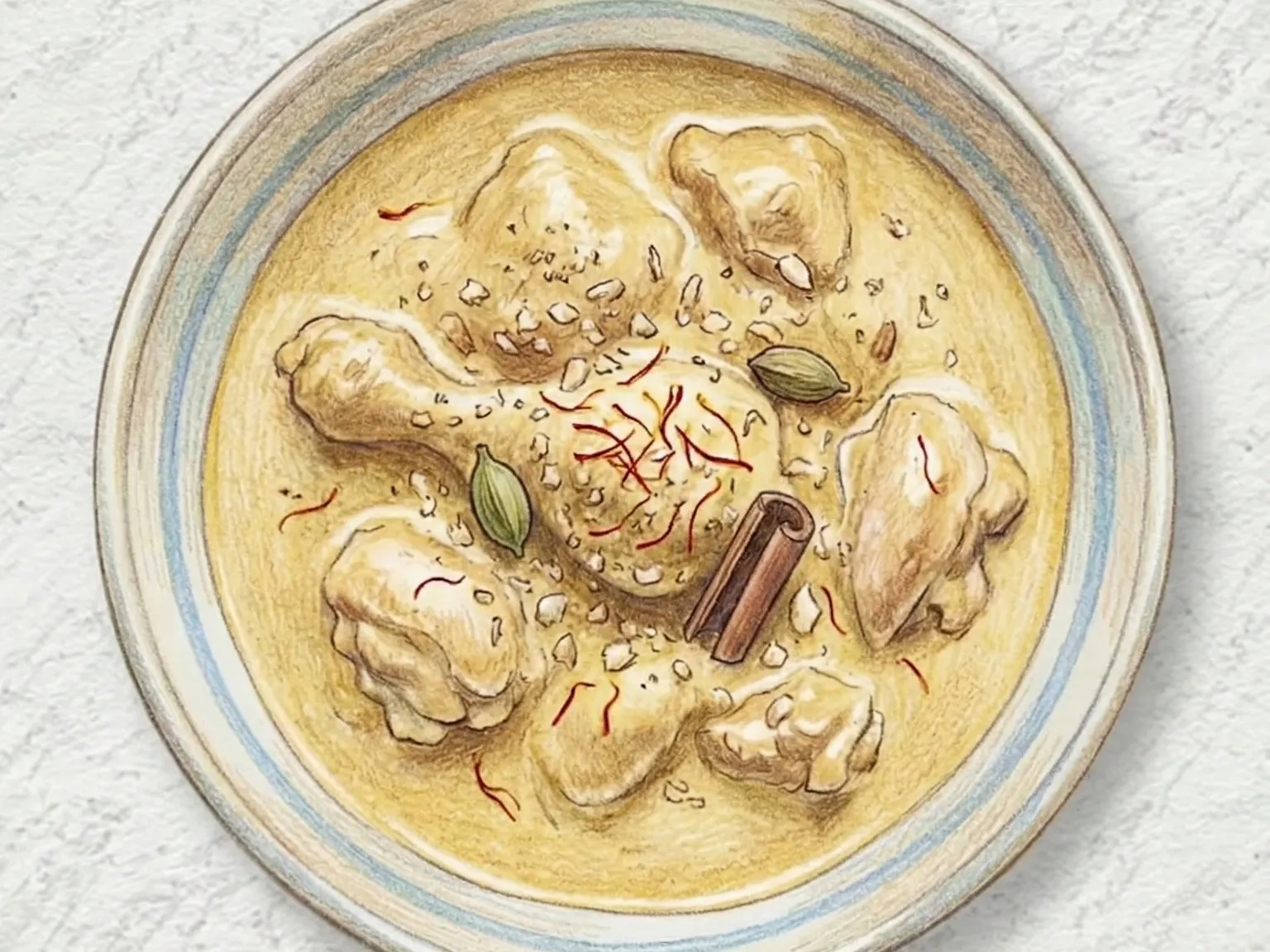
Chicken korma developed in the kitchens of the Mughal courts, where cooks built dishes around layered subtlety rather than raw heat. The sauce begins with cashews or almonds soaked overnight and ground into a fine paste, which gives the gravy a velvety body and toasted-nut richness without any cream. Chicken is marinated in yogurt with whole spices - cardamom pods, cloves, cinnamon sticks, and mace blades - then brought to a low simmer where the warm aromatics slowly infuse the liquid and meet the tang of the yogurt, producing a flavor that is complex yet entirely without aggression. Saffron dissolved in warm milk and stirred in near the end stains the sauce a deep gold and adds a faint floral quality, two elements that mark a properly made korma. The dish is frequently recommended to diners encountering Indian food for the first time because of its mildness, but the dense nut-paste base, the careful balancing of a dozen aromatics, and the slow integration of yogurt make korma one of the most technically demanding preparations in the North Indian canon - far more than a simple mild curry.
Instructions
Read the steps as a cooking flow: prep, heat, seasoning, doneness control, and finish.
- 1Season
Soak 40g cashews in hot water for 10 minutes, then drain them well.
Blend until the paste is thick and completely smooth, scraping the sides so no hard pieces remain in the sauce later.
- 2Prep
Cut 700g chicken thighs into bite-size pieces.
Mix with 6 tbsp plain yogurt, 4 minced garlic cloves, and 1 tbsp ginger, massage until coated, and marinate at least 15 minutes so the surface softens evenly.
- 3Control
Heat oil in a pan and cook 2 thinly sliced onions over medium-low heat for 25-30 minutes.
Stir often, lower the heat if edges darken too fast, and blend once they are deep golden brown.
- 4Control
Warm the same pan over medium heat and add the marinated chicken.
Cook for 3-4 minutes, stirring from the bottom, until the outside turns opaque and the yogurt marinade stops looking raw.
- 5Control
Add the onion paste, 1 tsp garam masala, and 1 tsp ground coriander.
Reduce to low heat and simmer for 15 minutes, stirring whenever the sauce thickens so the nutty onion base does not catch.
- 6Control
Stir in the remaining yogurt, cashew paste, and 80ml heavy cream in that order over low heat.
Simmer gently for 5 minutes, stopping before a hard boil, until the sauce is pale cream with a light oil sheen.
After the steps
Pick a recipe that fits this dish.
Continue with shared ingredients, meal pairings, or a similar method.
Recipes That Go Well With This
More Asian →Based on shared ingredients and meal pairing
Chicken Tikka Masala
Chicken tikka masala marinates chicken overnight in yogurt, curry powder, garlic, and ginger, then grills or broils it at high heat to develop char on the surface before finishing in a sauce of tomato puree, garam masala, and heavy cream. The lactic acid in yogurt gently breaks down surface proteins while acting as a vehicle to drive the spices deeper into the meat. Browning diced onion in butter, then cooking tomato puree with garam masala for at least fifteen minutes allows the sharp, raw edges of the spices to mellow and integrate fully, building a sauce base with genuine depth. Heavy cream added just before serving wraps the tomato acidity and chili heat in a smooth, rich body that unifies the dish. Overnight marination makes a substantial difference compared to a short soak, as the spices have time to penetrate to the center of each piece. Basmati rice or naan bread served alongside is standard, and dragging the bread through the sauce captures the full range of flavor in a single bite.
Chicken 65 (South Indian Deep-Fried Spiced Yogurt Chicken)
Chicken 65 is a South Indian deep-fried chicken dish that traces its origin to the Buhari Hotel in Chennai, where it first appeared on the menu in 1965. The name has generated a minor mythology: one theory says it was the 65th item on the original menu, another claims the recipe calls for exactly 65 ingredients, and a third insists the chicken required 65 days of marination - none of which has been conclusively verified. The marinade is built around whole-milk yogurt, red chili powder, turmeric, and a coarse ginger-garlic paste, which work together to tenderize the chicken while depositing both heat and tang deep into the fibers. After marinating for several hours, the pieces are dusted in cornstarch and fried until the exterior forms a thin, crackling shell while the interior stays moist from the dairy in the marinade. The dish is not finished after frying. The fried chicken goes back into a hot pan where it is tossed briskly with curry leaves, whole dried red chilies, and mustard seeds in a small amount of oil. When curry leaves hit hot fat, they release a distinctive aroma - something between roasted nuts and citrus peel - that clings to the surface of each piece and layers over the chili-yogurt flavors already present. This double-cooking method is what separates chicken 65 from generic fried chicken. Originally a bar snack in South India's pub culture, it spread across the subcontinent and now appears on menus everywhere from Bangalore to Delhi. The heat level varies significantly by restaurant, ranging from gently warming to genuinely tongue-numbing.
Masala Chai
Masala chai is an Indian spiced milk tea made by simmering crushed ginger, cinnamon, and cardamom in water until the spices release their oils fully, then adding black tea leaves and whole milk and continuing to heat gently over low flame. The spices build aromatic depth that wraps around the tea's tannins, transforming them into warm, rounded complexity rather than raw astringency. Stirring in sugar during the final minutes of simmering softens the spice's sharpness and allows the milk's creaminess to come forward. Using whole spices rather than ground powders keeps the brew free of gritty residue and produces a cleaner, more transparent aroma in each cup.
Kadhi Pakora (Yogurt Curry with Fritters)
Kadhi pakora is a yogurt-based curry from North India, especially popular in Punjabi home cooking, where gram flour fritters are simmered in a tangy, spiced yogurt gravy. The pakoras are made by mixing a portion of gram flour with sliced onion, salt, and water into a thick batter, then deep-frying spoonfuls until golden. The remaining gram flour is whisked with yogurt, water, turmeric, and red chili powder to form the kadhi base, which must be stirred constantly in the early stages to prevent the yogurt from splitting. Cumin seeds are bloomed in oil to release their aroma before the kadhi mixture is poured in and simmered gently for twenty minutes, allowing the raw flour taste to cook out completely. Adding the fried pakoras near serving time preserves some of their texture, while longer simmering lets them absorb the gravy and turn soft throughout.
Serve with this
Kachumber Salad (Indian Kachumber salad)
Kachumber salad finely dices cucumber, tomato, and red onion, then tosses them with chopped cilantro, lime juice, ground cumin, chaat masala, and salt in a quick Indian raw vegetable preparation. Removing some of the seeds from the cucumber and tomato limits excess moisture so the dressing stays concentrated rather than watery. Soaking the diced red onion in cold water for three minutes draws out its harsh sharpness, letting it blend more smoothly with the other ingredients. Ground cumin lays down a warm, earthy undertone, and chaat masala layers a tangy, salty complexity over the lime acidity, lifting a simple combination of vegetables into something distinctly Indian. Chopping cilantro stems together with the leaves releases more of the herb's aromatic oils than leaves alone provide. Letting the dressed salad rest for about fifteen minutes before serving allows the flavors to meld so the final result is noticeably more cohesive.
Guilin Rice Noodles (Silky Rice Noodles in Beef Brisket Broth)
Guilin rice noodles are the signature noodle dish of Guilin in Guangxi, China, built on a clear beef brisket broth that has been simmered until the collagen fully dissolves and the liquid turns deeply savory without becoming heavy. The slender rice noodle strands are smooth and slightly springy, and they absorb the broth as the bowl sits. Soy sauce seasons the soup with a salty, round undertone rather than any sharp edge. Pickled daikon radish is added as a topping for its crisp bite and vinegary tang, which cuts through the richness of the beef broth and resets the palate between mouthfuls. A drizzle of chili oil introduces a warm, slow-building heat that spreads through the soup. Fresh cilantro placed on top at the end adds a bright, citrus-forward herbal fragrance that ties the Southeast Asian-influenced profile of the bowl together. The combination of broth, noodles, and contrasting toppings is what makes Guilin rice noodles a dish people return to repeatedly.
Korean Pine Nut Porridge (Creamy Nutty Nourishing Rice Porridge)
Pine nuts are blended with water into a smooth milk, then stirred into soaked rice that has been sauteed in sesame oil to bring out its starch aroma. The pine nut milk is added after the rice has already simmered for ten minutes, because prolonged boiling diminishes the nuts' volatile fragrance. The finished porridge has a pale cream hue and leaves a lingering resinous pine-nut note on the palate. Thinly sliced jujube garnish adds a pop of red color and gentle natural sweetness that complements the nuttiness.
Similar recipes
Butter Chicken
Butter chicken - murgh makhani - starts by marinating chicken thighs in yogurt, garam masala, and cumin, then roasting or grilling them at high heat to develop a slightly charred, smoky exterior. That surface char is a defining element; plain poaching cannot replicate it. The tomato sauce base requires long, patient reduction - the raw acidity must cook off and round into sweetness before any dairy is added. Butter and heavy cream then go in, wrapping the spice blend sharp heat in a velvety richness that carries through to the last bite. Cumin and garam masala provide the earthy, layered warmth that anchors this curry's identity, and together they produce the mild, creamy character that sets murgh makhani apart from hotter Indian preparations.
Chicken Biryani (Mughal Spiced Saffron Layered Rice with Chicken)
Biryani emerged from the encounter between Persian pilaf technique and Indian spice culture during the Mughal Empire, and it remains a ceremonial dish served at weddings, festivals, and Friday prayer gatherings across the Indian subcontinent. Chicken is marinated in yogurt, saffron, garam masala, and ginger-garlic paste, then layered in a heavy-bottomed pot with par-cooked basmati rice, saffron milk, fried onions, and fresh mint placed between each layer. The pot is sealed with a flour-and-water dough in a technique called dum. Inside the sealed vessel, steam circulates and the rice and meat cook in each other's aromatic vapors, exchanging flavor in a way that open-pot cooking cannot replicate. When the dough seal is broken at the table, the released cloud of saffron, cardamom, and rosewater is the dish's most dramatic moment and the signal that it is properly done. In a well-executed biryani, each grain of basmati should stand apart and carry the seasoning evenly, and the bottom layer of rice should have formed a crisp, golden crust similar to Persian tahdig. The Hyderabadi and Lucknowi styles represent two distinct traditions: the former layers raw chicken directly with par-cooked rice and cooks everything together, while the latter par-cooks both components separately before assembling, producing a cleaner, more delicate result.
Chana Masala (Punjabi Spiced Chickpea Tomato Curry)
Chana masala is a staple of Punjabi home cooking and one of the most widely eaten vegetarian dishes across North India, found on the menus of dhabas, railway canteens, and five-star hotel restaurants alike. Dried chickpeas are soaked overnight and pressure-cooked until they hold their shape but yield when pressed -- the texture of the chickpea matters as much as the sauce around it. The sauce builds from finely diced onions fried until deeply browned, which provides natural sweetness and body without any cream. Tomatoes cook down with coriander, cumin, turmeric, garam masala, and amchur -- dried mango powder -- which contributes a tart, fruity acidity that sets this preparation apart from other chickpea curries and gives it a distinctive brightness no other spice replicates. The sauce should be thick and clingy, not soupy; each chickpea gets coated in a dark, spiced layer rather than sitting in loose liquid. Topped with sliced raw onion, green chili, and a squeeze of lemon, the dish pairs with bhatura -- fried bread -- as the iconic Punjabi street-food duo known as chole bhature. Scooped up with roti, the same preparation becomes an everyday weeknight meal that costs almost nothing to make.