Korean Popcorn Chicken
Quick answer
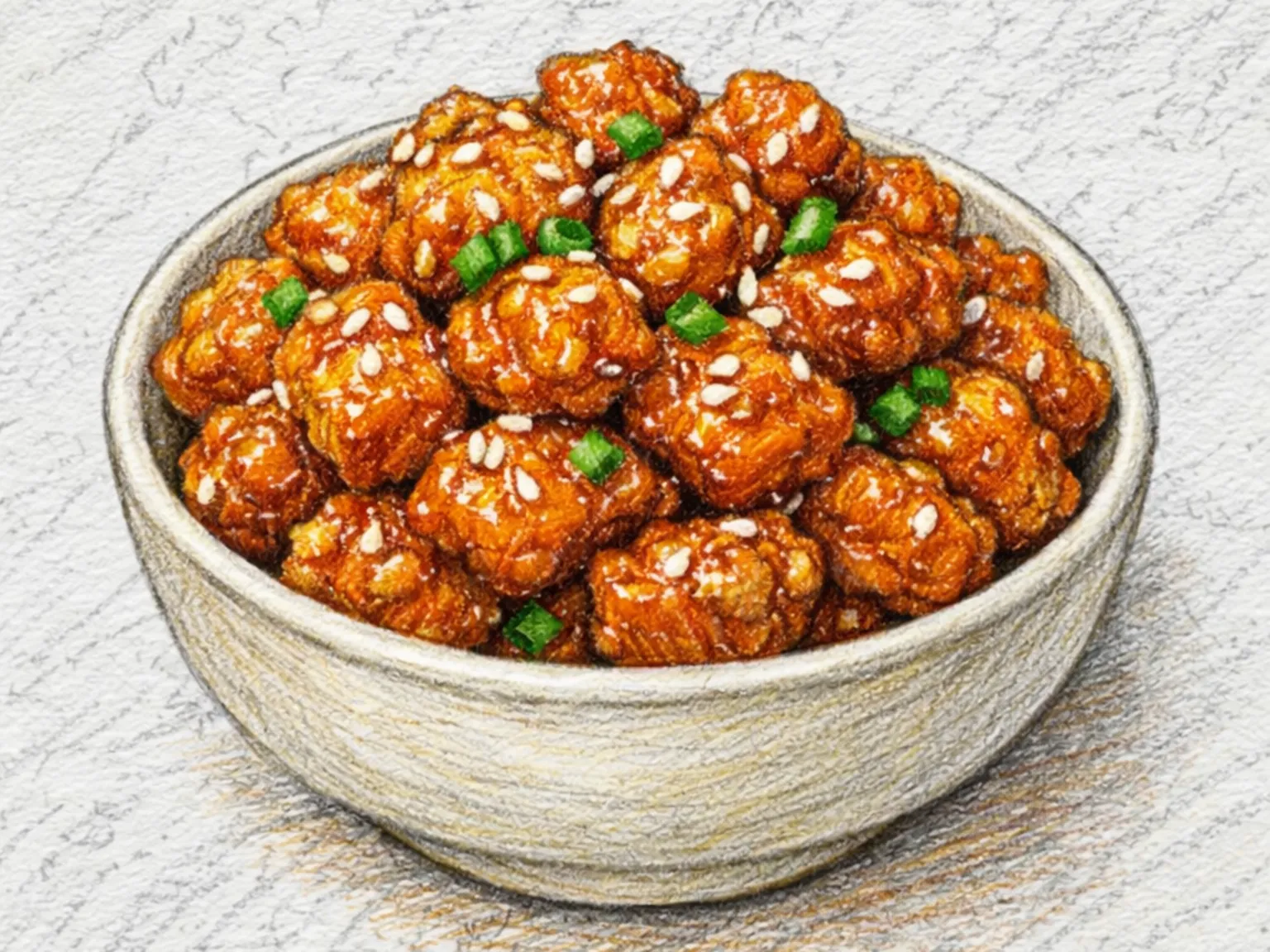
Popcorn chicken is a Korean fried snack made by cutting chicken breast into 2cm cubes, coating them in egg wash and cornstarch, then double-frying at 170 degrees Celsius.
What makes this special
- 2cm cubes of chicken breast are double-fried to achieve a light, consistent crunch in every bite.
- 2cm cubes maximize the batter-to-meat ratio for crunch in every bite
- Double fry locks in crunch outside while preserving moisture inside
Key ingredients
Core cooking flow
- 1 Pat 300g chicken breast dry, then cut it into even 2cm cubes so they fry at the same speed.
- 2 Beat 1 egg and mix it into the marinated chicken first, coating every surface lightly.
- 3 Pour 500ml cooking oil into a deep pan and heat it to 170 C.
Popcorn chicken is a Korean fried snack made by cutting chicken breast into 2cm cubes, coating them in egg wash and cornstarch, then double-frying at 170 degrees Celsius. The first fry sets the crust; the second fry drives out residual moisture, producing an exceptionally crunchy shell. Because the pieces are small, the crust-to-meat ratio is high, so every bite delivers maximum crunch. A glaze reduced from soy sauce, sugar, and oligosaccharide syrup coats each piece in a sweet-salty finish. Garlic powder mixed into the initial seasoning carries a mild garlic note through the oil.
Instructions
Read the steps as a cooking flow: prep, heat, seasoning, doneness control, and finish.
- 1Season
Pat 300g chicken breast dry, then cut it into even 2cm cubes so they fry at the same speed.
Toss with 2 tsp soy sauce, 1 tsp sugar, and 0.5 tsp garlic powder, then marinate for 10 minutes.
- 2Prep
Beat 1 egg and mix it into the marinated chicken first, coating every surface lightly.
Add 80g cornstarch in portions, separating the pieces with your hand until the outside looks dry and powdery, not wet or clumpy.
- 3Heat
Pour 500ml cooking oil into a deep pan and heat it to 170 C.
Fry the chicken in small batches for 3 to 4 minutes, avoiding crowding so the temperature does not drop, then remove when the crust turns pale golden.
- 4Heat
Rest the fried chicken on a rack or sieve for 2 minutes so steam can escape instead of softening the crust.
Raise the oil to 180 C, then fry again for 30 seconds to 1 minute until deeper golden and firmly crisp.
- 5Control
In a small pan, combine 2 tsp soy sauce, 1 tsp sugar, and 1 tsp oligosaccharide syrup over medium heat.
Simmer for 1 to 2 minutes, then turn off the heat as soon as the bubbles shrink and the glaze looks glossy.
- 6Finish
Add the hot chicken to the pan and toss quickly so the glaze coats it in a thin layer.
Stop as soon as every piece looks evenly shiny, because overmixing softens the crust, then transfer to a plate and serve immediately.
After the steps
Pick a recipe that fits this dish.
Continue with shared ingredients, meal pairings, or a similar method.
Recipes That Go Well With This
More Street food →Based on shared ingredients and meal pairing
Korean Curry Fried Rice (Golden Spiced Chicken Fried Rice)
Curry bokkeumbap is a Korean fried rice where curry powder coats each grain with warm spice and gives the rice a vivid golden color. Chicken breast, onion, carrot, and bell pepper are stir-fried together before the rice goes in, distributing protein and vegetables evenly through every serving. The curry fragrance develops gradually with each bite - more present than plain fried rice but lighter than a curry sauce, landing at a satisfying middle point between the two. Bell pepper adds sweetness and a visual contrast of color against the golden rice. Topping with a fried egg raises the dish further: when the yolk breaks and mixes into the rice, a layer of creaminess runs through each bite. The recipe works well with day-old rice and requires few ingredients, making it a practical weeknight meal.
Korean Sweet Spicy Pollock Floss Stir-fry
Myeongyeopchae-bokkeum stir-fries finely shredded dried pollock floss in gochujang and oligosaccharide syrup until each fiber strand is evenly coated and moist. Myeongyeopchae is thinner and softer-fibered than hwangtaechae, the wider dried pollock strips, arriving in a dense cotton-like bundle that must be loosened strand by strand before cooking. Running your fingers along the grain separates the fibers cleanly, allowing the seasoning to penetrate evenly and preventing the finished banchan from clumping together in the mouth. A dry toast of thirty seconds in an oil-free pan drives off residual moisture and coaxes out a toasted fish aroma before gochujang, gochugaru, oligosaccharide syrup, soy sauce, and minced garlic go in over the lowest heat for a rapid coating. The fine fibers absorb the sauce almost immediately and turn pliant and glistening, but heat held too long draws the moisture back out, leaving them tough and stiff, so the entire stir-fry must be completed within two minutes. A finishing drizzle of sesame oil and a scatter of sesame seeds deepen the nutty aroma. The resulting banchan occupies a middle ground between the chewier, more aggressively seasoned hwangtaechae-muchim and the bolder jinmichae-bokkeum, its mild sweet-spicy profile approachable enough for children. The relatively dry finish means the seasoning does not bleed into adjacent items in a lunchbox, and stored in an airtight container in the refrigerator the flavor holds well for up to five days.
Korean Sweet Corn Latte (Butter Sauteed Corn Milk Drink)
Sweet corn latte begins by sauteing cooked corn kernels in butter until fragrant, then simmering them in milk to draw out the corn's natural sugars before blending everything smooth. The butter amplifies the starchy, roasted aroma during the initial saute, coating each kernel so that the fat-soluble flavor compounds dissolve fully into the milk during the five-minute simmer. Blending the mixture until completely smooth and then straining it through a fine sieve removes any remaining hull pieces, producing a texture as silky as a custard sauce. This straining step makes a noticeable difference in the final quality. Condensed milk adds a rounded sweetness, and a small amount of white pepper introduces a faint spiced warmth that gives the drink depth beneath the sweetness. It works equally well served hot in a ceramic mug or chilled and poured over ice; the corn aroma remains vivid in both versions.
Korean Chicken Gimbap (Crispy Chicken Tender Seaweed Rice Roll)
Chicken gimbap is a Korean seaweed rice roll filled with air-fried crispy chicken tenders, sesame-salt seasoned rice, lettuce, and mayonnaise. The timing of assembly is important: the chicken must go in immediately after cooking while the fried coating is still hot and rigid, otherwise moisture from the rice and lettuce softens the crust before the roll is even finished. Mayonnaise forms a creamy layer between rice and chicken that also acts as a barrier, slowing moisture transfer and keeping each component distinct. Lettuce adds a fresh, cool crunch that balances the richness of the fried chicken and mayo. Laying the chicken pieces in a straight line before rolling produces an even cross-section when the gimbap is sliced. Mixing hot sauce into the mayonnaise creates a spicy version that can be scaled to taste. The roll travels well and is a reliable choice for packed lunches.
Serve with this
Gotgam Cream Cheese Roll (Dried Persimmon Rolls)
Gotgam cream cheese roll is a no-cook Korean dessert that requires nothing more than a knife, a bowl, and a refrigerator. Dried persimmons are slit open and flattened into thin sheets, each one acting as the outer wrapper. The filling is cream cheese mixed with honey and fresh lemon juice to balance its natural richness with acidity, and finely chopped walnuts are folded in throughout to add a crunchy, nutty element to every bite. The filling is spread across the opened persimmon, which is then rolled tightly and wrapped in plastic wrap. Twenty minutes in the refrigerator firms the roll enough to slice cleanly. Dipping the knife in warm water and wiping it dry before each cut produces the smoothest cross-sections. The finished slices reveal clearly defined layers: the chewy, caramel-sweet dried persimmon on the outside, the tangy cream cheese in the middle, and flecks of walnut distributed throughout. The combination makes it a natural pairing with wine or a polished addition to a traditional holiday table.
Korean Fermented Soybean Paste Noodle Soup
Doenjang kalguksu is a Korean noodle soup of knife-cut wheat noodles in an anchovy broth enriched with fermented soybean paste. Straining the doenjang through a fine-mesh sieve before adding it to the broth serves a specific purpose: it prevents uneven lumps and ensures the paste dissolves uniformly, which keeps any bitter notes from concentrating in spots. The fermentation depth of the doenjang and the glutamate-rich anchovy stock reinforce each other without needing added seasoning. Zucchini cut into half-moons and sliced shiitake mushrooms contribute sweetness and aroma as the broth simmers; cubed tofu adds a soft, yielding contrast to the chewy noodles. Timing dictates quality here: the final salt adjustment goes in right before the noodles, because doenjang pushed through extended boiling develops a pronounced bitterness that is difficult to correct. Once the noodles go in, the soup should be finished within two minutes to preserve their elasticity.
Similar recipes
Korean Lemon Pepper Dakgangjeong
Boneless chicken thigh pieces are cut bite-size, coated thoroughly in potato starch, and double-fried at 170 then 180 degrees Celsius to build a shell that stays crunchy through the glazing step. The fried chicken goes straight into a reduction of lemon juice, honey, soy sauce, and butter, where the bright citrus acidity cuts cleanly through the rendered fat and cracked black pepper settles in as a slow, lingering finish. The entire tossing step must be completed in under twenty seconds before the steam softens the crust. Adding lemon zest directly into the glaze intensifies the citrus note considerably, and finished slices of lemon on the side make for a clean, vivid presentation.
Korean Soy Garlic Dakgangjeong
Soy-garlic dakgangjeong is Korean fried chicken made from boneless thigh pieces coated in potato starch and fried twice before being tossed in a soy-garlic glaze. The first fry runs at 170 degrees Celsius for five minutes to cook the meat through to the center. The second fry raises the temperature to 190 degrees and runs for two minutes to push residual moisture out of the crust and harden the surface. Both fries are necessary to achieve a crust firm enough to stay crisp under the wet glaze. Using only potato starch rather than a wheat-starch blend produces a thinner, more transparent coating that crisps harder and absorbs less oil. The sauce is reduced for no more than thirty seconds to one minute so the saltiness does not concentrate excessively. Vinegar is a key component: it cuts through the grease and leaves the palate clean after each bite. The fried chicken must go into the sauce while it is still loose, then be tossed over high heat quickly so the coating never has time to steam and soften. Sesame seeds scattered on top add a nutty fragrance and a textural contrast against the lacquered surface.
Korean Sweet Spicy Dakgangjeong
Yangnyeom dakgangjeong is Korean sweet-spicy fried chicken made by cutting boneless thigh meat into bite-size pieces, dredging them in potato starch, and running them through a two-stage fry. The first fry at 170 degrees Celsius cooks the meat through; the second fry at 185 degrees drives off the residual moisture the crust absorbed during the first pass, hardening the exterior into a shell that can withstand sauce tossing without collapsing. The glaze is a reduction of gochujang, gochugaru, corn syrup, and soy sauce, simmered down until the mixture is thick enough to coat a spoon without dripping off. Tossing the finished chicken in the hot glaze must happen off the heat and within twenty seconds, because the steam trapped between sauce and crust will turn the coating soggy if the process drags on. When done correctly, the result is a glossy, sticky exterior that crackles audibly at first bite even after the dish has cooled to room temperature, surrounding thigh meat that stays juicy inside.
Korean Stir-Fried Chicken
Dak-bokkeum is a Korean stir-fried chicken dish seasoned with a soy sauce-based marinade. Soy sauce, sugar, and minced garlic coat the chicken evenly before it hits the pan, producing a salty, umami-forward crust as it sears. Onion and carrot are added partway through, and the moisture they release as they soften blends into the seasoning to form a natural pan sauce without any added liquid. Sesame oil goes in at the end, its nutty aroma lifting through the dish as it finishes. Breast meat produces a leaner, cleaner-tasting result, while thigh meat stays more moist and springy throughout cooking. The dish pairs well with steamed rice and comes together quickly enough for weeknight cooking.