Korean Spicy Braised Cod with Radish
Stir-fry Medium

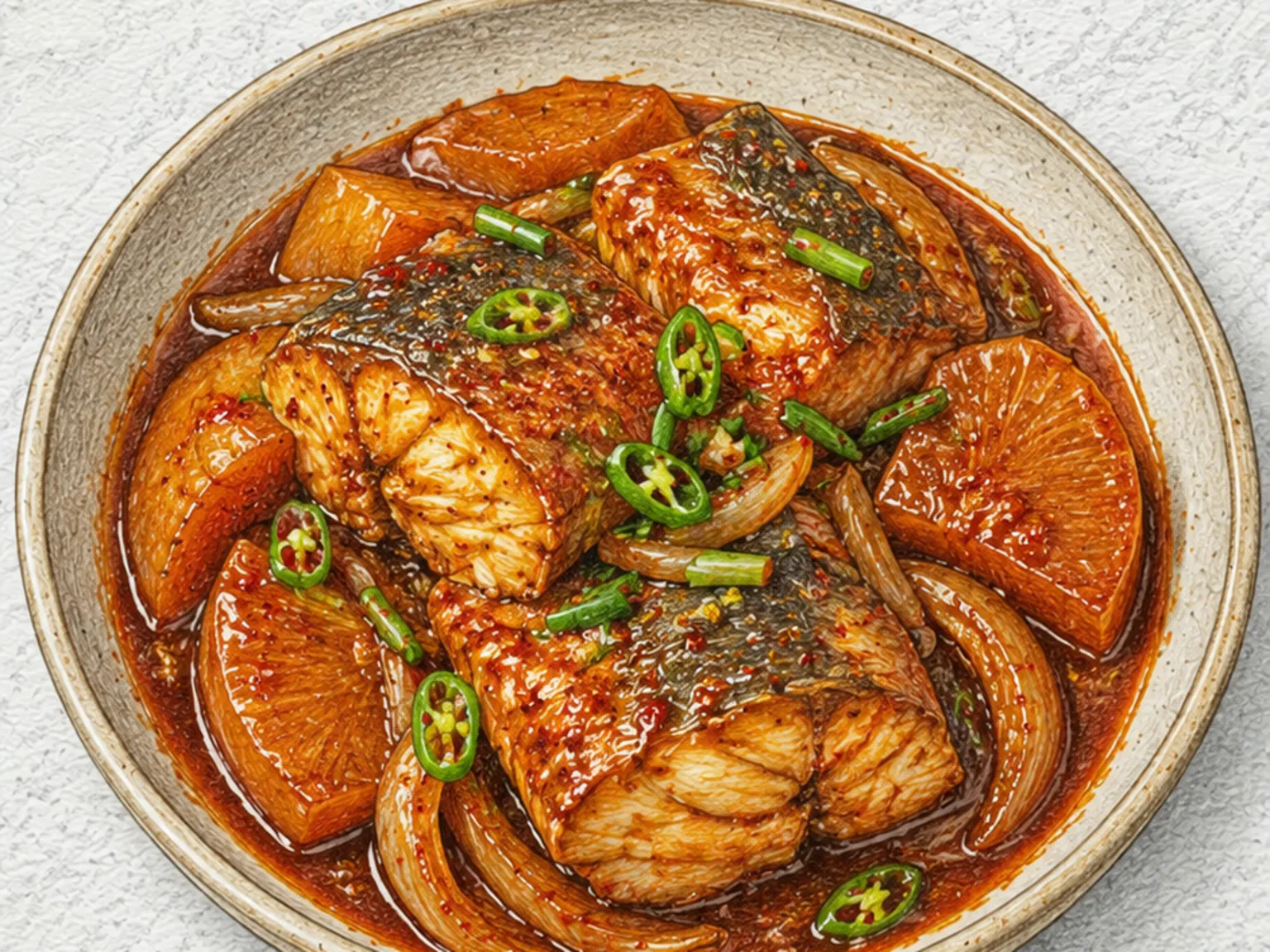
Korean Spicy Braised Cod with Radish

Quick answer

Cod fillets are braised in a seasoning sauce of soy sauce, gochujang, and gochugaru until the liquid reduces and the flavors soak into the flesh.

What makes this special

  • Lean cod fillets braised with gochujang and chili powder until the flavors penetrate deep.
  • Triple seasoning of gochujang, chili powder, and soy sauce layers spice on lean cod
  • Radish soaks up the braising liquid, becoming as flavorful as the fish
Total time
40 min
Level
Medium
Servings
4 servings
Ingredients
8
Calories
270 kcal
Protein
36 g

Key ingredients

cod piecesKorean radishonionsoy saucegochujang

Core cooking flow

  1. 1 Rinse 800 g of cod pieces briefly in 3% salted water, moving them gently instead of rubbing.
  2. 2 Slice 250 g of Korean radish flat and spread it across the bottom of the pot, then slice 120 g of onion.
  3. 3 Add 320 ml water, 4 tablespoons soy sauce, 1 tablespoon gochujang, 1.5 table...

Cod fillets are braised in a seasoning sauce of soy sauce, gochujang, and gochugaru until the liquid reduces and the flavors soak into the flesh. Cod is a lean fish with a clean, neutral character, and the bold seasoning penetrates the meat to add depth without overwhelming it. Daikon radish placed alongside the fish absorbs the braising liquid as it cooks, becoming as flavorful as the fish itself. Onion slowly softens and releases natural sweetness into the sauce during the simmer. The flesh flakes easily and separates cleanly from the bone, making this dish accessible for all ages. Keeping the lid on over medium heat during braising prevents the sauce from reducing too fast and ensures the fish cooks through evenly.

Prep 18min Cook 22min 4 servings

Instructions

Read the steps as a cooking flow: prep, heat, seasoning, doneness control, and finish.

6 steps
  1. 1
    Season

    Rinse 800 g of cod pieces briefly in 3% salted water, moving them gently instead of rubbing.

    Pat every surface dry so the fish smells cleaner and is less likely to break apart during braising.

  2. 2
    Heat

    Slice 250 g of Korean radish flat and spread it across the bottom of the pot, then slice 120 g of onion.

    The radish forms a base under the cod, so the fish cooks more gently and stays intact.

  3. 3
    Control

    Add 320 ml water, 4 tablespoons soy sauce, 1 tablespoon gochujang, 1.5 tablespoons gochugaru, and 1 tablespoon minced garlic.

    Bring it to a boil over high heat, stirring the sauce so the paste dissolves before the fish goes in.

  4. 4
    Heat

    When the radish turns partly translucent and a chopstick starts to enter with slight resistance, place the cod and onion on top.

    Add the fish to boiling liquid so the surface sets quickly and the pieces hold their shape.

  5. 5
    Control

    Lower to medium heat, cover, and braise for about 8 minutes.

    Instead of turning the cod, gently shake the pot and spoon the hot sauce over the top so the seasoning coats it without breaking the flesh.

  6. 6
    Control

    Uncover and reduce for 3 to 4 more minutes, until the sauce looks thicker and glossy on the fish.

    Turn off the heat, rest covered for 2 minutes, then check that the radish is tender before serving.

After the steps

Pick a recipe that fits this dish.

Continue with shared ingredients, meal pairings, or a similar method.

Recipes That Go Well With This

More Stir-fry →

Based on shared ingredients and meal pairing

Korean Spicy Braised Hairtail
Shared ingredient: korean radish Stir-fry

Korean Spicy Braised Hairtail

Galchi-yangnyeom-jorim is a Korean braised hairtail made by simmering sectioned cutlassfish and radish in a spicy-sweet sauce of gochugaru, soy sauce, and minced garlic. The seasoning penetrates the hairtail flesh as it cooks, suppressing any lingering fishiness while developing a layered, concentrated umami. Radish pieces are laid on the bottom of the pot first so they cook through completely and absorb the braising liquid, turning sweet and tender in a way that contrasts with the flaky fish above. Finishing with the lid off allows the sauce to reduce until it clings to the fish surface in a glossy, tight glaze. Fresh hairtail holds its shape better under heat, so the flesh can be lifted with chopsticks intact, while older fish tends to break apart during cooking. Adding Cheongyang chili increases the sharp heat, and a thin slice of fresh ginger worked into the sauce at the start removes any remaining fishiness before braising begins.

Korean Braised Monkfish in Spicy Soy Sauce
Shared ingredient: korean radish Stir-fry

Korean Braised Monkfish in Spicy Soy Sauce

Agwi-jorim is a braised monkfish dish built around a soy-based sauce rather than the chili paste used in the better-known agu-jjim. The technique is gentler and the flavor profile more balanced - salty, faintly sweet, with a moderate heat from gochugaru rather than the aggressive fire of gochujang. Thick rounds of Korean radish go into the pot first, serving two functions simultaneously: they act as a physical buffer that keeps the fish from sticking to the bottom, and they slowly absorb the braising liquid while releasing their own sweetness into it, becoming the most flavorful element in the finished dish. The braising sauce is straightforward - soy sauce, gochugaru, garlic, and water - but it concentrates significantly as it reduces, coating both the fish and radish in a deep amber lacquer. Monkfish is well suited to braising because of its high collagen content; the flesh stays tender and almost gelatinous even with extended cooking, never turning rubbery. The liver-colored skin softens into the sauce. To eat, the standard approach is to spoon the sauce-saturated radish and fish over a bowl of steamed rice, letting the braising liquid soak in. Less fiery than agu-jjim, agwi-jorim is the version more commonly made at home, where the controlled salt-sweet-spice balance appeals to a wider range of palates.

Korean Seasoned Bellflower Root
Serve together Side dishes

Korean Seasoned Bellflower Root

Doraji -- balloon flower root -- has been used in Korean cooking since the Goryeo dynasty, valued as both a medicinal herb and a staple namul ingredient. Unlike doraji-bokkeum, which stir-fries the root with gochujang and heat, this cold muchim preserves the characteristic firm, snappy crunch that makes doraji distinctive. The roots are shredded along the grain into thin strips, then vigorously rubbed with salt to draw out the saponins responsible for their sharp bitterness, and rinsed multiple times until the water runs clear. A seasoning of gochujang, vinegar, sugar, and sesame oil works into each fibrous strand, layering sweet, sour, and spicy notes over the residual earthiness of the root. This banchan appears on both Chuseok and Seollal holiday tables as one of the five-color namul, where the white of the doraji root represents the metal element in the five-phase system. Because the root holds its crunch well, this dish can be prepared ahead of time without losing texture, making it a practical choice for large gatherings.

Korean Braised Spanish Mackerel with Radish
Similar recipe Stir-fry

Korean Braised Spanish Mackerel with Radish

Samchi mu-jorim layers sliced Korean radish on the bottom of a pot, topped with Spanish mackerel steaks and onion, then braised in a sauce of gochujang, soy sauce, gochugaru, and garlic. The radish prevents the fish from sticking, absorbs the braising liquid, and turns translucent-soft as it cooks. Rather than flipping the fish, the sauce is spooned over the top repeatedly so the flesh stays intact. After about fifteen minutes of simmering on medium heat, the liquid reduces to a concentrated, mildly spicy broth with the radish's subtle sweetness woven through it.

Serve with this

Korean Taro Porridge (Perilla Oil-Toasted Rice with Taro Root)
Rice Medium

Korean Taro Porridge (Perilla Oil-Toasted Rice with Taro Root)

Soaked rice is toasted in perilla oil until fragrant, then simmered with peeled taro in a generous amount of water until the porridge reaches a thick, flowing consistency. Some taro pieces dissolve into the liquid and naturally thicken it, while others hold their shape and offer a starchy, crumbly bite. The gentle nuttiness of perilla oil and the mild earthiness of taro create a soothing combination with no sharp flavors. Seasoning with just salt preserves the delicate taste of the taro without masking it.

🏠 Everyday 🍱 Lunchbox
Prep 20min Cook 35min 4 servings
Korean Pyongyang Onban (Rice in Clear Chicken Broth)
Soups Medium

Korean Pyongyang Onban (Rice in Clear Chicken Broth)

Pyeongyang-onban is a North Korean-style warm rice soup in which steamed rice is submerged in clear chicken broth and topped with shredded chicken and sliced shiitake mushrooms. The chicken simmers with garlic and green onion for forty-five minutes, producing a clean, golden stock that is strained for clarity before use. The cooked meat is pulled into strips and set aside, while shiitake slices steep in the broth for five minutes to add an earthy dimension without muddying the liquid. Rice goes into the bowl first, followed by the hot broth and the chicken garnish, with salt as the sole seasoning. No fermented pastes, chili, or bold spices are used, which means the dish stands entirely on the quality of the stock itself. Onban was traditionally served as a breakfast dish in Pyongyang, and the deliberate restraint in seasoning makes it one of the gentler, more stomach-friendly preparations in the Korean rice soup tradition. A long, unhurried simmer is what separates a flat broth from one with real depth.

🏠 Everyday
Prep 20min Cook 55min 2 servings
Korean Young Napa Soybean Paste Stew
Stews Easy

Korean Young Napa Soybean Paste Stew

Young napa cabbage (eolgari) takes center stage in this doenjang jjigae, wilting into the broth and releasing a mild sweetness. The stock is built from dried anchovies and kelp, then seasoned with fermented soybean paste for a full-bodied base. Firm tofu and onion add substance, while a green chili provides a sharp finish. Eolgari is a tender spring-harvested young cabbage with soft fibers and a pronounced natural sweetness, so when combined with the savory doenjang broth it contributes a mellow, round flavor without any bitterness. Adding a generous amount of tofu helps the cubes absorb the saltiness of the paste and brings the entire soup into a well-balanced, smooth finish that pairs naturally with steamed rice.

🏠 Everyday 🥗 Light & Healthy
Prep 15min Cook 25min 4 servings

Similar recipes

Korean Braised Beltfish with Potatoes
Stir-fry Medium

Korean Braised Beltfish with Potatoes

Galchi-gamja-jorim is a Korean braise of ribbonfish and potatoes cooked together in a soy-based sauce seasoned with gochugaru, garlic, and onion. Ribbonfish has naturally oily, tender flesh that holds together well during braising, and as the fat renders into the liquid it builds a deep seafood umami that defines the dish. The potatoes absorb this concentrated broth as they cook, becoming floury and well-seasoned all the way through rather than just on the surface. Onion breaks down and dissolves into the sauce as it reduces, contributing sweetness that balances the salt and spice. The heat level is adjustable: standard gochugaru gives color and mild warmth, while adding cheongyang chili peppers sharpens the spice. The dish is best served when the sauce has reduced to a thick, glossy consistency that clings to each piece. A spoonful of that sauce over plain rice rounds out the meal. Sliced Korean radish added to the pot introduces a clean, slightly peppery sweetness to the broth.

🏠 Everyday 🍱 Lunchbox
Prep 18min Cook 22min 2 servings
Korean Braised Hairtail Fish
Steamed Medium

Korean Braised Hairtail Fish

Galchi-jjim is a Korean braised hairtail fish dish where sliced hairtail and Korean radish are simmered together in a seasoned broth of gochugaru, soy sauce, garlic, and ginger until the liquid reduces to a concentrated glaze. The fish has a rich, oily white flesh that drinks in the bold seasoning while staying tender and intact. Ginger juice is added specifically to neutralize the oceanic smell that hairtail can carry, keeping the finished dish clean and approachable. The radish cooks down in the braising liquid, becoming deeply seasoned throughout as it absorbs the spiced sauce. The remaining sauce is intentionally left in small quantity so it can be spooned directly over steamed rice, which is considered the most satisfying way to eat this dish. It is a staple Korean fish preparation that appears on home dinner tables across the year.

🏠 Everyday 🎉 Special Occasion
Prep 18min Cook 30min 2 servings
Korean Braised Mackerel in Spicy Sauce
Side dishes Medium

Korean Braised Mackerel in Spicy Sauce

Godeungeo-jorim is one of the most frequently cooked fish banchan in Korean homes, pairing mackerel's assertive flavor with a spicy braising sauce that demands steamed rice. Mackerel is cut into steaks and salted for ten minutes to draw out fishy odors, then arranged over thick radish slices that line the pot bottom. The radish serves dual duty: preventing the fish from sticking and releasing its natural sweetness into the braising liquid below. A sauce of gochugaru, gochujang, soy sauce, garlic, ginger, and sugar is spooned over, and the pot simmers covered for twenty minutes. During this time the seasoning penetrates the flesh while the radish absorbs enough sauce to rival the fish itself as the most satisfying component of the dish. Green onion added in the final minutes lifts the heavy spice with a fresh sharpness.

🏠 Everyday 🍱 Lunchbox
Prep 15min Cook 25min 4 servings

Tips

Cod breaks easily, so keep final simmering brief.

Nutrition (per serving)

Calories
270
kcal
Protein
36
g
Carbs
8
g
Fat
9
g