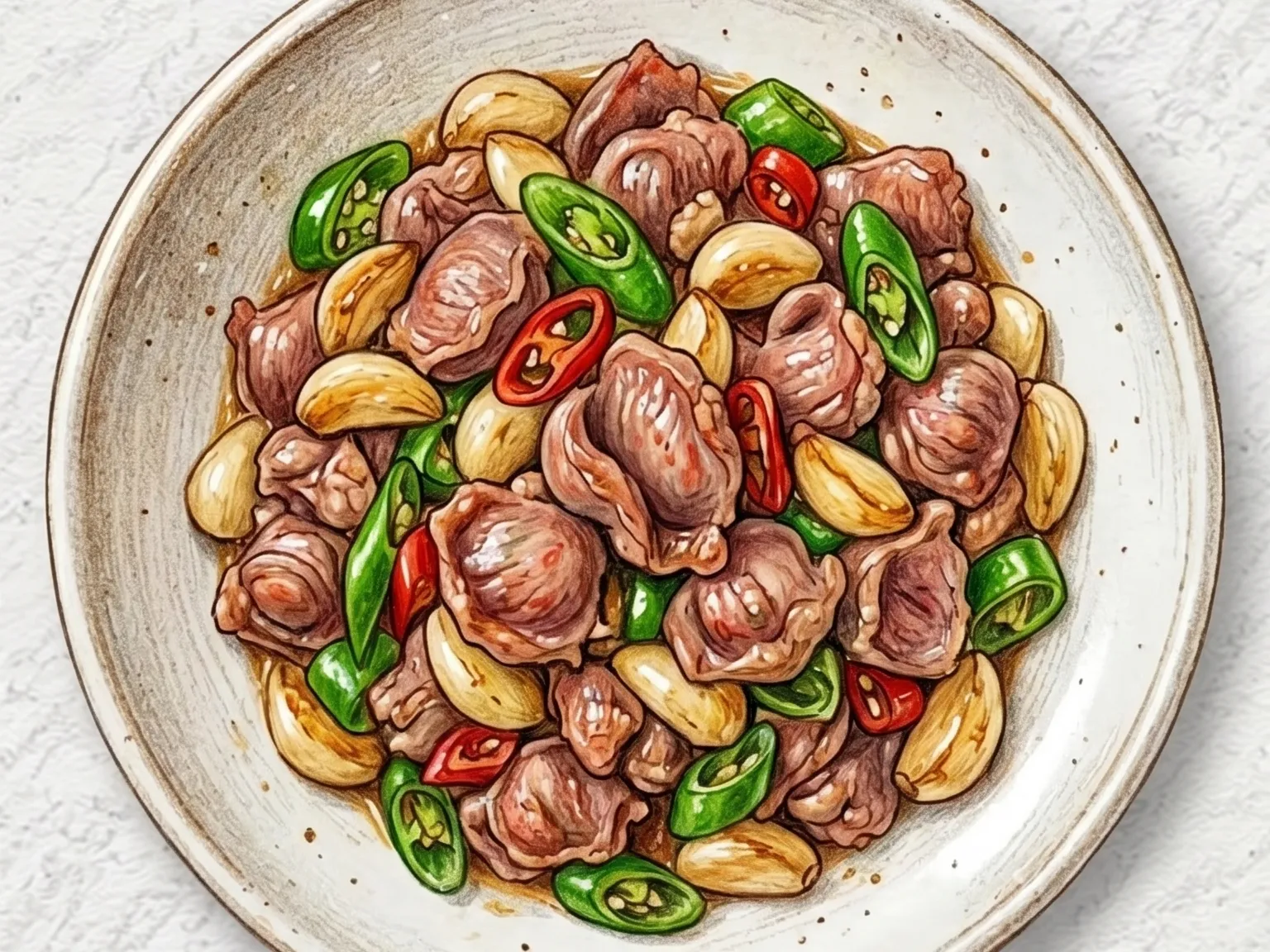
Korean Stir-fried Chicken Gizzards
Stir-fry Medium

Korean Stir-fried Chicken Gizzards

Quick answer

Dak-ttongjip-bokkeum is a stir-fried dish made from chicken gizzards cooked over high heat with garlic and cheongyang chili pepper.

What makes this special

  • Springy chicken gizzards stir-fried with garlic and spicy Cheongyang chili for a nutty chew.
  • Gizzard's dense, springy muscle turns nutty with every chew
  • Removing the inner membrane and blanching 3 minutes eliminates odor and slime
Total time
32 min
Level
Medium
Servings
2 servings
Ingredients
8
Calories
290 kcal
Protein
34 g

Key ingredients

chicken gizzardsgarlic clovesgreen chilionionsoy sauce

Core cooking flow

  1. 1 Remove the silvery membrane and any odorous parts from 350 g chicken gizzard...
  2. 2 Blanch the gizzards in boiling water for 3 minutes.
  3. 3 Slice 8 garlic cloves thinly and cut 80 g onion into narrow strips.

Dak-ttongjip-bokkeum is a stir-fried dish made from chicken gizzards cooked over high heat with garlic and cheongyang chili pepper. The gizzard, known as the near-wi in Korean, is the thick muscular organ a chicken uses to grind its food. It contains very little fat, is high in protein, and stays firm through cooking in a way that ordinary chicken meat does not. Proper cleaning before cooking is essential. The yellow inner lining and any adjacent odorous tissue must be removed entirely, or the finished dish will carry an off smell that no amount of seasoning can cover. Once cleaned and scored lightly on the surface to help seasoning penetrate, the gizzards go into a very hot pan. The goal is a fast, high-heat cook that sears the outside while leaving the interior tender and springy. Extended cooking over lower heat makes them chewy and tough. The texture is the defining quality of this dish - dense, elastic, and slightly resistant to the bite, with a mild savory nuttiness that deepens the longer you chew. Cheongyang chili cuts through any residual heaviness and adds a clean, quick heat. Garlic provides a deep aromatic foundation that complements the protein. Soy sauce and mirim season the stir-fry with a balance of salt and restrained sweetness. The dish is ordered frequently alongside beer or soju, where its chewy texture and moderate heat make it a satisfying accompaniment to cold drinks. It also works well as a rice side dish.

Prep 20min Cook 12min 2 servings

Instructions

Read the steps as a cooking flow: prep, heat, seasoning, doneness control, and finish.

6 steps
  1. 1
    Season

    Remove the silvery membrane and any odorous parts from 350 g chicken gizzards, then rinse several times under cold water.

    Drain well, and score the thicker pieces lightly so they cook evenly and absorb seasoning faster.

  2. 2
    Heat

    Blanch the gizzards in boiling water for 3 minutes.

    When the surface turns white and foam rises, lift them out, rinse under cold water, and pat dry so they sear instead of steaming in the pan.

  3. 3
    Control

    Slice 8 garlic cloves thinly and cut 80 g onion into narrow strips.

    Add 1 tablespoon cooking oil to a pan and heat it fully over high heat before adding aromatics, which keeps the stir-fry fast.

  4. 4
    Heat

    Add the garlic and onion, then stir-fry quickly for about 1 minute.

    When the garlic edges turn pale golden and the onion smells sweet, add the gizzards before the garlic darkens or turns bitter.

  5. 5
    Control

    Stir-fry the gizzards over high heat for 3 to 4 minutes until the outside browns and feels springy.

    Add 1 tablespoon soy sauce and 1 tablespoon cooking wine, then cook 1 more minute until glossy.

  6. 6
    Control

    Add 2 diagonally sliced cheongyang chilies and 0.5 teaspoon black pepper, then stir-fry for only 1 more minute.

    Turn off the heat as soon as the chili aroma is clear and the pan juices are nearly reduced.

After the steps

Pick a recipe that fits this dish.

Continue with shared ingredients, meal pairings, or a similar method.

Recipes That Go Well With This

More Stir-fry →

Based on shared ingredients and meal pairing

Korean Garlic-Grilled Chicken Gizzards
Shared ingredient: chicken gizzards Grilled

Korean Garlic-Grilled Chicken Gizzards

Dakttongjip-maneul-gui is a Korean dish of chicken gizzards grilled and stir-fried over high heat with whole garlic cloves and cheongyang chili peppers. Gizzards are dense, pure-muscle organs with a firm, satisfying chew that sets them apart from other chicken cuts. Scoring them deeply before cooking opens the compact tissue so heat penetrates evenly and seasoning reaches the interior; a ten-minute soak in cooking wine beforehand removes any off-odor and lets the flavors absorb. Whole garlic cloves cooked alongside the gizzards undergo a visible transformation - the exterior caramelizes to a golden brown while the inside softens and turns almost creamy, converting raw sharpness into a rounded, sweet depth. The seasoning stays deliberately minimal - only salt and black pepper - so the natural flavor of the gizzards remains the focus, with cheongyang chilies providing a brief, clean heat that punctuates each bite without overwhelming the palate. The dish works equally well as an anju with drinks or as a savory side with steamed rice.

Korean Spicy Stir-fried Cartilage
Shared ingredient: cheongyang chili Drinks

Korean Spicy Stir-fried Cartilage

Odolppyeo-bokkeum is a fiery Korean stir-fry of chicken cartilage marinated in a sauce of gochujang, gochugaru, soy sauce, garlic, and sugar, then cooked at maximum heat for a short burst. The cartilage delivers a distinctive crunch-then-chew that no other cut can replicate, and thorough drying with paper towels before marinating ensures the sauce clings directly to the surface. After ten minutes of marinating, the cartilage hits a ripping-hot oiled pan to pick up smoky wok char, followed by onion, green onion, and hot green chilies that are tossed until all moisture evaporates and the glaze turns glossy. Keeping the total stir-fry time brief is critical, since prolonged cooking turns the cartilage from pleasantly crunchy to unpleasantly tough.

Korean Stir-fried Balloon Flower Root
Serve together Side dishes

Korean Stir-fried Balloon Flower Root

Doraji -- balloon flower root -- has been cultivated in Korea for centuries, valued in cooking and herbal medicine alike. The raw root carries a pronounced bitterness from saponins, so it must be shredded into thin strips, rubbed vigorously with salt, left for ten minutes, then rinsed twice in cold water. The salt scrub draws out the saponins while preserving the root's firm, snappy bite. A base of green onion goes into the pan first to build a fragrant oil, then the prepared doraji stir-fries for two minutes before gochujang, soy sauce, and oligosaccharide syrup go in for another three minutes. The heat is raised at the end to drive off moisture, so the sauce tightens and clings to each strip rather than pooling in the pan. The result is a glossy, sweet-spicy banchan with a distinctly chewy pull.

Korean Spicy Stir-fried Chicken Feet
Similar recipe Stir-fry

Korean Spicy Stir-fried Chicken Feet

Dakbal-bokkeum stir-fries chicken feet in a sauce of gochujang, gochugaru, and soy sauce to produce one of the most distinctively textured dishes in Korean drinking food. Chicken feet are almost entirely skin, cartilage, and small bones with very little actual meat, and it is precisely this structure that gives the dish its appeal. The skin is fatty and gelatinous, clinging to the bones with a sticky chew that is unlike any other protein. Gochujang and gochugaru create a layered heat that builds slowly, while sugar threads through the spice with a sweet, lingering finish. Adding cheongyang chili peppers intensifies the burn without changing its fundamental character. Because the bones are numerous and thin, eating dakbal is a hands-on, deliberate process of stripping skin and cartilage with the teeth and lips, which makes it an inherently social and unhurried dish. Its natural setting is alongside cold beer or soju. Different establishments vary the spice level and sauce base, ranging from fire-hot buldak-style preparations to milder soy-based versions.

Serve with this

Korean Grilled Mackerel Rice Bowl
Rice Medium

Korean Grilled Mackerel Rice Bowl

Mackerel fillet is pan-seared skin-side down until the skin turns crisp and golden, then served over rice with a quick sauce of soy sauce, cooking wine, oligosaccharide syrup, minced ginger, and softened onion. The oily flesh of the mackerel absorbs the soy-ginger glaze, producing a clean, salty-sweet finish without fishiness. Keeping the pan still for the first minute of searing is the key technique for achieving skin that crisps evenly rather than steaming in its own moisture. Brushing the fillet with a little cooking wine before cooking further neutralizes any residual odor. Chopped chives scattered on top complete the bowl with color and a mild onion bite. Cooking the sauce in the same pan using the rendered mackerel fat deepens the umami and ties the two components together.

🏠 Everyday 🍺 Bar Snacks
Prep 15min Cook 20min 2 servings
Korean Seafood Hot Pot Soup
Soups Medium

Korean Seafood Hot Pot Soup

Haemul-tang is a Korean seafood hot pot that throws together crab, shrimp, clams, and squid in a fiery, brick-red broth. The liquid starts with gochugaru and plenty of garlic, building a spicy base that the seafood then amplifies with its own briny juices. Radish chunks soften as the pot bubbles, thickening the broth slightly and adding a cool sweetness behind the heat. Green onions and cheongyang peppers go in toward the end for a sharp, vegetal bite. The magic of haemul-tang lies in the convergence of flavors: crab shells release a sweet, crustacean stock; clams open to spill their liquor; shrimp and squid contribute distinct textures from snappy to chewy. The pot is brought to the table still at a rolling boil, and diners pick through the shells and tentacles while the broth continues to concentrate.

🏠 Everyday 🎉 Special Occasion
Prep 25min Cook 30min 4 servings
Korean Pork Bone Stew (Slow-Simmered Pork Spine & Potato)
Stews Medium

Korean Pork Bone Stew (Slow-Simmered Pork Spine & Potato)

Gamjatang is one of Korea's most recognized bone soups, made by simmering pork spine for a long time until the broth turns milky white and rich with collagen. Doenjang and gochugaru form the seasoning foundation, while perilla seed powder -- a signature addition -- gives the broth a nutty, slightly creamy depth that is hard to replicate with any substitute. Potatoes simmer until they absorb the broth and soften to the core, and the dried napa cabbage leaves add a chewy, vegetal contrast to the thick liquid. A handful of perilla leaves stirred in near the end brings a fresh herbal note, and the ritual of picking tender pork off the bones with chopsticks is part of what makes eating gamjatang a hands-on, satisfying experience. It is traditionally sought out as a late-night meal or a hangover cure.

🍺 Bar Snacks 🏠 Everyday
Prep 30min Cook 60min 4 servings

Similar recipes

Korean Stir-Fried Chicken
Stir-fry Easy

Korean Stir-Fried Chicken

Dak-bokkeum is a Korean stir-fried chicken dish seasoned with a soy sauce-based marinade. Soy sauce, sugar, and minced garlic coat the chicken evenly before it hits the pan, producing a salty, umami-forward crust as it sears. Onion and carrot are added partway through, and the moisture they release as they soften blends into the seasoning to form a natural pan sauce without any added liquid. Sesame oil goes in at the end, its nutty aroma lifting through the dish as it finishes. Breast meat produces a leaner, cleaner-tasting result, while thigh meat stays more moist and springy throughout cooking. The dish pairs well with steamed rice and comes together quickly enough for weeknight cooking.

🏠 Everyday 🌙 Late Night
Prep 15min Cook 15min 2 servings
Korean Spicy Whelk Stir-fry
Stir-fry Easy

Korean Spicy Whelk Stir-fry

Golbaengi bokkeum is a spicy Korean whelk stir-fry that uses canned whelk with a sauce built from gochujang, gochugaru, vinegar, sugar, and sesame oil. The firm, chewy texture of the whelk is the defining quality of the dish, which means cooking time must stay within two to three minutes to prevent the meat from toughening further. Vinegar adds a tangy brightness that lifts and balances the heat from the chili components. A splash of the canning liquid stirred in during cooking enhances the whelk's natural brininess and keeps the sauce from drying out. Julienned cucumber, sliced onion, and scallion are added off the heat so they stay crisp and retain their raw freshness rather than wilting into the sauce. As a banchan, it pairs directly with rice, but served alongside thin wheat noodles or glass noodles it transforms into one of Korea's most beloved drinking snacks, a staple of old-school pojangmacha stalls where the combination of cold beer and spicy, chewy whelk has been a fixture for decades.

🍺 Bar Snacks 🏠 Everyday
Prep 15min Cook 8min 2 servings
Korean Stir-fried Garlic Scapes
Stir-fry Easy

Korean Stir-fried Garlic Scapes

Maneul jong bokkeum is a Korean banchan of garlic scapes cut into 4 cm lengths and stir-fried with onion, then coated in a sauce of gochujang, soy sauce, and oligosaccharide syrup. The pungent, sharp character of garlic scapes meets gochujang's spicy heat and the syrup's glossy sweetness, producing a balanced three-way flavor of salty, sweet, and spicy that is immediately addictive. Timing is the most important variable in making this dish properly. Garlic scapes become tough and fibrous if overcooked, so pulling them from the heat while the color is still a vivid, saturated green is essential. When cooked to the right point, the exterior of each scape is lacquered with the glossy sauce while the interior stays crisp and slightly snappy. The onion caramelizes gently as it cooks, adding a background sweetness that rounds out the sauce without competing with the garlic. Sesame seeds scattered over the finished dish add a layer of toasted nuttiness. The banchan holds well in the refrigerator for three to four days, making it a practical dish to prepare ahead of time. It works equally well as a rice accompaniment or as a drinking snack.

🏠 Everyday 🍱 Lunchbox
Prep 10min Cook 8min 2 servings

Tips

Blanching helps remove gamey odor effectively.
Avoid overcooking to keep gizzards pleasantly chewy, not tough.

Nutrition (per serving)

Calories
290
kcal
Protein
34
g
Carbs
6
g
Fat
14
g