Korean Wild Chive Soybean Paste Soup
Quick answer
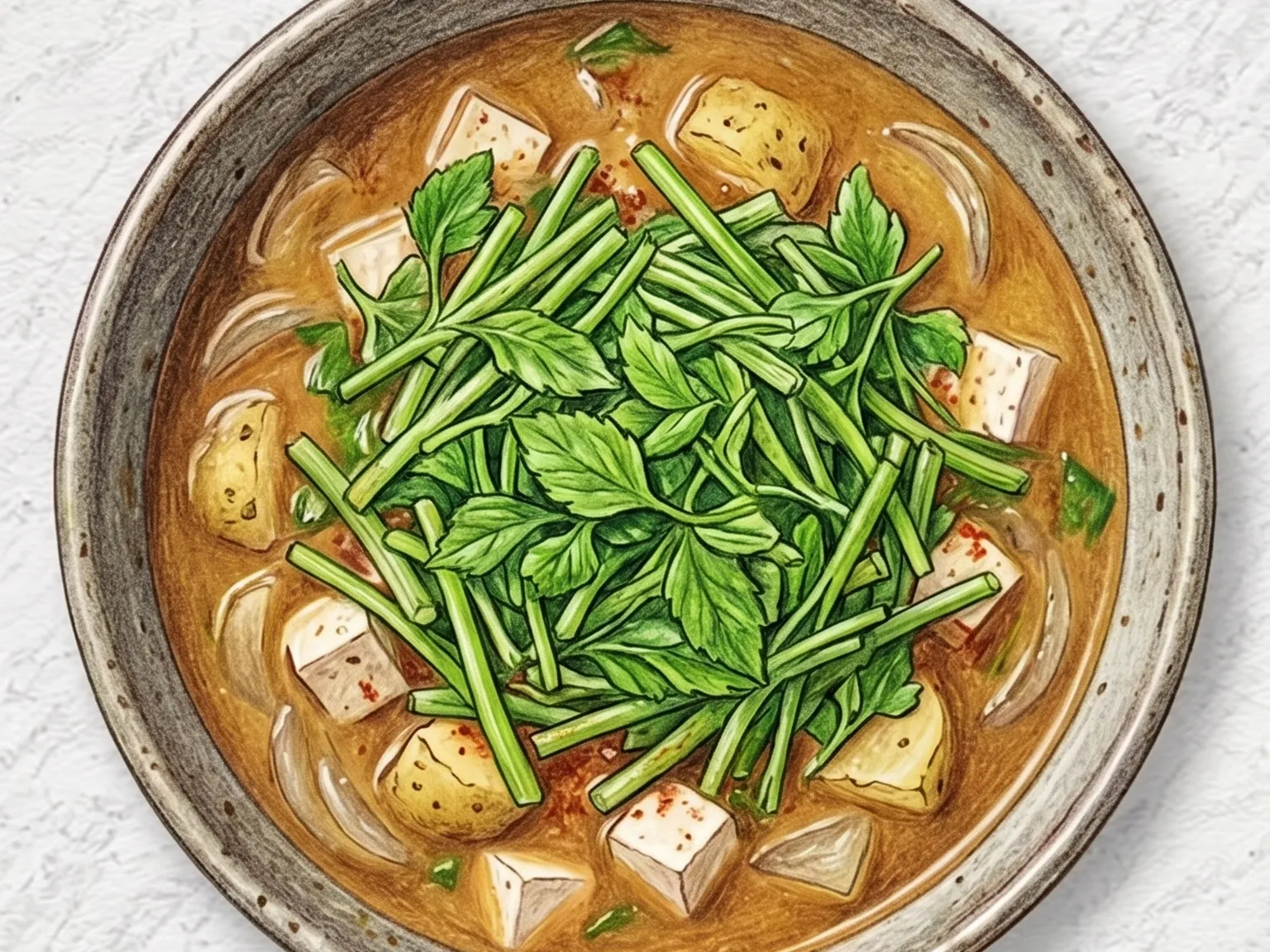
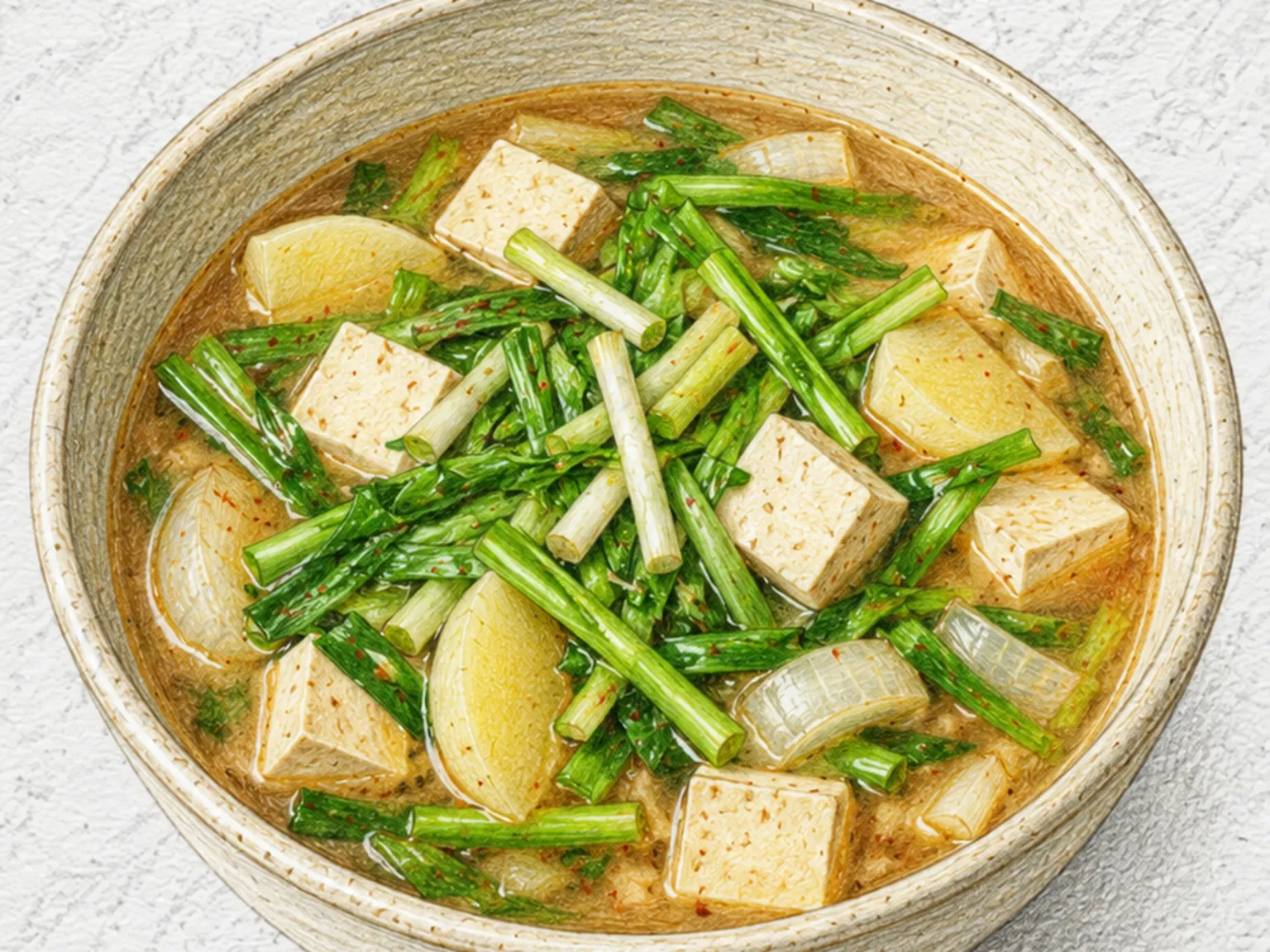
Dallae doenjang-guk is a springtime Korean soybean paste soup that showcases wild chives, a seasonal ingredient valued for its sharp, garlicky bite and short availability window.
What makes this special
- Dallae doenjang guk highlights the peppery, garlicky bite of wild spring chives in a warm soybean paste base.
- Wild chive added last minute keeps its sharp, peppery spring aroma intact
- Potato boiled 6 minutes first releases starch that subtly thickens the broth
Key ingredients
Core cooking flow
- 1 Shake soil from 70g wild chives, rinse them several times, and drain well.
- 2 Slice 120g potato thinly so it cooks quickly and releases starch into the broth.
- 3 Put 750ml anchovy-kelp stock and the sliced potato in a pot, then bring it t...
Dallae doenjang-guk is a springtime Korean soybean paste soup that showcases wild chives, a seasonal ingredient valued for its sharp, garlicky bite and short availability window. The anchovy-kelp stock is first simmered with potato and onion to build body and sweetness, then doenjang is dissolved in and tofu added for a soft, tender contrast against the broth. Wild chives go in only during the final minute of cooking, because their pungent aroma dissipates rapidly under sustained heat; cooking them too long makes them indistinguishable from ordinary green onion in both flavor and appearance. The bulb end of each chive stalk carries a stronger bite than the leaves, so mincing the bulbs finely distributes their flavor more evenly through the broth. A half teaspoon of gochugaru tints the soup a faint red that visually matches the chive's natural heat. Because dallae is in season for only a brief window, setting a few raw stalks aside to place at the table as a garnish amplifies the fresh spring character of the dish.
Instructions
Read the steps as a cooking flow: prep, heat, seasoning, doneness control, and finish.
- 1Prep
Shake soil from 70g wild chives, rinse them several times, and drain well.
Mince the bulb ends finely so their sharper bite spreads through the soup, then cut the green stems into 4cm lengths.
- 2Heat
Slice 120g potato thinly so it cooks quickly and releases starch into the broth.
Slice 70g onion, then cut 120g tofu into bite-size pieces, handling it gently so the cubes stay intact.
- 3Control
Put 750ml anchovy-kelp stock and the sliced potato in a pot, then bring it to a steady simmer over medium heat.
Cook about 6 minutes, until the potato edges soften slightly and cloud the broth.
- 4Control
Press 1.5 tbsp doenjang through a strainer into the simmering stock and stir well.
If thick bits remain, ladle hot broth over them and dissolve them fully so the soup does not taste salty in patches.
- 5Control
Add the onion, 1 tsp minced garlic, and 0.5 tsp Korean chili flakes.
Keep the heat at medium and simmer 4 minutes, skimming foam if needed, until the onion softens and the broth turns faintly red.
- 6Finish
Add the tofu and simmer 3 minutes, just until heated through.
Add the wild chives last and cook only 1 minute, then turn off the heat and serve immediately while their sharp aroma remains fresh.
After the steps
Pick a recipe that fits this dish.
Continue with shared ingredients, meal pairings, or a similar method.
Recipes That Go Well With This
More Soups →Based on shared ingredients and meal pairing
Korean Zucchini Soybean Paste Soup
The soup that comes to mind when Koreans think of home cooking. Not a dish for special occasions - this is what gets made on ordinary weeknights when nothing more specific has been decided. Anchovy-kelp stock is the base: dried anchovies and a piece of kombu in cold water, brought to a boil and simmered ten minutes. Doenjang dissolved through a strainer into the finished stock adds the fermented, earthy depth that defines the soup. Onion goes in first and sweetens the broth as it softens. Zucchini, sliced into half-moons, follows with minced garlic, cooking for five minutes at most - past that point the slices lose their shape and the broth becomes murky. Cubed tofu is added last, just to warm through without breaking. The result is a cloudy, golden soup where the salty funk of the doenjang sits underneath a gentle vegetable sweetness. A sliced cheongyang chili makes it spicy; left out, the soup is mild enough for any table.
Korean Wild Chive Soybean Paste Stew
This doenjang jjigae features dalrae (wild chives), a prized spring ingredient in Korean cooking. Anchovy-kelp stock is simmered with soybean paste, tofu, zucchini, and onion to build a full-bodied, savory base, then wild chives are added just before turning off the heat to preserve their sharp, garlicky aroma. A single Cheongyang chili adds measured heat that underscores the earthiness of the doenjang without overwhelming it. Adding the chives root-end included intensifies the fragrance noticeably compared to using leaves alone. At its best between February and April when freshly harvested dalrae is available, this is a seasonal jjigae that restores appetite when nothing else seems appetizing.
Korean Geomeun Kong Juk (Black Bean Porridge)
Black beans are soaked for at least four hours, then boiled until the skins wrinkle and the flesh softens through to the center. They are blended with their cooking liquid into a thick, smooth slurry that forms the base of the porridge. This bean puree is combined with separately soaked rice and the mixture is simmered over low heat, stirred regularly to prevent the starch from catching on the bottom of the pot. As the rice breaks down and the starch gelatinizes, the porridge thickens gradually into a smooth, velvety consistency. The anthocyanins in the black bean skins stain the porridge a deep purple-gray, and the flavor is earthy and distinctly nutty, unlike the lighter taste of plain rice porridge. Passing the finished porridge through a sieve removes the bean skins for a cleaner texture. Seasoned with salt alone, it reads as a savory meal; a tablespoon of sugar shifts it toward something gently sweet. Pine nuts and sesame scattered on top layer in additional nuttiness, and the porridge is frequently made as restorative food given the beans nutritional density.
Korean Spring Cabbage Soybean Paste Soup
Bomdong doenjang-guk is a seasonal Korean home soup made by simmering spring cabbage and doenjang in rice-rinsing water, which adds a subtle starchy body to the broth and softens the saltiness of the paste. The thicker cabbage stems go in first to soften properly while retaining some bite, and the tender leaves are added at the end to hold their natural sweetness and color. Tofu, a pinch of red chili flakes, and green onion round out the bowl with depth and mild heat. A drop of sesame oil just before serving adds a nutty finishing aroma. Spring cabbage has a high water content and turns mushy quickly, so the leaves should be added less than two minutes before turning off the heat.
Serve with this
Korean Seasoned Sea Grapes Salad
Kkosiraegi-muchim is a tangy, low-calorie banchan made from kkosiraegi, a red algae seaweed whose thin, noodle-like strands snap with a distinctive crunch that no other seaweed can replicate. Blanching must not exceed twenty seconds, as anything longer collapses the characteristic texture, so a timer is essential. The seaweed goes straight from the boiling water into cold water to stop the heat and lock in elasticity. The dressing brings together gochugaru, soup soy sauce, vinegar, maesil-cheong, garlic, and sesame oil; the green plum extract layering in a fruity acidity that lifts the dish beyond simple sour-spicy flavoring. Julienned cucumber threaded through the seaweed strands provides a crisp, garden counterpoint to the oceanic depth. At roughly 72 kilocalories per serving with high dietary fiber content, this banchan appears frequently in Korean diet meal plans because it satisfies without adding much to the calorie count. Eating it promptly after seasoning prevents the cucumber from releasing water and diluting the dressing. Served cold in summer, it doubles as a refreshing side that pairs well with grilled meat or plain rice.
Korean Cauliflower Jangajji (Pickled Cauliflower)
Korean pickled cauliflower made by soaking bite-sized florets in a boiled-and-cooled brine of soy sauce, vinegar, and sugar. The dense, compact structure of cauliflower absorbs the pickling liquid at a gradual pace, developing flavor over time without turning soft - a texture advantage over vegetables like cucumber or radish that break down faster. Vinegar and sugar balance each other cleanly, and the soy sauce adds a low layer of umami beneath the bright, tangy top note. The pickle works well as a palate cleanser alongside fried or grilled food, and holds up just as well as a plain rice side. The preparation is simple: boil the brine, let it cool, pour it over the florets, and wait.
Korean Beoseot Deulkkae Jeon (Mushroom Perilla Pancake)
Mushroom and perilla seed jeon brings together oyster mushrooms and shiitake, sliced thin and folded into a batter built on perilla seed powder and a splash of soy sauce. Perilla seeds carry a heavier, slightly bitter nuttiness compared to sesame, and that quality anchors the earthy depth of the mushrooms rather than competing with it. Seasoning the batter directly with soy sauce means the pancake holds its own without a dipping sauce, though one on the side does not go amiss. Frying with enough oil gives the exterior a thin, crisp shell while the mushroom filling stays moist inside. Oyster mushrooms torn along their grain develop a pleasantly chewy bite as they cook; shiitake sliced fine distribute evenly so the whole pancake cooks at the same rate. It works as a makgeolli pairing or a straightforward side, and holds up well at room temperature - the perilla aroma actually deepens as it cools.
Similar recipes
Korean Spinach Soybean Paste Soup
Sigeumchi-doenjang-guk is a foundational Korean soup that combines spinach with soybean paste in anchovy-kelp stock, producing a broth that is earthy, warm, and deeply familiar to anyone who grew up eating Korean home cooking. Doenjang is dissolved into the simmering stock first, establishing a savory, slightly funky baseline. Spinach is added near the end and wilts within seconds, contributing a soft green color and a faint bitterness that, rather than clashing with the fermented paste, amplifies its complexity. Tofu is a common addition that gives the soup more substance and a creamy counterpoint to the leafy greens. Garlic and green onion handle the aromatics, and no chili is used, keeping the soup on the gentle end of the Korean flavor spectrum. The key technical point is timing: spinach left in boiling liquid too long turns dull and mushy, so experienced cooks drop it in and turn off the heat almost immediately. This soup is one of the most frequently prepared versions of doenjang-guk in Korean kitchens precisely because spinach is available year-round, affordable, and cooks in moments. It pairs seamlessly with any banchan spread and never competes for attention on the table.
Korean Napa Outer Leaf Soybean Soup
Ugeoji doenjang-guk is a deeply comforting soybean paste soup made with the tough outer leaves of napa cabbage that might otherwise be discarded. The leaves are first massaged with doenjang, perilla oil, and garlic, a step that drives the fermented paste deep into the cabbage's thick veins so that when the soup simmers, the flavor releases gradually into the broth. Rice-rinsing water replaces plain stock as the cooking liquid, adding a gentle starchiness that rounds the doenjang's salt into something softer and more enveloping. As the ugeoji cooks down, it turns from a leathery sheet into a silky, almost melting tangle that drapes over the spoon and floods the mouth with concentrated vegetable-and-miso flavor. The broth itself becomes a murky, golden-brown pool of umami, tasting of earth, fermentation, and the quiet bitterness that only well-cooked greens provide. Cubed tofu gives textural relief, and thin rings of cheongyang chili pepper, if added, introduce a sharp heat that cuts the richness. It is a soup that transforms humble ingredients into something far greater than their parts.
Korean Aralia Shoot Soybean Paste Stew
Dureup, the young shoots of the aralia tree, appear for only a few weeks in spring. Their pleasant bitterness and firm bite translate well into the savoury heat of doenjang broth. Anchovy stock forms the base, and both doenjang and gochujang are stirred in together to give the soup an earthy depth with a steady background heat. Zucchini and onion round out the bitterness with sweetness. Tofu fills the bowl with a soft contrast. The shoots go in late in the cooking so their crunch survives the heat of the broth.