Duck Confit

Duck Confit

Quick answer

Duck confit is a traditional French preservation dish that begins with rubbing duck legs in coarse salt, fresh thyme, garlic, and cracked black pepper, then leaving them...

What makes this special

  • Slow cooking in duck fat follows a twelve-hour salt and herb cure for tender meat.
  • 12-hour salt cure followed by 3-hour confit at 90°C in duck fat
  • Slow collagen breakdown produces meat that pulls apart easily
Total time
200 min
Level
Hard
Servings
2 servings
Ingredients
7
Calories
580 kcal
Protein
38 g

Key ingredients

duck legssea saltthymegarlicbay leaves

Core cooking flow

  1. 1 Trim any remaining feather bits from the 2 duck legs and pat them dry.
  2. 2 Cover the seasoned duck legs closely and cure them in the refrigerator for 12 hours.
  3. 3 After curing, rinse the surface lightly under running water to remove excess salt and aromatics.

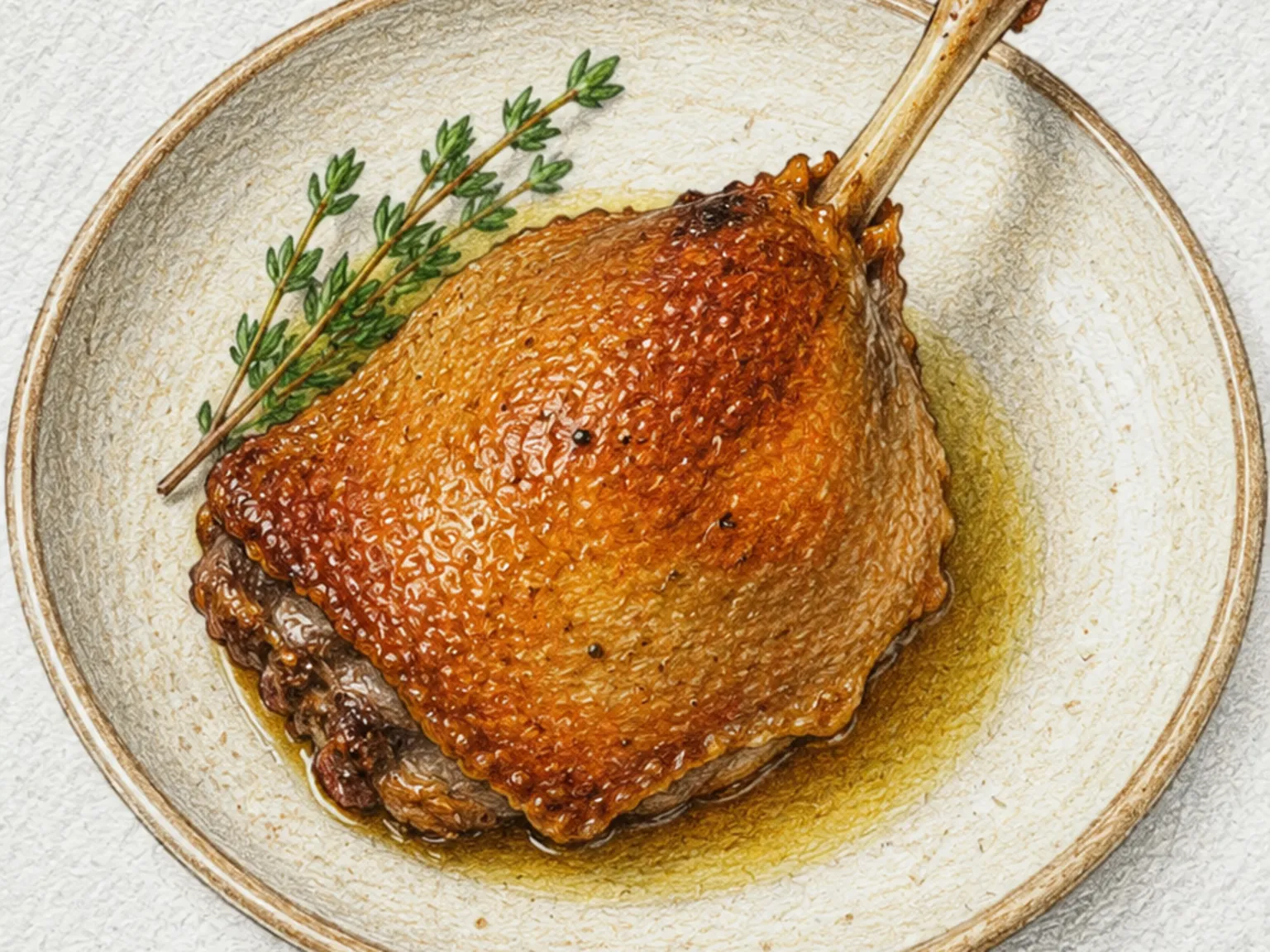
Duck confit is a traditional French preservation dish that begins with rubbing duck legs in coarse salt, fresh thyme, garlic, and cracked black pepper, then leaving them to cure in the refrigerator for twelve hours. This salting stage draws moisture out of the meat through osmosis and allows the aromatic compounds from the thyme and garlic to begin working their way into the flesh. After rinsing the salt off completely and drying the legs thoroughly, they are submerged in duck fat held at a steady 90 degrees Celsius and left there for three hours. The extended low-temperature cooking is the defining technique of confit: the gentle heat gradually dissolves the collagen in the connective tissue, converting it to gelatin without tightening the muscle fibers, which is what produces meat tender enough to pull apart with no resistance. This result is impossible to achieve by cooking at higher temperatures. The cooked legs can be stored submerged in their fat in the refrigerator for several weeks, which explains why confit was invented as a preservation method in the era before refrigeration. When ready to eat, the legs are lifted from the fat and placed skin-side down in a hot pan for a final sear that renders the skin into a crackling, shattering shell. The contrast between that crisp exterior and the yielding interior - silky, rich, and deeply savory from the curing and slow cooking - is what makes duck confit one of the most satisfying preparations in the French culinary tradition. The leftover duck fat is a prized cooking medium and adds exceptional depth when used for roasting or frying potatoes.

Prep 20min Cook 180min 2 servings
Recipes by ingredient → garlic

Instructions

Read the steps as a cooking flow: prep, heat, seasoning, doneness control, and finish.

6 steps
  1. 1
    Control

    Trim any remaining feather bits from the 2 duck legs and pat them dry.

    Rub evenly with 3 teaspoons sea salt, 1 teaspoon black pepper, thyme, and crushed garlic, covering the skin and the meat side.

  2. 2
    Control

    Cover the seasoned duck legs closely and cure them in the refrigerator for 12 hours.

    Discard any liquid drawn out during curing, and check that the flesh feels firmer before moving on.

  3. 3
    Season

    After curing, rinse the surface lightly under running water to remove excess salt and aromatics.

    Dry the skin and crevices thoroughly with paper towels, because leftover moisture can make the hot fat spit.

  4. 4
    Control

    Place 200 g duck fat or butter and the bay leaves in a small pot and bring it to 90C.

    Add the duck legs so they are covered as much as possible, keeping the heat low without letting the fat boil.

  5. 5
    Heat

    Cook slowly at around 90C for 3 hours.

    Do not stir the legs; just check the temperature occasionally, and consider them done when a fork slides into the meat with almost no resistance.

  6. 6
    Finish

    Before serving, lift the duck legs from the fat and lightly wipe off excess fat and moisture.

    Put them skin-side down in a very hot pan and sear over high heat until the skin turns crisp, then serve immediately.

After the steps

Pick a recipe that fits this dish.

Continue with shared ingredients, meal pairings, or a similar method.

Recipes That Go Well With This

More Western →

Based on shared ingredients and meal pairing

Beet and Goat Cheese Salad
Serve together Salads

Beet and Goat Cheese Salad

Beet and goat cheese salad begins with whole beets wrapped in foil and roasted at 200°C for forty-five to sixty minutes, long enough for their raw, earthy undertone to convert almost entirely into a concentrated, caramel-adjacent sweetness. Peeling the skins while the beets are still warm requires only the pressure of a paper towel - they slip off cleanly - and slicing them before they cool preserves the vivid crimson-purple cross-section that makes the dish visually striking. Crumbled goat cheese placed on the warm slices softens slightly, and its tangy acidity cuts through the dense sweetness of the roasted root rather than competing with it. Walnuts toasted briefly in a dry pan lose much of their raw bitterness, developing a nuttiness that bridges the mineral quality of the beet and the dairy sharpness of the cheese. Balsamic reduction does more than dress the plate: its concentrated sweet-tart intensity ties the separate components into a coherent whole. Arugula underneath the beet slices provides a peppery bitterness that sharpens the contrast against the sweetness, giving the salad a complexity well beyond what its short ingredient list suggests. A simple dressing of extra-virgin olive oil and lemon juice over the greens keeps the balance light and clear.

Korean Fish Cake Soup (Clear Anchovy Radish Broth)
Serve together Drinks

Korean Fish Cake Soup (Clear Anchovy Radish Broth)

Eomuk-tang is a Korean fish cake soup in which skewered fish cakes and thick radish slices simmer in a clear broth built from dried anchovies and kelp. The kelp must be removed the moment the water begins to boil, otherwise it releases a slimy texture that clouds the broth. Cutting the radish thick allows it to slowly release natural sweetness over the long simmer. Rinsing the fish cakes in hot water before adding them washes away surface oil and keeps the broth clear and clean. Soup soy sauce adjusts the seasoning, and green onion and black pepper finish the pot. Adding the radish before the fish cakes ensures it has enough time to fully soften and sweeten the broth, since it takes longer than the eomuk to cook through.

Gotgam Cream Cheese Roll (Dried Persimmon Rolls)
Serve together Desserts

Gotgam Cream Cheese Roll (Dried Persimmon Rolls)

Gotgam cream cheese roll is a no-cook Korean dessert that requires nothing more than a knife, a bowl, and a refrigerator. Dried persimmons are slit open and flattened into thin sheets, each one acting as the outer wrapper. The filling is cream cheese mixed with honey and fresh lemon juice to balance its natural richness with acidity, and finely chopped walnuts are folded in throughout to add a crunchy, nutty element to every bite. The filling is spread across the opened persimmon, which is then rolled tightly and wrapped in plastic wrap. Twenty minutes in the refrigerator firms the roll enough to slice cleanly. Dipping the knife in warm water and wiping it dry before each cut produces the smoothest cross-sections. The finished slices reveal clearly defined layers: the chewy, caramel-sweet dried persimmon on the outside, the tangy cream cheese in the middle, and flecks of walnut distributed throughout. The combination makes it a natural pairing with wine or a polished addition to a traditional holiday table.

Duck a l'Orange
Similar recipe Western

Duck a l'Orange

Duck a l'orange is a French classic built on the contrast between shatteringly crisp duck skin and a glossy, bittersweet orange sauce. The skin of the duck breast is scored in a crosshatch pattern and seasoned with salt and pepper, then placed skin-side down in a cold pan before any heat is applied. Starting from cold is the key: as the pan warms gradually to medium-low, the thick layer of subcutaneous fat renders out slowly and evenly, leaving the skin golden and crackling rather than greasy. After flipping and cooking for two to three more minutes, the breast is removed to rest while the sauce is assembled in the same pan. Excess fat is poured off, then sugar and red wine vinegar are cooked together into a dark caramel. Orange juice and zest go in next, and the liquid reduces by half into a glossy sauce with concentrated citrus intensity. A tablespoon of cold butter swirled in at the very end smooths out the acidity and gives the sauce a sheen. Over-reducing the sauce draws out bitterness from the zest, so pulling the pan off heat at the right moment is critical. The rested breast is sliced on the bias and arranged on the plate, with the sauce spooned over and alongside.

Similar recipes

Beef Tartare
Western Medium

Beef Tartare

Beef tartare is a French preparation of premium tenderloin hand-chopped with a knife, never passed through a grinder, so that each small piece stays intact and delivers a clean, juicy bite rather than a pasty mouthfeel. The chopped meat is mixed with capers, anchovies, shallots, and cornichons, then bound with egg yolk and Dijon mustard. Capers and anchovies provide a salty, briny depth that makes raw beef compelling as a dish, while the Dijon adds a sharp, direct mustard heat that brings focus to every forkful. The egg yolk coats each morsel in a silky, rich film that holds the mixture together without masking the meat itself. Freshness is non-negotiable here - the quality of the tenderloin is the entire foundation of the dish, and there is no technique or seasoning that compensates for inferior beef.

🍺 Bar Snacks 🎉 Special Occasion
Prep 20min 2 servings
Bouillabaisse (Provencal Saffron Seafood Stew)
Western Hard

Bouillabaisse (Provencal Saffron Seafood Stew)

Bouillabaisse is a Provencal seafood stew that originated with Marseille fishermen cooking whatever catch remained unsold, distinguished above all by saffron's golden color and subtle floral aroma carried through the broth. Fennel and tomatoes are sauteed in olive oil first to build a fragrant base, then saffron-steeped fish stock is added and brought to a simmer. Firm-fleshed fish such as monkfish or sea bass go in first, with shrimp and mussels added last to protect their texture - overcooked shellfish turns rubbery and loses all elasticity. The broth builds complexity from the successive contributions of each seafood type, with every variety releasing its own distinct character of ocean flavor into the pot. Prolonged simmering concentrates the broth intensely, so once the fish is added, maintaining high heat and finishing quickly is the key to a broth that is rich but still clear and clean. Traditionally, grilled baguette spread with garlicky rouille is dipped into the broth alongside the seafood.

🎉 Special Occasion
Prep 30min Cook 40min 4 servings
Chicken Cordon Bleu
Western Medium

Chicken Cordon Bleu

Chicken cordon bleu is a Swiss-French dish where chicken breast is pounded flat to five-millimeter thickness, layered with ham and Emmental cheese, rolled tightly, and secured with toothpicks before being coated in flour, beaten egg, and breadcrumbs. The thin, even pounding is critical: uneven thickness causes the outer sections to overcook while the thicker center remains undercooked. Pan-frying in a mixture of butter and oil over medium heat for four to five minutes per side allows the breadcrumb crust to turn golden and crisp while conducting enough heat inward to melt the cheese completely. Cutting into the finished roll reveals a cross-section of molten cheese oozing between layers of ham and chicken. The ham provides a salty counterpoint to the mild breast meat, and the melted Emmental adds a nutty, stretchy richness that holds the interior layers together. Resting the roll for two minutes after removing from the pan prevents the cheese from spilling out all at once when cut.

🎉 Special Occasion 🍺 Bar Snacks
Prep 25min Cook 20min 2 servings
French Baguette
Baking Hard

French Baguette

A baguette is a traditional French bread made from only four ingredients: bread flour, water, yeast, and salt. Because the formula strips away every variable beyond technique, the final quality is determined almost entirely by the precision of fermentation management and the confidence of the baker at each stage. A hydration level of seventy percent or higher is required to develop the open, irregular crumb structure that defines the interior; dough that is too dry will close up in the oven and produce a dense, uniform crumb with none of the characteristic airy pockets. A long first fermentation builds layers of acidity and deep wheat flavor that a short rise simply cannot provide, and during shaping the dough should be handled with restraint, using only gentle folds that preserve the large gas bubbles rather than pressing them out. Scoring lines, known as coupes, cut along the top surface control the direction of oven spring; the blade must be sharp enough and the movement decisive enough that the dough does not drag and tear beneath it. Introducing steam into the oven during the first ten to fifteen minutes of baking prevents the crust from setting prematurely, giving the loaf room to expand fully before the surface dries and crisps into its signature crackling shell. A well-made baguette crackles audibly when squeezed and, when sliced, reveals an interior cross-section showing holes of varied sizes scattered unevenly through the crumb. The day it is baked is the day it should be eaten; once the crust begins to soften as it cools, something irreplaceable is lost.

🎉 Special Occasion 🧒 Kid-Friendly
Prep 30min Cook 25min 2 servings
French Crepes
Baking Easy

French Crepes

French crepes are thin, flexible pancakes made from a pourable batter of flour, eggs, milk, and melted butter, cooked on a hot surface until golden and slightly lacy at the edges. The batter must rest in the refrigerator for at least one hour before cooking so that the gluten network fully relaxes and the flour absorbs the liquid evenly. A rested batter spreads more smoothly and yields a crepe that is tender rather than rubbery. A small ladleful is poured onto a hot lightly buttered pan and tilted quickly in a circular motion to spread a thin, even layer that cooks in under a minute. When the edges lift slightly and develop a golden, freckled underside, the crepe is ready to flip for a brief second-side cook. The flavor is neutral and gently buttery, which makes crepes adaptable to sweet fillings like Nutella, jam, or fresh berries as well as savory combinations such as Gruyere, ham, and a fried egg in the style of a complete galette. Batter keeps well in the refrigerator for up to two days, making crepes a practical choice for weekday breakfasts and weekend brunches alike. On Parisian streets, crepe vendors work large round griddles, spreading, filling, and folding the crepes into paper-wrapped triangles handed to customers to eat while walking, a piece of everyday food culture inseparable from the city itself.

🧒 Kid-Friendly
Prep 15min Cook 20min 4 servings

Tips

Save leftover duck fat for frying potatoes.

Nutrition (per serving)

Calories
580
kcal
Protein
38
g
Carbs
2
g
Fat
46
g