Ebi Fry (Japanese Panko-Crusted Shrimp)
Quick answer
Ebi fry developed during Japan's Meiji era as Western cooking techniques arrived and were reinterpreted through a Japanese lens, becoming one of the defining dishes of yo...
What makes this special
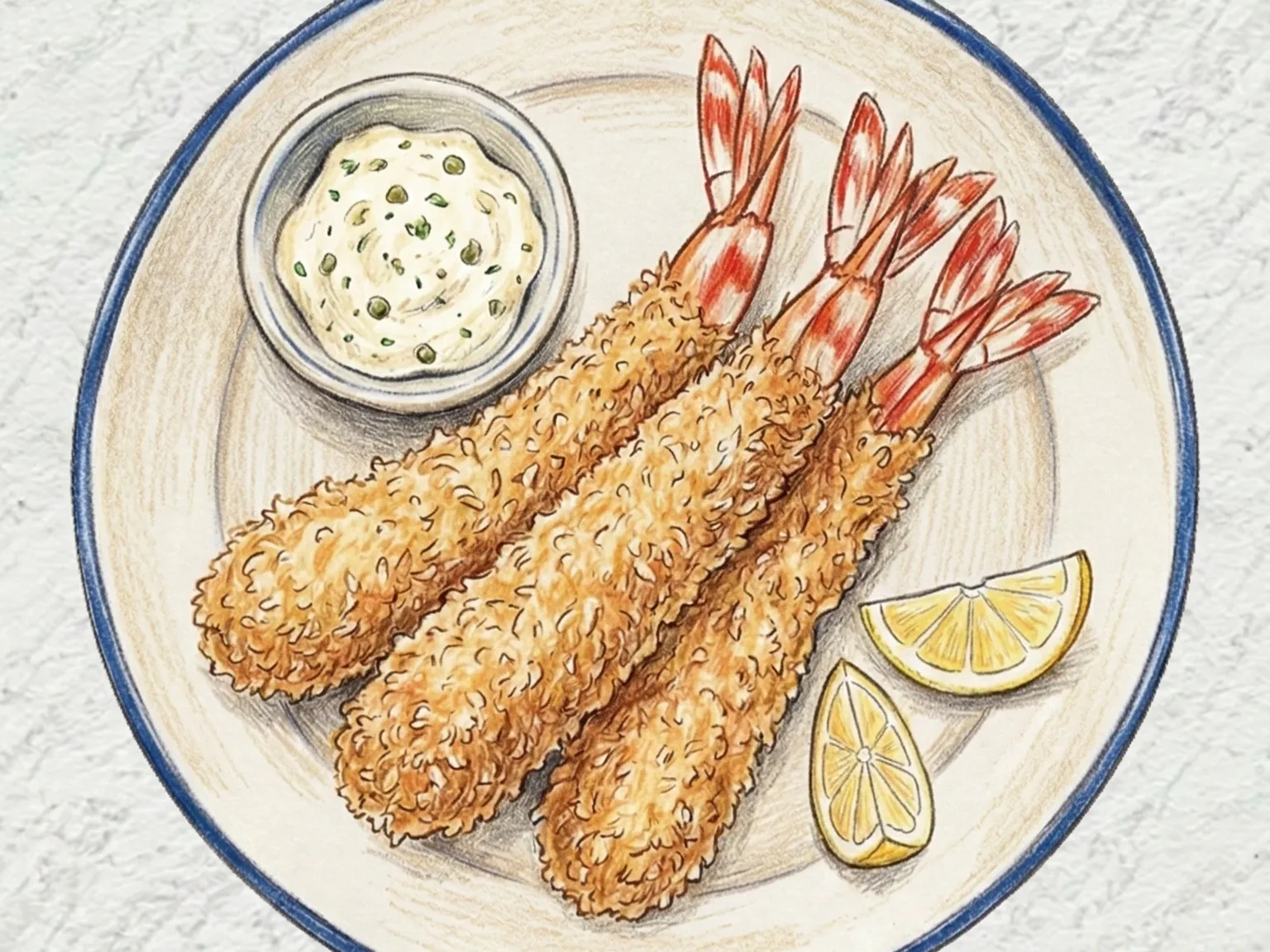
- Ebi Fry consists of straight, elongated shrimp coated in panko and deep-fried until crisp.
- Scoring the belly tendon keeps shrimp straight and elongated through frying
- Panko's coarse irregular crumb creates a lighter crisp than Western breadcrumbs
Key ingredients
Core cooking flow
- 1 Peel 10 large shrimp, leaving the tails attached for handling.
- 2 Pat the shrimp dry, then season evenly with 0.5 teaspoon salt and 0.25 teaspoon black pepper.
- 3 Set up 40g flour, 1 beaten egg, and 100g panko in that order.
Ebi fry developed during Japan's Meiji era as Western cooking techniques arrived and were reinterpreted through a Japanese lens, becoming one of the defining dishes of yoshoku - the country's own adaptation of European cuisine. Preparation starts by cutting the tendons along the shrimp's belly at several points and pressing each piece flat against a cutting board so it holds a straight, elongated shape when lowered into hot oil rather than curling back on itself. The three-stage coating of flour, egg wash, and coarse panko breadcrumbs is central to the dish's character: panko's jagged, irregular flakes puff and expand in hot oil, producing a crust that is unmistakably lighter and more open-textured than anything made with fine Western breadcrumbs. Because the shrimp fries quickly at high temperature, the flesh stays fully moist and snaps with a satisfying springiness when bitten. Tartar sauce, with its creamy acidity and flecks of pickled vegetables, offsets the richness of the crust, while tonkatsu sauce takes the flavor in a sweeter, fruitier direction. The dish migrates easily across formats: tucked into bento boxes as a daily side, placed on top of curry rice for an ebi fry curry, or layered into soft milk bread as an ebi katsu sando. Its staying power in Japanese home cooking and restaurant menus alike reflects how thoroughly yoshoku dishes have become part of everyday Japanese food culture.
Instructions
Read the steps as a cooking flow: prep, heat, seasoning, doneness control, and finish.
- 1Prep
Peel 10 large shrimp, leaving the tails attached for handling.
Remove the vein from the back, make 3 to 4 shallow cuts along the belly, then press each shrimp gently against the board until it stays straight.
- 2Season
Pat the shrimp dry, then season evenly with 0.5 teaspoon salt and 0.25 teaspoon black pepper.
Rest for 5 minutes so the seasoning settles, and blot again if the surface looks wet before coating.
- 3Control
Set up 40g flour, 1 beaten egg, and 100g panko in that order.
Dust each shrimp thinly with flour, shake off excess, dip in egg, then cover with panko using light pressure so the flakes stay airy.
- 4Heat
Pour 500ml frying oil into a deep pot and heat it to 170 to 175C.
Fry only 3 to 4 shrimp at a time for 2 to 3 minutes, keeping the batch small so the oil temperature does not drop.
- 5Heat
Lift the shrimp out when the panko is evenly golden and the surface feels lightly crisp.
The flesh should look opaque and springy, so avoid extending the frying time once the crust is ready.
- 6Finish
Stand the fried shrimp on a wire rack for about 1 minute so excess oil drains away.
Plate them while the crust is still crisp, and serve with tartar sauce or tonkatsu sauce if using.
After the steps
Pick a recipe that fits this dish.
Continue with shared ingredients, meal pairings, or a similar method.
Recipes That Go Well With This
More Asian →Based on shared ingredients and meal pairing
Japanese Korokke (Crispy Panko Potato and Beef Croquette)
Korokke is a Japanese potato croquette that traces its roots to the French croquette but has become a distinctly Japanese comfort food. Potatoes are boiled until completely soft, mashed while still hot, then mixed with sauteed onion and seasoned ground beef. The mixture is shaped into flat ovals, coated in flour, dipped in beaten egg, and rolled in panko breadcrumbs before frying at around 170 degrees Celsius. The panko crust turns an even golden brown and stays audibly crunchy, while the interior remains fluffy and starchy. A drizzle of Worcestershire or tonkatsu sauce is the standard condiment. In Japan, korokke are a staple of butcher shops and prepared-food counters, where they are fried to order and eaten on the spot or carried home still warm. Cream korokke filled with bechamel and crab, curry-flavored korokke, and kabocha pumpkin korokke are among the popular variations. Allowing the shaped patties to cool fully before frying keeps them from falling apart in the oil, and maintaining a steady temperature around 170 degrees prevents the crust from absorbing excess oil and turning greasy.
Assorted Japanese Tempura
Tempura moriawase is an assorted platter of Japanese tempura featuring shrimp, sweet potato, eggplant, and shishito peppers, each coated in a light, shatteringly crisp batter. The batter is the heart of the technique: egg and ice-cold water are combined with cake flour and stirred only a few times with chopsticks, leaving visible lumps. This minimal mixing prevents gluten development, which is what keeps the coating featherlight rather than dense. Each piece is fried at 170 to 180 degrees Celsius for a short time-long enough to cook the interior while the batter puffs into an airy, lacy crust. Patting ingredients dry before dipping ensures the batter adheres properly. The tentsuyu dipping sauce, made from dashi, soy sauce, and mirin, is served with freshly grated daikon radish, whose mild sharpness cuts through the oil and refreshes the palate between bites. Tempura moriawase is meant to be eaten immediately after frying, when the contrast between the crackling exterior and the just-cooked filling is at its peak.
Salmon Brown Rice Power Bowl
Salmon brown rice power bowl sears a salmon fillet four to five minutes per side until the skin crisps and the interior stays moist, then plates it over cooked brown rice with blanched spinach, julienned carrot, and sliced avocado. A sauce of soy sauce, lemon juice, and sesame oil layers umami depth, citrus brightness, and nutty aroma into a single drizzle that ties the mild grain to the rich fish. Brown rice's firm, chewy texture contrasts with the tender salmon flesh, and avocado fills the gap with a smooth, fatty creaminess. Pulling the salmon from heat while the center is still slightly translucent preserves moisture - overcooking causes the proteins to contract and squeeze out the juices.
Yuzu Karaage (Japanese Citrus-Marinated Fried Chicken)
Yuzu karaage is a citrus-accented variation of Japanese fried chicken that incorporates yuzu into the traditional soy-ginger marinade. Boneless chicken thighs are marinated in soy sauce, cooking sake, garlic, ginger, and yuzu marmalade, which infuses the meat with a floral citrus fragrance distinct from lemon or lime. After marinating, the pieces are coated in potato starch and deep-fried until the exterior turns shatteringly crisp while the inside stays moist and well-seasoned. The yuzu adds a bright, aromatic acidity that lifts the richness of the fried coating and dark soy marinade, giving each bite a clean finish rather than a heavy aftertaste.
Serve with this
Chicken and Egg Rice Bowl
Oyakodon simmers bite-size chicken thigh and sliced onion in a soy-mirin broth, then binds everything with a soft-set egg before sliding it over steamed rice. The name means 'parent and child,' referring to the chicken and egg sharing the same bowl. Onion goes into the broth first to release its natural sweetness, followed by the chicken, which cooks just until tender. Beaten eggs are poured in a circular motion and the lid goes on briefly, leaving the egg custardy rather than fully set. That half-cooked egg absorbs the savory-sweet broth and coats each grain of rice. Despite using only a handful of ingredients, the layered umami from soy sauce and mirin gives the dish a satisfying depth.
Mentaiko Yuzu Cream Udon
Myeongran yuja cream udon is a Japanese-style noodle dish that features a sauce made from a combination of salted pollock roe and yuzu marmalade. The base of the liquid consists of heavy cream and milk, which are enriched with butter to create a dense and smooth texture. The preparation begins by melting butter in a pan and sauteing minced garlic until the aroma is released. Once the garlic is fragrant, the cream and milk are poured in. This mixture needs to simmer over low heat for approximately two to three minutes until it thickens enough to coat the back of a spoon. Instead of adding the yuzu marmalade all at once, the cook incorporates it in small amounts. This gradual process allows for precise control over the citrus acidity so that it complements rather than overshadows the richness of the heavy cream. After removing the pan from the heat, two-thirds of the salted pollock roe is stirred in. The residual warmth of the sauce is sufficient to gently cook these eggs, ensuring they remain tender. The remaining third of the roe is reserved to be placed raw on top of the finished bowl, providing a distinct briny flavor and a grainy texture in every bite. To finish the dish, freshly cracked black pepper is added for a subtle sharpness, and shredded nori is scattered over the top to provide a roasted, oceanic scent that works well with the yuzu fragrance. The thick udon noodles provide a substantial chew that allows them to carry the heavy sauce and stand up to the combination of salty, creamy, and acidic elements without the flavors becoming lost.
Korean Egg Drop Soup for Anju
Gyeran-tang is a light Korean egg drop soup seasoned with soup soy sauce and minced garlic in a clear broth. Beaten eggs are poured in a thin stream along chopsticks held just above the surface of the boiling liquid, breaking the flow into fine threads that set almost instantly into soft, silky ribbons. The garlic contributes a quiet background savoriness without dominating, and a pinch of black pepper adds a dry, peppery warmth that offsets the mildness of the egg. Sliced green onion scattered on top just before serving releases a fresh, grassy fragrance as it meets the steam. The soup comes together in under fifteen minutes and requires no special ingredients, making it a practical choice for breakfast or as a gentle restorative when a plain, comforting bowl is needed.
Similar recipes
Japanese Shrimp with Mayo
Ebi mayo was invented by Hong Kong-born chef Chou Yuanji while working in Japan, fusing Cantonese prawn cookery with the rich creaminess of Japanese mayonnaise. Shrimp are coated in cornstarch and deep-fried until the shell crackles, then tossed in a sauce of mayonnaise, condensed milk, and lemon juice. The condensed milk tempers the mayo's tang and adds a gentle sweetness. Japanese Kewpie mayonnaise, made with egg yolks only rather than whole eggs, is denser and more umami-rich than Western varieties, and this difference is what gives ebi mayo sauce its distinctive body. The crispy starch coating absorbs the thick sauce on the surface while the shrimp beneath stays springy, creating a two-layered texture -- creamy on first contact, then bouncy when the teeth reach the center. Ebi mayo is a staple of izakaya menus and Chinese restaurants in Japan, and has crossed into convenience-store bento boxes and onigiri fillings as one of the country's most ubiquitous fusion flavors.
Japanese Stir-Fried Udon
Yaki udon is a Japanese stir-fried noodle dish where thick udon noodles are tossed in a soy-based sauce over high heat with sliced pork or seafood and vegetables such as cabbage, carrot, and scallion. The high heat gives the noodles lightly charred edges while keeping their chewy center intact. Bonito flakes (katsuobushi) are often scattered on top just before serving, where they wave from the residual heat. The recipe takes about 25 minutes and depends on maintaining strong heat throughout the stir-fry to avoid steaming the noodles.
Grapefruit Shiso Shrimp Salad
Grapefruit shiso shrimp salad brings together ice-chilled blanched shrimp, membrane-free grapefruit segments, shredded shiso leaves, and thinly sliced cucumber and radish, all tossed in a yuja marmalade dressing. Blanching the shrimp for exactly two minutes and transferring them immediately to ice water locks in a firm, springy texture by contracting the protein rapidly while preventing the rubbery toughness that comes from overcooking. Removing all of the white pith from the grapefruit eliminates bitterness and leaves only the clean, tart juice of the flesh. Cutting the segments free from the membrane also makes the pieces easier to eat in a single bite. The dressing is built from yuja marmalade, rice vinegar, olive oil, and pepper, and the yuzu's floral acidity layers on top of the grapefruit to create a pronounced citrus profile that is bright but not harsh. The mint-like herbal quality of shiso leaves neutralizes any trace of fishiness from the shrimp and ties the Japanese-influenced flavor framework together. The crisp bite of cucumber and radish contrasts with the softness of the shrimp and grapefruit segments. Serving the salad well chilled is necessary to keep every texture and fragrance sharp and distinct rather than muted.