Eggplant Parmesan
Western Medium

Eggplant Parmesan

Quick answer

Eggplant Parmesan starts by salting one-centimeter-thick rounds of eggplant and leaving them for ten minutes so that bitterness and excess moisture draw out before cooking.

What makes this special

  • Salting eggplant rounds for 10 minutes draws out bitterness before crispy breading.
  • 10-minute salt draw removes bitterness and excess moisture before breading
  • Stretchy mozzarella and sharp parmesan trade off in each layer
Total time
60 min
Level
Medium
Servings
4 servings
Ingredients
8
Calories
520 kcal
Protein
23 g

Key ingredients

eggplanttomato saucemozzarella cheeseParmesan cheeseflour

Core cooking flow

  1. 1 Slice the eggplants into even one-centimeter rounds and sprinkle lightly with salt.
  2. 2 Set out 80 g flour, 2 beaten eggs, and 120 g breadcrumbs in separate dishes.
  3. 3 Heat a skillet over medium heat and add 2 tablespoons olive oil.

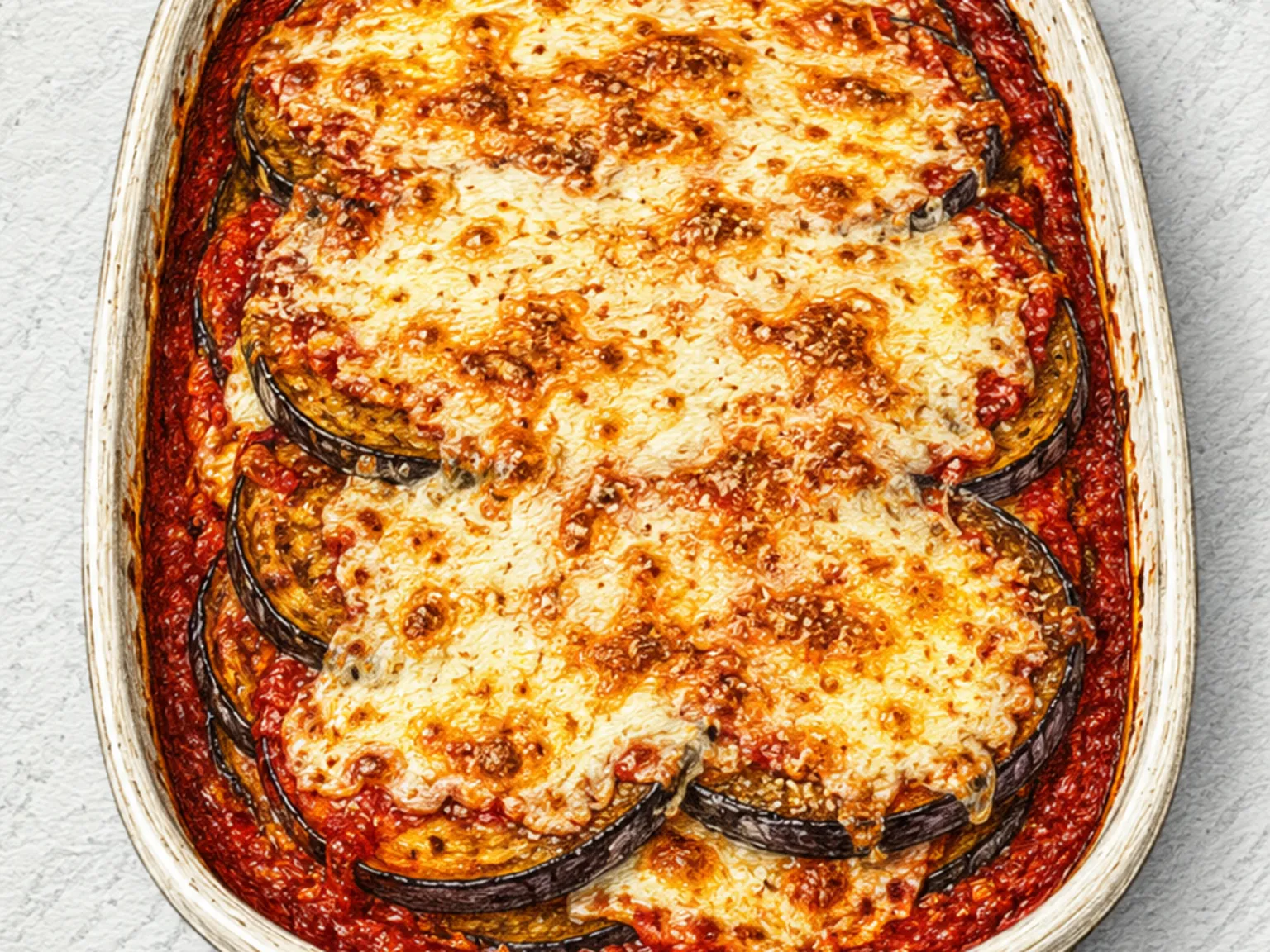
Eggplant Parmesan starts by salting one-centimeter-thick rounds of eggplant and leaving them for ten minutes so that bitterness and excess moisture draw out before cooking. Each slice is then patted dry, dredged through flour, dipped in beaten egg, and pressed into breadcrumbs before pan-frying in olive oil until the coating turns golden and crisp on both sides. In a baking dish, layers of tomato sauce, fried eggplant, torn mozzarella, and grated Parmesan are stacked twice in succession, then baked at 200 degrees Celsius for twenty minutes until the cheese has melted, bubbled up, and browned at the edges. The eggplant contributes a dense, meaty softness that holds the weight of the sauce and cheese above it. The tomato's bright acidity cuts through the richness of two cheeses, and the sharp, granular edge of Parmesan sharpens each layer where the milder mozzarella melts smoothly. Over-saucing is the main hazard: too much tomato makes the layers collapse and turns the eggplant waterlogged, so measuring the sauce with a restrained hand protects both texture and structure. Assembling the dish a day ahead and refrigerating before baking lets the flavors develop further, producing a noticeably richer result the following day.

Prep 25min Cook 35min 4 servings
Recipes by ingredient → flour egg olive oil

Instructions

Read the steps as a cooking flow: prep, heat, seasoning, doneness control, and finish.

6 steps
  1. 1
    Control

    Slice the eggplants into even one-centimeter rounds and sprinkle lightly with salt.

    Let them stand for 10 minutes, then press the surface dry once moisture beads appear so bitterness and excess water are reduced.

  2. 2
    Heat

    Set out 80 g flour, 2 beaten eggs, and 120 g breadcrumbs in separate dishes.

    Coat each eggplant slice thinly with flour, dip it in egg, then press on breadcrumbs so the coating holds during frying.

  3. 3
    Control

    Heat a skillet over medium heat and add 2 tablespoons olive oil.

    Fry the slices without overlapping, about 2 minutes per side, until both sides turn golden and the edges feel set rather than soft.

  4. 4
    Season

    Preheat the oven to 200C and spread a thin layer of tomato sauce over the baking dish.

    Add eggplant, part of the 220 g mozzarella, and part of the 60 g Parmesan in that order.

  5. 5
    Season

    Build one more layer in the same order, using the 450 ml tomato sauce with restraint.

    If sauce pools around the sides, use less, because excess sauce makes the fried eggplant soften and the layers collapse.

  6. 6
    Finish

    Bake at 200C for 20 minutes, until the cheese melts and the edges bubble and brown lightly.

    Remove the dish, rest it for 5 minutes so the layers settle, then cut and serve warm.

After the steps

Pick a recipe that fits this dish.

Continue with shared ingredients, meal pairings, or a similar method.

Recipes That Go Well With This

More Western →

Based on shared ingredients and meal pairing

Gnocchi alla Sorrentina (Tomato Mozzarella Baked Gnocchi)
Shared ingredient: tomato sauce Western

Gnocchi alla Sorrentina (Tomato Mozzarella Baked Gnocchi)

Gnocchi alla Sorrentina is a southern Italian baked pasta dish from the Sorrento coast where soft potato gnocchi are tossed in tomato sauce, blanketed with torn mozzarella and grated Parmesan, then baked until the cheese melts and bubbles. Garlic is gently coaxed in olive oil before the tomato sauce goes in and simmers, drawing the garlic's mellow sweetness throughout the base. Gnocchi are boiled only until they float and then immediately drained to preserve their characteristic pillowy chew, before being folded into the sauce with half the basil and transferred to a baking dish. Eight minutes at 220 degrees Celsius transforms the cheese into a molten, pulling layer that unites the bright tomato acidity and the salty richness of the two cheeses into a single flavor. The remaining fresh basil scattered across the top at the end adds a fragrant lift that anchors the dish to its coastal Italian origins.

Chicken Parmesan
Shared ingredient: parmesan Western

Chicken Parmesan

Chicken Parmesan coats pounded chicken breast in a mixture of breadcrumbs and grated Parmesan, pan-fries it until golden on both sides, then tops it with tomato sauce and mozzarella before baking until the cheese melts and browns at the edges. The preparation begins by pounding the breast to a uniform thickness of no more than 1.5 centimeters - consistent thickness is what allows both sides to reach the same golden color in the pan without one side burning while the other stays underdone. After breading, the cutlet should rest for about five minutes before going into the hot pan. This brief rest allows the coating to bind to the surface of the meat, so it remains intact when sauce and cheese are layered on top and the dish goes into the oven. The cross-section of a finished piece shows the layered structure clearly: a crisp breadcrumb shell, the lean white meat beneath, the bright acidity of tomato sauce, and the pull of melted mozzarella. Ten to twelve minutes at 200 degrees Celsius is enough for the mozzarella to melt completely and develop light caramelization at its edges while leaving the chicken inside moist rather than dried out.

Porcini Truffle Mushroom Tagliatelle
Serve together Pasta

Porcini Truffle Mushroom Tagliatelle

Porcini truffle mushroom tagliatelle relies on the liquid left over from rehydrating dried porcini as the flavor engine of the entire dish. Soaking dried porcini for thirty minutes or more produces a deep brown, intensely earthy liquid that carries far more umami than any fresh mushroom can alone. Shallots and garlic are cooked slowly in butter and olive oil until soft, then white wine is added to deglaze the pan and lift the savory residue from the bottom. Rehydrated porcini and a selection of fresh mixed mushrooms go in next, followed by the strained soaking liquid, and the sauce is simmered down until concentrated and thick. Truffle paste is stirred in only after the pan is removed from heat - adding it while still on the flame burns off the volatile compounds responsible for its aroma. Grated Parmigiano-Reggiano and flat-leaf parsley are folded through at the end. Wide tagliatelle ribbons are the ideal carrier: their surface area and chewy structure hold the dense sauce without falling apart.

Ricotta Spinach Stuffed Shells
Similar recipe Western

Ricotta Spinach Stuffed Shells

Ricotta spinach stuffed shells fill jumbo pasta shells with a mixture of ricotta cheese, blanched spinach, egg, and Parmesan, then bake them in tomato sauce under a layer of melted mozzarella. Squeezing all excess water from the blanched spinach is the critical step - soggy filling makes the shells slide apart and dilutes the sauce underneath. The egg in the filling acts as a binder that firms up during baking, holding the ricotta and spinach together as a cohesive mass inside each shell. Even shells that tear during boiling can be placed on the sauce and baked without issue - the sauce supports them and the cheese covers any imperfections. A generous layer of tomato sauce on the bottom of the baking dish prevents the shells from drying out, while 20 minutes at 190 degrees Celsius melts the mozzarella into a soft, stretchy cap.

Serve with this

Tomato Basil Juice
Drinks Easy

Tomato Basil Juice

Tomato basil juice is a cold savory drink made by blending ripe tomatoes with fresh basil leaves and straining the result through a fine sieve to remove seeds and skins. The ripeness of the tomato determines much of the flavor: fully ripe tomatoes carry free glutamates that produce a natural umami depth, whereas underripe fruit tastes predominantly sour without the sweetness and savory body that makes the juice satisfying. Basil should be added to the blender immediately before blending rather than sitting cut or torn, because the volatile oils that produce its aroma begin oxidizing quickly once the leaves are damaged. After blending to a smooth consistency, passing the juice through a fine-mesh strainer or cheesecloth removes the solids and produces a texture smooth enough to drink without resistance. Salt and black pepper season the juice, and fresh lemon juice raises the acidity in a way that brightens the overall flavor rather than making it sour. A small addition of olive oil emulsifies into the juice and activates fat-soluble aromatic compounds in both the tomato and the basil, producing a fuller, rounder flavor than the unstrained version. The juice must be thoroughly chilled before serving, as warmth mutes the herbal freshness. It works well as a brunch drink, a light non-alcoholic aperitif, or a base for savory cocktails.

🍺 Bar Snacks ⚡ Quick
Prep 10min 2 servings
Bam Tiramisu (Chestnut Tiramisu)
Desserts Medium

Bam Tiramisu (Chestnut Tiramisu)

Chestnut tiramisu is a variation of the traditional Italian dessert that incorporates chestnut puree into the mascarpone cheese filling. This modification transforms a standard cafe dessert into a preparation specifically associated with the autumn season in Korea. The fundamental elements of the recipe remain consistent with the classic version. It utilizes ladyfinger biscuits that have been soaked in espresso, a filling made of whipped mascarpone and cream, and a final layer of cocoa powder. However, the introduction of chestnut puree alters the profile of the cream. Instead of a simple dairy richness, the mixture takes on an earthy quality. Using a puree made from chestnuts boiled at home, rather than a store-bought paste, helps maintain the natural grain of the nut. This provides the cream with a specific texture that is noticeable in every spoonful. When preparing the ladyfingers, the espresso soak requires a high level of precision. Each biscuit should be dipped for approximately one to two seconds. If the ladyfingers are submerged for a longer duration, they absorb an excessive amount of liquid. This leads to a waterlogged consistency which can cause the structural layers of the dessert to collapse while it sits in the refrigerator. The assembly process follows a predictable sequence. A layer of soaked ladyfingers is placed at the bottom, followed by a layer of the chestnut cream. This pattern is repeated once more before the entire dish is placed in the refrigerator to rest for at least four hours. This period of refrigeration is essential to the final outcome. During these hours, the ladyfingers absorb moisture from both the espresso and the cream layer above them. This process changes the biscuits from a crunchy state to a soft texture similar to cake, which allows for clean slices. Just before the dessert is served, a thin layer of cocoa powder is applied to the top. This adds a bitter element that balances the sweetness of the chestnuts. Preparing the tiramisu in individual glass containers or cups ensures that the portions are easy to manage and allows the different layers of the dessert to be clearly visible from the side.

🧒 Kid-Friendly 🌙 Late Night
Prep 20min Cook 5min 2 servings
Mushroom Spinach Warm Salad
Salads Easy

Mushroom Spinach Warm Salad

Button mushrooms are seared over high heat for a deep caramelized crust, then spinach is added just long enough to barely wilt in the residual heat of the pan. Garlic bloomed in olive oil at the start ensures the entire pan is fragrant before the other ingredients are added. Once the mushrooms go in, leaving them untouched for one to two minutes is the critical step: stirring immediately causes them to steam and release water, which prevents browning and dilutes the flavor. Balsamic vinegar deglazed in at the end lifts the pan with a balance of sweetness and acidity, and grated parmesan melts into the warm greens for a salty, nutty finish. The salad should be eaten immediately: the spinach holds its vivid green and the mushrooms retain their firm, springy bite only while everything is hot. The entire dish comes together in under ten minutes, making it a reliable choice for a quick weeknight side or a no-effort addition to a wine table.

🥗 Light & Healthy ⚡ Quick
Prep 10min Cook 10min 2 servings

Similar recipes

Pasta alla Norma (Sicilian Fried Eggplant Tomato Pasta)
Noodles Easy

Pasta alla Norma (Sicilian Fried Eggplant Tomato Pasta)

Pasta alla Norma originates from Catania in Sicily and combines fried eggplant cubes with a simple tomato passata sauce. Salting the eggplant beforehand draws out moisture and bitterness, resulting in firmer pieces that absorb less oil during cooking. Garlic provides aromatic depth, while fresh basil added off-heat preserves its fragrance. The dish is named after Vincenzo Bellini's opera Norma, a tribute to its status as a Sicilian culinary masterpiece. It can be served as a noodle dish, with simple accompaniments chosen to match the sauce, broth, or topping.

🏠 Everyday 🎉 Special Occasion
Prep 15min Cook 20min 2 servings
Baked Lasagna
Western Medium

Baked Lasagna

Baked lasagna stacks wide pasta sheets between slow-cooked beef Bolognese sauce, ricotta, mozzarella, and Parmesan, then bakes the whole assembly into the kind of deeply layered dish that is foundational to Italian baked pasta. Construction begins with a thin coat of tomato sauce on the bottom of the baking dish to prevent sticking, followed by alternating layers of pasta, meat sauce, and cheese. Ricotta spreads as a mild, creamy buffer between the layers, tempering the acidity of the tomato base and keeping the interior moist. Mozzarella melts into the spaces between layers, binding them together and stretching when pulled. Parmesan scattered over the top forms a golden-brown crust after forty-five minutes of baking. A single preparation yields four or more servings, making it practical for gatherings. Assembling the lasagna the night before and refrigerating it overnight gives the sauce time to absorb into the pasta, producing a more cohesive texture when it finally bakes. Leftovers reheat well and lose little of the original flavor, so the dish improves as a meal-prep option.

🎉 Special Occasion
Prep 25min Cook 45min 4 servings
Gochujang Eggplant Ricotta Lasagna Rolls
Pasta Hard

Gochujang Eggplant Ricotta Lasagna Rolls

Gochujang eggplant ricotta lasagna rolls begin by roasting diced eggplant with olive oil and salt at 200 degrees Celsius. Fifteen minutes in the oven drive out moisture and collapse the flesh into a soft, dense interior. The roasted eggplant is combined with ricotta and spread across boiled lasagna sheets, which are rolled tight and arranged in a baking dish. A sauce of tomato puree, gochujang, sauteed onion and garlic, and dried oregano is simmered for ten minutes until the chili paste loses its raw edge and the tomato acidity settles into the mix, producing a layer that is spicy and faintly tangy. The rolled sheets are covered in sauce and topped with mozzarella, then baked until the cheese browns and blisters into a firm crust. Below that crust the eggplant-ricotta filling stays moist and soft, and the contrast between the crisp cheese cap and the tender interior defines each slice.

🎉 Special Occasion
Prep 25min Cook 35min 4 servings

Tips

Salting eggplant first helps remove bitterness and extra moisture.
Avoid over-saucing to keep the layers from turning soggy.

Nutrition (per serving)

Calories
520
kcal
Protein
23
g
Carbs
35
g
Fat
32
g