Fish Head Curry (Coconut Tamarind Curry)
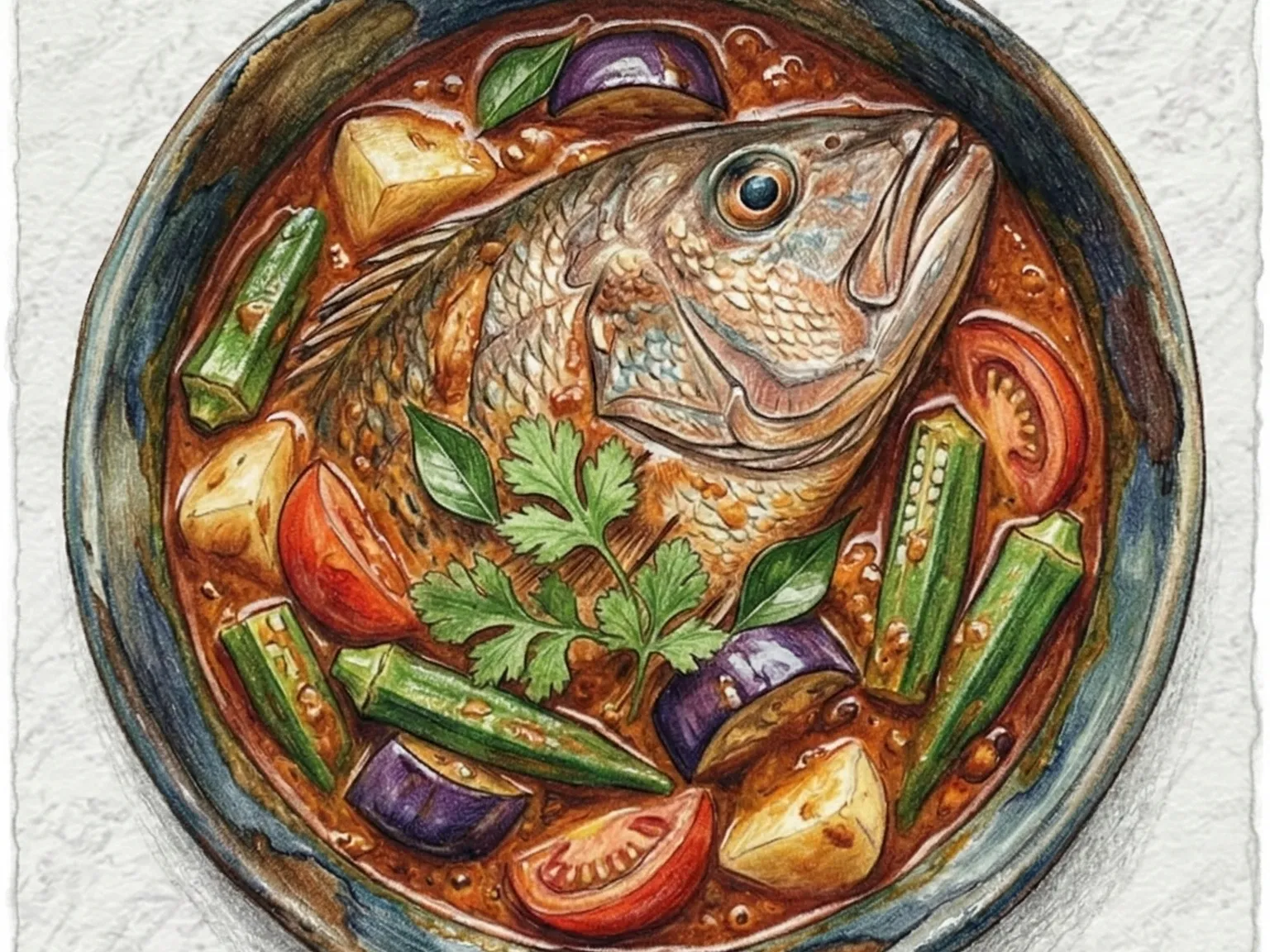
Fish head curry was born in 1940s Singapore when M.J. Gomez, a Keralite immigrant, noticed his Chinese customers' fondness for fish heads and married it with a South Indian curry base - creating a dish that belongs to no single culture but has become Singapore's own. A whole snapper head, sometimes weighing over a kilogram, simmers in a thick gravy of coconut milk, tamarind, curry leaves, fennel seeds, and fish curry powder; the collagen from the head dissolves into the broth, giving it a sticky, lip-coating richness. The cheek meat and the gelatinous flesh around the eyes absorb the most curry and are the most prized portions - fought over equally by Indian, Malay, and Chinese diners at the table. Okra, eggplant, and tomato stew alongside, each vegetable interacting with the gravy differently: okra thickens, eggplant absorbs like a sponge, and tomato contributes a fruity acidity. The dish is traditionally served on a banana leaf with steamed rice at restaurants along Singapore's Little India, where the head arrives in a clay pot still bubbling from the kitchen.
Adjust Servings
Instructions
- 1
Clean fish head, pat dry, and season lightly with salt.
- 2
Heat oil and fry curry paste until aromatic.
- 3
Add coconut milk and tamarind water, then bring to a simmer.
- 4
Add fish head and tomato, simmer over medium heat for 15 minutes.
- 5
Add okra and eggplant and cook 8 to 10 minutes more until tender.
As an Amazon Associate, we may earn from qualifying purchases.
Tips
Nutrition (per serving)
More Recipes

Singapore Chili Crab (Singaporean Whole Mud Crab in Sweet Spicy Sauce)
Singapore chili crab is a national dish built around whole mud crabs wok-fried in a thick, glossy sauce that balances sweet, sour, and spicy in every spoonful. The sauce is a mixture of ketchup, sambal, garlic, and sugar, brightened with rice vinegar and thickened at the end with beaten egg, which curdles into soft ribbons throughout the gravy. The crabs are cracked but not fully shelled, so diners must work for each piece of meat - prying open claws, sucking sauce from joints, and using the back of a spoon to scoop gravy-coated flesh from the body. Deep-fried mantou buns served alongside are the essential mop for the remaining sauce; no self-respecting plate leaves any behind. The eating is loud, messy, and communal, with stacks of napkins and finger bowls as standard table settings.

Goan Fish Curry (Tangy Coconut Fish Stew)
Goan fish curry - known locally as xitt-kodi - is the daily staple of fishing communities along India's western Goa coast, blending Konkani culinary traditions with Portuguese colonial influences that arrived five centuries ago. Freshly grated coconut milk forms the base, into which a masala paste of tamarind, Kashmiri red chilies (prized for their vivid color and moderate heat), coriander seeds, and cumin is stirred. Local fish such as kingfish, pomfret, or mackerel is added bone-in and simmered gently for just five minutes - the restraint is critical, as overcooking turns the flesh mushy rather than letting it absorb the sauce while flaking cleanly at the touch of a spoon. Tamarind's sharp acidity cuts through the coconut cream's richness, producing a broth that feels fresh rather than heavy despite its creamy appearance. Goan fishermen cook their morning catch into curry by lunchtime, served over boiled rice (ukde tandull) - a pairing so fundamental to Goan identity that it transcends religion, caste, and neighborhood.

Kaya Toast (Singaporean Coconut Jam Butter Toast)
Kaya toast is a cornerstone of the Singaporean breakfast table, consisting of crisp-toasted white bread filled with kaya - a jam made from coconut milk, eggs, sugar, and pandan leaf - and a thick slab of cold butter. The kaya is cooked low and slow, stirred constantly until it thickens into a pale green spread with a fragrance that is floral, nutty, and caramel-sweet all at once. When the cold butter meets the hot toast, it begins to soften without fully melting, creating pockets of salt against the sweet jam. The traditional accompaniment is a pair of soft-boiled eggs seasoned with dark soy sauce and white pepper, meant to be mixed into a loose dip for the toast. The entire meal is washed down with kopi, a strong local coffee sweetened with condensed milk. This combination has remained virtually unchanged in Singaporean coffee shops for decades.

Hainanese Curry Rice (Mixed Curry Gravy Platter)
Hainanese curry rice is a Singaporean comfort plate that layers crispy pork cutlet, boiled potato, and blanched cabbage over steamed rice, then drenches everything in a mix of curry gravy and braised soy sauce. The curry begins by blooming curry powder in oil to release its fragrance, then simmering it with coconut milk and water until the sauce turns thick and carries a gentle coconut sweetness alongside the spice. What distinguishes this dish is the deliberate mixing of two different sauces on the plate, where the curry heat meets the salty-sweet depth of soy-based gravy. The pork cutlet is sliced only at the moment of serving to preserve its crunch against the wet sauces. Soft potato pieces and slightly firm cabbage provide textural variety between bites of crunchy cutlet and saucy rice.

Korean Spicy Braised Hairtail
Galchi-yangnyeom-jorim is a Korean braised hairtail in a spicy-sweet sauce made from chili flakes, soy sauce, and garlic. The seasoning soaks into the tender hairtail flesh during simmering, suppressing any fishiness while building layered umami. Radish pieces braise alongside the fish, softening completely and offering a textural contrast to the flaky meat. Reducing the sauce uncovered at the end concentrates the flavors into a thick, glossy glaze.

Korean Jeju-style Braised Hairtail
Galchi-jorim-jeju is a Jeju Island regional specialty where thick hairtail chunks are braised with radish and potato in a bold, spicy sauce. Compared to mainland versions, Jeju-style uses a more generous amount of seasoning and liquid, producing a stew-like consistency. The radish provides a cooling, clean sweetness that counterbalances the intense chili heat. Using Jeju silver hairtail, known for its thick, fatty flesh, further enriches the dish and absorbs the pungent sauce deeply.