Florentine Cookies (Caramel Almond Lace with Chocolate)
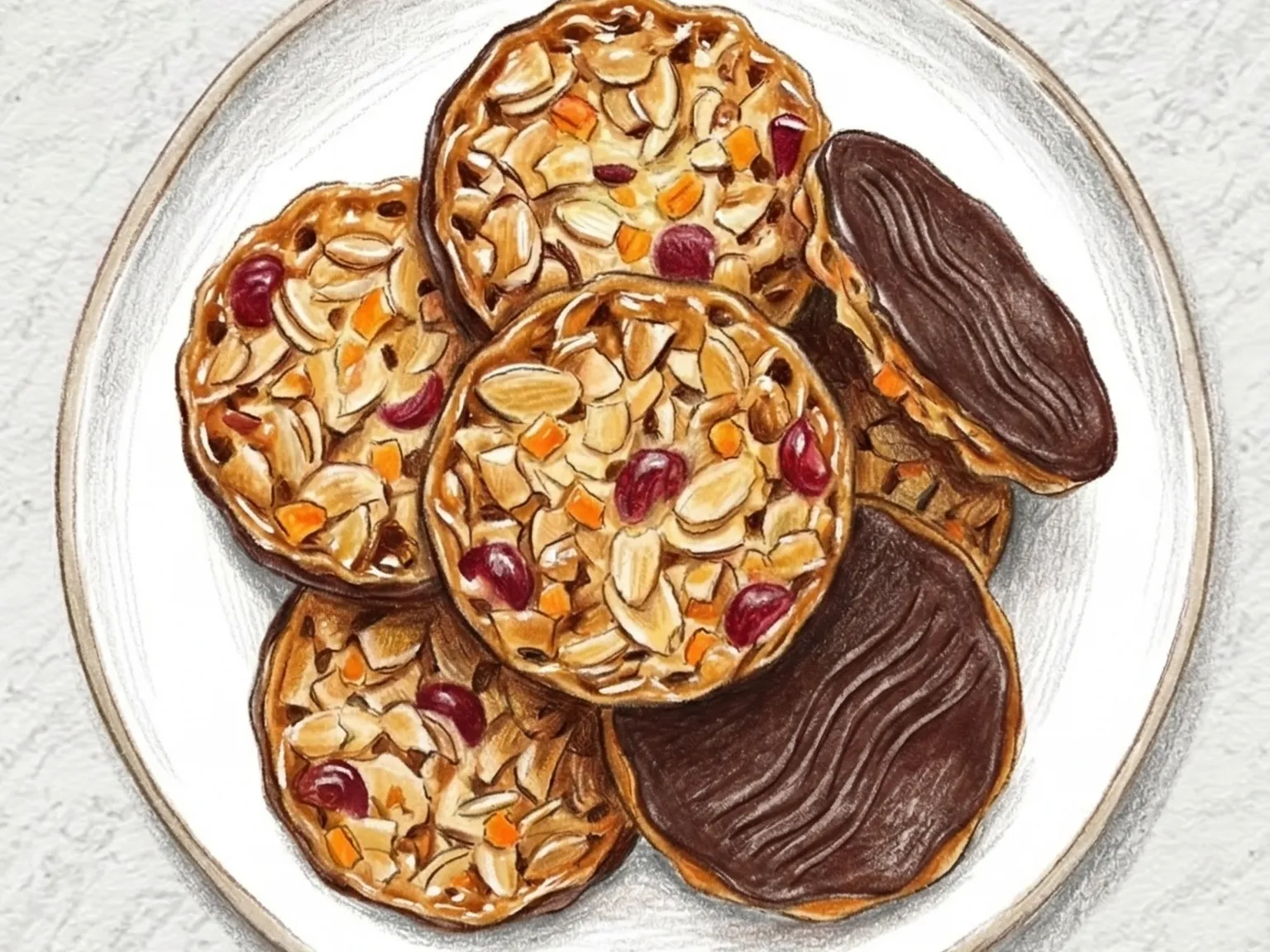
Florentine cookies are thin, lace-like confections made by binding sliced almonds, candied orange peel, and dried cherries in a bubbling caramel of sugar, butter, and cream. The mixture is spooned onto baking sheets and spreads in the oven as the caramel liquefies, fusing the nuts and fruit into flat, crisp discs with a translucent amber surface. Once cooled, one side is coated with dark chocolate and scored with a fork to create the classic wave pattern. The flavor is a layered interplay of caramelized sugar, toasted almonds, citrus peel bitterness, and chocolate depth - far more complex than their flat appearance suggests. They shatter when bitten, then give way to chewy pockets of caramel and fruit. Stored in an airtight container, they hold their crunch for several days and make elegant gifts.
Adjust Servings
Instructions
- 1
Heat cream, sugar, honey, and butter over low heat until a smooth syrup forms.
- 2
Turn off heat and stir in flour and almonds evenly.
- 3
Spoon small portions onto parchment with enough spacing.
- 4
Bake at 170C until golden at the edges, then cool completely.
- 5
Spread melted dark chocolate on the back side and let it set.
As an Amazon Associate, we may earn from qualifying purchases.
Tips
Nutrition (per serving)
More Recipes

Almond Biscotti
Biscotti - meaning 'twice-cooked' in Italian - originated in the Tuscan city of Prato, where they have been baked since at least the 14th century as provisions for long sea voyages because the double baking drives out nearly all moisture. The dough is shaped into a flat log, baked once until firm, then sliced on the diagonal and baked again at a lower temperature until each slice is dry and hard throughout. Whole almonds embedded in the crumb provide a contrasting crunch and a toasted, slightly bitter note that balances the vanilla-scented dough. The resulting cookie is deliberately too hard to eat comfortably on its own - it is meant to be dipped into espresso, Vin Santo, or strong black coffee, where the liquid softens the outer layer while the core stays crisp. This dual texture, hard giving way to yielding, is the entire point of the biscotti tradition.

Chocolate Chip Cookies
Chocolate chip cookies are the most baked cookie in American kitchens, and their apparent simplicity masks a surprising number of variables. The ratio of brown sugar to white sugar determines the texture - more brown sugar yields chewier cookies, more white sugar makes them crisper. Creaming the butter aerates the dough, giving the baked cookies a slight puff. Chocolate chips, whether milk, dark, or semi-sweet, melt in the oven and resolidify into pockets of concentrated chocolate that contrast with the surrounding dough. The critical moment is knowing when to pull the tray from the oven: the edges should be golden and set while the center still looks underdone, because residual heat will finish the job as the cookies cool on the pan. A pinch of flaky salt pressed into the tops before baking sharpens every flavor. Fresh from the oven, the cookies are barely holding their shape, yielding to the slightest pressure - and that is precisely the point.

Cannoli
Cannoli are Sicilian pastries consisting of crisp, tube-shaped shells filled with sweetened ricotta cream. The shell is made from dough enriched with lard, rolled thin, wrapped around metal tubes, and deep-fried until it develops multiple flaky layers that shatter audibly with each bite. The ricotta filling has a slight graininess that distinguishes it from smooth pastry cream, giving it a lighter, more textured quality. Chopped pistachios, candied citrus peel, or chocolate chips pressed into the exposed ends add color and contrasting flavor. The cardinal rule is that shells must be filled just before serving, because any contact with the wet filling turns the crisp pastry limp. In Sicily, cannoli are traditionally tied to Carnival season, though bakeries serve them year-round.

Sfogliatella (Neapolitan Layered Shell Pastry with Ricotta)
Sfogliatella is a Neapolitan pastry built from a lean flour-and-water dough that is stretched paper-thin, brushed with butter, and rolled into a tight cylinder to create hundreds of distinct layers. Slices of this cylinder are opened into a shell shape, filled with a mixture of ricotta cheese, sugar, cinnamon, and orange zest, then baked at high heat. In the oven, the butter between each layer turns to steam and forces the sheets apart, producing an exterior that shatters audibly at the first bite. Inside, the ricotta filling softens to a warm, fragrant cream with citrus and spice notes that contrast beautifully with the crisp shell. The thinner the dough is stretched before rolling, the more pronounced the layered effect becomes - professional bakers aim for near-transparency. Overfilling is the most common cause of failure, as excess moisture from the ricotta can burst through the delicate layers during baking. The ideal sfogliatella emerges from a 200-degree oven deeply golden on every ridge, with a filling that is just set and still slightly creamy in the center.

Classic Tiramisu
Classic tiramisu layers ladyfingers briefly soaked in a syrup of cooled espresso and Marsala wine with a cream made from egg yolks whipped with sugar over a bain-marie, then folded with mascarpone and softly whipped heavy cream. Dipping the ladyfingers for only about one second prevents them from absorbing too much liquid and collapsing. Whipping the cream to soft peaks and folding it gently keeps the filling light rather than dense. The bittersweet depth of espresso plays against the rich, buttery smoothness of mascarpone, creating a flavor contrast that develops further with chilling. A minimum of four hours in the refrigerator - ideally overnight - allows the layers to meld into a cohesive, melt-in-the-mouth texture.

Rosemary Focaccia
Rosemary focaccia is an Italian olive-oil bread made from a high-hydration dough that is proofed twice, dimpled with fingertips, topped with rosemary, minced garlic, and flaky salt, and baked at 220 degrees Celsius. The wetter the dough, the better the signature open crumb and chewy interior develop, so resisting the urge to add extra flour during handling is important. A sixty-minute first proof followed by a thirty-minute second proof gives the yeast enough time to produce the gas that creates a light, airy structure. Generous olive oil pooled in the dimples essentially fries the surface during baking, creating crisp pockets across the top. Cooling for ten minutes after baking lets steam escape and sharpens the contrast between the crunchy crust and the moist, pillowy crumb inside.