Olive Herb Flat Bread (Leaf-Shaped Provencal Bread)
Quick answer
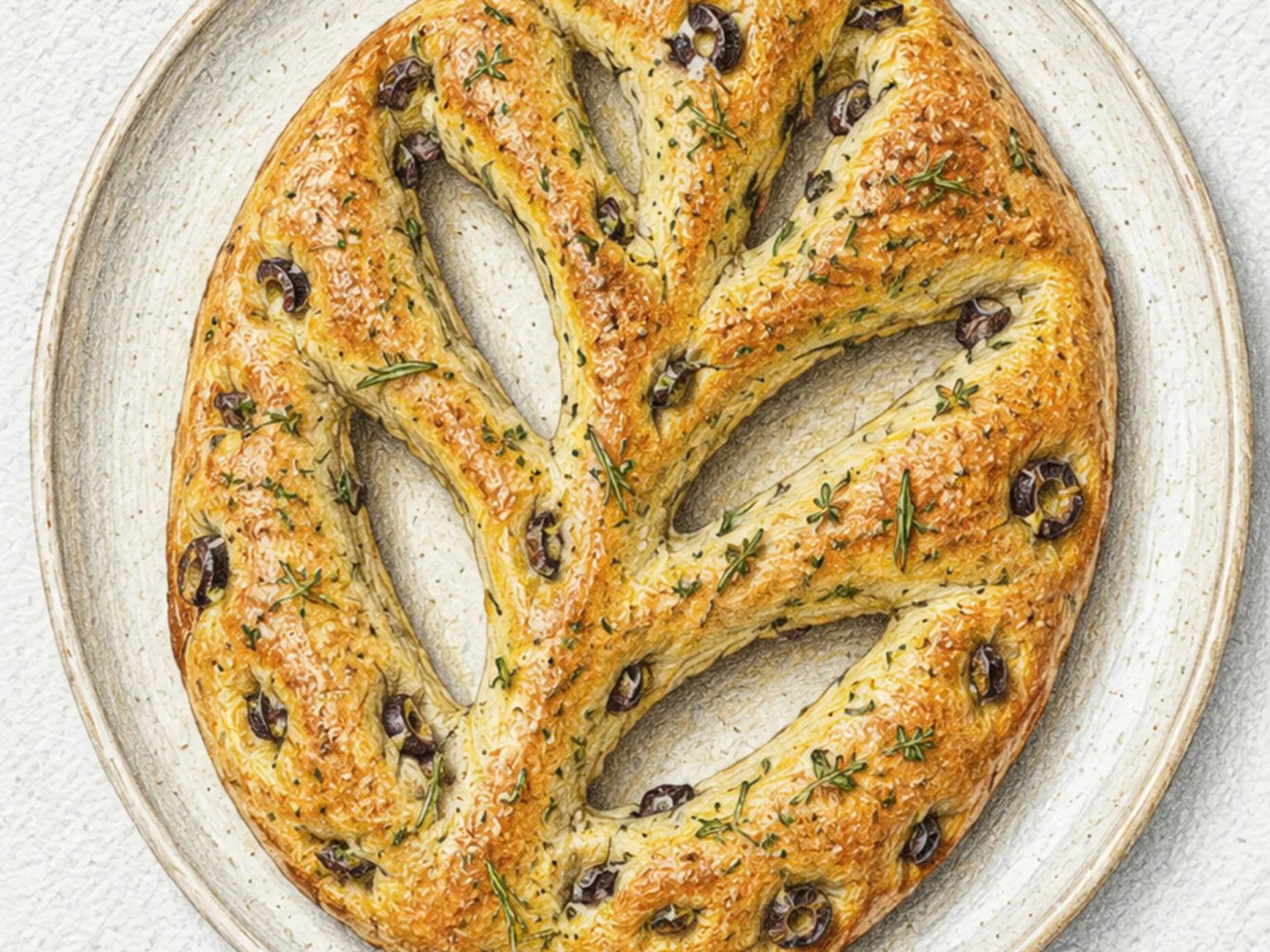
Fougasse is a flatbread from Provence in southern France, shaped with decorative slashes that resemble a leaf or wheat sheaf.
What makes this special
- Olive herb flat bread from Provence featuring decorative slashes for a leaf-like shape.
- Leaf-shaped slashes make thin parts crisp and thick parts chewy in one piece
- Kalamata olives folded into the dough burst with brine in every bite
Key ingredients
Core cooking flow
- 1 Warm 190 ml water until just lukewarm, then stir in 5 g instant yeast and leave it for 5 minutes.
- 2 Pour the yeast water into the flour mixture and stir until no dry flour remains.
- 3 Pat 70 g black olives dry and chop them roughly so they do not release too much moisture.
Fougasse is a flatbread from Provence in southern France, shaped with decorative slashes that resemble a leaf or wheat sheaf. The dough is enriched with olive oil and studded with Kalamata olives, rosemary, and thyme, distributing pockets of briny, herbal flavor throughout the bread. The distinctive cuts serve more than an aesthetic purpose - they increase the crust-to-crumb ratio dramatically, so thinner sections bake to a crackling crispness while thicker areas remain soft and chewy. This variation in texture within a single piece is what makes fougasse more interesting than a uniform loaf. The surface is brushed with olive oil before baking, which produces a golden, glossy finish. Best eaten warm, when the aromatic oils from the herbs and olives are most volatile. It pairs naturally with southern French dishes, charcuterie boards, or a simple bowl of good olive oil for dipping.
Instructions
Read the steps as a cooking flow: prep, heat, seasoning, doneness control, and finish.
- 1Season
Warm 190 ml water until just lukewarm, then stir in 5 g instant yeast and leave it for 5 minutes.
In a large bowl, mix 300 g bread flour with 5 g salt so the salt is evenly distributed.
- 2Prep
Pour the yeast water into the flour mixture and stir until no dry flour remains.
Add 20 ml olive oil and knead for 8 to 10 minutes, until the dough becomes smooth, elastic, and only lightly tacky.
- 3Prep
Pat 70 g black olives dry and chop them roughly so they do not release too much moisture.
Fold in the olives, 3 g rosemary, and 2 g thyme briefly, distributing them without tearing the dough.
- 4Control
Cover the bowl and proof the dough in a warm place for about 60 minutes.
It is ready when it has nearly doubled and a fingertip mark slowly springs back instead of filling in immediately.
- 5Prep
Press the dough gently to remove only large bubbles, then stretch it into a broad leaf shape.
Cut one long center slit and several side slits, then pull each opening wide so it does not close while baking.
- 6Heat
Rest the shaped dough for 15 minutes while heating the oven to 220°C.
Brush with the remaining 10 ml olive oil and bake for 18 to 20 minutes, until the edges are golden and thin sections feel crisp.
After the steps
Pick a recipe that fits this dish.
Continue with shared ingredients, meal pairings, or a similar method.
Recipes That Go Well With This
More Baking →Based on shared ingredients and meal pairing
Dark Chocolate Baguette
This rustic chocolate baguette features a crisp crust filled with dark chocolate chips. The dough is prepared by combining bread flour, cocoa powder, dry yeast, salt, sugar, and lukewarm water. Once the dough becomes elastic after kneading, dark chocolate chips are folded in gently. After the first rise, the dough is divided and rested before being shaped into long, tapered ovals. This shaping helps retain moisture in the thicker crumb during baking. The loaves are proofed a second time, scored diagonally, and sprayed generously with water. Baking them at 220 degrees Celsius with oven steam creates a distinct double-layered crispy crust. High-quality cocoa powder and dark chocolate chips ensure a deep cacao flavor throughout the bread, offering a subtle sweetness inside a crusty exterior.
French Baguette
A baguette is a traditional French bread made from only four ingredients: bread flour, water, yeast, and salt. Because the formula strips away every variable beyond technique, the final quality is determined almost entirely by the precision of fermentation management and the confidence of the baker at each stage. A hydration level of seventy percent or higher is required to develop the open, irregular crumb structure that defines the interior; dough that is too dry will close up in the oven and produce a dense, uniform crumb with none of the characteristic airy pockets. A long first fermentation builds layers of acidity and deep wheat flavor that a short rise simply cannot provide, and during shaping the dough should be handled with restraint, using only gentle folds that preserve the large gas bubbles rather than pressing them out. Scoring lines, known as coupes, cut along the top surface control the direction of oven spring; the blade must be sharp enough and the movement decisive enough that the dough does not drag and tear beneath it. Introducing steam into the oven during the first ten to fifteen minutes of baking prevents the crust from setting prematurely, giving the loaf room to expand fully before the surface dries and crisps into its signature crackling shell. A well-made baguette crackles audibly when squeezed and, when sliced, reveals an interior cross-section showing holes of varied sizes scattered unevenly through the crumb. The day it is baked is the day it should be eaten; once the crust begins to soften as it cools, something irreplaceable is lost.
Clafoutis (French Baked Cherry Custard Dessert)
Clafoutis is a traditional French dessert from the Limousin region made by arranging fresh cherries in a buttered baking dish, then pouring over a thin batter of eggs, sugar, milk, and flour and baking at 180 degrees Celsius for thirty to thirty-five minutes. The batter is considerably thinner than pancake batter, and the result when baked is a texture that sits between a creamy custard and a light sponge -- the edges puff and turn golden while the center around the cherries stays moist and yielding. Using unpitted cherries is the traditional method: the pits release a faint almond scent during baking that perfumes the surrounding batter in a way that pitted fruit cannot replicate. The cherries also hold their shape better with the pits in. Vanilla extract deepens the egg-and-milk base, and the cherries' own tart juice seeps into the batter during baking, creating concentrated pockets of fruit flavor that balance the overall sweetness. Clafoutis is served directly from the baking dish, typically dusted with powdered sugar and brought to the table while still warm, because the custard texture softens and loosens slightly as it cools, making the warm version noticeably more appealing. Made with blueberries, plums, or apricots instead of cherries, the dessert takes a different name -- flaugnarde -- though the technique remains identical.
Vanilla Honey Madeleines (French Shell Cakes with Honey)
Eggs, sugar, and honey are whisked together, then combined with melted butter, cake flour, and vanilla to form a batter that bakes into small, shell-shaped French cakes with a characteristic bump on the back. The honey works alongside sugar to sweeten the madeleine while contributing a floral undertone that plain sugar cannot provide. Melted butter saturates the batter with richness, and vanilla bridges the honey and butter flavors into a cohesive aroma. Chilling the batter for at least thirty minutes is the key to the signature hump - the cold batter hitting the hot oven creates a rapid rise in the center while the edges have already begun to set. Each mold cavity should be well-buttered and filled to eighty percent to ensure clean edges and consistent shape. Baking time is brief, ten to twelve minutes, and the madeleines must be removed as soon as the rims turn golden to preserve the moist, spongy interior. They are best eaten within hours of baking, when the crust is still faintly crisp and the center yields softly.
Serve with this
Beet and Goat Cheese Salad
Beet and goat cheese salad begins with whole beets wrapped in foil and roasted at 200°C for forty-five to sixty minutes, long enough for their raw, earthy undertone to convert almost entirely into a concentrated, caramel-adjacent sweetness. Peeling the skins while the beets are still warm requires only the pressure of a paper towel - they slip off cleanly - and slicing them before they cool preserves the vivid crimson-purple cross-section that makes the dish visually striking. Crumbled goat cheese placed on the warm slices softens slightly, and its tangy acidity cuts through the dense sweetness of the roasted root rather than competing with it. Walnuts toasted briefly in a dry pan lose much of their raw bitterness, developing a nuttiness that bridges the mineral quality of the beet and the dairy sharpness of the cheese. Balsamic reduction does more than dress the plate: its concentrated sweet-tart intensity ties the separate components into a coherent whole. Arugula underneath the beet slices provides a peppery bitterness that sharpens the contrast against the sweetness, giving the salad a complexity well beyond what its short ingredient list suggests. A simple dressing of extra-virgin olive oil and lemon juice over the greens keeps the balance light and clear.
Jeungpyeon (Fermented Makgeolli Rice Cake)
Jeungpyeon is a traditional Korean fermented rice cake made by mixing rice flour with makgeolli, resting the batter in a warm place for one hour until air pockets form throughout, then steaming for eighteen to twenty minutes. The yeast and lactic acid bacteria in the makgeolli break down the rice starch and generate small bubbles, and a supplementary amount of baking powder ensures the cake rises into a soft, sponge-like crumb. Raisins and pumpkin seeds pressed onto the surface just before steaming absorb heat and steam, the raisins plumping and the seeds releasing their richness directly into the top of the cake. Wrapping the steamer lid in cloth catches condensation before it can drip down and dimple the surface, which is the key to a smooth top. Unlike plain steamed rice cakes, jeungpyeon carries a faint tang and fermentation aroma from the makgeolli that sets it apart. Records place it at Joseon royal banquets, and it remains a particular favorite as a summer dessert when its lightness is most welcome.
Korean Makgeolli Punch (Rice Wine Yuja Citrus Bowl)
Makgeolli punch is a fruity Korean rice wine cocktail that combines makgeolli with yuja marmalade, lemon juice, and lemon-lime soda in a large bowl over plenty of ice. The creamy grain character of makgeolli merges with the bright citrus of yuja to create a light, festive drink. Thinly sliced apple floated in the bowl adds crisp bites of fruit between each ladle. A single gentle stir just before serving keeps the carbonation intact and the flavors evenly distributed. The main ingredients are makgeolli, lemon-lime soda, yuja marmalade, and lemon juice, and the recipe depends on careful handling of chilling time and sweetness.
Similar recipes
Honey Madeleines (Buttery Shell-Shaped French Cakes)
Honey madeleines are small French sponge cakes characterized by their shell-like shape and the prominent rounded mound that rises on their underside during the baking process. To successfully create this characteristic hump, the prepared batter must be rested in a refrigerator until it is thoroughly chilled before being placed into a preheated oven set to a high temperature. This specific thermal shock between the cold batter and the hot air causes the outer edges of the cake to set almost immediately. While the exterior firms up, the steam generated inside the batter is forced upward through the center, resulting in the distinct bump that separates a correctly baked madeleine from one that remains flat. The recipe utilizes a high proportion of melted butter to ensure the edges are crisp and develop a deep golden color. By substituting a portion of the standard granulated sugar with honey, the cakes gain a specific floral sweetness and a rounded flavor profile that sugar alone cannot provide. When served fresh from the oven, the exterior provides a light crunch that gives way to a moist and spongy texture inside. This combination releases the fragrance of toasted butter and warm honey as the cake is eaten. The addition of lemon zest to the batter introduces a sharp citrus quality. This component serves to balance the inherent richness of the butter and prevents the flavor from becoming overly heavy on the palate. Madeleines are best consumed within a very narrow window of time, ideally within thirty minutes of leaving the oven. During this period, the outer shell retains its crispness while the center of the cake is still warm. These cakes are commonly served alongside a cup of black tea or coffee as a simple afternoon snack.
Chocolate Lava Cake
Chocolate lava cake bakes a batter of melted dark chocolate, butter, whole eggs, egg yolks, sugar, and a small measure of flour in buttered ramekins at 220 degrees Celsius for ten to twelve minutes, producing a set crust and molten center from a single brief baking window. The high oven temperature firms the outside and top of the batter into cake while the core stays liquid, so breaking the surface with a spoon releases a slow pour of concentrated warm chocolate. High-cacao dark chocolate provides a complex, bittersweet depth that pairs with the richness of butter fat, and vanilla extract softens and rounds the overall aroma. Timing controls everything in this recipe: overbaking by even two minutes sets the center solid and destroys the signature flow. The edges of each ramekin should feel just firm when pressed lightly through a towel at the ten-minute mark. Ramekins can be filled ahead and refrigerated, but the baking time then needs an extra one to two minutes to account for the colder starting temperature. Serving with a scoop of vanilla ice cream or a spoonful of cold heavy cream creates a striking contrast between the hot, dense chocolate interior and the chilled, lighter dairy.