French Crepes

French Crepes

Quick answer

French crepes are thin, flexible pancakes made from a pourable batter of flour, eggs, milk, and melted butter, cooked on a hot surface until golden and slightly lacy at the edges.

What makes this special

  • Rested batter spreads paper-thin across a hot pan to produce soft, lacy French crepes.
  • One hour of resting relaxes gluten so the crêpe spreads paper-thin without tearing
  • Golden lace edges appearing at the rim signal the right moment to flip
Total time
35 min
Level
Easy
Servings
4 servings
Ingredients
7
Calories
150 kcal
Protein
5 g

Key ingredients

eggsmilkflourmelted buttersugar

Core cooking flow

  1. 1 Beat 2 eggs, then whisk in 300 ml milk, 15 g sugar, a pinch of salt, and the vanilla extract.
  2. 2 Whisk in the 30 g melted butter at the end until the batter is thin and smooth.
  3. 3 Cover the batter and refrigerate it for at least 1 hour so the flour hydrates and gluten relaxes.

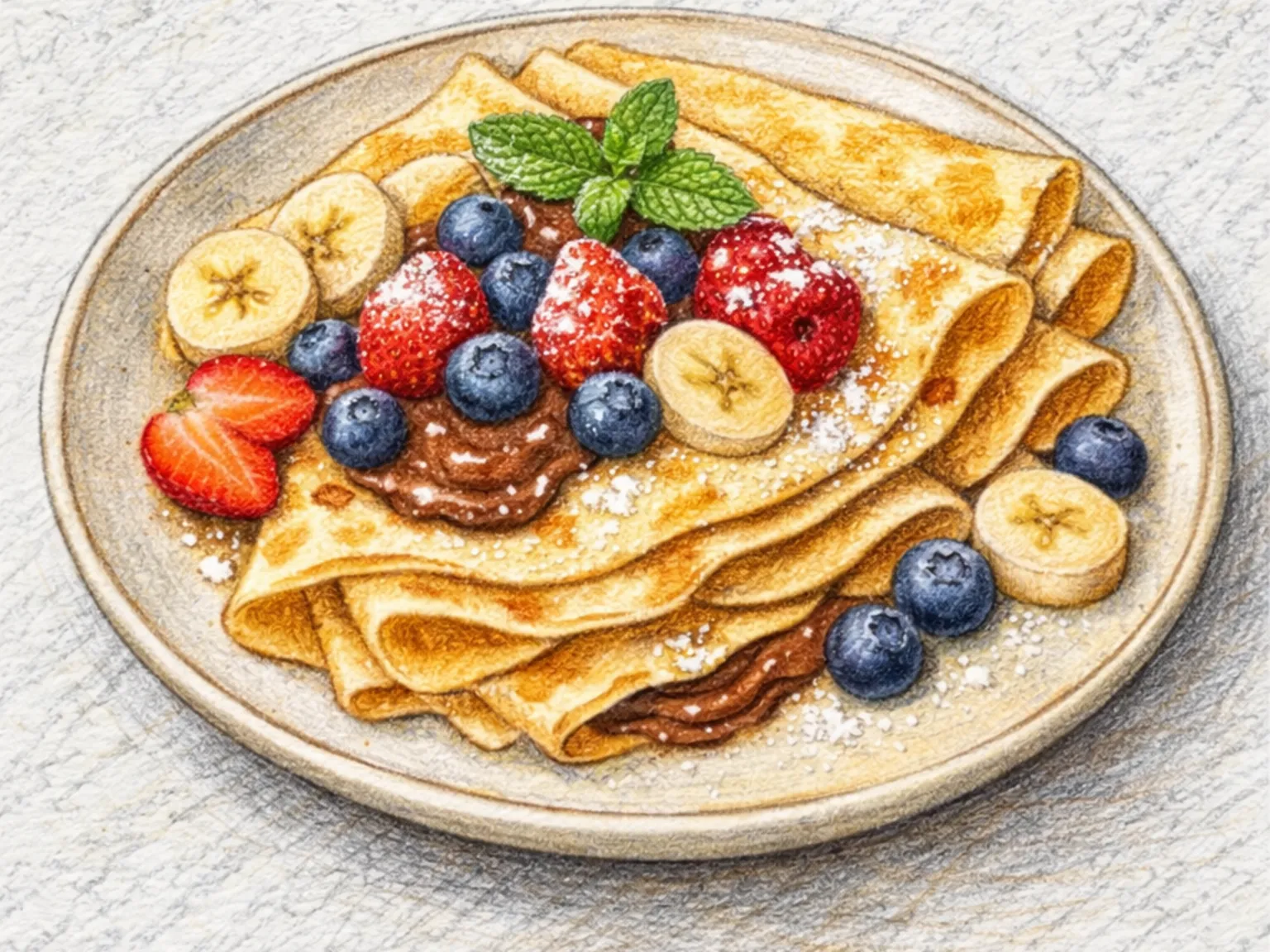
French crepes are thin, flexible pancakes made from a pourable batter of flour, eggs, milk, and melted butter, cooked on a hot surface until golden and slightly lacy at the edges. The batter must rest in the refrigerator for at least one hour before cooking so that the gluten network fully relaxes and the flour absorbs the liquid evenly. A rested batter spreads more smoothly and yields a crepe that is tender rather than rubbery. A small ladleful is poured onto a hot lightly buttered pan and tilted quickly in a circular motion to spread a thin, even layer that cooks in under a minute. When the edges lift slightly and develop a golden, freckled underside, the crepe is ready to flip for a brief second-side cook. The flavor is neutral and gently buttery, which makes crepes adaptable to sweet fillings like Nutella, jam, or fresh berries as well as savory combinations such as Gruyere, ham, and a fried egg in the style of a complete galette. Batter keeps well in the refrigerator for up to two days, making crepes a practical choice for weekday breakfasts and weekend brunches alike. On Parisian streets, crepe vendors work large round griddles, spreading, filling, and folding the crepes into paper-wrapped triangles handed to customers to eat while walking, a piece of everyday food culture inseparable from the city itself.

Prep 15min Cook 20min 4 servings
Recipes by ingredient → egg milk flour butter

Instructions

Read the steps as a cooking flow: prep, heat, seasoning, doneness control, and finish.

6 steps
  1. 1
    Season

    Beat 2 eggs, then whisk in 300 ml milk, 15 g sugar, a pinch of salt, and the vanilla extract.

    Add the 120 g flour gradually so lumps break down before the batter becomes too thick.

  2. 2
    Step

    Whisk in the 30 g melted butter at the end until the batter is thin and smooth.

    It should run from a ladle in a light stream, not fall in thick ribbons.

  3. 3
    Control

    Cover the batter and refrigerate it for at least 1 hour so the flour hydrates and gluten relaxes.

    It can keep for up to 2 days; stir once before cooking to even the texture.

  4. 4
    Control

    Heat a non-stick pan over medium-low heat and coat it very lightly with butter.

    Pour in a small ladleful of batter and immediately tilt and swirl the pan to make a thin, even circle.

  5. 5
    Heat

    Cook for about 40 seconds, until the wet shine on top fades and the edges lift slightly.

    Check for golden speckles underneath, then flip gently so the thin crepe does not tear.

  6. 6
    Finish

    Cook the second side for only about 10 seconds so the crepe stays soft and flexible.

    Stack on a plate, then serve with Nutella and berries or with Gruyere and ham for a savory filling.

After the steps

Pick a recipe that fits this dish.

Continue with shared ingredients, meal pairings, or a similar method.

Recipes That Go Well With This

More Baking →

Based on shared ingredients and meal pairing

Choux Cream Puffs (French Hollow Pastry with Vanilla Custard)
Shared ingredient: egg Baking

Choux Cream Puffs (French Hollow Pastry with Vanilla Custard)

Choux cream puffs are built around pate a choux, a paste cooked directly on the stovetop by combining water, butter, and flour over heat, then beating in eggs one at a time until the dough is smooth, glossy, and just thick enough to hold a piped shape. Once mounds are piped onto a baking sheet and slid into a hot oven, the water content in the dough converts rapidly to steam, inflating each piece into a hollow shell while the exterior sets into a crisp, deep-golden crust. The key to a reliably hollow interior is patience with the eggs: adding them too quickly or all at once produces uneven expansion, while a gradual approach allows the structure to develop properly. Once completely cooled - cooling fully is not optional, as residual heat will melt the filling - a small hole is pierced in the bottom of each shell and pastry cream is piped inside. The contrast upon biting is what makes the pastry compelling: the thin, shattering shell breaks to release cool, silky custard against the palate. The pastry cream itself is made by simmering milk with a split vanilla bean, then whisking the infused milk into egg yolks, sugar, and cornstarch, cooking until thick, and chilling until cold and set. Filled puffs should be consumed within two to three hours, as moisture from the cream migrates into the pastry over time, softening the crust and eliminating the textural contrast that defines the experience.

Brioche Loaf
Shared ingredient: egg Baking

Brioche Loaf

Brioche loaf is a French enriched bread defined by a high ratio of eggs and butter to flour. Softened butter is added in stages during kneading, small amounts at a time, until the fat is fully absorbed and the gluten has developed enough for the dough to stretch into a thin, nearly translucent sheet without tearing. The extended mixing time and the cold retard during overnight proofing give the final crumb its extraordinarily fine structure. Baked in a loaf pan, brioche comes out with a deep golden crust that is thin and slightly brittle, enclosing an interior that tears into long, cotton-soft strands. The butter flavor runs through every layer, so the bread is rich enough to eat on its own without any spread. Once sliced and lightly toasted, the contrast between the crisp outer face and the soft, moist center becomes more pronounced. Brioche absorbs custard quickly and holds its shape under heat, which makes it a preferred base for French toast and bread pudding.

French Toast
Serve together Western

French Toast

French toast soaks thick bread slices in a mixture of beaten eggs, milk, sugar, vanilla extract, and cinnamon until both sides absorb the custard evenly. The soaked bread is then cooked in melted butter over medium-low heat until each side turns golden brown and lightly caramelized on the surface while staying soft and moist inside. Slightly stale bread works better than fresh because its drier crumb absorbs more of the egg mixture without falling apart. Warm cinnamon and vanilla fragrance fills the kitchen during cooking. A drizzle of maple syrup and a dusting of powdered sugar finish the dish, and adding whipped cream or fresh fruit elevates it further.

French Baguette
Similar recipe Baking

French Baguette

A baguette is a traditional French bread made from only four ingredients: bread flour, water, yeast, and salt. Because the formula strips away every variable beyond technique, the final quality is determined almost entirely by the precision of fermentation management and the confidence of the baker at each stage. A hydration level of seventy percent or higher is required to develop the open, irregular crumb structure that defines the interior; dough that is too dry will close up in the oven and produce a dense, uniform crumb with none of the characteristic airy pockets. A long first fermentation builds layers of acidity and deep wheat flavor that a short rise simply cannot provide, and during shaping the dough should be handled with restraint, using only gentle folds that preserve the large gas bubbles rather than pressing them out. Scoring lines, known as coupes, cut along the top surface control the direction of oven spring; the blade must be sharp enough and the movement decisive enough that the dough does not drag and tear beneath it. Introducing steam into the oven during the first ten to fifteen minutes of baking prevents the crust from setting prematurely, giving the loaf room to expand fully before the surface dries and crisps into its signature crackling shell. A well-made baguette crackles audibly when squeezed and, when sliced, reveals an interior cross-section showing holes of varied sizes scattered unevenly through the crumb. The day it is baked is the day it should be eaten; once the crust begins to soften as it cools, something irreplaceable is lost.

Serve with this

Beet and Goat Cheese Salad
Salads Medium

Beet and Goat Cheese Salad

Beet and goat cheese salad begins with whole beets wrapped in foil and roasted at 200°C for forty-five to sixty minutes, long enough for their raw, earthy undertone to convert almost entirely into a concentrated, caramel-adjacent sweetness. Peeling the skins while the beets are still warm requires only the pressure of a paper towel - they slip off cleanly - and slicing them before they cool preserves the vivid crimson-purple cross-section that makes the dish visually striking. Crumbled goat cheese placed on the warm slices softens slightly, and its tangy acidity cuts through the dense sweetness of the roasted root rather than competing with it. Walnuts toasted briefly in a dry pan lose much of their raw bitterness, developing a nuttiness that bridges the mineral quality of the beet and the dairy sharpness of the cheese. Balsamic reduction does more than dress the plate: its concentrated sweet-tart intensity ties the separate components into a coherent whole. Arugula underneath the beet slices provides a peppery bitterness that sharpens the contrast against the sweetness, giving the salad a complexity well beyond what its short ingredient list suggests. A simple dressing of extra-virgin olive oil and lemon juice over the greens keeps the balance light and clear.

🥗 Light & Healthy 🎉 Special Occasion
Prep 15min Cook 35min 2 servings
Einspanner (Espresso with Vanilla Whipped Cream)
Drinks Medium

Einspanner (Espresso with Vanilla Whipped Cream)

The Einspanner is a coffee beverage originating from Austria that features a distinct layered structure consisting of espresso at the bottom and a dense portion of whipped cream on top. This cream is typically seasoned with a small amount of sugar and vanilla extract to provide a subtle sweetness that complements the coffee. A primary characteristic of this drink is the sharp visual and textural contrast between the dark espresso base and the thick, pale cream that rests on the surface. Proper preparation of the cream is essential for the beverage to function as intended. It must be whipped until it reaches a specific consistency of approximately seventy percent stiffness, which allows it to remain fluid enough to float and spread evenly across the entire surface of the espresso. If the cream is over-whipped and becomes too firm, it will form clumps and fail to integrate naturally with the coffee as the person drinks it. The assembly process involves cooling the espresso for a short period before pouring it into a glass containing ice. The whipped cream is then added slowly by using the back of a spoon to guide it onto the surface of the coffee. This specific technique is used to ensure that the two layers remain separate and do not mix prematurely. To finish the preparation, a fine layer of cocoa powder is dusted over the top of the cream. This addition provides a light chocolate flavor that serves as a bridge between the bitter notes of the espresso and the sweet taste of the whipped cream. Customarily, an Einspanner is consumed without the use of a straw. The standard method is to sip the coffee directly through the layer of cream so that both components reach the palate at the same time. This allows for the simultaneous experience of the concentrated coffee and the flavored cream in every mouthful.

🍺 Bar Snacks 🧒 Kid-Friendly
Prep 10min Cook 5min 2 servings
Black Sesame Tea Cookies (No-Bake Korean Pressed Cookies)
Desserts Easy

Black Sesame Tea Cookies (No-Bake Korean Pressed Cookies)

Heukimja dasik is a traditional Korean pressed tea cookie made by binding roasted black sesame powder and almond flour with honey and rice syrup, then pressing the mixture into a decorative wooden mold. No heat is applied at any point: the rich, toasty depth of the sesame and the fatty body of the almond combine within the sticky honey base to produce a crumbly, melt-in-the-mouth texture. A small measure of sesame oil improves binding, and dusting the mold with pine nut powder before pressing yields a sharply defined surface pattern. Resting the shaped cookies in an airtight container for thirty minutes allows them to firm up, resulting in bite-sized confections traditionally served alongside tea at a Korean tea table.

🧒 Kid-Friendly ⚡ Quick
Prep 20min 4 servings

Similar recipes

Beef Tartare
Western Medium

Beef Tartare

Beef tartare is a French preparation of premium tenderloin hand-chopped with a knife, never passed through a grinder, so that each small piece stays intact and delivers a clean, juicy bite rather than a pasty mouthfeel. The chopped meat is mixed with capers, anchovies, shallots, and cornichons, then bound with egg yolk and Dijon mustard. Capers and anchovies provide a salty, briny depth that makes raw beef compelling as a dish, while the Dijon adds a sharp, direct mustard heat that brings focus to every forkful. The egg yolk coats each morsel in a silky, rich film that holds the mixture together without masking the meat itself. Freshness is non-negotiable here - the quality of the tenderloin is the entire foundation of the dish, and there is no technique or seasoning that compensates for inferior beef.

🍺 Bar Snacks 🎉 Special Occasion
Prep 20min 2 servings
Croque Monsieur (Béchamel Ham and Cheese Melt)
Western Easy

Croque Monsieur (Béchamel Ham and Cheese Melt)

Croque monsieur is a Parisian café classic built on a smooth béchamel sauce made from a butter-flour roux whisked with warm milk. One slice of white bread is spread with Dijon mustard before being layered with sliced ham and grated Gruyère cheese. The second slice tops the sandwich, which then gets a generous coat of béchamel and more cheese on the upper surface. Baking at 200 degrees Celsius for ten minutes melts the interior filling, and a brief three-minute broil creates a golden, bubbling crust on top. The mustard's pungent sharpness balances the salty richness of ham and cheese, keeping the overall flavor clean.

🏠 Everyday 🌙 Late Night
Prep 15min Cook 15min 2 servings
Duck Confit
Western Hard

Duck Confit

Duck confit is a traditional French preservation dish that begins with rubbing duck legs in coarse salt, fresh thyme, garlic, and cracked black pepper, then leaving them to cure in the refrigerator for twelve hours. This salting stage draws moisture out of the meat through osmosis and allows the aromatic compounds from the thyme and garlic to begin working their way into the flesh. After rinsing the salt off completely and drying the legs thoroughly, they are submerged in duck fat held at a steady 90 degrees Celsius and left there for three hours. The extended low-temperature cooking is the defining technique of confit: the gentle heat gradually dissolves the collagen in the connective tissue, converting it to gelatin without tightening the muscle fibers, which is what produces meat tender enough to pull apart with no resistance. This result is impossible to achieve by cooking at higher temperatures. The cooked legs can be stored submerged in their fat in the refrigerator for several weeks, which explains why confit was invented as a preservation method in the era before refrigeration. When ready to eat, the legs are lifted from the fat and placed skin-side down in a hot pan for a final sear that renders the skin into a crackling, shattering shell. The contrast between that crisp exterior and the yielding interior - silky, rich, and deeply savory from the curing and slow cooking - is what makes duck confit one of the most satisfying preparations in the French culinary tradition. The leftover duck fat is a prized cooking medium and adds exceptional depth when used for roasting or frying potatoes.

🎉 Special Occasion 🍺 Bar Snacks
Prep 20min Cook 180min 2 servings

Tips

Resting the batter relaxes gluten for thinner, more tender crepes.

Nutrition (per serving)

Calories
150
kcal
Protein
5
g
Carbs
20
g
Fat
6
g