Korean Stir-fried Seaweed and Anchovies
Quick answer
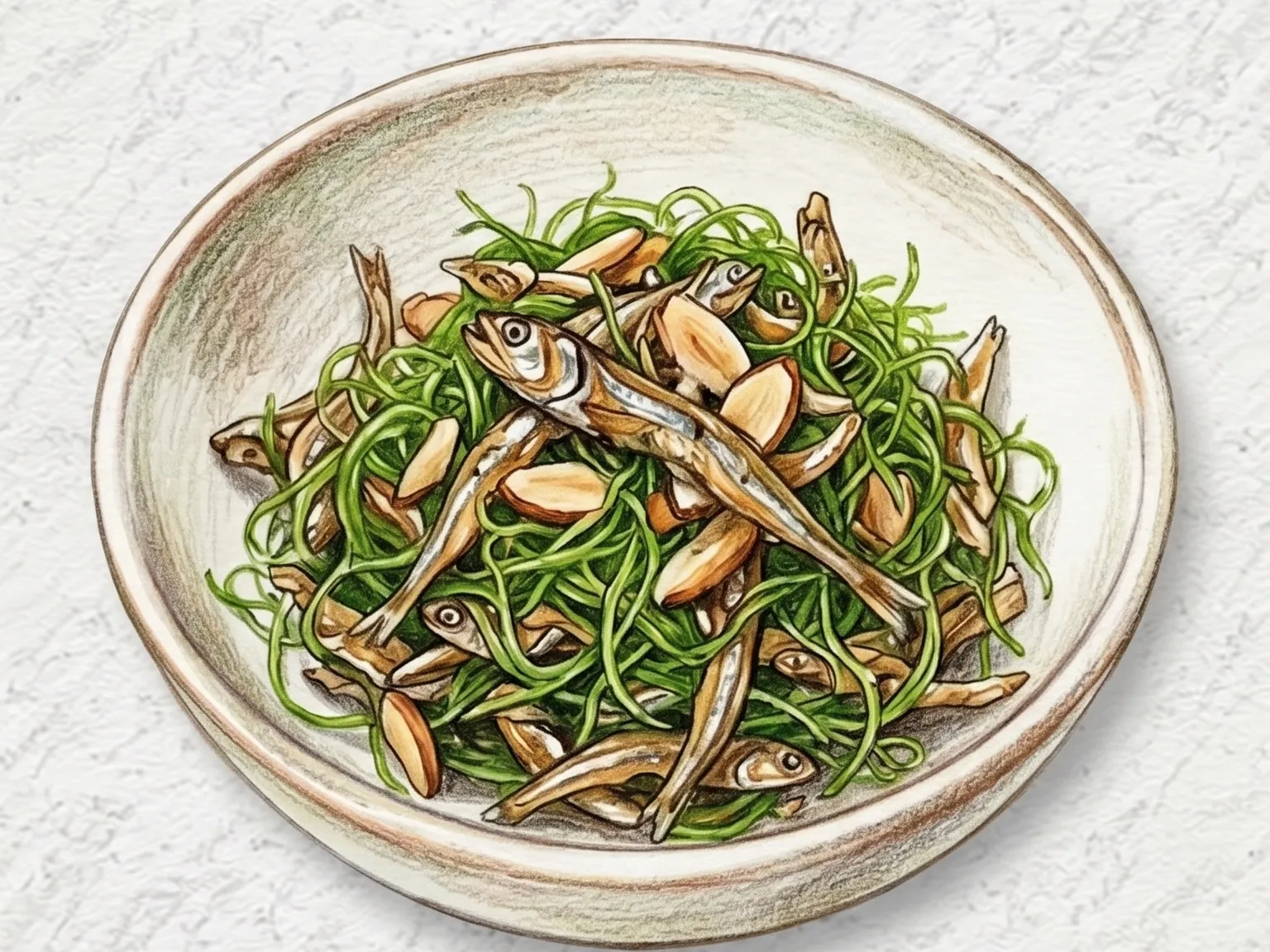
Gamtae myeolchi bokkeum is a crispy Korean banchan that combines small dried anchovies with gamtae seaweed and sliced almonds in a soy-syrup glaze.
What makes this special
- Gamtae-myeolchi-bokkeum combines sea lettuce and dried anchovies for a mineral-rich, crispy banchan.
- Gamtae seaweed from the south coast has milder bitterness than common sea lettuce
- Dry-roasting anchovies first drives off moisture and reduces fishiness
Key ingredients
Core cooking flow
- 1 Break 20g gamtae into 4-5cm pieces by hand and shake 120g anchovies in a sie...
- 2 Dry-toast anchovies in a pan over medium heat for 1 minute.
- 3 Add 1 tbsp oil to the same pan, add 30g sliced almonds, and toast over mediu...
Gamtae myeolchi bokkeum is a crispy Korean banchan that combines small dried anchovies with gamtae seaweed and sliced almonds in a soy-syrup glaze. Gamtae is a green seaweed harvested along parts of Korea's southern coast, milder and less bitter than common sea lettuce, with a gentle oceanic fragrance that complements rather than overpowers the anchovies. The first step is toasting the anchovies in a dry pan without oil until they turn slightly golden and fragrant; this drives off moisture and mellows their fishy edge. The soy and oligosaccharide syrup glaze is added next, coating each anchovy in a glossy, lightly sweet-savory layer. Oligosaccharide syrup is preferred over honey or corn syrup because it is less viscous, which keeps the anchovies separated rather than clumped. Almond slices are stirred in to provide a larger, firmer crunch that contrasts with the tiny anchovies and adds a mild nutty sweetness. Gamtae is added only in the final seconds - ten seconds over heat is enough to warm it and release its aroma, and longer exposure will turn it yellow and dull. Once everything is cooled completely before sealing in an airtight container, the banchan holds its crunch for one to two weeks, making it an ideal make-ahead dish for weekly meal prep. The anchovies provide calcium and the gamtae contributes marine minerals, giving the dish a nutritional balance that matches its flavor.
Instructions
Read the steps as a cooking flow: prep, heat, seasoning, doneness control, and finish.
- 1Step
Break 20g gamtae into 4-5cm pieces by hand and shake 120g anchovies in a sieve to remove fine crumbs and scale dust.
- 2Control
Dry-toast anchovies in a pan over medium heat for 1 minute.
When the surface looks slightly dry and the fishy smell fades, remove them from the pan.
- 3Control
Add 1 tbsp oil to the same pan, add 30g sliced almonds, and toast over medium-low heat for 30 seconds until lightly golden.
Remove before they darken further.
- 4Control
Reduce to low heat, add 1 tbsp soy sauce, 1 tbsp cooking wine, and 2 tbsp oligosaccharide syrup; simmer for 20 seconds.
When bubbles form and the sauce thickens slightly, it is ready.
- 5Control
Add anchovies and almonds to the sauce pan, raise to high heat, and toss quickly for 20 seconds until sauce coats every anchovy with a glossy sheen. Then add gamtae.
- 6Step
Add gamtae, turn off heat, and toss gently for 20 seconds.
Stir in 0.5 tsp sesame oil and sesame seeds, cool completely, then store in an airtight container.
After the steps
Pick a recipe that fits this dish.
Continue with shared ingredients, meal pairings, or a similar method.
Recipes That Go Well With This
More Stir-fry →Based on shared ingredients and meal pairing
Korean Stir-fried Anchovies
Myeolchi-bokkeum is a foundational Korean banchan of small dried anchovies glazed in a sweet-salty coating of soy sauce and oligosaccharide syrup. The anchovies are first dry-roasted in a clean pan on low heat for three minutes to remove fishiness and build crunch. A sauce of garlic, soy sauce, and syrup is bubbled separately, and the anchovies are tossed back in for a quick, even coating. Sesame oil and toasted sesame seeds finish the dish; once fully cooled, the glaze sets firm, giving the anchovies a snappy texture that keeps well in an airtight container for over a week.
Korean Stir-fried Anchovies with Shishito Peppers
Kkwarigochu myeolchi bokkeum is a Korean banchan of dried anchovies and shishito-style peppers cooked together and glazed with soy sauce and oligosaccharide syrup. The anchovies are dry-toasted first in an unoiled pan over medium heat until their moisture evaporates and the fishiness reduces, then set aside. Oil goes into the pan next and the kkwarigochu peppers are fried over medium-high heat until blistered and darkened in spots, which develops a slightly bitter, charred edge that adds character to the finished dish. The anchovies return to the pan along with the peppers, soy sauce is added for the base seasoning, and then the heat is reduced before the oligosaccharide syrup goes in. Adding the syrup over reduced heat is the step that most often goes wrong: high heat scorches the syrup almost immediately, preventing the glaze from forming and leaving a bitter residue instead. Over low heat, the syrup coats the anchovies and peppers in a thin, shiny layer as it slowly reduces. Sesame oil and whole sesame seeds are stirred in at the end for fragrance and texture. The finished dish layers the crunchy, salty anchovies against the syrup's gentle sweetness, with the peppers providing mild heat that prevents the flavor from becoming cloying. Stored in a sealed container in the refrigerator, the banchan keeps well for several days.
Korean Kimchi Fried Rice (Kimchi Bokkeumbap)
Finely chopped aged kimchi is stir-fried together with ground pork until the fermentation tang of the kimchi and the fat rendered from the pork combine into a deep, layered umami base. Kimchi juice is added to the pan along with gochujang and a measured touch of sugar, glazing the rice in a spicy-sweet coating. High heat throughout the stir-fry is what keeps each grain separate and lightly crisp rather than soft and clumped; the pan also needs to be fully heated before the ingredients go in, or the rice will stick. A soft-fried egg placed on top lets the runny yolk temper the heat when it is broken and mixed in, and using well-fermented, deeply soured kimchi noticeably shifts the depth of the flavor. Adding spam or canned tuna are equally common household variations, and the dish adapts readily to whatever is available. A drizzle of sesame oil just before serving lifts a toasty, nutty fragrance over the finished bowl.
Korean Sweet Stir-Fried Anchovies
Sweet stir-fried anchovies coat tiny dried anchovies in a glossy soy-syrup glaze without any chili heat, making it the classic lunchbox banchan for Korean children who cannot yet tolerate spice. The anchovies must be dry-toasted in an ungreased pan for about two minutes before any seasoning is added: this drives off residual moisture, raises a nutty aroma, and sets up the crispy texture that separates a well-made batch from a soggy, fishy-smelling one. Soy sauce, rice syrup or oligosaccharide, and sugar are then stirred in over low heat, and the single most important moment in the recipe is when the syrup first begins to bubble. The heat must drop immediately at that point, because syrup that overcooks transforms into a brittle, tooth-cracking candy once it cools. Generous sesame seeds tossed in at the end add nuttiness and a visual finish, and once the batch cools completely, the anchovies clump lightly together into loose clusters that are easy to pick up in one or two bites. Although made from the exact same ingredient, this sweet glaze version has a completely different character from the spicy gochujang version of the same dish, and many Korean households keep both prepared simultaneously, rotating between them throughout the week.
Serve with this
Korean Seasoned Perilla Leaf Banchan
Kkaennip-muchim uses the same core ingredient as kkaennip jorim but skips the heat - raw perilla leaves are dressed directly with a soy-chili seasoning. While the braised version offers soft, fully wilted leaves, this muchim preserves the leaf's rough surface texture and its sharp, almost peppery raw aroma. The dressing - soy sauce, gochugaru, garlic, and chopped scallion - is spread thinly between stacks of five leaves; over-applying makes the dish too salty. A ten-minute rest lets the seasoning absorb into the leaf fibers. Perilla leaves are rich in rosmarinic acid, an antioxidant that has contributed to their reputation as a health food in Korea. Served alongside samgyeopsal or ssambap, the leaves' strong herbal scent cuts through the richness of fatty pork.
Korean Kimchi Mandu Jjigae (Kimchi Dumpling Stew)
Kimchi mandu jjigae drops whole frozen kimchi dumplings straight into a simmering pot of aged kimchi, tofu, and anchovy stock. The dumpling wrappers absorb the broth as they cook, swelling plump and moist, while the kimchi filling inside echoes the stew's tangy base and doubles the fermented depth. Gochugaru and soup soy sauce add a clean chili heat, and firm tofu cubes absorb the spiced broth for a softer textural contrast. Because the dumplings themselves carry seasoning, it is better to start with less sauce and adjust after tasting the broth. This is a filling, no-fuss meal that needs nothing more than a bowl of steamed rice alongside it.
Korean Soft Tofu Soup (Mild Clear Broth with Silken Tofu)
Sundubu-guk is the gentler sibling of the more widely known sundubu-jjigae, trading the latter's fiery red broth for a clear, mild soup that puts silken tofu front and center. The base is a simple anchovy and kelp stock, seasoned with soup soy sauce and nothing more assertive, so the broth stays transparent and clean on the palate. Blocks of unpressed soft tofu are slipped into the simmering liquid and heated just until they are warmed through - overcooked sundubu loses the trembling, custard-like texture that defines the dish. Each spoonful collapses gently on the tongue, releasing a faint, sweet soybean flavor that pairs effortlessly with the umami-rich stock. A small addition of salted shrimp paste can be stirred in at the table to introduce a subtle marine depth without disrupting the soup's calm character. This is the soup Koreans turn to when appetite is low, digestion needs rest, or the body simply craves something warm and uncomplicated. It is equally suitable for young children and elderly diners, and its quiet simplicity is precisely its strength.
Similar recipes
Korean Stir-Fried Eggplant Banchan
Gaji bokkeum turns eggplant, a vegetable Koreans have cultivated since the Goryeo period, into a quick, oil-glazed banchan where cooking speed matters as much as the seasoning. The eggplant is sliced into half-moons, and the pan must be smoking hot before they go in - any hesitation and the pieces steam rather than sear, collapsing into a soggy mass. High heat with restrained oil produces lightly charred edges while the interior becomes silky and almost custardy, two contrasting textures in the same bite. Soy sauce, garlic, and sesame oil go in during the final thirty seconds, sizzling against the hot surface and coating each piece in a thin, caramelized glaze. The result has a concentrated, clean umami quality that a braised preparation cannot match. Because the spongy cellular structure of eggplant absorbs oil rapidly, starting with too much fat leaves each piece greasy rather than glazed - the dish relies on pan temperature, not oil volume. Korean home cooks return to this recipe as a weeknight banchan precisely because the whole process, from cutting board to table, takes under ten minutes, and the payoff is consistently good.
Korean Garlic Scape Anchovy Braise
Maneuljjong-myeolchi-jorim is a Korean pantry side dish of garlic scapes and small dried anchovies glazed in soy sauce, oligosaccharide syrup, and sesame oil. The anchovies are coated evenly as the seasoning heats around them, building a sweet-salty shell that deepens into nuttiness with each bite. Garlic scapes are cut into short pieces and stir-fried directly in the sauce without blanching, which keeps them snappy rather than soft. Oligosaccharide syrup holds its shine and moisture longer than plain sugar, and sesame oil is added only at the very end to preserve its aroma. The finished dish keeps for well over a week under refrigeration, making it a reliable weekly batch cook. It travels well in lunchboxes, and spooned over hot white rice the glaze soaks into the grains and brings the whole bowl together.
Korean Anchovy & Shishito Braise
Myeolchi kkwari jorim is a Korean side dish of dry-toasted small anchovies and shishito peppers glazed in a sweet soy sauce with corn syrup and cooking wine. Toasting the anchovies first drives off any fishy smell and brings out their nuttiness, while the peppers are stir-fried in oil to release a mild, lingering heat. The glaze coats everything in a shiny, sweet-salty finish, and sesame oil with sesame seeds add a final toasted aroma. This banchan tastes even better the next day after the sauce has fully settled in, making it one of the most reliable lunchbox staples in Korean home cooking.