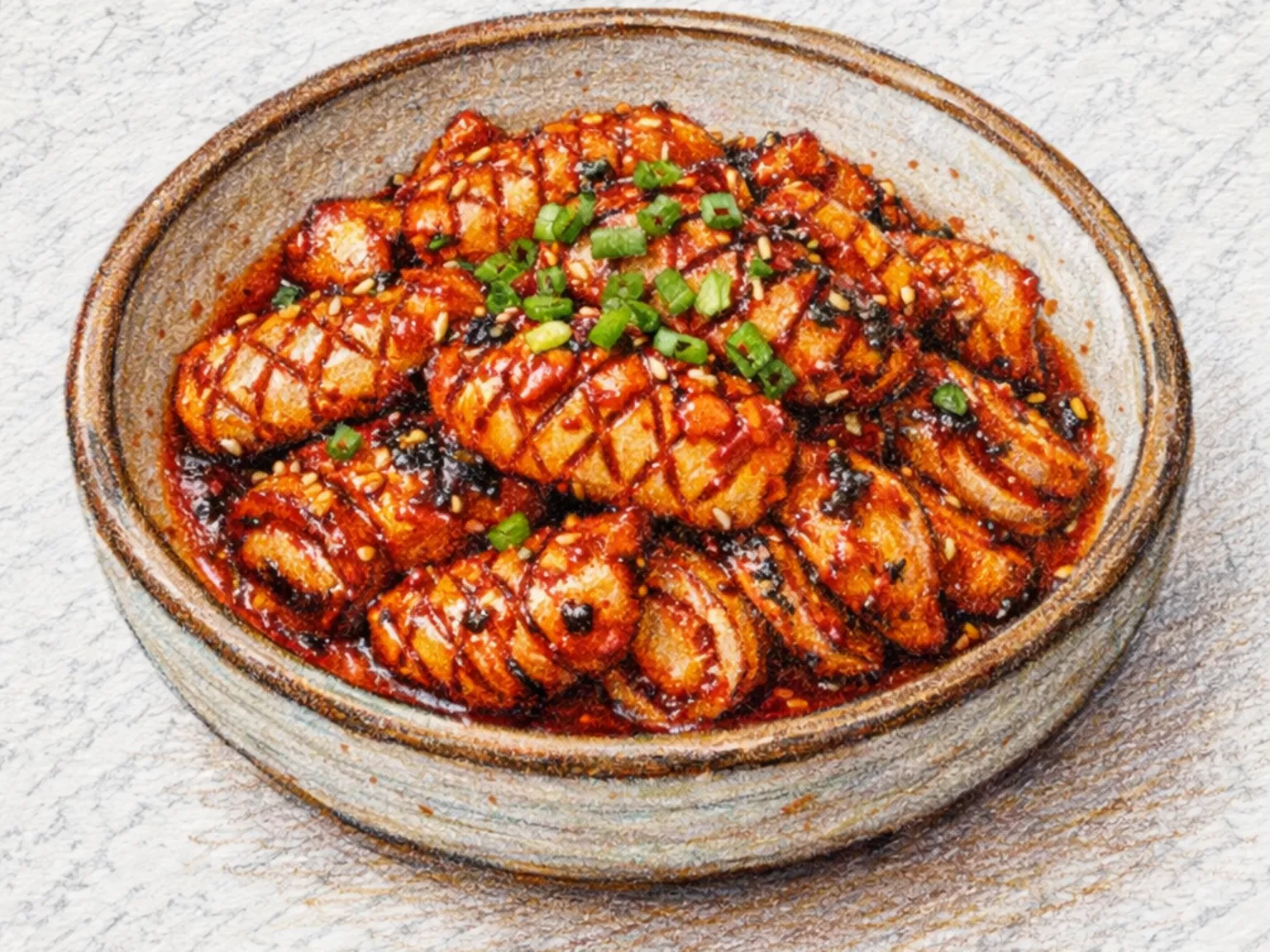
Korean Gapojingeo Yangnyeom Gui (Spicy Grilled Cuttlefish)
Grilled Medium

Korean Gapojingeo Yangnyeom Gui (Spicy Grilled Cuttlefish)

Quick answer

Gapojingeo-yangnyeom-gui is spicy grilled cuttlefish prepared by scoring the body in a deep crosshatch pattern and coating it with a glaze of gochujang, Korean chili flak...

What makes this special

  • Gapojingeo Yangnyeom Gui is a spicy grilled cuttlefish with a glossy, caramelized gochujang coating.
  • Gochujang and oligosaccharide caramelize on high heat into glossy red coating
  • Pat-drying surface before sauce ensures marinade stays on without running off
Total time
30 min
Level
Medium
Servings
2 servings
Ingredients
9
Calories
280 kcal
Protein
32 g

Key ingredients

cuttlefishgochujanggochugarusoy sauceoligosaccharide syrup

Core cooking flow

  1. 1 Remove the guts and skin from 500g cuttlefish and score the body deeply in a 0.5 cm crosshatch pattern.
  2. 2 Mix 1.5 tbsp gochujang, 1 tbsp gochugaru, 1 tbsp dark soy sauce, 1 tbsp olig...
  3. 3 Add the cuttlefish and 0.5 sliced onion to the sauce and marinate for 15 minutes.

Gapojingeo-yangnyeom-gui is spicy grilled cuttlefish prepared by scoring the body in a deep crosshatch pattern and coating it with a glaze of gochujang, Korean chili flakes, soy sauce, oligosaccharide syrup, and garlic. The deep scoring is critical for the thick cuttlefish body: it allows the marinade to penetrate the flesh fully and causes the scored sections to curl open under high heat, creating a flower-like shape that maximizes surface contact with the glaze. When gochujang's heat and the syrup's sticky sweetness hit high heat together, they caramelize into a glossy, deep-red coating that clings to the cuttlefish, while sesame oil folded into the marinade adds a toasted undertone beneath the spice. Chunky-cut onion and green onion grilled alongside release moisture that evaporates into sweetness, naturally tempering the intensity of the chili glaze without diluting the marinade's savory depth. Patting the cuttlefish completely dry before marinating ensures the glaze adheres evenly rather than sliding off, and keeping the cooking time short over high heat prevents the flesh from turning tough and rubbery.

Prep 20min Cook 10min 2 servings

Instructions

Read the steps as a cooking flow: prep, heat, seasoning, doneness control, and finish.

6 steps
  1. 1
    Prep

    Remove the guts and skin from 500g cuttlefish and score the body deeply in a 0.5 cm crosshatch pattern.

    Deep scores are essential for the marinade to penetrate the flesh.

  2. 2
    Season

    Mix 1.5 tbsp gochujang, 1 tbsp gochugaru, 1 tbsp dark soy sauce, 1 tbsp oligosaccharide syrup, 1 tbsp minced garlic, and 1 tbsp sesame oil to make the sauce.

  3. 3
    Season

    Add the cuttlefish and 0.5 sliced onion to the sauce and marinate for 15 minutes.

    Pat the cuttlefish dry with paper towels beforehand so the sauce adheres well.

  4. 4
    Season

    Preheat a grill pan on high for 2 minutes.

    Intense heat is needed so the sugar in the sauce caramelizes quickly into a glossy red coating.

  5. 5
    Heat

    Place the cuttlefish and grill quickly for 2 minutes per side.

    Overcooking makes it tough, so flip the moment the cuts open and the aroma rises.

  6. 6
    Finish

    Brush on the remaining sauce thinly and grill 1 more minute for a glossy finish.

    Scatter sliced green onion over the top, cut into bite-sized pieces, and serve immediately.

After the steps

Pick a recipe that fits this dish.

Continue with shared ingredients, meal pairings, or a similar method.

Recipes That Go Well With This

More Grilled →

Based on shared ingredients and meal pairing

Korean Grilled Webfoot Octopus
Shared ingredient: green onion Grilled

Korean Grilled Webfoot Octopus

Cleaned webfoot octopus is tossed in a marinade of gochujang, chili flakes, soy sauce, and sugar for ten minutes, then seared on high heat for just three to four minutes. Webfoot octopus has thicker tentacles than nakji and a more resilient chew, which makes it particularly well suited to this type of spicy, high-heat preparation. The short cooking time is not a shortcut -- it is the point. Overcooking webfoot octopus makes it rubbery and dry, and the difference between three minutes and five minutes is the difference between tender-chewy and tough. High heat is equally important: the goal is to sear, not steam, so the pan must be very hot and the pieces should not be crowded. Where the glaze catches on the pan surface and scorches slightly, it leaves behind charred bits that coat the octopus with a smoky depth the marinade alone cannot provide. Green onion added in the final seconds cuts through the heat with a sharp, fresh note. Just before the main harvest season in spring, webfoot octopus carries roe that adds a rich, creamy nuttiness to each bite, and this is when Korean cooks consider the ingredient at its peak. The cooked pieces wrap well in perilla leaves and are also popular as a fried rice finisher.

Korean Ori Gochujang Gui (Gochujang Grilled Duck)
Shared ingredient: onion Grilled

Korean Ori Gochujang Gui (Gochujang Grilled Duck)

Ori-gochujang-gui is spicy gochujang-grilled duck, where sliced duck is marinated for fifteen minutes in a paste of gochujang, soy sauce, Korean chili flakes, minced garlic, pear juice, and sesame oil, then grilled alongside sliced onion over medium-high heat for ten to twelve minutes with frequent turning. Pear juice tempers the aggressive salt and heat of gochujang while acting as a natural tenderizer for the duck, and sesame oil forms a thin film that slows moisture loss during grilling. As duck fat renders out and combines with the chili paste, a concentrated sweet-spicy sauce pools in the pan-basting the meat continuously with this liquid builds a glossy, lacquered surface. Wrapping each piece in a perilla leaf before eating adds an herbal fragrance that softens the chili burn.

Ojingeo-muguk (Korean Squid Radish Soup)
Serve together Soups

Ojingeo-muguk (Korean Squid Radish Soup)

Ojingeo-muguk is a clear Korean soup that pairs squid and radish in a gently sweet, clean-tasting broth built without any chili or strong seasoning. Radish is added to cold water from the start and simmered for at least eight minutes, during which the vegetable slowly releases a natural sweetness that forms the flavor foundation of the soup. Squid is cleaned, sliced into rings, and added only after the radish has softened, and the timing here is critical: five minutes in the hot broth is enough for the flesh to turn fully opaque and pleasantly firm, but even a minute or two beyond that causes the proteins to tighten and the rings to turn rubbery and tough. Soup soy sauce seasons the broth without darkening it, and minced garlic provides depth without heat. Sliced green onion stirred in at the end neutralizes any residual seafood aroma and leaves the broth tasting bright and clean. The simplicity of the combination is the point: the radish's sweetness and the squid's umami reinforce each other in a broth that is light in body but surprisingly satisfying.

Korean Kkotge Gochujang Gui (Spicy Grilled Crab)
Similar recipe Grilled

Korean Kkotge Gochujang Gui (Spicy Grilled Crab)

Kkotge-gochujang-gui is a Korean spicy grilled crab where halved blue crabs are thoroughly coated in a thick paste of gochujang, gochugaru, soy sauce, oligosaccharide syrup, and garlic, then marinated for fifteen minutes before going onto a medium-heat grill. The sugar in the syrup and the fermented compounds in the gochujang caramelize over direct flame, forming a glossy, dark-red lacquer on the shell while the crab meat underneath is steam-cooked by the insulating shell, keeping it moist and sweet. Controlled medium heat is essential because the sauce scorches quickly: four minutes shell-side down first, then a flip for five to six more minutes ensures even cooking without burning. When the crab is turned, the sauce drips into the interior cavity and coats the exposed meat directly, intensifying the spice penetration on the flesh side. A final drizzle of sesame oil and a scatter of toasted sesame seeds layer a nutty, smoky fragrance over the lacquered coating.

Serve with this

Korean Stir-Fried Sweet Potato Stems
Side dishes Medium

Korean Stir-Fried Sweet Potato Stems

Goguma julgi - sweet potato stems - are the above-ground vines of the sweet potato plant, a byproduct that Korean cooks transform into a summer namul rather than discarding. The most labor-intensive step is peeling each stem by hand, pinching the outer skin with a fingernail and pulling it away to reveal the tender core beneath. After blanching for two minutes and rinsing in cold water, the stems are stir-fried in perilla oil with garlic and seasoned with soup soy sauce. Perilla powder stirred in at the end thickens the remaining liquid into a nutty glaze. In season during summer, the stems are harvested from sweet potato fields before the tubers themselves are dug up.

🏠 Everyday 🍱 Lunchbox
Prep 30min Cook 10min 4 servings
Korean Thick Doenjang Bibimbap
Rice Easy

Korean Thick Doenjang Bibimbap

Gangdoenjang-bibimbap is a rice bowl built around gangdoenjang, a reduced and concentrated version of the fermented soybean paste cooked down with vegetables and tofu until most of the moisture has evaporated. Where ordinary doenjang jjigae centers on broth, gangdoenjang is intentionally reduced to intensify the fermented depth, allowing the paste to cling to rice like a thick sauce when spooned over and mixed in. Minced garlic is bloomed in sesame oil first, then diced onion and zucchini are added and cooked through before the dissolved doenjang and minced shiitake go into the pan to reduce over gentle heat. Firm tofu is crumbled in during the final stage, breaking apart as it cooks and giving the sauce a heavier, more substantial body. Water is added in 20 to 40 milliliter increments to adjust consistency depending on the saltiness of the paste. A chopped cheongyang chili raises the heat and sharpens the savory quality of the doenjang. An extra drizzle of sesame oil when mixing amplifies the nuttiness, and a fried egg or crumbled dried seaweed on top turns the bowl into a complete and filling meal.

🏠 Everyday 🌙 Late Night
Prep 15min Cook 18min 2 servings
Chicken Mu (Korean Fried Chicken Radish Pickle)
Kimchi Easy

Chicken Mu (Korean Fried Chicken Radish Pickle)

The crunchy, sweet-sour radish pickle served with every order of Korean fried chicken - now easy to make at home in under 15 minutes. Cubed radish is submerged in a cooled brine of vinegar, sugar, salt, and whole black peppercorns. Using fully cooled brine rather than hot is critical for maintaining the radish's firm, snapping crunch. Ready to eat after one day of refrigeration, its bright acidity cleanses the palate between bites of crispy chicken. Stored in a glass jar, this pickle keeps for over a week.

⚡ Quick 🏠 Everyday
Prep 10min Cook 5min 4 servings

Similar recipes

Korean Grilled Squid and Pork
Grilled Medium

Korean Grilled Squid and Pork

Osam-gui is a Korean mixed grill of squid and pork belly marinated together in a spicy sauce of gochujang, soy sauce, sugar, minced garlic, and sesame oil, then cooked on a pan or grill. As the pork belly renders its fat, it merges with the marinade to form a rich, savory-spicy sauce in the pan that the squid absorbs during cooking, producing a deeper flavor than either ingredient would achieve alone. The two proteins cook at very different rates, so the pork belly goes in first for five to six minutes to render its fat and partially cook through before the squid is added-squid toughens past three to four minutes of heat exposure. The gochujang paste scorches easily at high temperatures, so maintaining medium heat and turning the pieces frequently is necessary to build a glossy glaze without any burnt bitterness.

🍺 Bar Snacks 🏠 Everyday
Prep 30min Cook 15min 2 servings
Korean Spicy Squid Salad (Gochujang Blanched Squid)
Side dishes Easy

Korean Spicy Squid Salad (Gochujang Blanched Squid)

Ojingeo-muchim tosses blanched squid in a gochujang-vinegar dressing for a tangy, spicy seafood banchan that works equally well as a rice side dish or as anju with drinks. Squid, unlike vegetables, has an extremely narrow blanching window that determines the entire outcome: one minute to ninety seconds in boiling water is the limit. Beyond that, the proteins contract and the texture turns rubbery; under that, the interior stays translucent and fishy. Plunging into ice water immediately after blanching halts carryover cooking and locks in the ideal springy-bouncy texture. The dressing combines gochujang, gochugaru, vinegar, sugar, garlic, sesame oil, and sesame seeds, with vinegar playing the pivotal role - it introduces a sharp acidity over the squid's marine umami, forming a triangular balance with the chili heat. Julienned onion and cucumber mixed in add textural variety and stretch the portion. A popular variation stirs in one tablespoon of mayonnaise, whose emulsified fat wraps around the heat and produces a milder, creamier version.

🏠 Everyday 🍱 Lunchbox
Prep 15min Cook 5min 4 servings
Grilled Octopus & Water Parsley Salad
Salads Medium

Grilled Octopus & Water Parsley Salad

Grilled octopus and minari salad is a Korean seafood salad made by searing pre-cooked octopus over high heat for two to three minutes to pick up char and smoke, then tossing it with water parsley cut into 4 to 5 cm lengths, shredded red bell pepper, and sliced onion in a gochugaru-vinegar dressing. Patting the octopus completely dry before searing is essential to get a proper char rather than steaming, and keeping the cooking time short over high heat leaves the interior chewy while the exterior picks up color; prolonged heat makes the flesh rubbery. The dressing of vinegar, olive oil, gochugaru, and minced garlic leads with bright acidity and builds into a gentle, lingering heat that gives the octopus's mild savoriness a clearer direction. Minari should be added at the end so its clean, grassy fragrance does not dissipate, and letting the dressed salad rest for three minutes allows the dressing to absorb evenly into each component. The contrast between the red bell pepper and the bright green minari makes this salad a visually striking addition to a spread, and the whole dish comes together in about ten minutes, making it practical when adding a quick side.

🍺 Bar Snacks 🥗 Light & Healthy
Prep 20min Cook 10min 2 servings

Tips

Cuttlefish turns tough if overcooked, so grill hot and fast.
Apply extra sauce near the end to prevent burning.

Nutrition (per serving)

Calories
280
kcal
Protein
32
g
Carbs
12
g
Fat
11
g