Gateau au Chocolat (Rich Flourless Chocolate Cake)
Quick answer
Gateau au chocolat is a French-style chocolate cake built on an unusually high ratio of dark chocolate and butter relative to flour.
What makes this special
- Rich flourless chocolate cake with a high cocoa ratio for a dense, truffle-like texture.
- Only 50g flour against 200g chocolate and 120g butter achieves truffle-like density
- Folded meringue keeps the crumb from being too heavy, letting it melt on the tongue
Key ingredients
Core cooking flow
- 1 Preheat the oven to 170°C and prepare the cake pan.
- 2 Melt the chocolate with 120 g unsalted butter slowly over a double boiler.
- 3 Whisk the yolks with part of the sugar until the color turns paler.
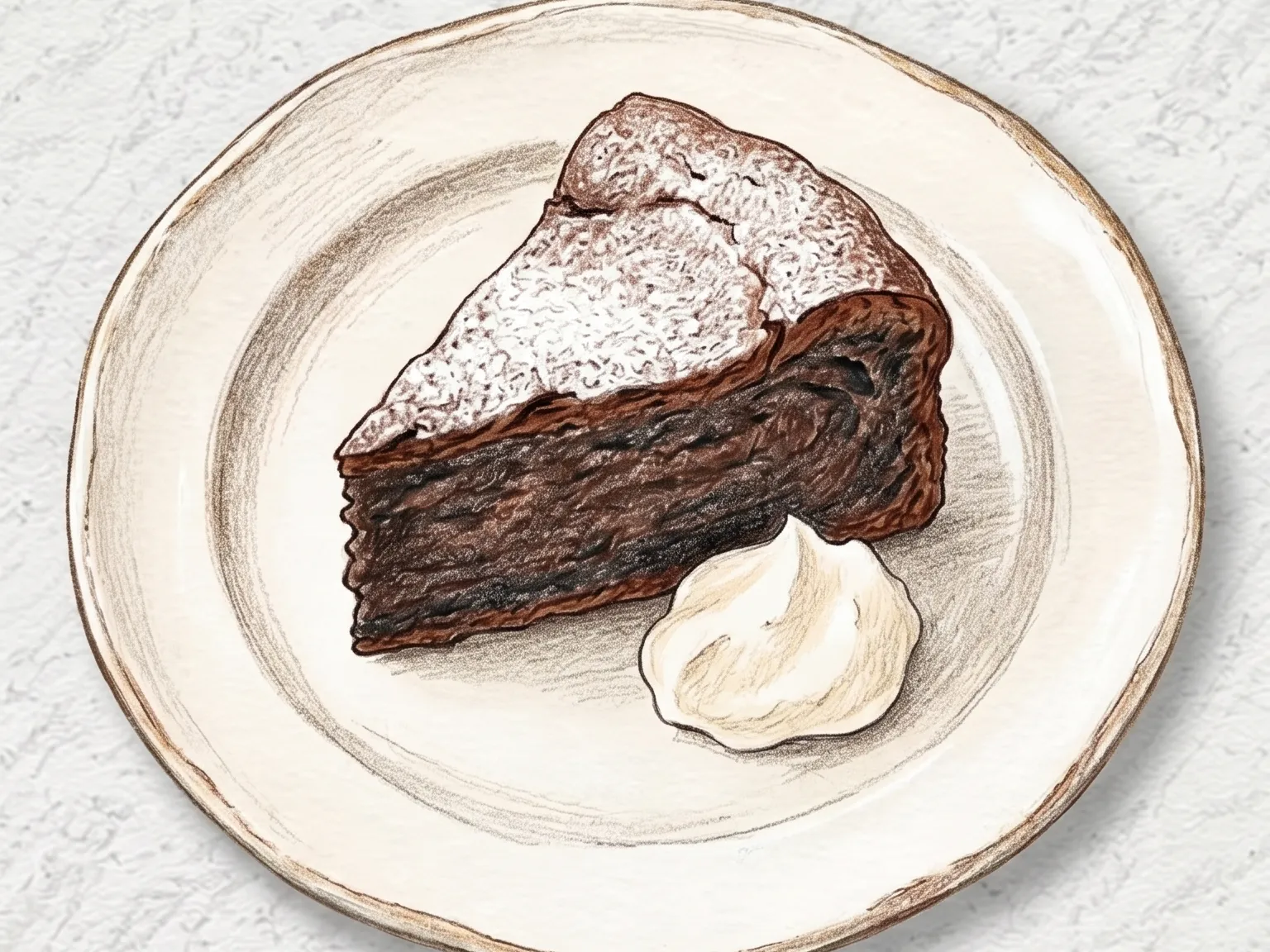
Gateau au chocolat is a French-style chocolate cake built on an unusually high ratio of dark chocolate and butter relative to flour. Many versions use only a trace of flour or none at all, so the structure depends almost entirely on eggs and melted chocolate rather than on gluten development. Whipping the egg whites separately into a glossy meringue and folding them into the batter introduces just enough trapped air to prevent the result from feeling dense and leaden; the finished cake is simultaneously rich and melt-on-the-tongue light. Straight from the oven the center appears underset, but as the cake cools fully on a rack the interior firms to a fudge-like consistency and a thin, crackly shell forms across the top. Sliced, it reveals an intensely dark cross-section that looks as concentrated as it tastes. A fine dusting of powdered sugar provides visual contrast against the dark surface, and a generous spoonful of lightly whipped, unsweetened cream tempers the bittersweet intensity. The cake actually improves if left overnight: moisture redistributes evenly through the crumb and the chocolate flavor deepens noticeably, making it an ideal candidate for baking a full day ahead of birthdays or dinner gatherings where a reliable, make-ahead dessert is needed.
Instructions
Read the steps as a cooking flow: prep, heat, seasoning, doneness control, and finish.
- 1Prep
Preheat the oven to 170°C and prepare the cake pan.
Break 200 g dark chocolate into small pieces, then separate the 4 eggs into yolks and whites so the meringue can be folded in later.
- 2Season
Melt the chocolate with 120 g unsalted butter slowly over a double boiler.
Keep water out of the bowl, stir until glossy and smooth, then remove from the heat and let it cool to lukewarm.
- 3Season
Whisk the yolks with part of the sugar until the color turns paler.
When the chocolate mixture is no longer hot, add it gradually to the yolks and mix evenly without scrambling the eggs.
- 4Season
Whip the whites with the remaining sugar and 1 g salt into a glossy meringue.
Stop when soft peaks hold their shape, because overbeating makes the batter harder to fold and can deflate it.
- 5Step
Sift in 50 g cake flour and 20 g cocoa powder, then fold gently just until no dry streaks remain.
Add the meringue in 2 or 3 additions, folding carefully to keep the trapped air.
- 6Finish
Pour the batter into the pan and bake for 28 to 30 minutes.
Pull it when the center still jiggles slightly and a toothpick has moist crumbs, then cool completely and finish with cocoa powder.
After the steps
Pick a recipe that fits this dish.
Continue with shared ingredients, meal pairings, or a similar method.
Recipes That Go Well With This
More Baking →Based on shared ingredients and meal pairing
Chocolate Lava Cake
Chocolate lava cake bakes a batter of melted dark chocolate, butter, whole eggs, egg yolks, sugar, and a small measure of flour in buttered ramekins at 220 degrees Celsius for ten to twelve minutes, producing a set crust and molten center from a single brief baking window. The high oven temperature firms the outside and top of the batter into cake while the core stays liquid, so breaking the surface with a spoon releases a slow pour of concentrated warm chocolate. High-cacao dark chocolate provides a complex, bittersweet depth that pairs with the richness of butter fat, and vanilla extract softens and rounds the overall aroma. Timing controls everything in this recipe: overbaking by even two minutes sets the center solid and destroys the signature flow. The edges of each ramekin should feel just firm when pressed lightly through a towel at the ten-minute mark. Ramekins can be filled ahead and refrigerated, but the baking time then needs an extra one to two minutes to account for the colder starting temperature. Serving with a scoop of vanilla ice cream or a spoonful of cold heavy cream creates a striking contrast between the hot, dense chocolate interior and the chilled, lighter dairy.
Vanilla Honey Madeleines (French Shell Cakes with Honey)
Eggs, sugar, and honey are whisked together, then combined with melted butter, cake flour, and vanilla to form a batter that bakes into small, shell-shaped French cakes with a characteristic bump on the back. The honey works alongside sugar to sweeten the madeleine while contributing a floral undertone that plain sugar cannot provide. Melted butter saturates the batter with richness, and vanilla bridges the honey and butter flavors into a cohesive aroma. Chilling the batter for at least thirty minutes is the key to the signature hump - the cold batter hitting the hot oven creates a rapid rise in the center while the edges have already begun to set. Each mold cavity should be well-buttered and filled to eighty percent to ensure clean edges and consistent shape. Baking time is brief, ten to twelve minutes, and the madeleines must be removed as soon as the rims turn golden to preserve the moist, spongy interior. They are best eaten within hours of baking, when the crust is still faintly crisp and the center yields softly.
Clafoutis (French Baked Cherry Custard Dessert)
Clafoutis is a traditional French dessert from the Limousin region made by arranging fresh cherries in a buttered baking dish, then pouring over a thin batter of eggs, sugar, milk, and flour and baking at 180 degrees Celsius for thirty to thirty-five minutes. The batter is considerably thinner than pancake batter, and the result when baked is a texture that sits between a creamy custard and a light sponge -- the edges puff and turn golden while the center around the cherries stays moist and yielding. Using unpitted cherries is the traditional method: the pits release a faint almond scent during baking that perfumes the surrounding batter in a way that pitted fruit cannot replicate. The cherries also hold their shape better with the pits in. Vanilla extract deepens the egg-and-milk base, and the cherries' own tart juice seeps into the batter during baking, creating concentrated pockets of fruit flavor that balance the overall sweetness. Clafoutis is served directly from the baking dish, typically dusted with powdered sugar and brought to the table while still warm, because the custard texture softens and loosens slightly as it cools, making the warm version noticeably more appealing. Made with blueberries, plums, or apricots instead of cherries, the dessert takes a different name -- flaugnarde -- though the technique remains identical.
Chocolate Mousse
Chocolate mousse achieves a fundamental paradox: it tastes intensely of chocolate yet feels almost weightless on the tongue. Dark chocolate is melted gently over a bain-marie and cooled until warm but no longer hot enough to deflate the cream. Whipped cream is then folded in three separate additions: the first loosens the chocolate mass, the second begins to lighten its density, and the third introduces the full airy volume that defines mousse. Some recipes add egg yolks for richness and a custard-like body, while beaten egg whites lift the texture even further. Chilling for at least two hours allows the mousse to set to a consistency that holds its shape on a spoon yet dissolves on contact with the palate. The cacao percentage governs both the bitterness and the intensity of the finished dessert, and chocolate above seventy percent produces a mousse that reads as unmistakably adult in its depth. A small measure of vanilla extract rounds the sharper edges of the cocoa without competing for attention. Mousse can be served directly in individual cups, spread into a tart shell to firm overnight, or piped into layers with cream for a more composed plated dessert. A dusting of unsweetened cocoa through a fine sieve over the top surface is the minimal finishing touch.
Serve with this
Beet and Goat Cheese Salad
Beet and goat cheese salad begins with whole beets wrapped in foil and roasted at 200°C for forty-five to sixty minutes, long enough for their raw, earthy undertone to convert almost entirely into a concentrated, caramel-adjacent sweetness. Peeling the skins while the beets are still warm requires only the pressure of a paper towel - they slip off cleanly - and slicing them before they cool preserves the vivid crimson-purple cross-section that makes the dish visually striking. Crumbled goat cheese placed on the warm slices softens slightly, and its tangy acidity cuts through the dense sweetness of the roasted root rather than competing with it. Walnuts toasted briefly in a dry pan lose much of their raw bitterness, developing a nuttiness that bridges the mineral quality of the beet and the dairy sharpness of the cheese. Balsamic reduction does more than dress the plate: its concentrated sweet-tart intensity ties the separate components into a coherent whole. Arugula underneath the beet slices provides a peppery bitterness that sharpens the contrast against the sweetness, giving the salad a complexity well beyond what its short ingredient list suggests. A simple dressing of extra-virgin olive oil and lemon juice over the greens keeps the balance light and clear.
Honey Ginger Ribbon Cookies
Maejakgwa are traditional Korean ribbon cookies made from a firm dough of wheat flour, sesame oil, and ginger juice, rolled to 2 mm thickness, slit lengthwise through the center, and twisted through the opening into a knot shape before frying. Slow-frying at 160 degrees Celsius turns them light golden and crisp all the way through without darkening the surface unevenly. A warm coating of honey blended with rice syrup is applied while the cookies are still hot, adding a glossy, sweet shell that sets as it cools. The ginger lends a subtle warm bite that sits behind the nuttiness of sesame oil rather than announcing itself upfront, and a final dusting of pine nut powder contributes a soft, buttery fragrance that completes the layering of flavor. Each piece shatters lightly when bitten, yet the syrup-soaked sections at the twisted edges carry a slight chewiness that gives the cookie a layered texture unusual for a fried dough confection. Maejakgwa appear regularly on ritual food tables at memorial ceremonies and are commonly prepared for Lunar New Year and Chuseok.
Korean Dalgona Coffee (Whipped Instant Coffee Foam Milk)
Dalgona coffee is made by whipping equal parts instant coffee, sugar, and hot water with a hand mixer for three to five minutes until stiff, caramel-colored peaks form, then spooning the foam over iced milk. The whipped layer carries a concentrated, bittersweet coffee flavor that gradually blends into the cold, neutral milk below as you stir. A light dusting of cocoa powder on top introduces a faint chocolate note, and increasing the sugar slightly helps the whipped cream hold its stiff structure longer.
Similar recipes
Pain au Chocolat
Two sticks of dark chocolate are sealed inside laminated croissant dough and baked until the exterior shatters into golden, buttery flakes. As the pastry cools for a minute on the rack, the chocolate inside transitions from fully molten to a soft, fudgy state that clings to the layers when torn apart. Dozens of paper-thin sheets of dough, created through repeated folding with cold butter, give each bite an audible crunch followed by a yielding, airy interior. Using chocolate with at least fifty-five percent cacao ensures that the filling carries enough bitterness to stand up to all that butter. Shaped portions freeze well, allowing an overnight thaw and morning proof for fresh pastries without starting from scratch.
Chocolate Souffle
Chocolate souffle folds stiffly beaten egg white meringue into a base of melted dark chocolate and egg yolks, then bakes it in a buttered ramekin at high heat until it rises dramatically above the rim. The intense oven heat expands the air trapped within the meringue, pushing the souffle upward while the exterior sets into a thin, delicate crust and the interior remains a molten, near-liquid chocolate cream. Breaking through the top with a spoon releases a rush of hot, intensely flavored chocolate from inside, and that moment of opening is the point of the entire dessert. The souffle begins to deflate within a minute or two of leaving the oven, so it must go directly to the table without delay. Coating the inside of the ramekin with butter followed by sugar is not optional: this surface preparation gives the batter traction to climb straight upward rather than sticking to the sides and collapsing unevenly. Using chocolate with a high cocoa content produces a deeper, more defined contrast between bitterness and sweetness. The most critical technical step is folding the meringue into the chocolate base using broad, circular motions with a spatula and a minimum number of strokes, because overmixing deflates the air bubbles that are responsible for the rise. Serve dusted with powdered sugar or alongside a scoop of vanilla ice cream.