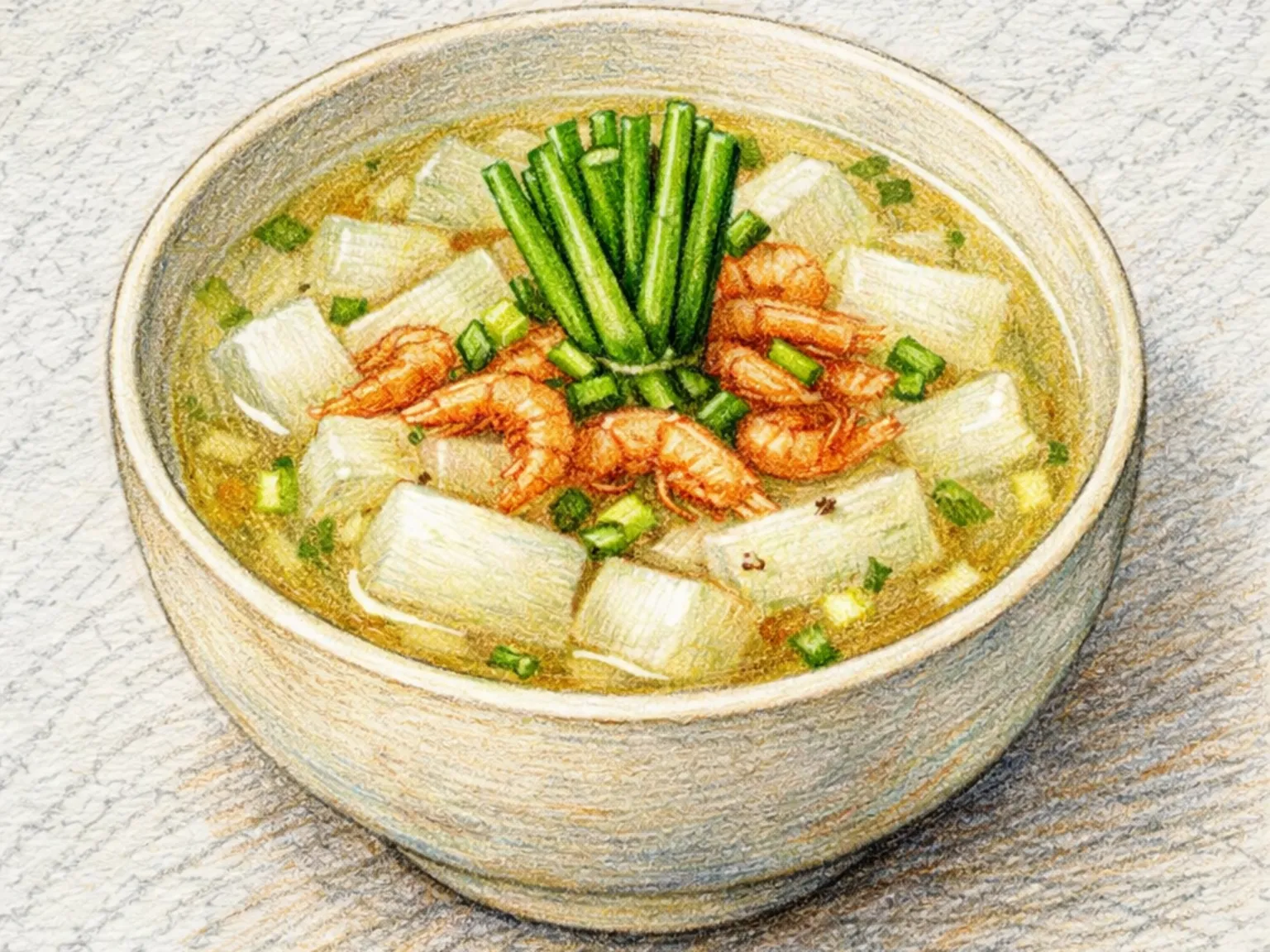
Korean Dried Shrimp Radish Soup
Soups Easy

Korean Dried Shrimp Radish Soup

Quick answer

Geon-saeu-muguk is a clear Korean soup that pulls deep flavor from two inexpensive ingredients: dried shrimp and Korean radish.

What makes this special

  • Geon-saeu-muguk pulls deep flavor from dried shrimp and radish toasted in fragrant sesame oil.
  • Stir-frying dried shrimp in sesame oil infuses concentrated seafood aroma into the fat
  • No anchovy stock needed; dried shrimp alone deliver full umami depth
Total time
30 min
Level
Easy
Servings
4 servings
Ingredients
7
Calories
120 kcal
Protein
10 g

Key ingredients

dried shrimpkorean radishwaterminced garlicsoup soy sauce

Core cooking flow

  1. 1 Slice 260g Korean radish into flat pieces about 3cm wide and 0.5cm thick so they cook quickly and evenly.
  2. 2 Warm 1 teaspoon sesame oil in a pot over medium heat.
  3. 3 Add the sliced radish and stir-fry for 2 more minutes so the pieces are coat...

Geon-saeu-muguk is a clear Korean soup that pulls deep flavor from two inexpensive ingredients: dried shrimp and Korean radish. The dried shrimp are toasted in sesame oil before any water is added. This step is not cosmetic. As the shrimp heat up, their moisture evaporates and the concentrated briny sweetness intensifies and bonds with the oil, releasing a fragrant, almost caramelized seafood aroma that becomes the backbone of the entire broth. Without this toasting step, the soup tastes thin and flat. Radish slices go in after the shrimp, simmering in the water until translucent and releasing a gentle natural sweetness that rounds out the saltiness of the shrimp. Minced garlic and soup soy sauce are added for seasoning, and that is essentially all that is needed. No separate anchovy or kelp stock is required; the dried shrimp generate enough umami on their own to make the broth taste full and layered. Once the water comes to a boil, the soup is ready in under fifteen minutes, which makes it genuinely practical for weeknight cooking when time is short. Sliced green onion stirred in just before serving lifts the aroma and gives the bowl a fresh note to balance the deep, savory broth. Salt can substitute for the soup soy sauce if a cleaner-tasting liquid is preferred.

Prep 10min Cook 20min 4 servings

Instructions

Read the steps as a cooking flow: prep, heat, seasoning, doneness control, and finish.

6 steps
  1. 1
    Finish

    Slice 260g Korean radish into flat pieces about 3cm wide and 0.5cm thick so they cook quickly and evenly.

    Slice half a green onion diagonally, mixing white and green parts, and keep it ready for the finish.

  2. 2
    Control

    Warm 1 teaspoon sesame oil in a pot over medium heat.

    Add 35g dried shrimp and stir for about 1 minute, just until the shrimp feel drier and a strong savory seafood aroma rises without burning.

  3. 3
    Heat

    Add the sliced radish and stir-fry for 2 more minutes so the pieces are coated with sesame oil and shrimp flavor.

    When the edges start turning slightly translucent, pour in 1.4 liters of water.

  4. 4
    Control

    Bring the pot to a boil over high heat, then reduce to medium when foam rises.

    Skim off the pale foam with a spoon so the broth stays clear instead of cloudy or muddy-tasting.

  5. 5
    Control

    Add 1 teaspoon minced garlic and 1 tablespoon soup soy sauce, then simmer over medium heat for about 10 minutes.

    The radish should look translucent and yield easily when pressed or pierced with chopsticks.

  6. 6
    Season

    Add the sliced green onion and boil for just 1 more minute so its fresh aroma stays bright.

    Taste the broth, adjust with salt if needed, and turn off the heat while the soup remains clear.

After the steps

Pick a recipe that fits this dish.

Continue with shared ingredients, meal pairings, or a similar method.

Recipes That Go Well With This

More Soups →

Based on shared ingredients and meal pairing

Muguk (Korean Radish Anchovy Broth Soup)
Shared ingredient: korean radish Soups

Muguk (Korean Radish Anchovy Broth Soup)

Muguk is the most elemental expression of Korean soup: radish cut generously and simmered in anchovy-kelp stock until the broth runs clear, sweet, and gently savory. The simplicity of the ingredient list is deceptive. As the radish cooks, its starch and natural sugars dissolve into the water, building a broth that tastes mild on the surface but carries real depth underneath. Cutting the radish in thick cubes or wide slabs preserves its shape through the long simmer while allowing the interior to soften completely. Slicing too thin causes the radish to disintegrate and the broth to turn cloudy. Seasoned with nothing more than soup soy sauce, garlic, and sliced green onion, muguk is versatile enough to sit beside any banchan without competing. It serves equally well as a framework: add beef strips and it becomes sogogi-muguk, add dried pollock and it becomes hwangtae-muguk, swap the soup soy for salted shrimp and the character shifts toward briny and refreshing. All that is needed to start a pot are a single radish, a handful of dried anchovies, and a strip of dried kelp, which is why Korean households return to this soup more frequently than almost any other. Reheated the next day, the radish softens further and the broth deepens, making leftovers better than the original.

Ojingeo-muguk (Korean Squid Radish Soup)
Shared ingredient: korean radish Soups

Ojingeo-muguk (Korean Squid Radish Soup)

Ojingeo-muguk is a clear Korean soup that pairs squid and radish in a gently sweet, clean-tasting broth built without any chili or strong seasoning. Radish is added to cold water from the start and simmered for at least eight minutes, during which the vegetable slowly releases a natural sweetness that forms the flavor foundation of the soup. Squid is cleaned, sliced into rings, and added only after the radish has softened, and the timing here is critical: five minutes in the hot broth is enough for the flesh to turn fully opaque and pleasantly firm, but even a minute or two beyond that causes the proteins to tighten and the rings to turn rubbery and tough. Soup soy sauce seasons the broth without darkening it, and minced garlic provides depth without heat. Sliced green onion stirred in at the end neutralizes any residual seafood aroma and leaves the broth tasting bright and clean. The simplicity of the combination is the point: the radish's sweetness and the squid's umami reinforce each other in a broth that is light in body but surprisingly satisfying.

Korean Kimchi Acorn Jelly Rice Bowl
Serve together Rice

Korean Kimchi Acorn Jelly Rice Bowl

Acorn jelly (dotorimuk) is sliced into strips, placed over rice, and drenched in a chilled broth made from kimchi juice, cold water, and a touch of sugar. The jelly's slippery, bouncy texture contrasts with the crunch of chopped kimchi, while the tangy broth refreshes the palate with every spoonful. A light toss of sesame oil on the rice provides a nutty base, and roasted seaweed flakes add an ocean-like finish. Adding ice cubes makes it even more bracing, a distinctly Korean way to beat summer heat with a cold, brothy rice bowl. If the kimchi is too tart, a small addition of sugar rounds the flavor into balance.

Korean Dried Pollock Radish Soup
Similar recipe Soups

Korean Dried Pollock Radish Soup

Hwangtae-muguk is an everyday Korean soup made with dried pollock strips and radish in a clean, clear broth. The pollock is first sautéed in sesame oil to coax out its characteristically nutty, savory fragrance, then water is added and the radish simmers until soft and sweet. Soup soy sauce and minced garlic provide the only additional seasoning, keeping the flavor profile transparent enough to let the pollock's concentrated umami and the radish's natural sweetness take center stage. The simplicity of the ingredient list belies the depth of the resulting broth, which tastes fuller than the sum of its parts. It is among the most frequently cooked soups in Korean homes, appearing on breakfast tables and as a reliable remedy on mornings after heavy meals. The pollock's tender, delicate flesh holds together well in the clear broth.

Serve with this

Korean Pickled Celtuce Stems
Side dishes Medium

Korean Pickled Celtuce Stems

Gungchae is the dried stem of celtuce (Lactuca sativa var. asparagina), known in Chinese as wosun, and in Korea it carries the name meaning palace vegetable, reflecting its historical association with royal court cuisine. When rehydrated from its dried state, the stems regain a firm, almost cartilaginous crunch that is the defining quality of the ingredient and the entire reason to use it. Packed into sterilized glass jars, the stems are covered with a boiling brine of soy sauce, vinegar, sugar, and water poured in while still hot, which drives the seasoning into the outer layers while preserving the interior snap. The pickle is edible after a single day, but three days is when the balance of tangy, salty, and sweet flavors reaches its peak. Served alongside grilled meats or rich main dishes, the crisp texture and bright acidity cut through heaviness and refresh the palate between bites, making it a natural companion to oily or heavily seasoned Korean mains.

🏠 Everyday 🍱 Lunchbox
Prep 20min Cook 10min 4 servings
Korean Beoseot Kimchi (Mushroom Kimchi)
Kimchi Medium

Korean Beoseot Kimchi (Mushroom Kimchi)

Blanching oyster and shiitake mushrooms before mixing them with gochugaru and fish sauce creates a side dish that bypasses the long fermentation usually associated with Korean kimchi. This boiling process removes the sharp raw scent of the mushrooms and softens their structure so the seasoning coats every surface evenly. Tearing the oyster mushrooms by hand along their natural grain allows the spicy and salty sauce to penetrate deeply while maintaining a natural bite. The thick caps of the shiitake mushrooms provide a firm, chewy element that lasts throughout the meal. Using fish sauce introduces a concentrated saltiness and a fermented profile that distinguishes this from basic seasoned vegetables. Fresh garlic chives contribute a clean, grassy aroma that balances the heavier spices. Since it does not require aging, this preparation is ready to eat immediately and reaches its peak flavor on the day it is made. Swapping chives for scallions provides a more delicate scent, and adding king oyster or enoki mushrooms introduces different physical textures. Including finely chopped squid or octopus transforms the dish into a seafood version with flavors from the ocean. Because mushrooms release water and lose their firm texture after a few days in the refrigerator, preparing small batches for immediate consumption ensures the highest quality.

🍱 Lunchbox 🏠 Everyday
Prep 20min Cook 8min 2 servings
Korean Seaweed Oyster Pancake
Pancakes Medium

Korean Seaweed Oyster Pancake

Miyeok oyster jeon is a Korean seaweed and oyster pancake that offers a savory taste of the ocean. The cooking begins by rinsing fresh oysters in light salted water and draining them, while soaked seaweed is squeezed firmly to remove moisture before being cut. The pancake batter is prepared by mixing Korean pancake mix, cold water, an egg, minced garlic, and soup soy sauce. The seaweed, oysters, and minced red chili are gently folded into the batter. Ladles of the mixture are pan-fried in oil over medium-low heat for three minutes on each side, ensuring the oysters stay submerged in the batter to cook. The finished pancake features a crisp exterior with a soft, chewy seaweed interior, and juicy oysters that release their briny flavor with every bite.

🍺 Bar Snacks 🍱 Lunchbox
Prep 20min Cook 16min 4 servings

Similar recipes

Korean Abalone Radish Soup
Soups Medium

Korean Abalone Radish Soup

Jeonbok-muguk is a refined Korean clear soup that simmers sliced abalone and radish in kelp broth, delivering a depth of flavor far beyond the simplicity of its preparation. The cooking begins by sauteing the abalone together with its viscera in sesame oil before any liquid is added. The innards, dark green and intensely flavored, dissolve into the oil and tint the eventual broth with a faint jade color while releasing a concentrated marine umami that kelp broth alone cannot provide. Radish sliced into thin rounds cooks alongside, softening steadily until translucent and releasing a natural sweetness that counterbalances the abalone's inherent salinity. Soup soy sauce and garlic are the only additional seasonings, deliberately minimal so the abalone's character defines the soup rather than the condiments. Adding the abalone too early toughens the meat; the right moment is when the radish has turned translucent, leaving the abalone just enough time to cook through while retaining its firm, chewy bite. In Korea, abalone carries cultural weight as a gift for new mothers, the ill, and guests at formal celebrations, making this soup a gesture of care as much as a recipe. The broth that results from this combination tastes far more expensive than the effort involved.

🏠 Everyday 🥗 Light & Healthy
Prep 20min Cook 25min 2 servings
Korean Shrimp Mulmandu in Light Broth
Street food Easy

Korean Shrimp Mulmandu in Light Broth

Saeu-mulmandu-broth is a Korean dumpling soup where shrimp-filled mandu are simmered in a clear broth seasoned with soup soy sauce and garlic. The shrimp is added to the pot first and allowed to cook in the liquid before the dumplings go in, establishing a seafood base that the wrappers gradually absorb during cooking. As the dumplings simmer, their skins turn translucent and the filling becomes faintly visible through the surface. They are ready when they float to the top, at which point the wrappers are tender but still intact. Green onion is stirred in at the end for a fresh, mild sharpness, and the broth is adjusted with salt and white pepper. Despite its clear, light appearance, the soup carries real depth: the gentle sweetness drawn from the shrimp combines with the savory notes released from the filling inside each dumpling, building a broth that tastes more complex than its short ingredient list would suggest. A full bowl with several dumplings makes a complete light meal, and the soup is particularly comforting during cooler months. Frozen store-bought shrimp dumplings work well in this recipe, making it a practical option for quick weeknight cooking.

🧒 Kid-Friendly ⚡ Quick
Prep 15min Cook 10min 2 servings
Korean Perilla Radish Greens Shrimp Stew
Stews Medium

Korean Perilla Radish Greens Shrimp Stew

Deulkkae mucheong saeu jjigae is a hearty stew made with radish greens, medium shrimp, and four tablespoons of perilla seed powder stirred into an anchovy-kelp stock base. Radish greens rather than dried sigeumchi give the stew a tender but substantive chew, and they absorb the savory broth well during cooking. Doenjang and soup soy sauce season the stock without overpowering the perilla, which contributes a deep, earthy nuttiness that defines the broth's character. As the shrimp cook, they release a clean briny sweetness that adds another layer of savory depth. Blanching and rinsing the radish greens before adding them removes any bitter edge and keeps the broth clear. The result is a sturdy, old-fashioned home-style stew with a well-rounded, deeply satisfying flavor.

🏠 Everyday
Prep 20min Cook 30min 4 servings

Tips

Toasting dried shrimp first reduces fishiness and boosts umami.
Finish with salt instead of soy sauce for a cleaner broth.

Nutrition (per serving)

Calories
120
kcal
Protein
10
g
Carbs
7
g
Fat
5
g