Gochu Oil Tuna Puttanesca Spaghetti
Quick answer
The foundation of this Gochu oil tuna puttanesca spaghetti is established by integrating the olive oil reserved from a can of tuna with a secondary portion of chili oil.
What makes this special
- Korean chili oil and tuna meet dissolved anchovies for a pungent, savory puttanesca.
- Anchovies dissolved fully in low-heat oil leave only salty depth, no fishiness
- Tuna can oil and chili oil as dual base concentrate umami before anything else
Key ingredients
Core cooking flow
- 1 Boil 180g spaghetti in well-salted water until 1 minute short of the package time.
- 2 Pour the olive oil from the 120g tuna can into a wide pan and add 1 tablespoon chili oil.
- 3 Add 12g sliced garlic and 3 anchovy fillets, then cook over low heat for 2 to 3 minutes.
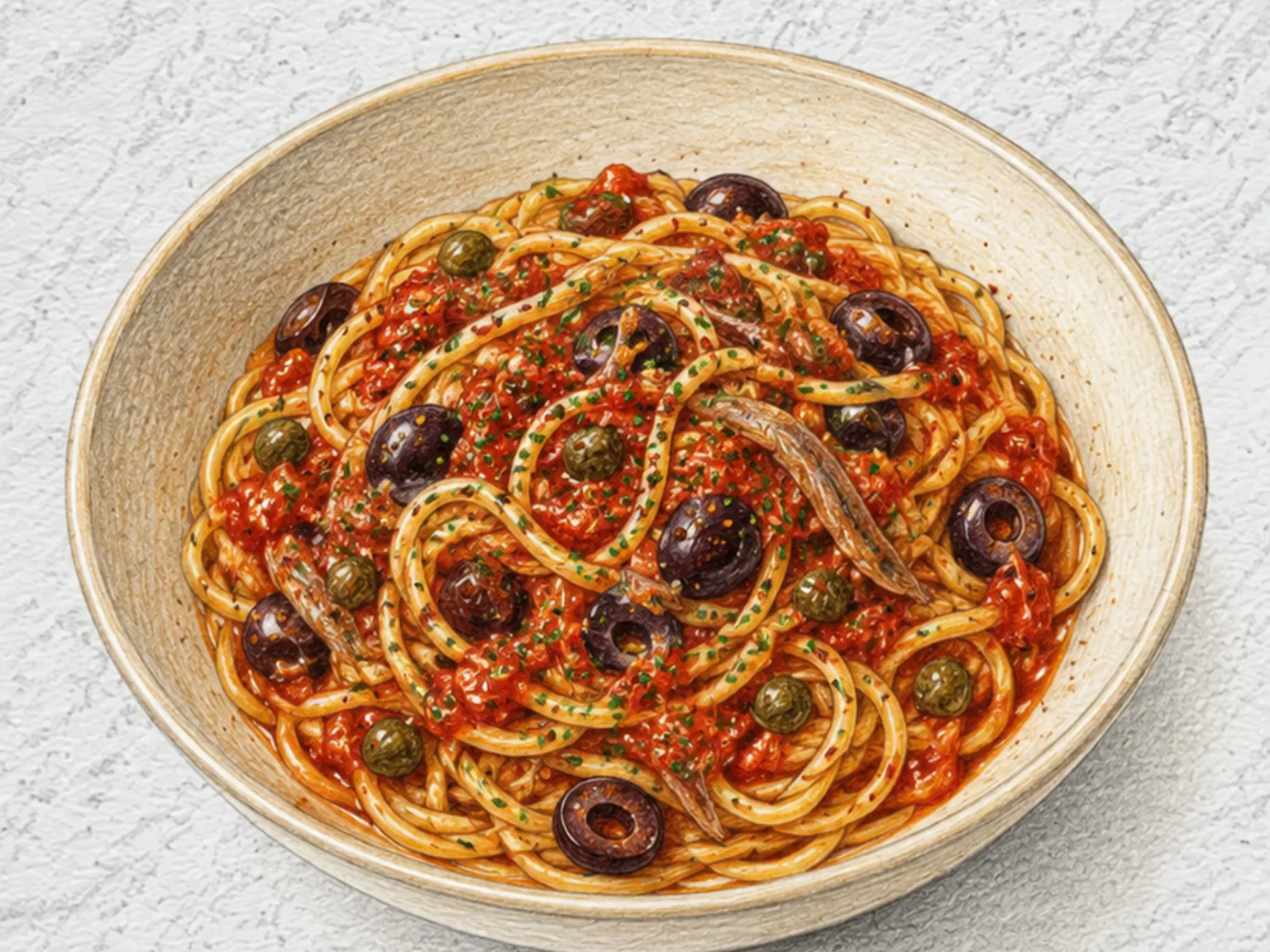
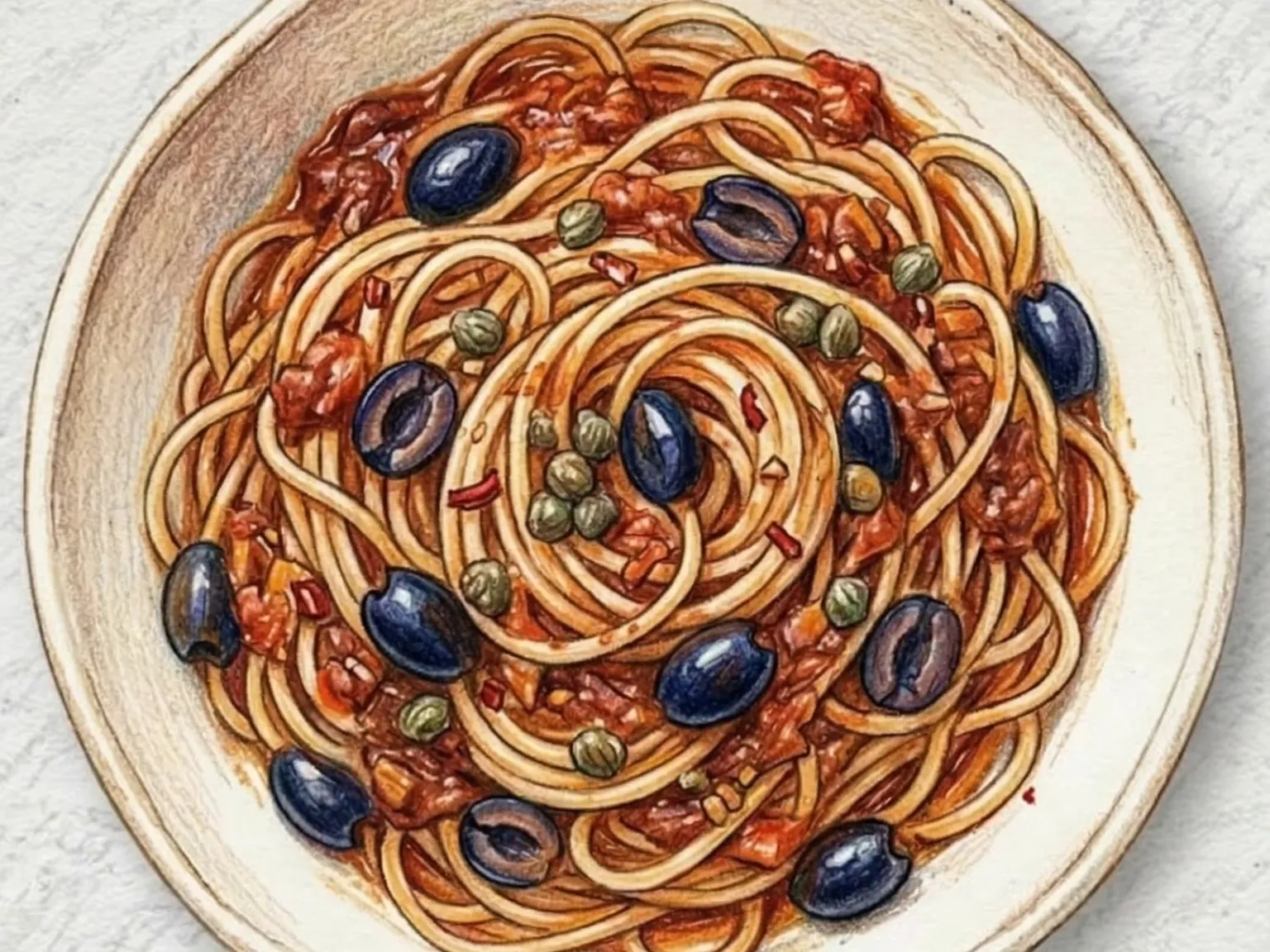
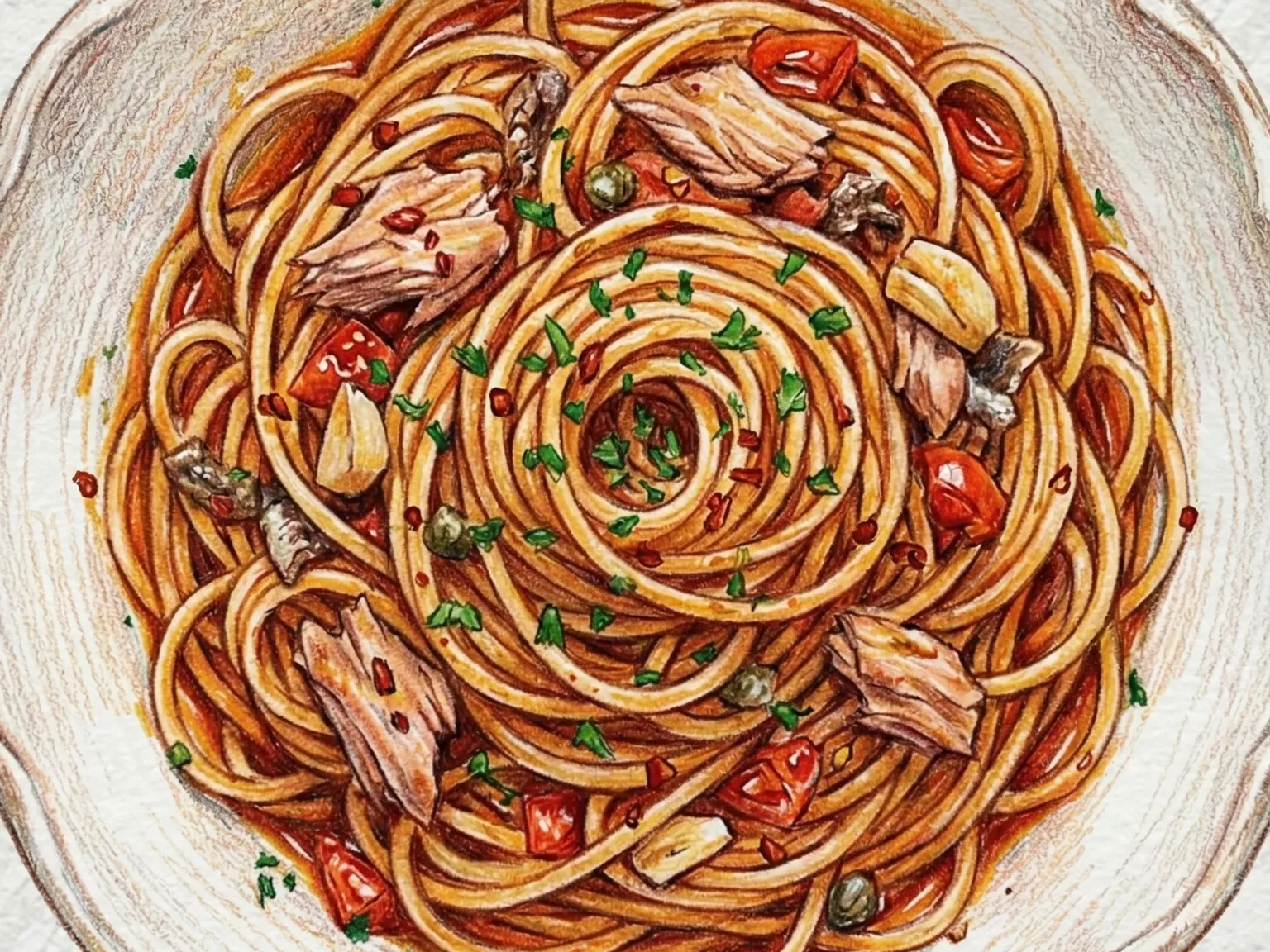
The foundation of this Gochu oil tuna puttanesca spaghetti is established by integrating the olive oil reserved from a can of tuna with a secondary portion of chili oil. This combined oil serves as the medium for sautéing sliced garlic and whole anchovy fillets over a consistently low heat. The process continues until the anchovies have fully dissolved into the warm fat, a step that allows their natural saltiness to permeate the base while eliminating any lingering traces of fishiness. Crushed tomatoes are then introduced to the pan and left to simmer for six minutes over medium heat. This period of simmering reduces the liquid content, which in turn concentrates the flavors and makes the natural acidity of the tomatoes more prominent. After this reduction, capers and black olives are added to provide distinct layers of brine and a characteristic hint of bitterness to the mixture. The solid pieces of tuna are folded in during the final two minutes of cooking. This short duration ensures that the tuna maintains its structure and provides a firm texture instead of disintegrating into the liquid. The cooked spaghetti and a small quantity of starchy pasta water are then combined with the sauce over high heat. This rapid tossing emulsifies the fats and liquids into a glossy coating that adheres uniformly to every surface of the pasta. To finish the dish, a handful of chopped parsley is scattered on top to introduce a fresh herbal quality that lightens the dense and salty profile of the sauce. Red chili flakes can be included at any stage of the process to allow for the precise adjustment of heat levels.
Instructions
Read the steps as a cooking flow: prep, heat, seasoning, doneness control, and finish.
- 1Finish
Boil 180g spaghetti in well-salted water until 1 minute short of the package time.
Reserve half a cup of starchy pasta water, then drain the noodles promptly so they stay firm for finishing in the sauce.
- 2Control
Pour the olive oil from the 120g tuna can into a wide pan and add 1 tablespoon chili oil.
Keep the tuna chunks aside for later, handling them gently so they do not break before the final simmer.
- 3Control
Add 12g sliced garlic and 3 anchovy fillets, then cook over low heat for 2 to 3 minutes.
Stir often until the anchovies dissolve into the oil and the garlic edges turn pale golden, without letting them brown.
- 4Control
Add 250g crushed tomatoes and simmer over medium heat for 6 minutes.
Let the edges bubble steadily until the sauce thickens and the oil turns reddish, which shows the tomato acidity has concentrated and mellowed.
- 5Season
Stir in 1.5 tablespoons capers and 40g halved black olives for 1 minute so their briny flavor spreads through the sauce.
Add the tuna last and warm it for only 2 minutes to keep firm pieces intact.
- 6Finish
Add the spaghetti and reserved pasta water to the pan, then toss quickly over high heat for 1 minute.
When the sauce looks glossy and clings to the strands, fold in 8g parsley and serve immediately.
After the steps
Pick a recipe that fits this dish.
Continue with shared ingredients, meal pairings, or a similar method.
Recipes That Go Well With This
More Pasta →Based on shared ingredients and meal pairing
Spaghetti alla Puttanesca
Spaghetti alla puttanesca melts anchovy fillets into olive oil with sliced garlic over low heat, creating a deeply savory base before any tomato is added. Hand-crushed whole tomatoes, halved black olives, capers, and red pepper flakes go in next and simmer for eight minutes, during which the sauce reduces and the briny, salty, and spicy elements fuse into a bold, cohesive flavor. The anchovies dissolve completely, leaving no trace of fish but contributing an intense umami backbone. Because capers and anchovies are already heavily salted, seasoning is adjusted only at the very end by taste. The spaghetti is pulled one minute short of al dente and finished in the sauce pan with a splash of pasta water, which allows the starch to bind the sauce tightly to each strand.
Pasta Puttanesca (Neapolitan Anchovy Olive Caper Tomato Sauce)
Pasta puttanesca is a Neapolitan pasta sauce built from anchovies melted into olive oil, crushed whole tomatoes, black olives, capers, and peperoncino. The anchovies dissolve completely during cooking, leaving behind a deep umami foundation rather than a fishy taste. Olives and capers provide enough salt that additional seasoning is rarely needed. The entire sauce comes together in under twenty minutes using shelf-stable pantry ingredients. Controlling noodle texture and sauce coating helps the ingredients cook evenly while keeping the final seasoning balanced.
Spaghetti Aglio e Olio (Garlic and Olive Oil Pasta)
Spaghetti aglio e olio appears in Italian cookbooks as far back as the 19th century, making it one of the oldest documented pasta preparations in the canon. The restraint is the point: five ingredients, no sauce made separately, and the whole dish done in under twenty minutes. Thinly sliced garlic goes into extra virgin olive oil over low heat, slowly transferring its flavor into the fat - the temperature must stay low enough that the garlic turns golden but never brown, since browning brings bitterness. Dried chili flakes follow, infusing a second layer of heat into the oil. The technical turning point is adding starchy pasta water and tossing the pan hard over high heat: the starch links the oil and water into an emulsion that clings to every strand rather than pooling at the bottom. Skip this step and the dish separates on the plate. Parmigiano is not traditional but has become near-universal; shaved over the top, it adds a salty, crystalline crunch. The finished pasta should look barely coated, each strand glistening rather than swimming in sauce. Getting that result consistently is what separates people who understand the dish from people who have simply followed the ingredient list.
Buchu Vongole Spaghetti (Korean Garlic Chive and Clam Pasta)
Buchu vongole spaghetti takes the Italian vongole format and finishes it with a fistful of Korean garlic chives, combining a briny shellfish sauce with the sharp, vegetal fragrance that buchu brings. Garlic slices and dried chili flakes are first infused in olive oil until fragrant, then white wine goes in and the alcohol burns off quickly, leaving only the wine's fruity character in the base. Manila clams added to the pan steam open in two to three minutes under a lid, releasing their liquor into the oil and wine. That clam broth carries enough salinity and umami to season the entire sauce - no added salt required at any point. A ladleful of pasta water stirred in while shaking the pan hard creates an emulsion that bonds the clam broth with the olive oil and coats every strand. The garlic chives are added off heat so they stay bright green and fragrant rather than going soft and losing their character. A scatter of chopped Italian parsley over the finished bowl adds a last note of herbal freshness.
Serve with this
Citrus Fennel Salad (Orange & Shaved Fennel with Arugula)
Fennel is shaved thin to highlight its anise-scented crunch, then paired with segmented orange for juicy acidity. Arugula contributes a peppery bite that offsets the citrus sweetness, and sliced almonds add a toasted crunch. The dressing stays minimal - olive oil and white wine vinegar - so the raw ingredients come through clearly without interference. Dressing should be added just before serving to prevent the fennel from wilting. The salad works well before rich meat or fish courses, since the citrus and fennel combination opens the palate rather than dulling it.
Tomato Basil Juice
Tomato basil juice is a cold savory drink made by blending ripe tomatoes with fresh basil leaves and straining the result through a fine sieve to remove seeds and skins. The ripeness of the tomato determines much of the flavor: fully ripe tomatoes carry free glutamates that produce a natural umami depth, whereas underripe fruit tastes predominantly sour without the sweetness and savory body that makes the juice satisfying. Basil should be added to the blender immediately before blending rather than sitting cut or torn, because the volatile oils that produce its aroma begin oxidizing quickly once the leaves are damaged. After blending to a smooth consistency, passing the juice through a fine-mesh strainer or cheesecloth removes the solids and produces a texture smooth enough to drink without resistance. Salt and black pepper season the juice, and fresh lemon juice raises the acidity in a way that brightens the overall flavor rather than making it sour. A small addition of olive oil emulsifies into the juice and activates fat-soluble aromatic compounds in both the tomato and the basil, producing a fuller, rounder flavor than the unstrained version. The juice must be thoroughly chilled before serving, as warmth mutes the herbal freshness. It works well as a brunch drink, a light non-alcoholic aperitif, or a base for savory cocktails.
Affogato
Affogato means drowned. A scoop of vanilla gelato, one shot of espresso pulled fresh, and that is the recipe. Its origins are placed in Milan's coffee bars around the mid-20th century, though the logic behind it is older - hot poured over frozen, bitter cut with sweet. What makes it work is physics as much as flavor: near-boiling espresso hits frozen cream and immediately begins melting the contact layer, creating a rapidly shifting border where coffee and vanilla blend before the temperatures equalize. The window for that state - two things at once, neither fully dominant - lasts roughly two minutes. The espresso must be poured at the table while the crema is still intact and the heat at its peak; a shot left sitting a minute loses both. Dark chocolate shaved on top introduces a dry cocoa note. Toasted almond slices give a crunch that holds briefly before the melting ice cream claims them too. Once everything is warm and uniform, it has become a coffee drink. The dessert lives in the transition.
Similar recipes
Cheongyang Chili Carbonara Spaghetti
Cheongyang chili carbonara spaghetti takes the classical Roman carbonara - built on egg yolks, Parmigiano-Reggiano, and Pecorino Romano emulsified with rendered pork fat - and introduces the sharp, lingering heat of Korean cheongyang peppers. Pancetta is rendered slowly over medium-low heat until the fat is fully released and the meat turns crisp, and the sliced chili and garlic are added to the rendered fat for just thirty seconds - long enough to infuse the oil with heat and fragrance without scorching the garlic. The cheese-egg base is made by whisking yolks with finely grated cheese until smooth; a useful ratio is two yolks to 20 grams of Parmigiano-Reggiano and 10 grams of Pecorino. This mixture must be folded into the drained pasta off direct heat, using reserved pasta water to loosen and emulsify - the starch and salt in the pasta water are what allow the sauce to coat each strand evenly rather than clump. The cheongyang pepper's capsaicin cuts cleanly through the concentrated richness of the egg and cheese fat, providing a clean finish that the classic Roman version does not have. The chili quantity is easy to adjust upward or downward, and using fresh whole peppers instead of pre-cut pieces produces a sharper heat with more green, vegetal character.
Bulgogi Meatball Tomato Spaghetti
Bulgogi meatball tomato spaghetti grounds the concept of Korean bulgogi - soy sauce, sugar, garlic, sesame - into a meatball format and cooks it inside an Italian tomato sauce. The ground beef is seasoned with the bulgogi mix, then breadcrumbs and egg are added to trap moisture so the meatballs hold together and stay tender through the twenty-minute simmer in passata. Searing the exterior first in a hot pan builds a Maillard crust that dissolves into the sauce as the meatballs cook through, thickening and deepening it in a way that uncooked meatballs dropped straight into the sauce cannot achieve. The soy-sugar seasoning intersects with the tomato's natural acidity to produce a sweet-salty depth that neither Korean nor Italian cooking arrives at independently. As the meatballs finish cooking inside the sauce, the boundary between meat and liquid blurs - each absorbs character from the other. Basil or parsley added at the end provides an herbal brightness that offsets the richness of the meat and tomato.
Chili Garlic Pork Belly Arrabbiata Penne
Chili garlic pork belly arrabbiata penne builds its flavor entirely from the fat rendered out of slowly crisped pork belly. Cooking the belly over medium-low heat until the surface is crackling and golden draws out the fat gradually, infusing it with a deep, savory richness that becomes the sauce's foundation. Minced garlic goes into the rendered fat next, followed by crushed tomatoes that reduce into a concentrated, spicy sauce. The tomato's natural acidity cuts through the fat's weight, preventing the sauce from turning heavy. A small ladle of starchy pasta water added before tossing emulsifies everything into a glossy coating. Penne's hollow tubes and ridged exterior capture the sauce both inside and out, so every bite delivers the smoky pork fat, tangy tomato, and chili heat simultaneously. Finishing with the reserved crispy pork pieces scattered on top adds a textural contrast between the sauce-soaked pasta and the crunchy meat.